OBLIVION review

StarringTom Cruise (Collateral), Morgan Freeman (The Shawshank Redemption), Olga Kurylenko (Quantum of Solace), Andrea Riseborough (Welcome to the Punch), Melissa Leo (The Fighter)


DirectorJoseph Koskinski (Tron: Legacy)


WritersKarl Gajdusek (Trespass) and Michael Debruyn


Runtime2 hours 6 minutes


Release Date10 April (UK), 19 April (US)


Oblivion tells the tale of Jack Harper (Cruise), a droid repairman working on a post-apocalyptic Earth. But things aren’t all as they seem as he gets thrown into an adventure that reveals the truth about the world and himself. Is Oblivion a new sci-fi classic, or is it much less intelligent than it suggests?
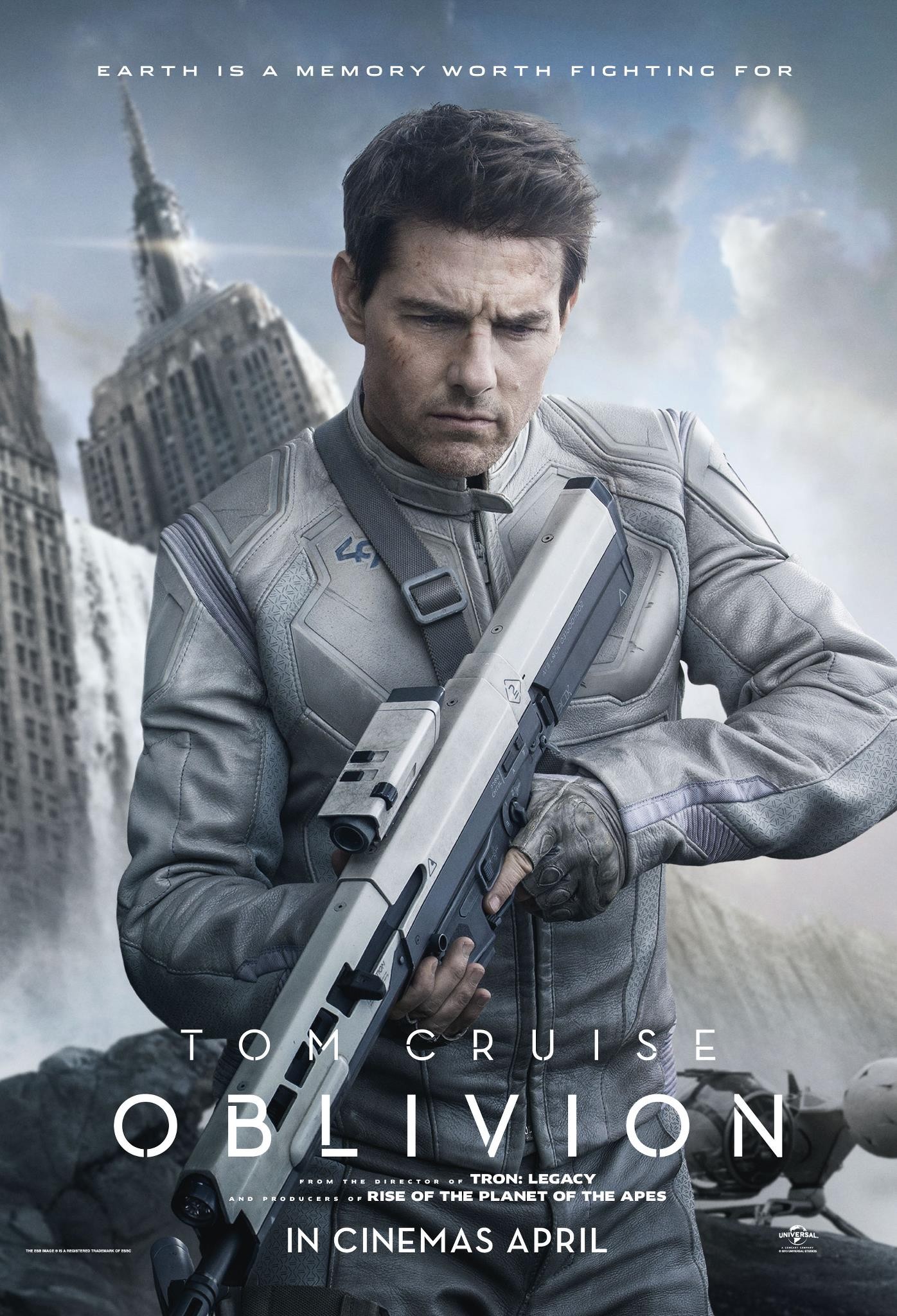
Oblivion-Poster

The film’s plot is well told and thought out. The world is interesting and has an original visual aesthetic of a dead Earth. The film is, at first at least, a slow-burner, bringing to mind more traditional sci-fi films like 2001. But by the third act, the film strays more into modern sci-fi tropes. By no means is this a bad thing; in fact, once the curtain had been pulled back on exactly what is going on I really got into the movie. There are enough twists in the movie for it to remain intriguing, though some are obvious even from the first few minutes if you’re paying attention. The film’s epilogue is a little confused and feels like there might have been some studio tampering there, but otherwise the plot makes sense, moves at a decent clip and remains entertaining throughout. The main problem with Oblivion is that it isn’t as original as it thinks it is. Whilst the film does tackle many of its sci-fi concepts in its own way, so many of them have been done before. Elements are clearly taken from several other sci-fi films such as Total RecallMoonWALL-E and Planet of the Apes (I’ll let you figure out what those elements are). There are some interesting new ideas that I found fascinating, but I can’t reveal them for spoilers sake. Eventually it got a bit tiring going “Oh, it’s like_______”, and I was hoping the film would have some new ideas beyond the visuals.

Tom Cruise still manages to keep going making blockbuster after blockbuster despite most men of his age either retiring to dramas or joining The Expendables. Love him or hate him, he always gets the job done and does exactly what you want from a protagonist. He doesn’t exactly go beyond the material he’s working with considering the archetypical nature of his character, but he works as a hero that has enough humanity to get behind his motivation. Morgan Freeman isn’t in the film as much as the marketing wants you to think he is, but he gives the performance you’d expect from him. Olga Kurylenko fares decently, but she lacks enough charisma for her to truly stand out for such a pivotal character. Andrea Riseborough gives the breakthrough performance here, bringing what could be such a typical character beyond the material and make her role as memorable as she possibly can. I can’t say much of Melissa Leo for fear of spoilers, but her Southern drawl got grating by the end of the film.

Whether you liked or loathed Tron: Legacy, I think we can all admit it looked beautiful. Director Joseph Koskinski brings that same visual eye to Oblivion, making a gorgeous looking picture out of a desolate landscape. The design of everything feels very slick and stark, blaringly standing out amongst the grimy setting of much of the film, though I will say that much of it would have felt more at home in a video game like Mass Effect or Portal. The cinematography is stupendous, the sound effects blisteringly rocky, and the visual effects are seamlessly integrated and feel much more natural than most blockbusters of this ilk. The film’s score is very reminiscent of Daft Punk’s score for Tron: Legacy, the tone of which definitely works here as well. Koskinski is obviously much more of a visual director than one of actors, but when everything he does looks this pretty it’s hard to complain.

In the end, Oblivion is a gorgeous piece of cinema that excels in the technical department, but falters in creating a truly original story. Despite some uncredited work from the great Michael Arndt (who will tackling sci-fi again soon with Star Wars Episode VII), the plot here just feels too much like an amalgam of other ideas. Well-executed and well-implemented ideas, but unoriginal ones nonetheless. I think this film will be as divisive as Tron: Legacy was but, as a defender of the aforementioned film, I think I sit on the positive end of the spectrum despite my complaints. Koskinski has a bright future in the film industry; he just needs to find a script that clicks to use as a sturdy foundation, and then use his visual imagination to build upon it.


FINAL VERDICT: 8/10
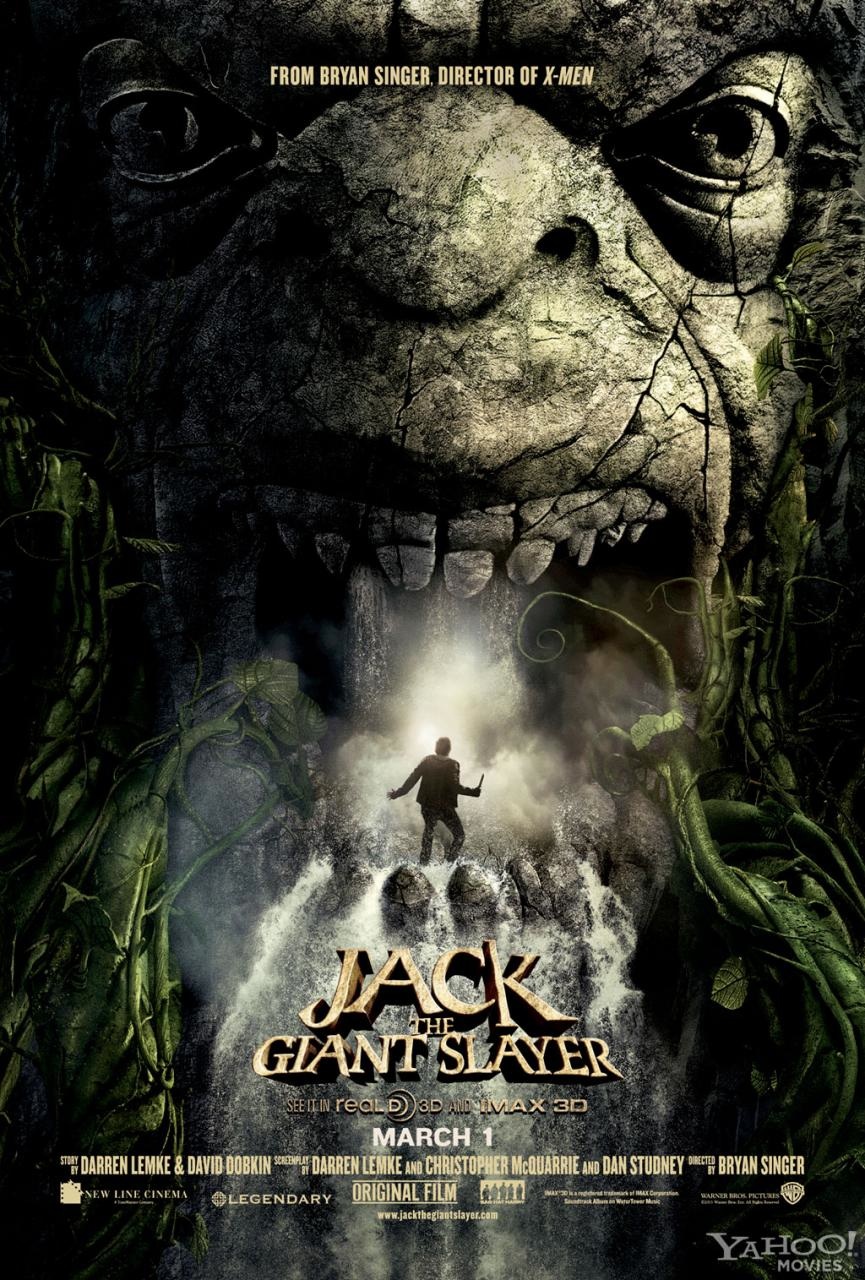
JACK THE GIANT SLAYER review

Starring: Nicholas Hoult (Warm Bodies), Eleanor Tomlinson (Alice in Wonderland), Ewan McGregor (Trainspotting), Bill Nighy (Love Actually), Stanley Tucci (The Lovely Bones), Ian McShane (Pirates of the Carribean: On Stranger Tides)


Director: Bryan Singer (The Usual Suspects)


Writers: Darren Lemke (Shrek Forever After), Christopher McQuarrie (Jack Reacher) and Dan Studney


Runtime: 1 hour 54 minutes


Release Date: March 1 (US), March 22 (UK)


After a big delay in release from June 2012 to March 2013 and a slight title change, Bryan Singer’s epic retelling of Jack and the Beanstalk has arrived in theatres to little fanfare. Is this the John Carter of 2013 as some claim, or does this tale have more than meets the eye?

Image

Let’s make this clear: Jack the Giant Slayer is not a serious, dark version of the story. Snow White & The Huntsman it ain’t. The film is more aptly compared to classic 80’s fantasy pics like The Princess Bride or Willow. While this light-hearted tone works for the most part, there are two major flaws to it that can cause some problems. Firstly, the film occasionally seems to edge a bit darker and off-tone with some gruesome (but often implied) deaths. Secondly, whilst the film’s attitude is good and fits the story, the humour is often lacking. They luckily never fall into the trap of trying to modernise things or insert pop culture references, but most of the jokes are obvious and played-out. Some manage to hit the mark, but most just fall flat and further adds to the somewhat confused tone. Story wise, this is a very classic hero’s journey plot, hitting every beat in the rhythm expected. That doesn’t make the movie bad, in fact the film is quite enjoyable for the most part, but the film lacks much surprise or innovation as everything plays out as expected. The film does pack some good action scenes in there of large scale, and also the characters are just defined and human enough for you to care even if they follow the archetypes to a T. Whilst things are somewhat spoiled by an unnecessary and baffling epilogue, Jack the Giant Slayer is never boring, never tiresome and its runtime flies by at a good pace.

The acting in the film is of good quality, though somewhat limited considering the material they are working with. Nicholas Hoult always makes a convincing and sympathetic protagonist, but the character of Jack lacks enough interesting character traits to root for him beyond the fact that he is the underdog and wants the princess. Eleanor Tomlinson plays this aforementioned royalty, and is equally effective despite playing a British version of Jasmine from Aladdin. Ewan McGregor is great in his supporting role, managing to be the only character who manages to go beyond his archetype and do some things differently. Stanley Tucci, whilst bordering on OTT for much of the film as the slimy advisor, at least looks like he’s having a lot of fun. Faring worse is Ewan Bremner as his toady sidekick, who is supposed to be annoying but is so to the point of tedium. Bill Nighy works as the Giant Leader and Ian McShane gets to have some fun wearing a silly costume, but again they lack enough definition to be truly memorable. Some more character depth could have really helped not only make these players stand out, but improve the quality of the film as a whole.

Jack the Giant Slayer is most impressive on a technical front; you can tell watching it that it cost a lot. Singer gives the film a very classic look and feel, very reminiscent of the adventure films of old. Whilst this can lead to the occasionally goofy costume or set, the film presents everything with so much confidence that you accept it. The cinematography shows off the look well, and also manages to avoid getting too close to the action. The special effects are of an extremely high standard and look great for the most part, but whenever we get into extreme close-ups on the giants they lose some of their magic. I admire the film for trying to create these creatures through CGI instead of using more old-fashioned trick photography, but the technology isn’t quite perfect yet.

In the end, Jack the Giant Slayer is a fun but severely flawed film. The film has just enough good stuff in it to be worth a watch, but perhaps another punch-up on the script and a much stricter and consistent tone could have helped the film stand out from the pack a bit more. I will say it is better than Singer’s last outing (the decent but forgettable WWII thriller Valkyrie), and I hope his return to the X-Men franchise with Days of Future Past next year will be much better return to form for the great director.


FINAL VERDICT: 6.5/10

TRANCE review

Starring: James McAvoy (Wanted), Vincent Cassel (Black Swan), Rosario Dawson (Sin City)

Director: Danny Boyle (Slumdog Millionaire)

Writers: Joe Ahearne and John Hodge (Trainspotting)

Runtime: 1 hour 41 minutes

Release Date: 27 March (UK), 5 April (US)

From the director of such classics as Trainspotting, 28 Days Later and Slumdog Millionaire, Trance is a strange blend of psychological thriller, heist film and a little dab of sci-fi. Does it all add up to something ingenious, or is it a cluttered mess?

Image

Trance is a film with many layers, constantly unravelling new elements and details to the point of confusion. What starts as a heist film reminiscent of The Thomas Crown Affair eventually enters the realm of films like Inception and Eternal Sunshine of the Spotless Mind. The film has an impatient pace, going from slow-burn to high-octane and back again. Whilst it does match with the whole theme the film is going for, it does add to the confusion. The film constantly switches between the real world and Simon (McAvoy)’s mind but, unlike Inception which makes it very clear, Trance keeps the line between fantasy and reality very loose which creates a strong feeling of paranoia and suspense. It does unfortunately lead to those “it was all just a dream” moments several times, which works to mixed affect. The big twist of the film (which I obviously won’t spoil) works at first and makes sense, but a later reveal kinda ruined it for me. The film even has an open ending very similar to Inception, but it lacks the weight and surprise of the one in that superior film.

The film has a very small central cast and they fulfil their roles well. McAvoy takes an even more drastic leap than he did in Welcome to the Punch; here, he plays a character who is much more complex and shady than anything he’s ever played before, often bordering on psychotic. Cassel plays it very cool as usual, but never looses the intimidating quality his character requires. This is arguably Dawson’s best role in years; her character is also very complicated and tragic, but I can’t say much more than that without spoiling things. The rest of the cast is pretty inconsequential; they are there to serve their purpose in the story and don’t do much else memorable. But the central characters are intriguing enough that you don’t really notice.

Boyle is a director who has a very strong visual flair but always adapts it to his material and doesn’t let it get in the way of the story. The same is true of Trance. The film is full of bright, saturated colours and make frequent use of the Dutch angle, further increasing the bizarre nature of the film.

Trance is definetly one of Boyle’s weaker films, but is still worth a watch for the performances and certain aspects of the story. The film feels lacking in certain areas, mainly due to an ending that I don’t think gels with the proceeding film. Hopefully Boyle’s next project will be much closer in quality to some of his previous works.

FINAL VERDICT: 6/10

GI JOE: RETALIATION review

Starring: Dwayne Johnson (Fast Five), Bruce Willis (Die Hard), Channing Tatum (Side Effects), Jonathan Pryce (Brazil), Ray Stevenson (Punisher War Zone)

Director: Jon Chu (Step Up 3D)

Writers: Rhett Reese and Paul Wernick (Zombieland)

Runtime: 1 hour 50 minutes

Release Date: 27 March (UK), 28 March (US)

Whilst in no way a good movie, GI Joe: The Rise of Cobra can be a ridiculous bit of fun if you keep your expectations low and go in with the right mind set. After spending nearly a year delayed for a pointless 3D conversion (which I didn’t even bother to see it in), the sequel Retaliation is now here with a big change up in cast and style. Is it worth taking up the call of duty again, or will you feel as betrayed as the Joes?

Image

The plot of Retaliation follows a very simple and familiar plot: the old betrayed-by-the-government-and-go-undercover routine. After seeing this so recently in Mission: Impossible – Ghost Protocol, the whole thing seemed played out and predictable. However, it’s clear that this movie knows its stupid and doesn’t try to linger on it too much by moving at a fast clip and shoving as many action scenes as it can. Regardless, the film lacks any kind of surprise or intrigue; there are no major twists and everything is laid out for you whilst the movie holds your hand. My main problem, however, is the confusing continuity. In a move similar to the Resident Evil movies, Retaliation wants you to both remember and forget things from the previous film. Certain elements are carried over (the fake president, Channing Tatum, Snake Eyes), whilst certain characters are written out with little fanfare (Destro) and other major players from the first film (Baroness, Dennis Quaid, Marlon Wayans) are never even mentioned in passing. It seems like the movie couldn’t decide if it wanted to be a sequel or a reboot and kinda went for both. Overall, the film at least has a good sense of humour and feels much more like a GI Joe film than the first one. Sillier elements like the Exo-Suits and the underground bases are gone, but this definitely does not mean the film goes completely for realism; it just never goes into the sci-fi-esque area the first went.

I don’t think anyone expects Oscar-caliber performances from GI Joe: Retaliation, but I think the acting in the film does help liven the proceedings in certain areas. Dwayne Johnson brings his trademark charm to the role of Roadblock, making him very hard to dislike despite the fact we don’t know much about other than he has two daughters and likes to quote Jay-Z. His chemistry with Tatum is strong and they get some good digs at each other, but then Tatum is hastily written out of the movie (probably just him fulfilling his contract from the first movie) and we lose one of the stronger aspects of the film. Bruce Willis enters the cast as the original Joe; he surprisingly puts much more effort in here than he did in Die Hard 5 and clearly knows what kind of movie he’s in. Ray Park returns as Snake Eyes to continue kicking some more ass, whilst RZA shows up out of nowhere in a terrible performance that has obviously been fiddled with in post. The rest of the main Joes are pretty forgettable; some are given some minor motivation and character (Lady Jaye) whilst others are given pretty much none at all (Flint, Jinx). On the Cobra side, Jonathan Pryce hams it up as Zartan in disguise as the president and Cobra Commander (now Joseph Gordon-Levitt free) has been given a much-deserved redesign to match his toy counterpart. Ray Stevenson plays a good heavy in the role of Firefly (but really cocks up his Southern accent) whilst Byung-hun Lee returns as Storm Shadow and seems to be the only one taking this s*** seriously.

Movies like GI Joe: Retaliation are made purely to create some expensive explosions and fight scenes, and the film accomplishes this task with schizophrenic results. The much-promoted Cliffside ninja battle is easily the best scene in the movie, and the punch-ups between Johnson and Stevenson can be pretty fun. Unfortunately, the film falls into the quick-cut trap and makes a chunk of the action incomprehensible. Other than the aforementioned ninja battle, the film lacks the ridiculous set pieces that made the first film enjoyable.

GI Joe: Retaliation isn’t as ridiculous as the first film, but it’s just as stupid. The film can be fun in pieces and is a much closer adaptation of the source, but it just doesn’t have the guts to go completely bats*** insane. It is a much better made film than the original on a writing and technical level and has just enough in it to be worth a watch, but the formula still isn’t right. If a third GI Joe adventure ever occurs, I hope they take the best elements of both films and mash them into a much more satisfying experience.

FINAL VERDICT: 6/10

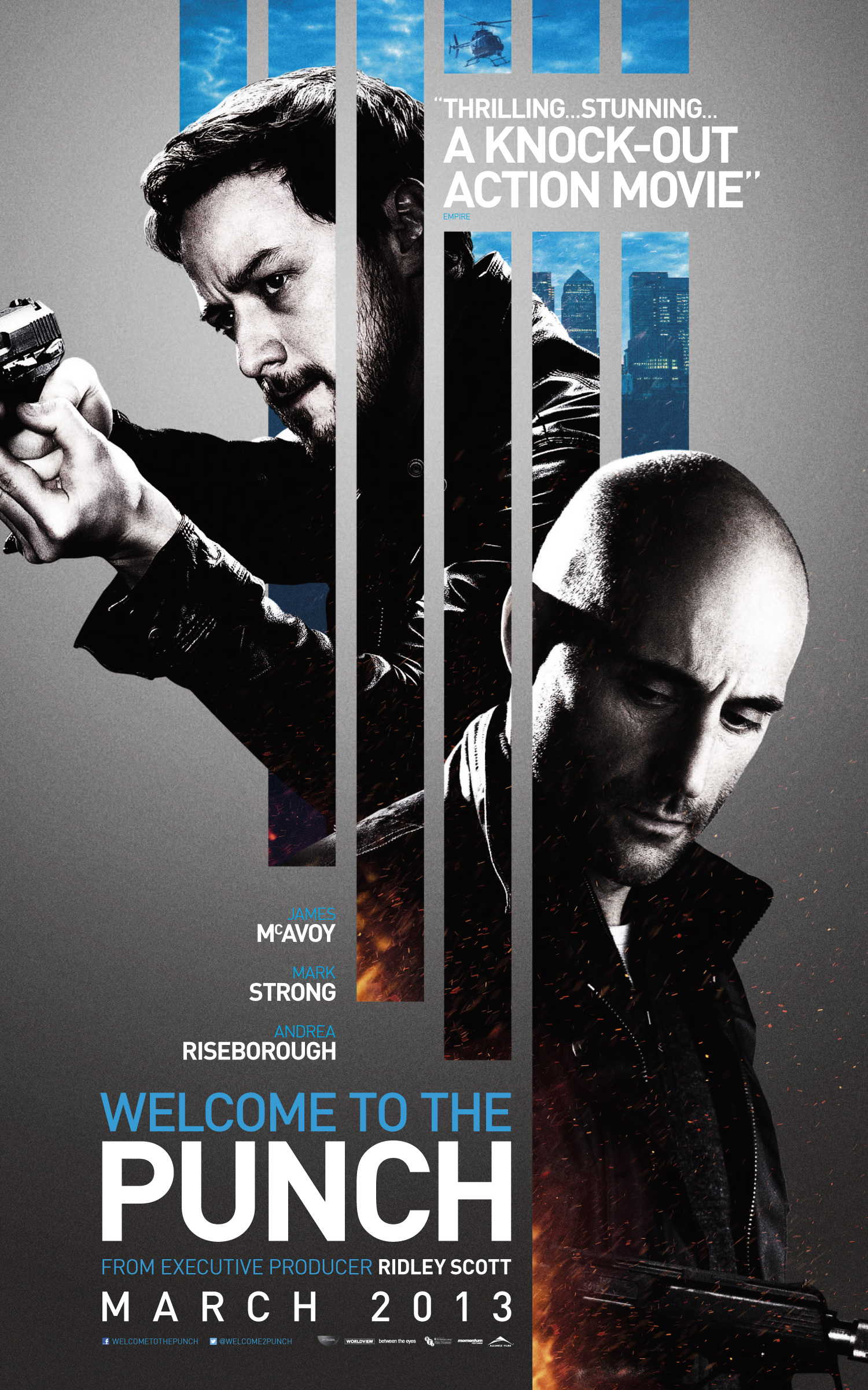
WELCOME TO THE PUNCH review

Starring: James McAvoy (X-Men: First Class), Mark Strong (Zero Dark Thirty), Andrea Riseborough (Made in Dagenham), David Morrissey (The Walking Dead)

Writer/Director: Eran Creevy (Shifty)

Runtime: 1 hour 39 minutes

Release Date: 15 March (UK), 27 March (US)

Welcome to the Punch comes to us from Eran Creevy, the writer/director of the indie Brit flick Shifty, which is a great example of a film with a small budget but plenty of ingenuity. Now armed with a bigger budget and bigger stars, does his sophomore attempt live up to the promise his first showed, or is Creevy a one-trick pony?

Image

For about the first half of Welcome to the Punch, you get pretty much what you expect from a British crime thriller. It’s definitely not bad and better than most of them these days, but nothing you haven’t seen before. But about halfway through, some major plot shifts lifts the comfort of the plot from under you and sends the film on a much different path. There are some very fresh and inventive ideas thrown into a plot that is pretty standard, and keep the movie from getting stale. Even with the familiarity, the film is still pretty well written with some good dialogue and characterization. Whilst I think the ending could have been a bit better, this is still a brisk and entertaining tale that even manages to throw some social and political commentary in there.

Punch features a wide variety of well-known and not-so-well-known British actors that all deliver on what they need to. McAvoy, cast a bit out of type as a gruff, Dirty Harry-esque cop, shows he has range and can handle himself in a scrap. Strong, whilst playing the kind of role he can do backwards at this point, brings enough depth and emotion to an otherwise stock role that you can get behind him by the end. Riseborough continues her rise up the ranks here, and avoids the stereotypical role of women in movies like this whilst also having very good chemistry with McAvoy. Peter Mullan is also entertaining in his role, providing some comic relief whilst remaining serious throughout.

The visual style of the picture is far removed from Shifty’s gritty realism. Punch has a very slick look to it, punctuated by a sharp, blue colour scheme that adds a lot of flair to the action. The cinematography can get very frenetic during the fight scenes, occasionally swerving towards Crank-level energy without going bats*** insane. Whilst the film sometimes falls into the old edit-things-so-fast-it’s-hard-to-tell-what’s-going-on trap, the action is mostly discernable and well choreographed, whilst the music is suitably moody and pulsating.

Welcome to the Punch is by no means groundbreaking or challenging as a motion picture, but it packs a lot of (pun intended) punch. It’s a much better film that most films of its ilk these days, and proves that Creevy has a bright future in the film industry if he plays his cards right.

FINAL VERDICT: 8/10

SIDE EFFECTS review

Starring: Jude Law (Sherlock Holmes), Rooney Mara (The Girl with the Dragon Tattoo), Catherine Zeta-Jones (Chicago), Channing Tatum (Magic Mike)

Director: Steven Soderbergh (Ocean’s Eleven)

Writer: Scott Z. Burns (Contagion)

Runtime: 1 hour 46 minutes

Release Date: 8 February (US), 8 March (UK)

Side Effects is supposedly Steven Soderbergh’s final theatrical release (his true final film, Behind the Candelabra, has been relegated to an HBO TV movie). Is this the swansong such a renowned director deserves, or is it a final effort not worth remembering?

Image

The plot of Side Effects is so full of twists and turns that I can’t even describe the basics without spoiling pretty much everything; you just have to see it for yourself. Just know that the trailers are throwing you for a loop and this is a much deeper and darker film than the marketing is letting on. Whilst the film starts pretty slow, a particular scene about a third of the way through (one that got the entire audience I saw it with to gasp) suddenly creates a huge turn and immediately got me intrigued and invested in the story. From there, the movie really kicks into gear and is a story that will be very hard for anyone to predict. I can’t say much more; now go see it for yourselves.

The cast does a great job with their roles; none of the main players disappoint. Law plays obsessive well, and his frenzied nature and inability to comprehend what is going on perfectly matches the state of mind most of the audience should be in. Mara gives her arguably the best performance of her career in a role that I think most actresses would struggle with due to its complexity, but she pulls it off perfectly natural. Zeta-Jones, whilst possibly a bit too suspicious at times, also gives her best performance in a long time. Tatum isn’t in the movie as long as the marketing tries to convince you he is, but in his brief time he also manages to emote much more than he averagely does.

Soderbergh has a very distinct but simple style to his movies, and that is all over Side Effects. Whilst the movie does have that graded look that a lot of Soderbergh movies have had recently where everything is tinted urine-yellow, it isn’t as strong or distracting as it was in Magic Mike or Contagion. The cinematography is pretty basic but effective, whilst the music fits the odd style the film is going for.

Side Effects is the first truly great movie of the year and is Soderbergh’s best film in a quite a while. The story is intriguing if occasionally confusing and the central performances are all very strong. All in all, Soderbergh couldn’t ask for a better movie to close his curtain on.

FINAL VERDICT: 9/10

OZ: THE GREAT AND POWERFUL review

Starring: James Franco (127 Hours), Mila Kunis (Black Swan), Rachel Weisz (The Brothers Bloom), Michelle Williams (Blue Valentine), Zach Braff (Garden State)

Director: Sam Raimi (The Evil Dead)

Writers: Mitchell Kapner (The Whole Nine Yards) and David Lindsay-Abaire (Rise of the Guardians)

Runtime: 2 hours 10 minutes

Release Date: 8 March (US, UK)

The Wizard of Oz is one of those classic movies that we were all forced to watch when we were young, and it is a film that I fondly remember. Despite several attempts, no one has ever been able to capture the magic of Oz the way the original did back in 1939. With the success of Alice in Wonderland several years ago, Disney is now taking a stab at L. Frank Baum’s work in the form of an unofficial prequel. Should you head down the yellow brick road again, or should you tap your heels together immediately and escape back to Kansas?

Image

The story of Oz is tale that has been told in many different ways before (even Raimi’s own Army of Darkness has the same basic story), but one that naturally fits the classic style of the rest of the proceedings. The film feels well structured and the pacing makes the 2-hour plus runtime fly by, but the dialogue could have used more work. I know it’s a kid’s movie, but too often I felt the dialogue was very on-the-nose when it really didn’t need to be. The film has a lot of humour, mainly between Franco and Braff, and most of the time it works well. They never have to resort to pop culture references or bathroom humour in order to create gags the way most family films do these days; it is all through character interaction. Nothing cheap and forced here like that other movie (coughMADHATTERBREAKDANCINGcough). The film also has plenty of references to the original film, from its black-and-white opening scenes to subtle references to characters and locations. It never feels too forced nor does it distract you from the story at hand. The film is an origin story for not just Oz, but the Wicked Witch of the West as well, and this story is handled generally quite well. I know fans of the musical Wicked are probably crying foul, but (as someone who hasn’t seen the show) I can say I have no problem with both versions of the story existing. This is simply just another interpretation of the character and neither version is truly canon with either the books or the original film. The film captures the feel of the 1939 version well; it merely expands upon through the use of a modern perspective and craftsmanship. I’m also glad the film didn’t resort to using a standard action climax and go against the entire style of the source material the way Burton’s Wonderland did. Here, there is a climax but one that feels much more natural to the story and doesn’t feel anywhere near as forced as Alice fighting a Jabberwocky purely to create tension and a sense of threat.

The cast of the film works, though maybe not the most ideal. Franco seems an odd choice for Oz at first (the original choice of Robert Downey Jr would have probably worked better), but he warms on you by the end. Weisz and Williams do well with their roles, even if Weisz hams it up a bit at points. Zach Braff is great as the monkey and has great chemistry with Franco, whilst Joey King as the china girl provides some much needed heart and emotion. My main problem with the cast is Mila Kunis; the way her character develops later on in the film (which I won’t reveal for spoilers sake) feels natural on paper, but Kunis doesn’t sell it convincingly enough. Maybe it’s the over-the-top nature of her performance, maybe the fact Kunis usually doesn’t play this broad a character, I’m not sure. There’s probably an actress out there who could have pulled this off better; I’m just not sure whom. Oh, and before I forget, there is a Bruce Campbell cameo for you Raimi enthusiasts. Whilst not his best, it is amusing and even calls back to his Evil Dead days.

Like Burton’s Wonderland, Oz was shot primarily on green screens with effects to create the magical land of Oz. Like it or not, it is still very visually impressive. The whole film has been designed beautifully, both in its original parts and those lifted from the original film. Raimi utilises his love of moving cameras and odd angles to great affect here, and the 3-D is actually worth the price this time round. Danny Elfman’s score for the film works most of the time, but whenever that choir kicks in it feels too much like a Burton film. And not in a good way.

Oz: The Great and Powerful is good return to form for Raimi, and probably one of the better live-action family films in recent memory. It’s a good companion piece to the 1939 classic as well as a good film on its own, and is a much better film that Burton’s Alice in Wonderland in every possible facet. It ain’t perfect, but that didn’t stop me from having a fun, nostalgia-filled time at the movies.

FINAL VERDICT: 8.5/10

TOMB RAIDER review

Developer: Crystal Dynamics (Tomb Raider: Legend)

Platforms: PS3 (version reviewed), Xbox 360, PC

Release Date: 5 March (US, UK)

I’ve never been a big follower of the Tomb Raider franchise. I’ve played bits of the previous games, and I saw the first movie, but other than that I’m mostly a stranger to the adventures of Lara Croft. As with pretty much everything these days, the franchise has gotten a gritty reboot. Can an old dog learn new tricks, or is this new beginning actually the end?

Image

A new tale with no ties to the previous titles, the story of Tomb Raider works mainly because so much attention had been paid to the character of Lara Croft. The game spends time letting you get to know her and shows how she developed from an innocent explorer, to frightened survivor, to hardened badass. I’ve not felt this much connection or sympathy for a character in a game since John Marston in Red Dead Redemption. Otherwise, the story is your basic Indiana Jones-type fair, but one with a lot more edge. This is a violent game, and earns its 18 certificate. From grizzly sacrificial murders to a scene where Lara wades her way through a river of blood, there is more shocking imagery in here than most horror films. It’s like a more f***ed-up version of Indiana Jones and the Temple of Doom.

Since we last saw Lara, the adventure platformer genre has been co-opted by the Uncharted franchise. Tomb Raider takes obvious queues from its contemporary, but adds elements from other games as well. Unlike Uncharted, Tomb Raider has a somewhat open world to explore for XP and treasures, much like Metroid Prime or Batman: Arkham Asylum. Also like those games, Lara gains and modifies her weapons and tools over the course of the game, which encourages you to backtrack to old locations to reach areas you couldn’t before. The platforming sections are brilliant, treading a fine line between classic Tomb Raider’s leaps of faith and Uncharted’s almost on-rails approach. The gunplay, whilst inferior to the platforming, is still a lot of fun and very challenging at points. There’s nothing more satisfying than headshotting an unsuspecting enemy with your bow and arrow before mowing down his buddies with a shotgun and finishing your last guy off with an arrow to the knee (I’m not making a Skyrim joke there. You can literally stab a guy in the knee with an arrow). Sure, it kinda goes against the whole “reluctant killer” thing, but it’s still fun. The puzzles are still here as well, and they are also fairly challenging. The game also has a multiplayer suite, but it’s pretty generic and feels tacked on. That, however, doesn’t spoil what is otherwise a fun and thrilling single player with enough length to be enjoyed playing through once without returning to find all the hidden gems.

Graphics wise, Tomb Raider is exactly Crysis 2 but it still looks great. A lot of attention has been paid to the environments, which all look distinctive and beautiful. The game seamlessly transitions between gameplay and in-game cutscenes; only the opening cut-scene is pre-rendered (and is pretty much just the initial trailer for the game anyway). The voice acting and motion capture here is excellent, particularly Lara herself, and the music perfectly matches the tone.

Tomb Raider is a fantastic game and one well deserving of your time. If Crystal Dynamics continue down this road for the rest of the franchise, I think they’ve found themselves a new fan. Whether you’re a Tomb Raider fanatic or just wanting something to hold you over until they announce Uncharted 4, this is the game for you.

FINAL VERDICT: 9/10

STOKER review

Starring: Mia Wasikowska (Alice in Wonderland), Matthew Goode (Watchmen), Nicole Kidman (Eyes Wide Shut), Jacki Weaver (Silver Linings Playbook)

Director: Park Chan-Wook (Oldboy)

Writer: Wentworth Miller (Prison Break)

Runtime: 1 hour 38 minutes

Release Date: 1 March (US, UK)

For a movie from the director of the brutal but brilliant Korean picture Oldboy, you’d hope that his Hollywood debut would have much more impact. Sadly, Stoker is a misfire of a film; one that has a solid starting point but ends up crashing short of the finish line.

Image

The basic premise of the film is intriguing and it is what mainly carries the film throughout. It fulfils what most thrillers lack these days: unpredictability. I honestly had no idea where this movie was going, and once the truth is revealed it is genuinely shocking. Unfortunately, the film then falls into a rushed and anti-climactic ending, one that doesn’t seem to gel with the previous eighty minutes. The film is very much a slow burner, making the film feel much longer than its actual brief runtime. This works well at the start, but the film begins to drag before suddenly moving too quickly to properly comprehend the meaning of its ending. The film’s writing is inconsistent, moving from pretty decent to downright amateurish. The film’s opening scenes are full of “subtle” exposition that feels unnatural, and everyone outside of the main characters feels like a cookie-cutter stereotype. Wentworth Miller has never been that great an actor, but he should probably take a few more writing classes before he attempts to touch a word processor again.

The film has a strong principal cast who are given material juicy enough to have fun with, but they all often seem lost and confused. Wasikowska is again playing the emo-ish oddball she usually plays but to much more eerie effect, but she never really gives us enough to fully understand what is going through her warped mind. Matthew Goode’s performance feels too over the top; I know we’re supposed to be suspicious of him, but does he constantly have to act so creepy. We get it! Nicole Kidman is decent in her part but never gets enough to do, and Jacki Weaver briefly enters the picture before unceremoniously disappearing. The actors don’t feel well directed enough, possibly the result of a foreign director’s vision either not being spelled out well enough or getting lost in translation.

If I can say anything extremely positive about the film, it at least looks very pretty. The cinematography makes a lot of use of long tracking shots that are executed well, as well as plenty of other neat camera tricks. This gives the film a sense of style and originality the rest of the film is sorely lacking.

Stoker is a film that I can’t hate, but it lacks so much that I can scarcely call it good. It lacks enough originality and suspense to make it feel compelling, further worsened by poor writing, mediocre performances and a confusing ending. Park Chan-Wook was aiming for a Hitchcockian feel with this one but we instead got a Brian DePalma film, and not a good one.

FINAL VERDICT: 5/10

CLOUD ATLAS review

Starring: Tom Hanks (Saving Private Ryan), Halle Berry (Monster’s Ball), Jim Broadbent (Hot Fuzz), Ben Whishaw (Skyfall), Hugo Weaving (The Lord of the Rings Trilogy)

Writers/Directors: The Wachowskis (The Matrix), Tom Tykwer (Run Lola Run)

Runtime: 2 hours 52 minutes

Release Date: October 26 (US), February 22 (UK)

Based on the absurdly long book by David Mitchell (no, not that David Mitchell), Cloud Atlas is an absurdly long movie by the creative minds of The Matrix trilogy and Run Lola Run. Does this collage of stories and talents amount to more than the sum of its parts, or is it a jumbled mess of ideas?

Image

The film is made up of six different stories, with elements, themes and occasionally characters crossing between them. The problem with it is that these stories are told all at the same time, cross cutting between them constantly and randomly in attempt to highlight the similarities between them. What this ends up doing instead is making the film hard to follow at times. Often, certain stories are left to gather dust for a while for far too long, leading me to say “Oh yeah, that story still exists” more often than I should be. The film’s runtime is far too long; a good half hour could have been lost easily in the cutting room. The stylistic differences between stories also cause some major tonal whiplash. One second, you’re watching Halle Berry being chased by a hitman through San Francisco. Next second, you’re watching Jim Broadbent and his wacky pals get into some hijinks at the retirement home. It just feels uneven and makes it hard to care about all these stories. That, and some of the stories just aren’t that interesting. After seeing which directors directed which sections, I discovered tended to like Tykwer’s parts more than the Wachowskis. Being a big fan of The Matrix, this is upsetting. After this, Speed Racer and The Matrix sequels, its fair to say these siblings are one-hit wonders.

The cast of this movie is full of notable stars playing multiple varied roles. Actors change age, race and even sex between stories, which can lead to both amazement and unintentional hilarity. Tom Hanks probably performs best through all of the stories, confirming that he is still one of the best actors working today. Berry is better here than she has been in a while, but I’ve never thought she was that great an actress to begin with. Broadbent is as wonderful as he is in everything, whilst Whishaw provides a great performance in his centrepiece role. The ever-threatening Hugo Weaving plays the villain in every story he’s in, but it’s hard to take him seriously when he’s in drag doing his best Nurse Ratchet impression. Pity these performances are wasted on such weak material.

Despite the story woes, at least Cloud Atlas is a technical achievement. Every story has its own visual style and flair, making them easily distinctive and easier to identify when flip-flopping around constantly. The music is beautiful and easily the best thing about the film. There has been much debate about the quality of the make-up, and I’d say it is pretty mixed. Often it’s really impressive (several times, I didn’t realise who played who until the credits), but at other points it’s just unnerving; the aforementioned Weaving in drag and Doona Bae made up to look Caucasian are the two obvious ones. I’m not saying it’s racist, it just isn’t very convincing.

Cloud Atlas is a bold and beautiful experiment, but one that fails miserably. The intentions are noble and craftsmanship accomplished, but the film is too muddled and inconsistent to leave me feeling anything other than utter confusion and disappointment.

FINAL VERDICT: 4/10