THE HUNTSMAN: WINTER’S WAR – a review by JJ Heaton

Starring: Chris Hemsworth (Thor), Charlize Theron (Mad Max: Fury Road), Emily Blunt (Sicario), Jessica Chastain (Zero Dark Thirty), Sam Claflin (The Hunger Games: Catching Fire), Nick Frost (Hot Fuzz), Rob Brydon (Cinderella)

Director: Cedric Nicolas-Troyan

Writers: Evan Spiliotopoulos (Hercules) and Craig Mazin (The Hangover Part II)

Runtime: 1 hour 54 minutes

Release Date: 4 April (UK), 22 April (US)

Hey, who here remembers Snow White and the Huntsman? Anyone? No? Well, Universal Pictures remembers it and apparently it made enough money to warrant another one, so here we are! Now all jokes aside, I actually liked Snow White and the Huntsman in several ways. I think it’s an absolutely gorgeous movie thanks to its cinematography, production and costume design, visual effects, and score. Those elements were so good that it was easier for me to excuse the thinly developed story and characters, but there were some hidden depths to the screenplay and they at least hired talented actors to play these roles. But even if that movie was excellent all around, waiting four years to capitalize on it and doing so without both your original star and director (which makes sense if you remember celeb gossip in 2012) would still feel like a perplexing move. And now that I’ve actually watched The Huntsman: Winter’s War, I can confirm it is truly as pointless a movie as it sounds.

The+Huntsman+Winter's+War

Now Winter’s War has been marketing itself as a prequel to the first film, but in reality it only is one for the first fifteen minutes; the on-screen card after which might as well just say “seven years later, after the first movie happened…” Now having to write around not having Kristen Stewart shouldn’t be too tricky. With the right imaginative mind, there is ample opportunity to expand the universe of the first film and tell a new story that doesn’t have to heavily rely on what came before. But Winter’s War makes the bad decision to heavily rely on the first film for its plot, in the process creating some serious problems. Snow White never appears in person outside of stock footage and the back of an obvious stand-in but she’s constantly referred to as if she’s a main character, and the backstories of Eric (Hemsworth) and Ravenna (Theron) have been expanded upon in ways that contradict what we were told in the first movie. But even ignoring those inconsistencies, the story and writing in this film is plain lazy and uninteresting. 90% of the dialogue is pure exposition, the pacing is achingly slow, the first act is plagued by constant narration explaining the obvious, the entire climax takes place in one room, and the film’s message is so tired and simplistic that TV shows targeted at toddlers wouldn’t use it. It really does feel like no effort was put into constructing this movie, and that sentiment unfortunately also extends to the film’s cast.

Chris Hemsworth is a naturally charming actor and that does come through in his second turn as Eric, but despite this supposedly being his movie he’s given pretty much no character development. We learn all about how he became The Huntsman, we learn about the relationship with his wife (Chastain) hinted at in the first movie and how that made him bitter, but he still remains an utterly bland presence in the story; all he does is walk in, make some wry comment, and then hit people with an axe. At least he’s actually in the movie for its majority, as Charlize Theron only clocks in about ten minutes of total screen time despite being the main antagonist, and her acting completely lacks the intensity of her over-the-top but compelling performance in the original. The only other returning players are Sam Claflin in what amounts to a cameo, and Nick Frost dragging along three new dwarf characters pointlessly along because they couldn’t get any of the others back. Now getting Emily Blunt and Jessica Chastain in your movie should add a great deal of life to it, but neither of them are given much to work with. The motivation of Blunt’s Ice Queen can pretty much be summed up as “I hate love and I kill anyone who feels it”, which is a dumb enough motive on it’s own but it also means she spends most of the movie acting like an emotionless popsicle. The movie also never makes up its mind as to whether we should fear or sympathise with her, and that fact it takes her the entire movie to figure out a shocking twist that should be obvious to anyone watching the movie doesn’t exactly speak well of the character’s intelligence. Chastain, meanwhile, struggles through a Scottish accent that she forgets she has with every other word whilst being stuck with the character template of Generic Female Bad-Ass Scorned By Love, lacking any romantic chemistry with Hemsworth and with no effort to really explain why they’re in love beyond “they looked at each other a lot as kids”.

Snow White and the Huntsman had a real grit to its visual style, with lots of fog looming through dark forests and dirt plastered across its cast and locations. This movie, in contrast, feels far too bright and clean, and in the process it makes all the artifice incredibly obvious. The sets look incredibly fake at points, as if you could lean on a wall and push it over to reveal it was simply painted wood, and the costumes have gone from beautiful and intricately detailed to gaudy and overdesigned. James Newton Howard’s score even feels tired, right down to the fact parts of it are taken straight from his score to the first film; not reorchestrated elements of themes, literally copied and pasted. You’d think at least the visual effects would be decent, given the film is directed by a former visual effects supervisor (which is never, ever a good sign), but they would look outdated even in 2012 when the first film came out. Pretty much nothing in this movie made me believe in this world, and of all the things a fantasy film should do that’s easily the most important.

You know those direct-to-DVD sequels to big movies you sometimes find on Netflix? The ones that are usually only tangentially related to the original and purely feel like a cash grab? The Huntsman: Winter’s War feels like one of those with a bigger budget and a theatrical release, but with the same amount of effort thrown in regardless. I wouldn’t say this movie is worthy of contempt, as it at least didn’t offend me or anything, but it’s still pointless nonsense that lacks any reasonable excuse to exist. And this is coming from someone who actually liked the first movie. I think that alone should confirm its quality.

FINAL VERDICT: 3/10

BATMAN v SUPERMAN: DAWN OF JUSTICE – a review by JJ Heaton

Starring: Ben Affleck (The Town), Henry Cavill (The Man from U.N.C.L.E.), Amy Adams (Enchanted), Jesse Eisenberg (The Social Network), Diane Lane (Hollywoodland), Jeremy Irons (Die Hard with a Vengeance), Holly Hunter (The Incredibles), Laurence Fishburne (The Matrix), Gal Gadot (Fast & Furious 6)

Director: Zack Snyder (Watchmen)

Writers: Chris Terrio (Argo) and David S. Goyer (Batman Begins)

Runtime: 2 hours 33 minutes

Release Date: 25 March (US, UK)

Seeing Batman and Superman together on the big screen was a childhood dream of mine, and I’m pretty sure I wasn’t alone in that line of thought. Warner Bros and DC have tried many times over the years to fulfil that dream, but it seems every time they attempted it always fell apart. But now, what was merely a hypothetical scenario to comic book geeks the world over is now a motion picture playing at a cinema near you. These two titans of popular culture are here to face off against each other. The hype could not be any more ferocious. An entire franchise’s future rests on the success of this one movie. Does it ultimately satisfy? Well…I guess it depends who you are.

08d16d4567f303c46f16a66041eca2f620352f4b

In terms of raw entertainment value, Batman v Superman: Dawn of Justice does try to give you as much as possible. Not only pitting the Man of Steel and the Dark Knight against each other, but also throwing Wonder Woman into the mix and setting the stage for a slew of DC Universe pictures, you cannot say this film is lacking for content. If anything, there is way, way too much going on. On a structural level the movie is an absolute nightmare, with the first two acts wildly jumping between half a dozen loosely connected narratives with no clear through line or perspective. The pacing is so haphazard that nothing is lingered on for long enough to properly invest in these characters, and the worst part of it is that so much of it is superfluous. There’s a whole subplot involving African terrorists and Russian mercenaries that’s only there to give something for Lois Lane to do in the first half, there are several dream sequences that are visually interesting but poorly integrated into the narrative, the film pretty much pulls its brakes in the middle of the third act in order to tease Justice League, and did we really need to see Batman’s origin story again? However, within the sloppiness of the story’s design can be found some really awesome stuff. The film does try to address the controversial elements of Man of Steel, diving more into the moral quandary a figure like Superman would cause in our world, and how it explores that from Batman’s perspective retroactively makes its predecessor’s ending mean something. The film’s third act does ultimately pay off and delivers exactly what is promised in the film’s title, making up for the unfocused beginning with a series of spectacular action sequences that don’t overstay their welcome the way Man of Steel’s did. Whilst it does end on somewhat of an uneven note, the promises this universe offers for exploration remain intriguing, and now that they’ve gotten all of this setup out the way, perhaps they can focus on telling a more coherent narrative next time.

What ultimately gives Dawn of Justice more life is its excellent cast, who manage to overcome the film’s narrative shortcomings to deliver all around strong performances. Remember three years ago when the Internet was infested with Ben Affleck haters after his casting? Well, they’re going to eat their words when they see his interpretation of Batman, because in a few scenes he quickly ranks up there as one of the best. He’s certainly the most brutal and intimidating Dark Knight ever put to screen, but never to a level where it seems grossly out of character like, say, Michael Keaton’s interpretation was at times, and he sells the physicality of the character far better than Christian Bale ever did. Whether you end up liking the movie or not, it’s hard not to get excited about this being the Batman we get for the next few years. Superman gets some much needed character development this time around as he further explores how his actions affect the world, and Henry Cavill has certainly honed his interpretation of Kal-El from Man of Steel into a strong centrepiece figure in this evolving universe. He and Affleck maybe don’t get as much screen time together as I would have liked, but in those moments they have strong chemistry whether butting heads or working side by side. Jeremy Irons also makes for a fantastic Alfred, nailing the sardonic sense of humour so often missing from other interpretations of the character, complimenting Affleck’s brooding determination excellently. Gal Gadot’s Wonder Woman was another figure of much debate upon her casting, but like Affleck she also defies expectations and finally brings the Amazonian warrior to life in a respectful and kick-ass way; her screen time is limited, but what’s there is wonderful and I’m even more excited to see how her standalone movie fares next year. Jesse Eisenberg’s Lex Luthor will certainly be the most divisive character, and I ultimately thought he was a bit of a mixed bag. Eisenberg’s performance was an interesting if wildly different interpretation of the character, playing him like a volatile mix of Mark Zuckerberg, Donald Trump and Max Landis, but ultimately it’s the script that scuppers him. The movie just fails to give Luthor a concrete motivation for his actions, instead having Eisenberg flit from collected tactician to fanatical eccentric (and don’t say “because he’s crazy” is his motivation). Holly Hunter, Scoot McNairy and Tao Okamoto are frankly wasted in their parts that are built up as important but are ultimately negligible by the halfway mark, whilst returning cast members like Amy Adams, Laurence Fishburne and Diane Lane are as strong as they were in Man of Steel but lack the screen time and story importance to truly shine.

Zack Snyder’s vision of the DC universe draws from many different sources, but mainly from works like “The Dark Knight Returns” and the New 52. It’s a grim looking film with muted colours and harsh lighting, but it does certainly capture the look of a comic book better than most DC adaptations to this date. The cinematography is far more controlled and fluid than it was in Man of Steel, which thankfully makes the action sequences more comprehensible. Speaking of which, the fight choreography is visually spectacular and captures the heightened sense of reality found in comic books better than most. The standout is a warehouse fight between Batman and an army of goons, which clearly draws influence from the fight mechanics of the Arkham video games to create a flowing and visceral thug beat down. Hans Zimmer teams up with Junkie XL for the film’s score, adding onto the already excellent Man of Steel pieces with some more modern accentuations; Wonder Woman’s theme “Is She With You?” is especially fist pump-worthy. The film’s editing, unfortunately, further adds to the structural clutter of the movie, as very rarely does one scene naturally segue into the next; pretty much every other scene ends with a cut to black. The visual effects are a little overly stylized and, like many of Snyder’s other works, it’s a little unclear whether the unreal aesthetic is intentional in order to highlight the artifice of the movie or not.

Like Man of Steel, Batman v Superman: Dawn of Justice is going to end up being a highly divisive film. What it gets right is pretty equally matched with what it gets wrong, and ultimately it’s going to be up to you to decide what you liked and didn’t like. I can only offer you my opinion, and mine is overall in the positive. It delivers an exciting event movie experience, the kind of movie designed to be seen on the biggest screen possible and to be enjoyed purely from an entertainment perspective, and if you can do that there’s plenty of fun to be had. But the true film critic in me cannot deny the movie has some serious flaws that come dangerously close to sabotaging the whole enterprise. The amount of story threads and sequel baiting done here often puts The Amazing Spider-Man 2 to shame, throwing everything at the screen at once rather than neatly organising its smorgasbord of ideas in a more cohesive manner. In spite of these problems, it does at least lay a stable foundation to build more stories upon, and hopefully this summer’s Suicide Squad can inject some much-needed personality back into the mix.

FINAL VERDICT: 6.5/10

10 CLOVERFIELD LANE – a review by JJ Heaton

Starring: Mary Elizabeth Winstead (Scott Pilgrim vs The World), John Goodman (Argo), John Gallagher Jr. (Short Term 12)

Director: Dan Trachtenberg (Portal: No Escape)

Writers: Josh Campbell & Matthew Stuecken and Damien Chazelle (Whiplash)

Runtime: 1 hour 47 minutes

Release Date: 11 March (US), 18 March (UK)

Well, this came out of nowhere. There have been rumblings about a sequel to Cloverfield for years, but nothing firm ever seemed in place despite the found footage monster movie’s success. This can mainly be attributed to its key players (director Matt Reeves, writer Drew Goddard, and producer JJ Abrams) having all moved onto much bigger projects since. But then in January, a cryptic trailer for 10 Cloverfield Lane pops up online and suddenly announces it’s going to be in cinemas in two months; Abrams is certainly known for his elusive marketing and secrecy, but this was one for the record books. What is this film? What’s it even about? How is it connected to Cloverfield? Well, I won’t say because this review is spoiler free, but I will say the answers may not satisfy you.

10cl_poster

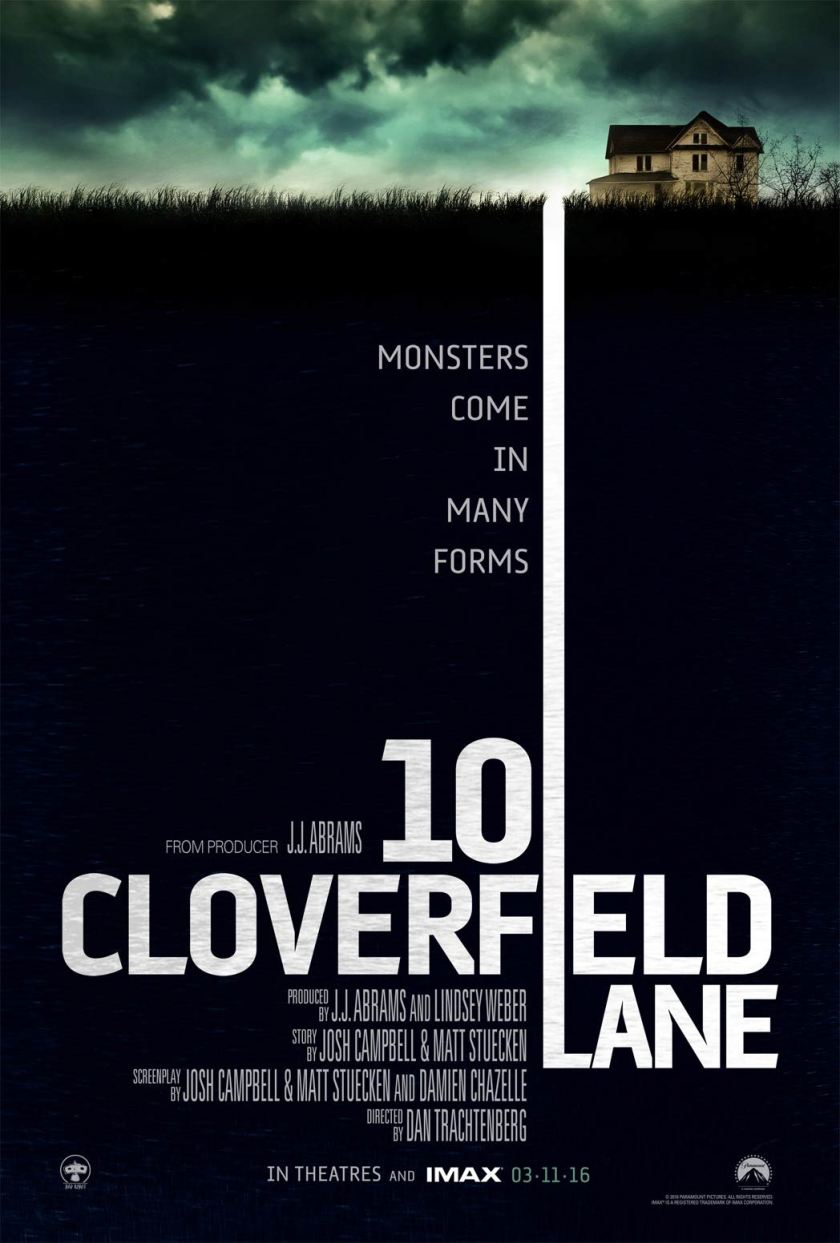
Talking about the plot of 10 Cloverfield Lane is tricky without revealing all of its secrets, and that’s especially annoying because that’s really where the film’s main problems lie. From a basic storytelling perspective, the film’s first act is excellent in creating a tense atmosphere that constantly keeps you on your toes. There were definitely moments where I had no idea where the story might go, and the film even does a good job of quickly debunking the easy answers early on. It’s not airtight, as typical Abrams quirks are present from the start, such as some clunky expository dialogue. You know, the kind where supporting characters speak in vague terms to seem mysterious, and so the protagonist constantly has to ask for clarification, thereby not-so-subtly providing the audience with important information? Yeah, that’s a writing crutch that needs to die. But despite this, the film keeps at a good pace and gradually ramps up the mystery, culminating in an exciting jump into a third act…and then the reveal happens. I won’t say what exactly goes down, but it’s clichéd, underdeveloped and ultimately unsatisfying. After doing so well to circumnavigate the obvious and really leave open the possibilities to something new or insane, the final ten minutes come off as slapdash and just leaves you with a whole new set of questions to the ones you had when the movie started. Again, I can’t say much without spoiling the whole thing, but I will say this: if the movie weren’t called 10 Cloverfield Lane, the ending would have been less obvious.

When creating a bottle film with a small cast of characters, it’s important that your minimal cast are not only good on their own but can bounce off each other effortlessly. The trio of Mary Elizabeth Winstead, John Goodman and John Gallagher Jr. do just that in 10 Cloverfield Lane. Winstead’s Michelle makes for an interesting set of eyes to view the story through, arriving in this situation with her own set of baggage that only hints at an elaborate back-story. She achieves a strong balance between anxious captive and resourceful fighter, being just capable enough for her actions to be believable in this situation. By the end she perhaps suddenly becomes a little too proficient at things she’s never done before, but Winstead is at least sure to give Michelle a sense of humour about the situation. John Gallagher Jr. makes for an interesting addition to the threesome, acting as more of the everyman in this situation caught between two opposing views and struggling to decide where his allegiance lies. He too certainly has his depths, but they aren’t explored in as much detail. But in all honesty, John Goodman steals this movie from his first moments on screen. It’s a wonderfully unsettling performance that constantly leaves you feeling uneasy about what he might do next. There’s a lot of subtlety to his performance, hinting at hidden characterisation through simple things like cadence and body language, and he ultimately gains as much sympathy from the audience as he does fear.

Director Dan Trachtenberg has mainly worked in commercials and online video before his debut here (if you haven’t already, check out his awesome Portal fan film), so he’s used to working with limited resources. Probably thanks to that, he’s managed to create a visually interesting movie despite being limited to one location for most of the running time. There’s nothing too flashy on a production level until the film’s third act, but through simple things like camera movement and lighting he establishes a clear mood and style for the film. He also makes excellent use of visual storytelling in his direction, with very sparse dialogue in the film’s bookends and relying instead on character emotion and action to convey the story. The tension is further heightened by Bear McCreary’s excellent score, which feels suitably sombre or exciting for whatever the scene calls for.

There’s a lot of great things I can say about 10 Cloverfield Lane, but even if brief a problematic ending can spoil an otherwise good film. The first two thirds of the film are incredibly well directed and Goodman’s performance is one of his best in perhaps a decade, but I can’t help but feel that there was more to be said before the credits rolled. This is a constant problem with JJ Abrams’ obsession with mystery box storytelling: the anticipation almost always overshadows the payoff. If the film didn’t call so much attention to how secretive it is, it might have gotten away with the ending because we wouldn’t have been trying to figure it out so hard. If you really want to know the answers, I certainly don’t think seeing is a waste of time. Just be sure to lighten your expectations and don’t overthink every plot turn, or you’ll only end up setting yourself up for a letdown. If nothing else, I hope this film gives Dan Trachtenberg more directing opportunities, because he’s clearly a talented guy and has certainly worked hard to even make it this far.

FINAL VERDICT: 7.5/10

KUNG FU PANDA 3 – a review by JJ Heaton

Starring: Jack Black (School of Rock), Bryan Cranston (Godzilla), Dustin Hoffman (Midnight Cowboy), J.K. Simmons (Whiplash), Angelina Jolie (Wanted), James Hong (Big Trouble in Little China), Seth Rogen (The Interview), David Cross (Arrested Development), Lucy Liu (Kill Bill), Jackie Chan (Rush Hour)

Directors: Jennifer Yuh Nelson (Kung Fu Panda 2) & Alessandro Carloni

Writers: Jonathan Aibel & Glenn Berger (Monsters vs. Aliens)

Runtime: 1 hour 35 minutes

Release Date: 29 January (US), 11 March (UK)

Kung Fu Panda is not a name that inspires confidence upon first utterance but, like Po himself, it’s a film that quickly proves it’s far better than any reasonable expectation. Mixing comedy and action with Eastern influences in animation, choreography and philosophy, it’s a movie that’s as inspiring as it is entertaining and gets better with every subsequent viewing. Its sequel was an even bigger triumph, upping the ante in every conceivable way whilst also adding greater emotional heft to the story. It also left on somewhat of a cliffhanger and now, nearly five years later, the answers have finally arrived in the form of Kung Fu Panda 3.

kung-fu-panda-3-second-teaser-poster

There is very a much a formula to a Kung Fu Panda story: Po is tasked with a challenge he internally struggles to combat, a threat rises that requires he complete that task, through spirituality and determination he overcomes his barrier, and then defeats the bad guy with his new-found enlightenment. The third instalment follows that structure to the letter and it is a little predictable at this point, but each film differentiates itself by teaching a different message through that narrative. The first film was about discovering hidden potential, the second about harnessing emotion, and the third is about finding identity and bettering others through their strengths rather than yours. Yes, it’s still mainly a film for kids with lots of silly jokes and cute characters, but there are deeper themes underneath for the older audience to appreciate. Though the story is pretty familiar by now, Kung Fu Panda 3 is a very appropriate capper to the trilogy with callbacks to the first two films that wrap up all the loose ends and bring newfound clarity to the series as a whole. I don’t believe it was planned like this from the start, but it’s been done in an elegant and seamless way that helps bring firm closure to the saga. I wouldn’t say there’s no chance of there ever being another film, but if this is the last we ever see of Po and The Furious Five, it’d be an appropriate note to go out on.

Jack Black may not have the greatest range, but in this type of role he excels. Po remains a lovable and endearing character even still, and it’s amazing that the series has managed to keep him so without diminishing all of the character development he’s gone through in the series; I think the key is that he’s goofy and affable, but never idiotic or tiresome. The film is mostly focused on his newfound relationship with his biological father Li (Cranston), which puts a strain on his adoptive father Mr. Ping (Hong), and the threesome bounce off each other incredibly well. Hong is as great as ever in this role, injecting the energetic earnestness he’s always brought to these movies, and it’s great to see how he deals with having to finally support Po rather than simply coddle him. Cranston gets a chance to stretch his comedy chops again after a series of dramatic roles, and he’s excellent at playing the laidback man-child you’d expect Po’s father to be. That’s not to say Cranston is all fun, as he does bring plenty of dramatic weight to the role when called for, and if the series continues I hope he’ll stay a major part of it. J.K. Simmons’ villain is perhaps the least interesting of the series’ antagonists thus far compared to Ian McShane and Gary Oldman, but he does make for a visually interesting foe and Simmons does milk all the humour that can be found in a legendary villain that no one in the story even remembers. Master Shifu (Hoffman) and The Furious Five (Jolie, Rogen, Cross, Liu, Chan) take mostly a backseat in the story this time around, but many of them do have their moments and all of their performers provide excellent voice work as usual.

The Kung Fu Panda films have always drawn as much influence from Eastern cinema as they have Western, and that is indeed also true of this third instalment. The energetic action choreography the series is known for is as much of a spectacle to watch as it’s always been, mixing in some more mystical elements to shake up the formula and further add to the insanity. The animation is crisp and beautifully flowing, whether gripped within a fight or simply admiring the scenery. Like Kung Fu Panda 2 did, the film also makes excellent use of 2D animation reminiscent of Chinese art that further adds to the cultural authenticity. Hans Zimmer’s music blends east and west beautifully into an action-packed score, and Dreamworks once again take full advantage of the capabilities of 3D to make it worth that extra few bucks for the experience.

Whilst I ultimately preferred its immediate predecessor, Kung Fu Panda 3 is still a more than worthy sequel that remembers everything that worked before. It doesn’t quite have the originality of the first film or the boldness of the second, but it still has heart where it counts and serves as a perfect wrap-up if this is to be the final instalment. Dreamworks’ output can be spotty in terms of quality, but when they get it right they really get it right and I can only hope that they can cap off their How to Train Your Dragon franchise with as much panache.

FINAL VERDICT: 8.5/10

HAIL, CAESAR! – a review by JJ Heaton

Starring: Josh Brolin (True Grit), George Clooney (Ocean’s Eleven), Alden Ehrenreich (Blue Jasmine), Tilda Swinton (Constantine), Scarlett Johansson (Lucy), Channing Tatum (22 Jump Street), Jonah Hill (The Wolf of Wall Street)

Writers/Directors: Joel & Ethan Coen (No Country for Old Men)

Runtime: 1 hour 46 minutes

Release Date: 5 February (US), 4 March (UK)

The Coen Brothers have shown they can handle a multitude of genres, often balancing several at the same time. Their films can be simultaneously gruesome and humorous, injecting their trademark wit and deadpan timing into even the most serious of situations. With its setting of classic 1950s Hollywood, Hail, Caesar! gives them the opportunity to play with genre more than ever, but by giving them so many toys to play with they never get the chance to pick a favourite.

hail-caesar-quad

The behind the scenes world of cinema in this era is fascinating and has served as the backdrop of many great films from LA Confidential to Hollywoodland, and with this movie it’s clear the Coens are lovers of the period too. The film certainly captures the madcap nature of this industry back then, touching on many of the topics of the day like sex scandals and the influence of communism, but it also embodies its setting in its presentation and tone. It certainly feels like a movie that could have been made in the period itself, and it takes every opportunity to explore every type of film made in the era. Whether it’s gargantuan historical epics, cheesy westerns or fabulous musicals, there is a bit of everything to be found in Hail, Caesar! Where the film falters, however, is in meshing all of these ideas together into a cohesive whole. The story flits between different storylines with often only the thinnest of links and little to no development (some plots are even resolved off-screen!), concepts and questions are brought up only to be offhandedly answered or quickly forgotten, and characters disappear for long stretches or sometimes never even return. The Coen Brothers have never been ones to be mindful of traditional structure or narrative, which has worked to great effect for them in films like The Big Lebowski, but here it not only feels needed but also thematically appropriate. If this is meant to be a satirical look at 1950s Hollywood through the lens of a 1950s Hollywood film, why not give it a traditional overarching plot? It would make it even more period authentic and further accentuate many of the film’s themes.

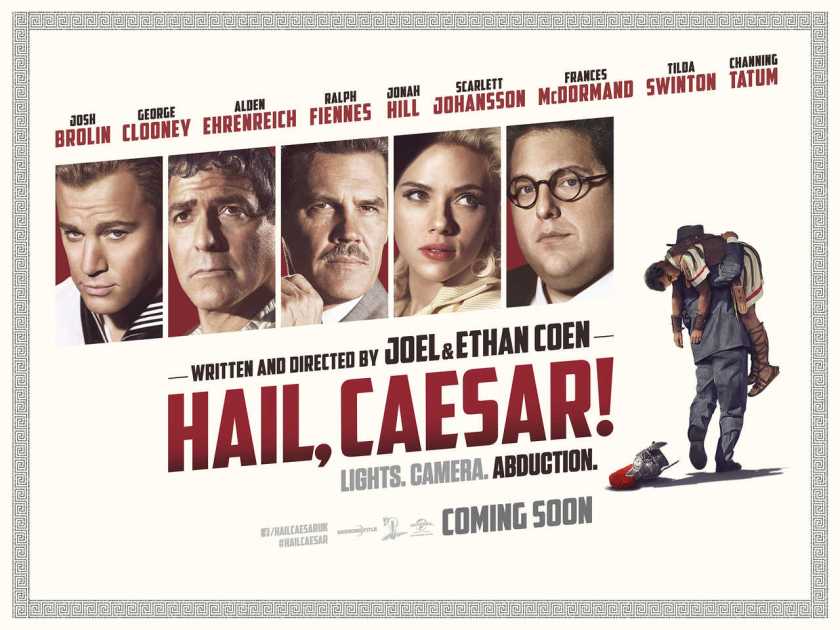
As always, The Coen Brothers have assembled a fantastic all-star cast to populate their film, but like the story most of them get lost in the shuffle. Josh Brolin is the main lead as real-life Hollywood fixer Eddie Mannix, and though he does a perfectly fine job with the material he isn’t given much room to stretch. He’s constantly concerned about his hectic job and how it’s affecting his family, but we don’t get any insight into his personal life beyond one brief scene, and the decision he makes about his career at the end is completely without conflict. The real scene-stealers of the film are George Clooney as the clueless and easily persuaded Baird Whitlock, and Alden Ehrenreich as the befuddled western star Hobie Doyle. Clooney is excellent at playing the self-absorbed actor who’s not as smart as he thinks he is, using his pretty boy charm to be humorous rather than enchanting. Ehrenreich shines in every scene he gets, his thick Southern drawl combined with his sweet but simpleton dialogue creating a fantastically amusing character; his scene with Ralph Fiennes as his fed-up director is easily the film’s comedy highlight. The rest of the cast, unfortunately, feel like mere flashes in the pan with many barely even getting one scene. There’s certainly some interesting characters amongst the bunch, like Channing Tatum’s Gene Kelly-esque musical star or Tilda Swinton in a dual role as competing journalists, but they only have the most tangential relation to the main plot. I could go on listing the recognisable names in this movie (Christopher Lambert, Alison Pill, David Krumholtz and Frances McDormand to name a few), but so many of them are in the film so little you could miss them in a brief bathroom break and lose nothing. Heck, Jonah Hill is heavily featured in all the marketing, and yet he has only one brief scene with about four lines of dialogue! I know that’s hardly the movie’s fault, but the expansive cast just adds to the clutter of content that is this movie.

What I cannot fault Hail, Caesar! for, however, is its presentation. As mentioned beforehand, the movie emulates the look and feel of 1950s Hollywood cinema whether focusing on the making of a picture or not. Roger Deakins’ cinematography masterfully captures that magical look seen in so many films of the era in both camerawork and lighting, all filmed in classic 35mm. The sets and costumes are all period perfect, gushing with lavish design and gloriously saturated colours, and the choreography on the film’s two dance sequences feels ripped right out of a masterpiece of the time. Carter Burwell’s score feels pitch perfect for the film’s style and tone, and what little visual effects work there may be blends seamlessly into the movie’s otherwise beautifully archaic appearance.

As much praise as they deservedly get, The Coen Brothers don’t always hit it out of the park and Hail, Caesar! probably won’t become a classic like many of their other films; I’m sure it’ll build a loyal fanbase, but I doubt it’s going to become anyone’s favourite. It certainly has a lot of interesting ideas, but it has far too many for its own good, resulting in an periodically intriguing but overall muddled experience. It’s certainly worth a watch for anyone with a passion for its subject matter, and Alden Ehrenreich’s performance is more than worth your time (seriously, he’s one of the best and most underutilised actors of his generation), but it’s nothing you need to rush out and see. Hopefully whatever Joel and Ethan have cooked up for us next will be a little more satisfying.

FINAL VERDICT: 6.5/10

ZOOTROPOLIS (aka ZOOTOPIA) – a review by JJ Heaton

Starring: Ginnifer Goodwin (Once Upon a Time), Jason Bateman (Horrible Bosses), Idris Elba (Beasts of No Nation), Jenny Slate (Obvious Child), J.K. Simmons (Whiplash), Bonnie Hunt (Cars), Octavia Spencer (The Help), Alan Tudyk (Frozen)

Directors: Byron Howard (Tangled) & Rich Moore (Wreck-It Ralph)

Writers: Jared Bush & Phil Johnston (Wreck-It Ralph)

Runtime: 1 hour 48 minutes

Release Date: 4 March (US), 25 March (UK)

All great children’s films have a strong message behind them, but rarely do they say anything particularly revolutionary. It’s usually just slight variations on ‘be yourself’, ‘follow your dreams’, and ‘don’t let others get you down’. Don’t get me wrong, there are some films for kids that have stronger, more subversive messages than that, but there are many more that don’t even try. Even Disney doesn’t always bother with an interesting moral, relying more on formula and heart to win audiences over than making them think. Frozen kind of changed their mindset on that, creating a perfect balance between traditional fairy tale magic and modernist perspectives on gender roles, and with Zootropolis (or Zootopia for any Americans that might be reading this) they’ve gone out of their way to make something equally conscious of our evolving world.

23298749279_0d967b0e96_o

From the outset, Zootropolis doesn’t seem like a particularly original film. Anthropomorphic animals living in a human-style city is a long established idea, the buddy cop formula has been overdone to the point of monotony, and what seems like the initial message (an optimistic small-town girl proving she can stand up with the big city folk) prepared me for something acceptable but not astounding. The film’s first half is very cute and certainly does a lot of inventive things with the richly detailed world it’s created, fashioning a lot of imaginative scenarios and gags about the animal kingdom without completely relying on stereotypes. But from a story perspective, it’s just a simple detective caper with plot elements we’ve seen as far back as the days of film noir. However, by the film’s halfway point, it’s quite clear all of the familiarity was on purpose to set up what the movie is really about. What begins as a very kid-friendly buddy comedy seamlessly morphs into a social commentary about racial profiling that uses the tropes of cop movies and kids’ movies alike to subtly get across its message. It’s a feat that’s completely going to go over children’s heads, but for the adults in the audience it’ll be something they can appreciate and assure them that their kids have actually learnt something from the experience. That doesn’t mean the film completely eschews formula from there, as the second half does still heavily rely on familiar plot beats and smart audience members will probably see the final villain reveal coming, but it uses them for power and emphasis rather than being lazy. By the story’s conclusion, Zootropolis completely destroys any preconceptions you may have had going into it by delivering a far richer film experience than anyone could suspect.

The buddy pairing of the by-the-book cop and the sleazy hustler they’re stuck with has been around since the genre began, and with the team of Judy Hopps (Goodwin) and Nick Wilde (Bateman) they don’t stray too far from the established formula. Ginnifer Goodwin has pretty much mastered the art of playing unbelievably nice people, and for the role of Hopps that brand of ‘gosh-darn’ wholesomeness works perfectly with the go-getter nature of the character. On the other hand, Jason Bateman’s performance as Wilde is a great change of pace for the actor, who’s excellent at playing the roughneck con man but rarely ever gets the chance to do so; he’s mostly been stuck playing variations on Michael Bluth for the past ten years. The two do compliment each other well as complete opposites, but the characters ultimately work not because of their clashing personalities or lifestyles. It’s because they both have inner prejudices of each other, and over the course of the film they learn to overcome those; again, a great example of how the film takes your expectations and flips them. However, the rest of the supporting cast doesn’t quite get as much subversive treatment. Idris Elba as the typical angry police captain comes off as way too harsh, mainly just to make Hopps’ situation more crushing and time-sensitive, and he never gets any sort of notable comeuppance for this behaviour. J.K. Simmons feels a bit wasted as the city mayor, disappearing for large chunks of the movie despite being often talked about, and though the marketing made a big deal about Shakira being in the movie she only has one real scene; she’s basically just there to plug the soundtrack. That doesn’t mean there aren’t some bright spots in smaller roles, with Jenny Slate as the clumsy and put-upon mayoral assistant Bellwether being an often amusing presence, and Tommy ‘Tiny’ Lister’s brief appearance works as a hysterical disparity between character and voice.

When you usually see animals acting like people, all they do is throw clothes on them and have them walk on their hind legs. Zootropolis goes beyond that and creates a world that feels far more viable for these various creatures to co-exist in. It remembers variables between these different species like size, body temperature and habitat, in turn making for a film with a wide variety of environments to explore, and they take every advantage of this they can through inventive production design. The animation quality is Disney perfection as expected, with rich detail in textures and fluid character movement. The sheer amount of varying characters on screen at once, all with unique details like varying speed and posture, further adds to the engrossing vibrancy of this world. Michael Giacchino’s score isn’t quite as memorable as many of his other works but it does help propel the film’s action, and Shakira’s theme song for the movie “Try Anything” is an enjoyable if clichéd pop song that fits the story’s message.

Of all the phrases I thought I’d use to describe Zootropolis, I never thought “socially relevant” would be one of them. Far more than just a fun family film with cute animals, this is a movie that feels important in the climate we live in where prejudice pervades almost every aspect of our daily existence. It teaches kids that generalising a group based on a small number of radical exceptions is unacceptable, that people from certain backgrounds are capable of making their way in untraditional fields for them, and that we all sometimes make unintentional mistakes that could be seen as disrespectful to others. Those are some pretty deep themes for an animated Disney film, but for a company that lords over so much of our popular culture it’s momentous of them to make a statement like this. I haven’t seen a film that cuts so deep like this since The LEGO Movie, and I’m sure that certain media groups are going to have a field day of claiming Disney is trying to indoctrinate kids with some sort of “agenda”, but they’re exactly the kind of idiots this film is against. If you’re a parent, take your kids to see Zootropolis not just because they’ll have a good time. Take them because it might make them better people.

FINAL VERDICT: 9/10

DEADPOOL – a review by JJ Heaton

Starring: Ryan Reynolds (Buried), Morena Baccarin (Firefly), Ed Skrein (The Transporter Refueled), T.J. Miller (How to Train Your Dragon), Gina Carano (Haywire), Brianna Hildebrand

Director: Tim Miller

Writers: Rhett Reese & Paul Wernick (Zombieland)

Runtime: 1 hour 48 minutes

Release Date: 10 February (UK), 12 February (US)

Deadpool has merely been a dream film for comic book fans for a long time; that movie that’s always been on the cusp of reality but always pulled away by fearful studio executives. After the treatment of the character in X-Men Origins: Wolverine, demand for a standalone Deadpool movie was practically demanded as penance. And now, thanks to fan insistence plus a few strategic leaks of an early screenplay and test footage, that dream film is now playing in a theatre near you. After so much anticipation, partnered with possibly the best marketing campaign in Hollywood history, you’d think the final product wouldn’t be able to live up to the hype. Anyone who still says that after watching it is a jaded contrarian, because this movie delivers everything it promises and more.

deadpool-ver8-acc2e

Yes, Deadpool is another superhero origin story, but I doubt you’ve ever seen one quite like this. Told through a fragmented structure a la Batman Begins, the story of how Wade Wilson became the Merc with a Mouth follows many tropes of the genre, but also breaks just about as many and makes fun of the others. It’s very self-aware of what it is doing, with direct call-outs to certain movies and the character of Colossus essentially serving as a metaphor for the traditional superhero movie. In terms of humour, the movie completely nails the fourth-wall breaking witticism of the comic books laced with copious amounts of innuendo. Is it a sense of humour that’s particularly biting or ingenious? No, but it’s not aspiring to be. The plot is mainly there as a platform for a series of ridiculous action sequences and some potty humour, but there is some substance underneath the style. If the movie were nothing but violence and sex gags, as much as that alone would have satiated fans, the film would have quickly become one-note. In a surprising twist, Deadpool is at its core a surprisingly touching romance story about staying with the one you love in spite of dire circumstances. It’s nothing that’s going to make you cry, but that ultimately invests you in the story far more than ironic quips about not being able to afford more X-Men cameos. This is a movie that delivers pure, adulterated entertainment (yes, I know that’s an oxymoron, but it’s intentional), tightly packing in a sh*tload of action and gags into a brisk run time that is never boring for a single frame. Oh, and like I even have to tell you, but STAY THROUGH THE CREDITS!

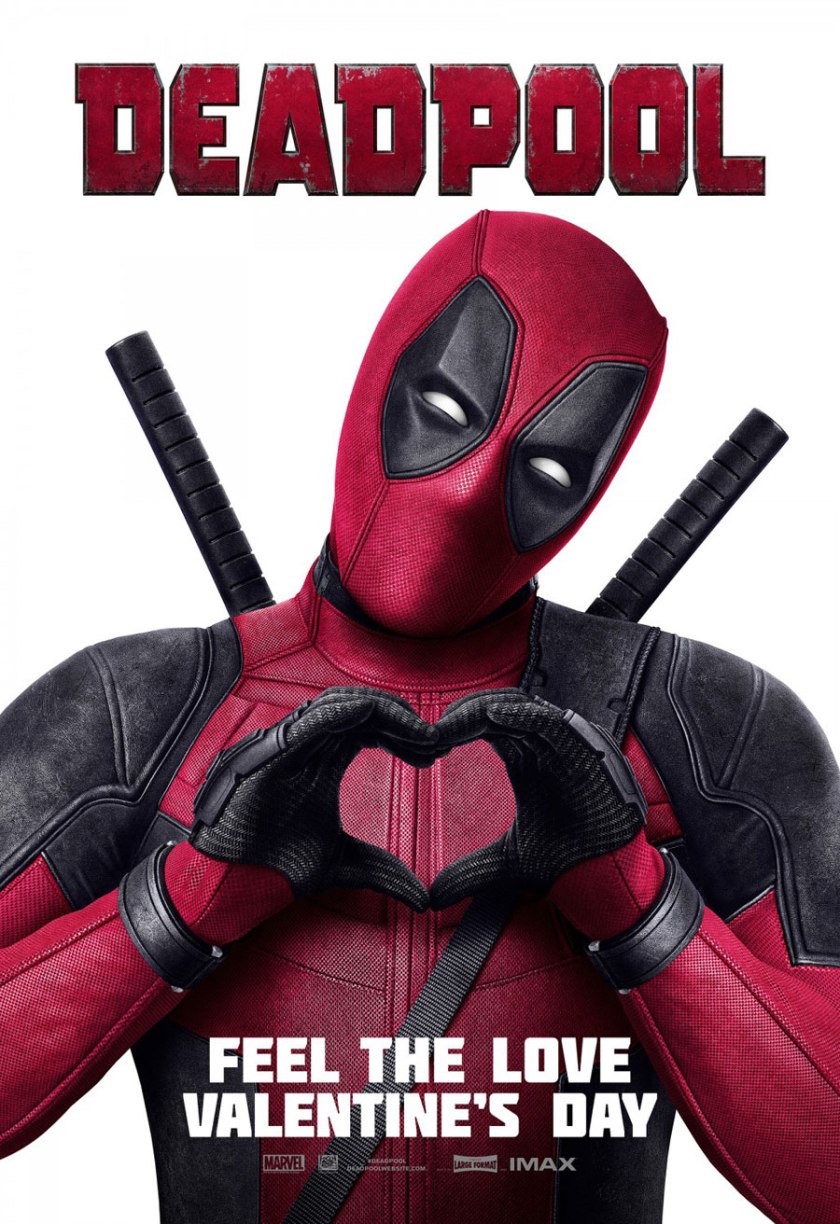
Ryan Reynolds was born to play Deadpool. In his first five minutes of screen time in X-Men Origins: Wolverine, he proved that before the movie got totally lazy and ruined him (don’t worry, it’s an issue firmly addressed here). Now getting to play the role unfiltered, Reynolds shines in what is his genuinely best performance to date. He belts out the one-liners like a champ and revels in every piece of awesomeness, but he’s also wonderful in the more serious moments (well, “serious for a Deadpool movie” moments). There’s an authentic horror when he sees what has become of him, a real fear when he can’t bear to show the woman he loves, and certified anger at the one who did it to him. They even make sure to give him his limits through a simple moral code; it’s one that only makes sense to him, but at least he has one. Again, this level of commitment is what sells the movie beyond its bizarre personality. Reynolds certainly ain’t getting Oscar consideration for this, but for a comic book fan this is the most accurate translation of a character since…well, actually, ever now that I think about it. Morena Baccarin makes for a perfect romantic foil for Wilson as the vivacious Vanessa, matching his quirks with her own for a very messed up but equally heartfelt romance. Her chemistry with Reynolds shoots off the screen and, though she does serve a damsel role in the climax, she’s no defenceless Mary Jane. Ed Skrein finally gets a decent role here as the villain Ajax who, though not an adversary for the ages, is an effective counterpoint to Deadpool’s personality and even quite funny in a deadpan way. T.J. Miller steals every scene he is in as the sardonic Weasel, blurting out kooky and nonsensical punch lines that will have you laughing every time, Gina Carano doesn’t get much dialogue but makes up for it through exemplary glowering, and Brianna Hildebrand is a revelation as the ever-apathetic X-Man-in-training Negasonic Teenage Warhead (yeah, if you couldn’t tell already, it’s that kind of movie).

When they promised that Deadpool would be R rated, fans were overjoyed and I think they’ll be more than satisfied by the carnage on display. Whilst not diabolical on a Takashi Miike level, there is certainly a good abundance of blood, dismemberment and colourful four-letter words. The action sequences are wonderfully photographed and creatively composed, completely avoiding lazy action movie choreography to create a vivid and totally awe-inspiring experience. The humour is even flavoured into the look of the film, with as many jokes in the background as there are in the dialogue (here’s a free hint: look closely at the pizza box). It’s hard to believe Tim Miller has never directed a feature film before, and he certainly deserves to do more considering the natural talent he’s displayed here. In a similar sense to Guardians of the Galaxy, Deadpool is also a movie defined by its eclectic soundtrack featuring a mix of rock, hip-hop and 80s cheese. Some are used for comedic effect, others for the sake of badassery, but they’re all fitting choices that are sure to making it to your iTunes playlist very soon. Combined with Junkie XL’s fantastic retro-inspired score, it’s a movie that’s as aurally pleasing as it is visually.

Is Deadpool a transcendent piece of filmmaking that epitomizes not only comic book movies but also the art form in general? F*ck no! But does it accomplish everything it sets out to do with exemplary form? Abso-f*cking-lutely, and that’s why it gets a perfect score. My cheeks are in literal pain right now because I was laughing so much in this movie, and whenever I wasn’t doing that I was grinning in awe. Deadpool is certainly a movie that doesn’t have mass-market appeal, but it perfectly appeals to the market it’s targeted at and that’s all you can ask for. This movie would have been perfectly satisfying if it has just been 90 minutes of jokes about giving Wolverine a blowjob, but it goes that extra mile by actually putting genuine heart and effort into the proceedings. Now it’s up to you, fanboys. Get out to your local cinema and support this movie with your cash. Don’t make this another Scott Pilgrim vs the World. If you simply go see this movie, we are going to get more of what we want and I think Hollywood would be a far more interesting place with more edgy, eccentric, batsh*t insane comic book movies.

FINAL VERDICT: 10/10!

PRIDE AND PREJUDICE AND ZOMBIES – a review by JJ Heaton

Starring: Lily James (Cinderella), Sam Riley (Maleficent), Bella Heathcote (Dark Shadows), Douglas Booth (Noah), Jack Huston (Kill Your Darlings), Matt Smith (Terminator Genisys), Charles Dance (Last Action Hero), Lena Headey (Dredd)

Writer/Director: Burr Steers (17 Again)

Runtime: 1 hour 48 minutes

Release Date: 5 February (US), 11 February (UK)

Let me get this off my chest: Abraham Lincoln: Vampire Hunter is an underrated modern classic! OK, maybe that’s a bit much, but damn I do love it in all its crazy glory. I certainly understand why a lot of people don’t appreciate it, and I think the problem is that the main joke is a hard sell. The humour in the premise comes from adding ridiculous elements to an otherwise straight story and playing it completely sincerely. For most people, it ends up feeling either too silly or too serious, but for me it worked and I found it to be a ridiculously fun plundering of American history. And now Seth Grahame-Smith’s other most well known work, a reworking of Jane Austen’s Pride and Prejudice into the world of the undead, has finally arrived on the big screen too. Does the joke work upon retelling, or will this one be lost on the general audience too?

ppz

First up, I must admit I have never read the original Austen novel. However, I have seen the 2005 film version with Keira Knightley, so I am at least somewhat familiar with the original story. From that standpoint, this retelling does follow all the same basic plot beats of the story for at least the first two thirds, though the context of many events have now been changed in the zombie apocalypse. Despite the imminent threat of the undead horde, the story’s main themes of class, love, and the role of a woman remain completely intact. The film’s main joke is still playing the story sincerely despite the absurdity, and again for me it’s a gag worthy of a few laughs. Adding kung fu battles to simple scenes of characters exchanging banter about betrothals and betrayals is a humorous sight, and by changing Elizabeth (James) from just a woman wanting some independence to one who wants to prove herself as a warrior first surprisingly adds a more modernist subtext. If you took out the zombies, the film would be a perfectly acceptable adaptation of Pride and Prejudice, but the third act is where the film does diverge considerably into a big action climax. It’s an understandable change, as a zombie film with the straight-up original ending would be a little anti-climactic, and for what it is it’s an enjoyable sequence that does fit well with the film’s own arc and tone. However, setting up this new climax not only means restructuring the original sequence of events, it means adding in some new story material at the cost of developing the original plot better. The film is well paced and I wouldn’t want to see it much longer, but to add so much to the story and yet make the film shorter than your average regular version of Pride and Prejudice does make it feel a little like cliff notes.

Pride and Prejudice and Zombies has a very strong cast that would have been excellent even in a regular adaptation, and their presence here in such a bizarre reinterpretation only gives the film more credence. Lily James makes for a wonderful Elizabeth Bennet, her previous experience with period pieces like Downton Abbey and Cinderella certainly helping her look the part, and she manages to make the character her own. Then again, considering she’s the only Elizabeth Bennet who knows Chinese martial arts and can decapitate zombies with a battle-axe, it’s easy for her to stand apart. Equally, Sam Riley’s Mr Darcy captures the original essence of the character whilst also adding a more tragic back-story and a gruffer demeanour; he’s basically a Georgian Batman. He and James share good chemistry as both adversaries and lovers, but unfortunately their story feels a little truncated. Most importantly, not as much time is given to Darcy’s important character arc, and by doing so it makes it a little harder to understand why Elizabeth eventually accepts him. The film does reinterpret their relationship by making their eventual love more mutual, through them saving each other rather than Darcy simply righting his wrongs, but even that feels a little too brief for it to be fully satisfying. This simplification also afflicts the story between Jane (Heathcote) and Bingley (Booth), but given both actors are amongst the weaker cast members the loss isn’t so disappointing. Mr Collins is the character most unaffected by the scenery change, still the awkward doofus he was in the original, but Matt Smith’s certainly taking the film a little less seriously than everyone else with his excitable performance; he’s an entertaining presence for sure, but he perhaps takes it a little too far. Charles Dance’s Mr Bennet is suitably doting and fatherly, and Lena Headey’s reinterpretation of Lady Catherine into a kick-ass zombie slayer is a change that provides both humour and awesomeness. Ultimately, it’s Jack Huston’s Wickham who has gone under the most drastic change from the original. Reinterpreted from a mildly scheming side character into the film’s main villain, it’s a change that has roots given the already present rivalry between him and Darcy, but considering so much of the film’s new material centres around his character, it’s a bit baffling that he ends up feeling like an even less nuanced character than he was before.

From a visual perspective, the film from a distance again looks like it could be a normal adaptation, but it’s the little details that clue you into the different dynamic. It’s a great exercise in visual contrast, seeing Georgian country houses surrounded by spiked gates or women brandishing blades on their garters, but it manages to never feel out-of-place. The action sequences are well choreographed, especially the martial arts sequences, but on a horror level it’s somewhat dissatisfying. There are plenty of decapitations, dismemberment and gutting, but the blood levels are pretty tame and some of the more gorier moments feel like they’ve been edited around to secure a lower rating; hopefully they can reinstate these for an unrated home video cut.

Pride and Prejudice and Zombies: if just the title sounds stupid for you, then you need not apply. However, if the idea of aristocrats bickering about inheritances whilst shooting zombies in the face sounds cool to you, then there’s certainly enough to enjoy here. Again I’m worried I might be the only one who appreciates the joke, as I’m sure Jane Austen fans will be frustrated to the concessions made to the story, whilst horror nuts will be annoyed by the lack of gore, but for me it struck the right balance between sincere adaptation and glorified joke. Abraham Lincoln: Vampire Hunter is the still the superior film for me, mainly because that did embrace the goofy a little more (c’mon, there’s a scene in that movie where Lincoln fights a vampire who throws horses at him!), but as its own film it achieves its goals admirably. Now, if you’ll excuse me, I need to write a version of To Kill a Mockingbird where it turns out Boo Radley was a werewolf the whole time.

FINAL VERDICT: 7.5/10

TRIPLE 9 – a review by JJ Heaton

Starring: Casey Affleck (Gone Baby Gone), Chiwetel Ejiofor (12 Years a Slave), Anthony Mackie (The Hurt Locker), Aaron Paul (Breaking Bad), Clifton Collins Jr (Crank: High Voltage), Norman Reedus (The Walking Dead), Teresa Palmer (I Am Number Four), Michael K Williams (The Wire), Gal Gadot (Fast Five), Woody Harrelson (Zombieland), Kate Winslet (Titanic)

Director: John Hillcoat (Lawless)

Writer: Matt Cook

Runtime: 1 hour 55 minutes

Release Date: 19 February (UK), 29 February (US)

Making a unique heist film is very hard to do. They’re heavily reliant on formula, so it’s very easy to follow it to the book and end up being generic, but if you stray too far it loses something. Triple 9 does bring a couple of new ideas to the table and, though nothing it does is particularly groundbreaking, it is an entertaining ride whilst it lasts.

final-uk-quad-hr

A major theme of Triple 9 is crossing threads and coincidence, so fittingly the story is told through various intersecting characters that form the bigger picture. It’s a technique that certainly helps increase the citywide scope of the narrative, but with so many plotlines to follow it does end up meaning the individual stories are quite simple. You’ve got the rookie cop struggling to fit in, the noble criminal fighting for his family, the crooked cop caught between two worlds, and they’re all stories you pretty much know the basic beats of; if you’ve seen The Departed, The Town, Point Break, Heat, Sicario, or any other such film, you know what’s coming. However, the film ultimately works because all these different stories are weaved together well enough through pitch-perfect pacing. After an exciting opening bank heist, a looming sense of tension is quickly created and the anticipation for the climax slowly builds throughout the entire film instead of just the last third. When the finale eventually kicks off, it feels a little abbreviated, but the epilogue is where every storyline truly pays off and the film ultimately ends on a suitably thematic note.

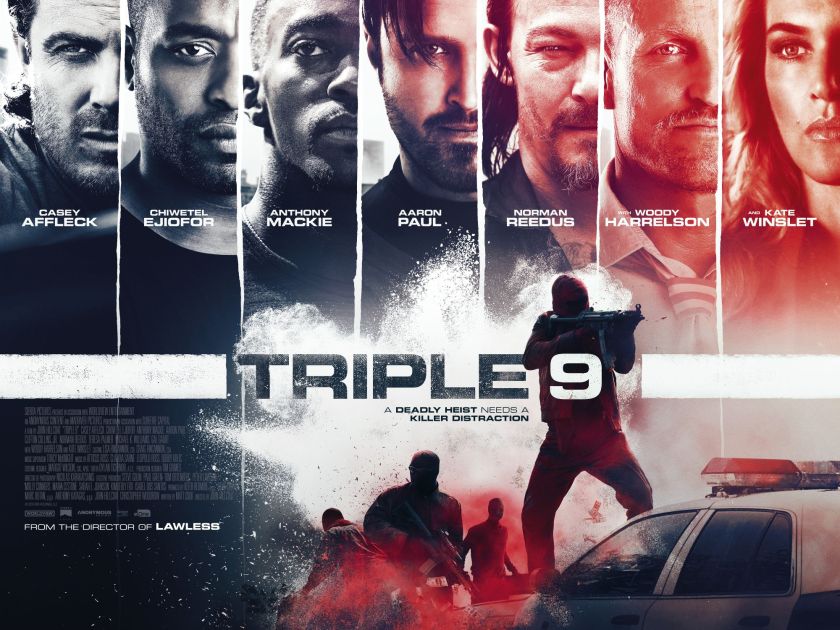
Triple 9 has an incredible cast, and though many of them get far less screen time than they deserve, I don’t think anyone’s phoning it in here. Casey Affleck’s Chris Allen is a little by the numbers, but the actor overcomes the marginal material with a powerful performance that hints at a darker, more inquisitive character. Anthony Mackie is great as the conflicted Marcus, injecting his natural charm into the character whilst never making us forget his more nefarious side; whether he and Affleck are arguing or bonding, it’s a compelling watch. Woody Harrelson is as engaging as ever as the vice-ridden but noble detective, and it’s great to see Clifton Collins Jr get a more prominent role that actually allows him to show off his talents. Chiwetel Ejiofor ends up stealing the show though (as he so often does), mining a lot of sympathy with very little screen time to create a character whose moral compass is very hard to pinpoint. The rest of the cast, whilst generally good on a performance level, is more problematic in terms of material. Aaron Paul is saddled with yet another variation on Jesse Pinkman, Norman Reedus’ role is basically an extended cameo, and Teresa Palmer and Gal Gadot’s roles can be summed up as “Affleck’s wife” and “Ejiofor’s baby mama”; that’s literally all there is to say about them. Kate Winslet playing a Russian mob boss is something I didn’t expect to be in her range and, though she certainly looks the part, her accent faded in and out and she ultimately doesn’t get her hands dirty enough to be threatening. Oh, and Michael K Williams is only in one scene, but he gets to play a role you’d never expect him in and he nails it.

Triple 9 doesn’t do anything to really make it stand out as a heist movie, but it does its job effectively enough. The pacing is tight, the performances are generally strong, and the way its structure and themes intertwine is interesting, but there isn’t anything that makes it something you need to rush out and see. If you’re curious enough and are in the mood for a dark but fun crime thriller, you could do far worse.

FINAL VERDICT: 7/10

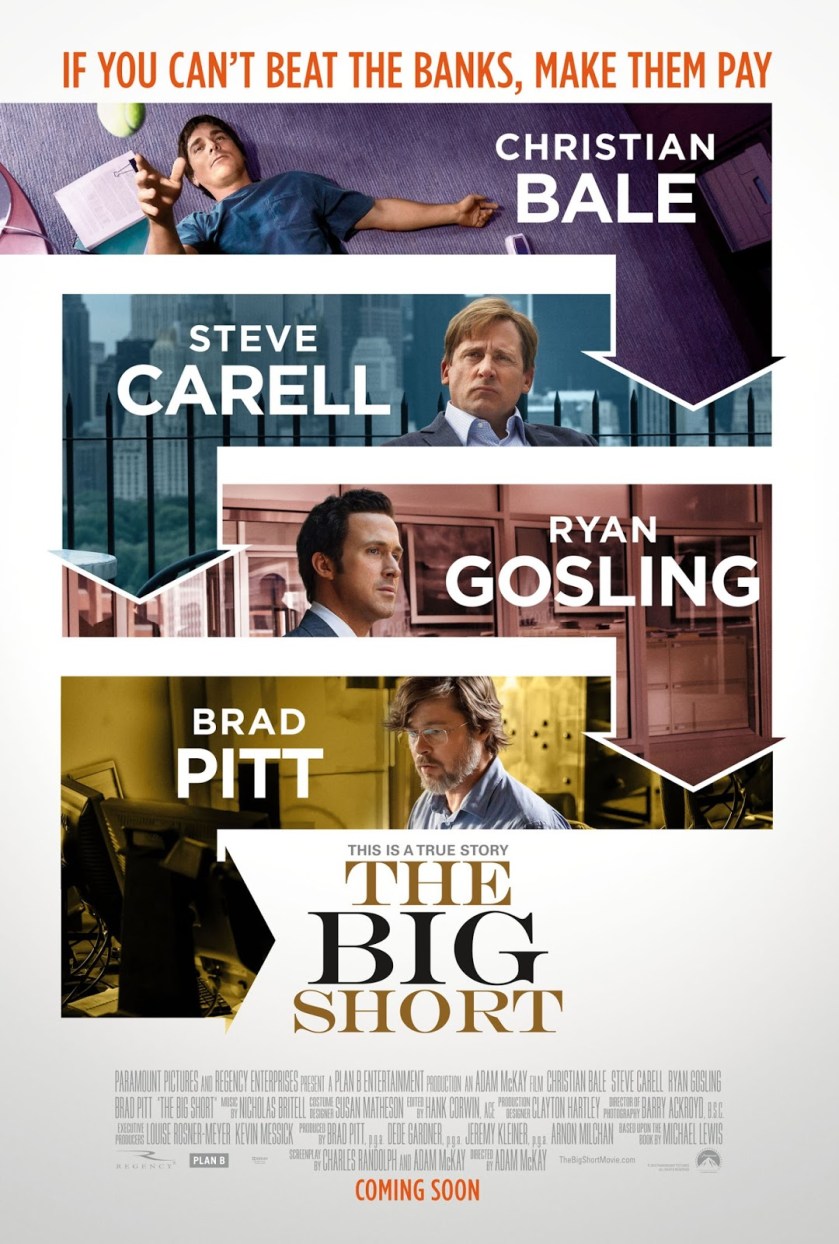
THE BIG SHORT – a review by JJ Heaton

Starring: Christian Bale (The Dark Knight), Steve Carell (Foxcatcher), Ryan Gosling (Drive), Brad Pitt (Moneyball), Rafe Spall (Hot Fuzz), Hamish Linklater (Fantastic Four), Jeremy Strong (Lincoln), John Magaro (Carol), Finn Wittrock (American Horror Story)

Director: Adam McKay (Anchorman: The Legend of Ron Burgundy)

Writers: Charles Randolph (Love and Other Drugs) and Adam McKay

Runtime: 2 hours 10 minutes

Release Date: 11 December (US), 22 January (UK)

Seeing a director drastically change genre isn’t a new thing. Sam Raimi and Peter Jackson went from gory horror films to iconic blockbusters, George Miller went from Mad Max to Babe: Pig in the City and back again, whilst Steven Spielberg and Danny Boyle flit between styles all the time. Regardless, seeing Adam McKay, director of comedies like Step Brothers and the Anchorman series, swap out goofy laughs for something more dramatic like The Big Short is still a shock. It’s not like McKay’s never shown signs of social commentary, considering how both Anchorman films do satirize the American news network in subtly biting ways, but this is the first time that side of himself has taken focus, and by doing so he’s somehow made one of the best films of 2015.

tbs_1-sht_intl

The story charts the lead-up to the 2007-2008 financial crisis through three intertwining stories, and the film does a great job of balancing these threads. Though tied together by a parallel goal, they each have their own unique flavour and show the effects of this impending crisis through different eyes. But just because McKay is focusing on serious subject matter doesn’t mean The Big Short is completely dull or po-faced or snooty. The film wants to be respectable, but it also wants to be accessible to a wide audience, and there’s no better way of being both educational and entertaining than through humour. There is a lot of financial jargon to follow, but everything is clearly explained to the audience in simple and entertaining ways. Whether through clever analogies, humorous asides, or characters directly explaining through the fourth wall, it genuinely educates you on how all these seemingly complicated systems are actually simple and flimsy, and soon the complicated mumbo-jumbo is easy to swallow. By doing this, it then allows you to focus on what’s actually going on and how broken the system was and still is. The film also gains a lot of credibility by never completely siding with our protagonists, nor does it paint them as manipulative hypocrites taking advantage the way The Wolf of Wall Street does. The Big Short’s ultimate goal is to show you that our financial crisis was caused by the ignorance and stupidity of the American banking system, and these people whose eyes we see it through did what they did mainly to prove to those bankers how ignorant and stupid they were for ignoring the signs.

The Big Short is so star-studded that I’m probably not going to even mention half of the famous faces the film has crammed into it, so let’s focus on our main players. Ryan Gosling acts as our main guide through the film as a participant in all three stories, and he excels as scheming market trader seizing the opportunity to make some money out of this falling tree; if the film has a Jordan Belfort equivalent, he’s the closest fit. Steve Carell is fantastic as the angry crusader trying to make a difference in yet another brilliant stretch for the comedy star; it’s hard to believe that he’s working under the same director here as the one who told him to say “I love lamp.” Carell’s underlings are wonderful played by Rafe Spall, Hamish Linklater and Jeremy Strong, each offering their own unique comedic flavour to the proceedings, whilst Brad Pitt’s understated performance as the jaded ex-banker helps ground the film when it gets too exuberant. But ultimately, Christian Bale steals the day as Michael Burry, the socially awkward hedge fund manager who discovers the impending crisis in the first place. Though not quite as transformative as some of his other performances, Bale does manage a convincing introverted weirdo and in turn manages to provide some of the film’s biggest laughs and harshest truths. There are a lot of cameos in the movie, some more important than others, but two in particular may rank among the best and funniest cameos in a movie ever; eat your heart out, Stan Lee.

The Big Short often feels more like a documentary than a fictionalised account, and a lot of that is thanks to the presentation. The cinematography uses a lot of loose handheld camera work, often wobbling around a scene whilst going in and out of focus. In most feature films, this would look amateurish but here it gives the film a stronger sense of verisimilitude; by making the film look more grounded in reality, it removes that aura that reminds you it’s not real. The editing is swift and crisp, keeping even the most jargon-heavy scenes feeling snappy and energetic, and there’s a lot of great use of pop culture imagery to remind ourselves of the world in the mid-2000s. That sense of era also permeates the eclectic soundtrack populated by recognisable songs from pop, rap and even heavy metal, often doing so to comedic effect. I won’t say much more, but the film probably has the best out-of-context use of the theme to Andrew Lloyd Webber’s Phantom of the Opera ever.

The Big Short is not just a great film; it’s an important film. It’s the kind of view into such an important subject I wish we got more often. So many filmmakers would have told this story through some serious filter, believing that would be the only way to for it to be done justice. But Adam McKay understands that often the best way to explain a bad situation is to mock it, and by doing so has created an entertaining satire that doesn’t avoid the hard truths of the matter. Even if you have no understanding of how Wall Street or mortgages work, this film explains it to you in a hilarious way and will have you invested in its issues by the time credits roll. After such a dramatic shift for McKay, it might be hard to seem him return to directing Will Ferrell shouting ludicrous nonsense, but whenever he next puts out something like The Big Short again I’ll be sure to pay attention.

FINAL VERDICT: 10/10!