SPECTRE review

Starring: Daniel Craig (The Girl with the Dragon Tattoo), Christoph Waltz (Inglourious Basterds), Léa Seydoux (Blue is the Warmest Colour), Dave Bautista (Guardians of the Galaxy), Naomie Harris (28 Days Later), Ben Whishaw (Paddington), Andrew Scott (Locke), Monica Bellucci (The Matrix Reloaded), Ralph Fiennes (The Grand Budapest Hotel)

Director: Sam Mendes (American Beauty)

Writers: John Logan (Gladiator) and Neal Purvis & Robert Wade (Skyfall) and Jez Butterworth (Edge of Tomorrow)

Runtime: 2 hour 28 minutes

Release Date: 26 October (UK), 9 November (US)

After such a spectacular outing in Skyfall, the James Bond series had a lot to live up to. Expectations for Spectre rose through the roof, but all it really had to do was match its predecessor and all would be right. Considering it has most of the same team in front of and behind the camera, you’d think there’d be at least some guarantee of that. Unfortunately, that’s not the case with Spectre but that’s not simply just because it’s not as good as Skyfall. Explaining how is going to be hard in a spoiler-free context, but I’ll try my best.

Spectre feels like the conclusion of a trilogy in many ways (if you consider Quantum of Solace as an epilogue to Casino Royale that you can just skip), with many events from the previous Daniel Craig Bond films referenced and brought to light from new perspectives. After Skyfall reintroduced many of the classic Bond elements back into the fold, Spectre picks up on that road and is the first movie in the series in a long time to truly feel like a classic Bond film. However, it perhaps goes too far in that direction. It never becomes cheesy, managing to balance a wonderful line between serious and fun better than any of Craig’s previous films, but it does heavily rely on series formula and rehashing ideas from previous films. Again, hard to say without spoiling everything, but this should help: if you didn’t like Star Trek Into Darkness, you probably won’t like Spectre for the same reasons. The film’s first two acts are fantastic and filled to the brim with exciting action sequences, witty banter and good character moments, but it’s the third act where the movie’s problems show their head and it irreversibly taints the rest of the experience. The pacing is extremely tight for such a long film and the plot does add up on a logic level (even though several elements feel stolen right out of this summer’s Mission: Impossible – Rogue Nation), but the film by this point so heavily relies on cliché that pretty much all tension is removed from the climax.

Daniel Craig has taken a long time to grow into the role of James Bond, but now that suit fits him like a glove. He’s still a brutal killer who takes no nonsense, but he’s grown a lot more sensitive and facetious since his early days chasing bomb makers through construction sites. I’d argue it’s Craig’s best performance in the series so far, but I don’t really see where the character can go from here; with Craig signed on for one more picture, I don’t know what more they can do with this interpretation of the character. Naomie Harris, Ben Whishaw and Ralph Fiennes all return from Skyfall as Moneypenny, Q and M respectively, and all remain perfectly suited to their roles even if the story constantly has to stretch to find ways to insert them into the story. Christoph Waltz plays exactly the sort of villain you’d expect Christoph Waltz to play in a Bond movie and, whilst his performance is entertaining, it does feel a little cartoony in places; he is practically one step away from exclaiming “No, Mr. Bond. I expect you to die!” Léa Seydoux makes an excellent Bond Girl as Madeleine Swann, balancing brains, brawn and allure perfectly…except for any time the plot needs a damsel and then she suddenly becomes useless; seriously, I could accept getting captured once, but twice? Dave Bautista is fantastic during his scenes as the tight-lipped Hinx but his screen time is cut abruptly and unceremoniously short, Andrew Scott’s C is so blatantly evil that he practically holds a sign exclaiming it when he enters his first scene, and Monica Bellucci feels totally wasted in a role that only serves two purposes: exposition and sex.

Sam Mendes surprised us all with his excellent handle on action in Skyfall, and in this department Spectre potentially tops it. From the opening Day of the Dead sequence to the car chase through Rome, the pursuit through the Austrian alps and the final showdown in home turf London, Spectre presents fantastic set pieces that are about as ludicrous as a Bond movie can get anymore without delving into Roger Moore territory. Hoyte Van Hoytema’s cinematography is beautifully lit and operated, which is clear from the film’s long opening shot that weaves through a parade, into a building, up an elevator, into a hotel room and back out onto the rooftops without a single clear cut. The fight choreography and stunt work is excellently done, especially a brutal train brawl between Craig and Bautista, which is further helped by crisp, well-timed editing. Thomas Newman’s score fits perfectly to the action and incorporates plenty of classic melodies, but the film’s theme “Writing’s On the Wall” by Sam Smith is extremely underwhelming; his melancholic voice is a poor fit for a Bond theme, lacking the power and personality which empowered all of the series’ best songs.

If Casino Royale is this franchise’s Batman Begins and Skyfall is The Dark Knight, then Spectre is The Dark Knight Rises: a solid film, great in certain aspects, but seriously flawed in important places. I know I’ve been negative throughout most of this review, but the movie is still a fun ride whilst it lasts. Craig’s performance and the action sequences are better than ever, but it treads on too much hallowed ground and samples previous work instead of reworking it into new material. Many Bond purists have claimed that the Daniel Craig films strayed too far from the franchise norm. Now if those same people complain that Spectre is too similar to other films in the series, they only have themselves to blame.

FINAL VERDICT: 7.5/10

THE LAST WITCH HUNTER review

Starring: Vin Diesel (Fast & Furious 7), Elijah Wood (Sin City), Rose Leslie (Game of Thrones), Michael Caine (The Dark Knight)

Director: Breck Eisner (Sahara)

Writers: Cory Goodman (Priest) and Matt Sazama & Burk Sharpless (Dracula Untold)

Runtime: 1 hour 46 minutes

Release Date: 21 October (UK), 23 October (US)

I’m a sucker for a ridiculous high concept action movie, especially those that delve into pre-existing mythologies and put a new twist on them. Pity most of them suck these days. Films like Resident Evil or I, Frankenstein could be good, but they get far too caught in looking cool rather than being entertaining; Underworld showed some promise in this department, but has since devolved into nonsense. I had some hope that The Last Witch Hunter could break the mould but, even though it tries just a little harder that its brethren, it’s still not enough.

I give massive points to The Last Witch Hunter for at least being somewhat self-aware. So many films of its ilk are far too earnest about their frankly ludicrous stories that they forget to have fun. This movie can at least make a joke or two about itself or sprinkle in humour to liven things up. However, it doesn’t do it quite enough to balance out the tone and the movie still mostly falls into the taking-itself-too-seriously camp. The basic Highlander-meets-Blade template they’ve gone for isn’t a bad jumping off point, but they don’t build anything interesting or new on that foundation. The first act is caked in exposition poorly disguised by stilted dialogue, but it’s all information that’s obvious without spoon-feeding because they’re relying on concepts used by practically every “secret world beyond our knowledge” story ever. The narrative is a pretty basic “stop the bad guy from taking over the world” scenario peppered with minor intrigue, but it falls apart not just due to predictable storytelling and plot holes you could drive a truck through, but also because the film completely lacks pay-off. The movie is actually pretty well paced, breezing through its reasonable runtime effortlessly, but that also means the third act feels incredibly rushed and underwhelming. The climax is essentially a series of story beats that could all be summed with the phrase “well, that was easy.” The film teases this giant epic battle but the final action sequence is just Vin Diesel fighting a corpse in a poorly lit cave. That’s it. Follow that up with some pathetic sequel baiting, and you’ve got one undercooked movie.

I like Vin Diesel as a person, but when he’s not playing a giant robot or a tree his range is pretty limited. It’s another standard Diesel performance with him injecting most of his own personality to compensate for the lack of one on the page; he might as well be playing Dominic Toretto in this movie for all the difference it makes. It’s not a bad or phoned-in performance, as Diesel’s natural charm does carry him through, but he doesn’t do anything you haven’t seen him do any of his other movies. Both Elijah Wood and Michael Caine feel wasted in their paper-thin roles, but at least Wood tries to inject some personality into his character with some funny asides before the plot throws him under the bus. Caine gives his typical disinterested paycheck performance (which makes his cloying narration in the first act even more dull), and for most of the movie he’s just a MacGuffin that has no payoff. The villains are incredibly weak with no dimension beyond the typical “we want to rule the world” routine, and potentially interesting avenues like the witch hunter council or other passive witches are completely glanced over. The main saving grace is Rose Leslie, who rises above the stodgy material to deliver a solid performance. She has surprisingly good chemistry with Diesel and displays hints of an interesting character history that’s never delved into, making me wonder why they didn’t just make the movie about her instead.

For what it’s worth, The Last Witch Hunter at least has enough of a budget to accomplish its outlandish concepts compared to similar movies. The production design for all the witch elements is twisted and beautifully so, but most of the movie is still set in dank urban locales and even some of those cool designs feel familiar (The Witch Queen, for example, looks like a cross between Regan from The Exorcist and The Borg Queen from Star Trek: First Contact). The CG work is pretty competent but nothing especially sticks out, and Steve Jablonsky’s score is effective if forgettable. However, the movie really fails to deliver on the action front. Most of the fight scenes rarely go beyond one-on-one and end far too quickly to register, which isn’t helped by impatient editing and incomprehensible camerawork. There’s no real standout action sequence, and for a movie like this you need at least one.

The Last Witch Hunter doesn’t lack effort but it lacks the energy to make it seem effortless. I appreciate its attempts to liven the mood with an occasional gag, but for a movie about an immortal bald man killing witches in modern day New York it still feels far too bland. It’s intermittently entertaining in a bored Saturday night sort of way, but there are plenty of other movies you could watch with similar premises that would be far more satisfying, and you don’t have to shell out money at the cinema to experience them.

FINAL VERDICT: 4/10

CRIMSON PEAK review

Starring: Mia Wasikowska (Alice in Wonderland), Tom Hiddleston (Thor: The Dark World), Jessica Chastain (Zero Dark Thirty), Charlie Hunnam (Pacific Rim)

Director: Guillermo Del Toro (Pan’s Labyrinth)

Writers: Guillermo Del Toro & Matthew Robbins (The Sugarland Express)

Runtime: 1 hour 59 minutes

Release Date: 16 October (US, UK)

Guillermo Del Toro has been away from his horror roots for the past few years, and Crimson Peak was advertised as a welcome return to the genre for the Mexican auteur. I love Del Toro’s more mainstream work like the Hellboy movies and Pacific Rim, but horror is his true passion and it comes through even in those films. However, Crimson Peak is not only much different to the film that was advertised but underwhelmingly so.

First things first: Crimson Peak isn’t really a horror movie. It’s a gothic romance story with some spooky elements, and not a particularly fresh one at that. After a brief chilling prologue, the whole first half of the film is basically just the burgeoning relationship between Edith (Wasikowska) and Thomas (Hiddleston) with nary a mention of the supernatural. Once we finally get to the haunted house, all the scary stuff starts to kick in but it still feels superfluous to the actual plot. Most of this part of the film is Edith engaging in Scooby-Doo antics of wandering around the house with a candle looking for clues, and then in the third act it turns into The Shining. The story unfolds in a very deliberate fashion, creating a great deal of anticipation as you wait for the movie to reveal its cards, but when it finally does there’s a compounding feeling of “is that it?” It really felt like the story was building up to something far bigger and imaginative, but in the end it’s rather mundane. It just really made me beg the question: why is there even a supernatural element? Seriously, you could write out all the ghosts in the movie and it would play out almost exactly the same. Why even waste time and money on all these ghost effects if they don’t actually have any impact on the plot? There’s nothing particularly wrong with the story; it flows well, there are some genuinely unnerving moments, and it all makes sense in the end. The problem is that this story could have been told far more simply, and all of its Del Toro embellishments feel like nothing more than that.

Mia Wasikowska has yet to impress me and Crimson Peak is no exception. She does a great job of looking scared, but for a woman whose supposedly trying to be independent in a man’s world she looks and sounds embarrassingly pathetic throughout the entire movie. I don’t wholly blame Wasikowska for her performance; I just think she’s been tremendously miscast. Tom Hiddleston, on the other hand, couldn’t be more perfectly fitted to his role. His character of Thomas Sharpe is an odd but fascinating fellow that you can never get full grips on. One minute he can be a charming romantic, the next a desperate businessman, then a wounded puppy. He’s a very hard man to read, and that makes him far more eerie a character. I wish Jessica Chastain took some notes from him, because she’s completely lacking in subtlety. From the moment she appears on screen, it’s obvious that Chastain’s Lucille is bad news and the nature of her relationship with Hiddleston is blindingly obvious. Chastain does do a good job of being believably crazy, but if she had held back in the first half it would have had much more impact. Charlie Hunnam’s role feels somewhat useless given that by the time he shows up to unload some shocking exposition Edith has already learnt most of it, and his unrequited relationship with her feels really tacked on.

What mainly saves Crimson Peak from being mediocre is that fact that it is gorgeous. Del Toro is a master when it comes to creating a visual style for his movies, and the production design here could easily be the best he’s had. Allerdale Hall itself is a gothic wonderland filled with incredible amounts of detail, and the fact that the entire set was achieved practically is a marvel in and of itself; full marks to Thomas Sanders for his work here. Dan Laustsen’s cinematography is also eerily beautiful, very reminiscent of his underappreciated work on Silent Hill (I think it’s the ever-present fog in both movies), capturing both scope and fear to create some impressive images. Fernando Velasquez’s score is chillingly sombre, and the sound design is also frighteningly excellent. However, disappointingly the creature work is lacking in the fact that there isn’t any. Del Toro has always made great use of practical effects in his movies, but here all the ghost effects are done entirely with CGI. The designs themselves are uniquely Del Toro and suitably gross, but the effects work itself looks a little undercooked and I wonder if it would have worked better if done in camera with some CG elaboration.

Crimson Peak is the cinematic equivalent of being overdressed for a party. It’s showed up with all these fancy bells and whistles that it doesn’t need and stretches to make them seem useful. Guillermo Del Toro’s direction on a technical level is impeccable as always, but I feel he could have held back on the grandiose and made this a simpler movie. The story actually feels hampered by the supernatural elements, which only end up making the actual plot seem far less impressive in comparison. It’s worth watching for Hiddleston’s performance and the pure spectacle of it, especially if you’re a Del Toro fan, but otherwise there’s not much to write home about. Now, Del Toro, do whatever you can to save Pacific Rim 2. I don’t want to see it go the way of the other six-bazillion projects you announced and then quietly abandoned.

FINAL VERDICT: 6/10


FINAL VERDICT: 6/10

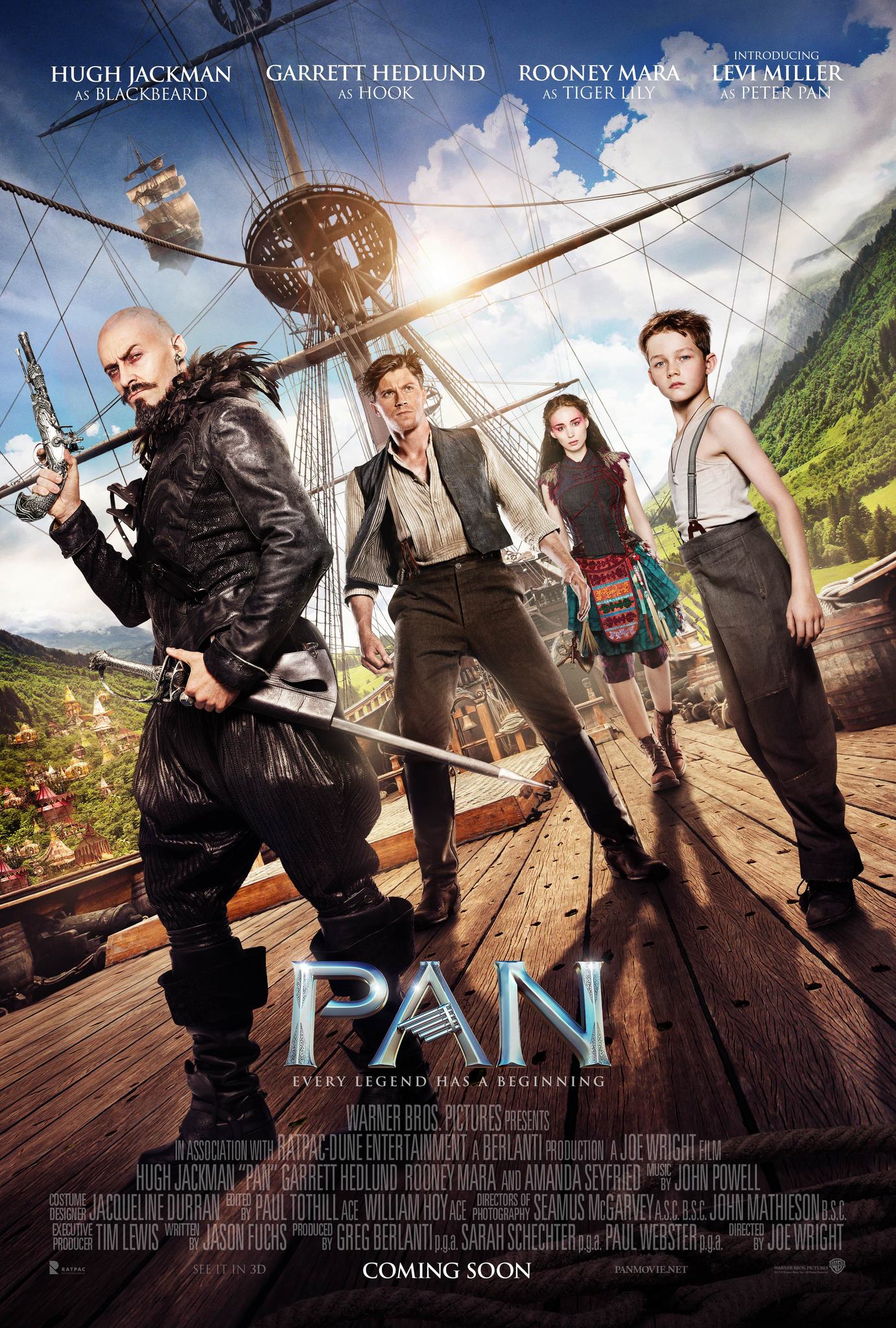
PAN review

Starring: Levi Miller, Hugh Jackman (X-Men: Days of Future Past), Garrett Hedlund (TRON: Legacy), Rooney Mara (The Girl with the Dragon Tattoo), Adeel Akhtar (Four Lions), Cara Delevingne (Paper Towns), Amanda Seyfried (Ted 2)

Director: Joe Wright (Hanna)

Writer: Jason Fuchs (Ice Age: Continental Drift)

Runtime: 1 hour 51 minutes

Release Date: 9 October (US), 16 October (UK)

For someone who’s only existed for a little over a century, Peter Pan is one of those timeless characters that every child knows about. Whether through the original play or the many film adaptations, The Boy Who Wouldn’t Grow Up serves as both a childhood fantasy and a warning about immaturity. Exploring the origins of this character is not a bad idea, and that’s exactly what Pan claims to be doing. Unfortunately, imagination doesn’t seem to be on the filmmakers’ side.

Pan is yet another example of Hollywood taking a classic story and cramming a “chosen one” narrative unnecessarily into it; see also Alice in Wonderland, The Amazing Spider-Man and Teenage Mutant Ninja Turtles. The plot is incredibly generic and predictable from start to finish, following genre tropes to the letter without a trace of irony or self-awareness. In a post-LEGO Movie age, it’s hard to get away with this kind of story without an interesting twist on it, but Pan seems to think that all this tired nonsense about prophecies and mysterious pasts is the twist. The film also fails on the promise of being a Peter Pan origin story as, by film’s end, the characters are far from where they were in at the start of the original story; perhaps they’re betting on making this a franchise. But bland storytelling aside, Pan also suffers from just plain old illogical creative choices. Why is the film set during World War II when the original story was written in 1904? What exactly led to nuns selling orphans to pirates? Why do the pirates sing anachronistic songs like “Smells Like Teen Spirit” and “Blitzkrieg Bop” for no apparent reason? And what is the point of Blackbeard wanting to use pixie dust as a source for immortality when it doesn’t at all factor into the plot beyond one quick scene; couldn’t he have just want it as a power source for his ships or something, and why is he having aging problems when he’s living in a land where nothing ages?! I know we’re using fairy tale logic here, but even with that these choices are just bizarre and don’t mesh at all.

Like the film’s style and tone, the performances in Pan are all over the place. Levi Miller is serviceable as Peter, but he’s written as far too noble and sweet. Peter Pan is supposed to be a mischievous and hedonistic kid but here there’s barely a hint of that, instead leaving us with yet another bland protagonist who’s only special because the plot keeps telling us he is. Hugh Jackman’s Blackbeard is overly theatrical and thinly drawn as a villain, his aforementioned motivations being weak and his presence far too comical to be taken as a serious threat; there are hints of a deeper character here through fleeting references and Jackman’s performance but it never reaches surface level. Rooney Mara’s casting as Tiger Lilly again led to claims of whitewashing, but I criticize the casting not so much for equality reasons (FYI, the Neverland natives are depicted as multicultural, but having a white woman as their princess is still a little off) but just Mara herself in general. Her character only serves the functions of spouting exposition and being a generic badass, and Mara’s performance is little more than saying her lines in a monotone quasi-British accent and smirking occasionally; it really reminded me of Natalie Portman in the Star Wars prequels, and that’s not a good thing. But the real killer in bad casting is Garrett Hedlund as James Hook. He fails to at all sell that this character will one day go on to be Pan’s great nemesis, with Hedlund instead portraying Hook as the aborted love child of Han Solo and Daniel Plainview; whatever dialect he’s attempting to do, it’s not working for him. The only saving grace is Adeel Akhtar as Smee, here portrayed somewhat like a pirate version of Maurice Moss, but his importance to the plot is sidelined by the film’s halfway mark.

Joe Wright has always had a great visual eye whilst not forgetting about story, but here the style not only outweighs the substance but the style itself isn’t that good either. It’s nice to see a film that embraces colour so much in a cinematic world defined by greys and browns, but the amount of saturation on screen can become a bit overpowering. The design aesthetic of the film is a bit imbalanced, with the pirates and natives being gaudily overdesigned whilst characters like Pan and Hook look far blander in comparison. John Powell’s music is suitably majestic and whimsical, but compared to his work on How to Train Your Dragon and Kung Fu Panda it’s practically just background noise. But Pan’s real problem on the technical front is that it relies far too much on CGI. It feels like half the movie was made in the computer and, whilst the effects are passable for the most part, it still clear that almost nothing you’re seeing on screen is actually there. I know this is a fantasy film and Wright could be going for the same Brechtian approach he had to Anna Karenina where he’s actually trying to amplify the artificiality of it, but here it just ends up making the film look shoddy and fake.

When Pan isn’t bombarding you with its bizarre creative decisions, it’s just being a generic fantasy story. It moves briskly and it’s never a pain to watch, but there’s nothing that really stands out about it despite all the weirdness on display. The screenplay is generic, the cast is poorly chosen, and despite his talent Joe Wright was just the wrong choice for this material. There are far superior film versions of Peter Pan out there that better capture the innocence and the essence of that classic tale far better than this, so unless you’re a die-hard Pan fan who has to see everything I suggest you watch one of those instead.

FINAL VERDICT: 5/10

THE WALK review

Starring: Joseph Gordon-Levitt (Looper), Ben Kingsley (Ghandi), Charlotte Le Bon (The Hundred-Foot Journey), James Badge Dale (Iron Man 3)

Director: Robert Zemeckis (Back to the Future)

Writers: Robert Zemeckis & Christopher Browne

Runtime: 2 hours 3 minutes

Release Date: 9 October (US, UK)

Amongst the great filmmakers working today, Robert Zemeckis’ name is one often forgotten. We all remember his films like Back to the Future, Who Framed Roger Rabbit?, Forrest Gump and many others, but despite this he doesn’t quite have the impact a name like Spielberg or Scorcese has. Maybe it’s because his output until recently has been dominated by iffy attempts at motion capture animation, maybe it’s because he doesn’t put his face out there or attach his name to other projects as much, but you cannot at all say it’s because he lacks a distinct voice. The Walk is unmistakably a Robert Zemeckis film in the traditional sense, and it’s a cinematic experience that really embraces the magic of the medium.

Based on the life of high wire artist Philippe Petit and his famous 1974 crossing of the World Trade Center (previously covered in the excellent Oscar-winning documentary Man on Wire), The Walk isn’t what I’d describe as a traditional biopic. Whilst the key events themselves are certainly accurate, Zemeckis chooses to tell the story in a far more fanciful way. This is clear from the opening moments as Petit (Gordon-Levitt) directly talks to the audience and provides running commentary on the whole film. It’s a jarring and bizarre choice at first, but as the film goes on it becomes clear this is all part of Zemeckis’ plan. Much like how Petit treats his art with an enchanting sense of awe, Zemeckis is trying to pull that same trick on the audience and lets the film play more like a fairy tale than a true story. The first two thirds are effective set-up that lets us get to know the characters, and the film’s playfulness means everything moves at an appropriately bouncy speed. But it’s the film’s final third that are the real reason to watch it, with Petit’s walk itself depicted in awe-inspiring fashion that makes the exuberant tone really pay off, and the film’s final line and shot could easily render some to tears. The film isn’t without its problems though. Gordon-Levitt’s narration is still a bit much at points, often feeling less like a narrator and more like a children’s TV presenter, and the film constantly feels the need to explain why the characters are speaking in English rather than French, but the film’s overall effect is hard to deny once all is said and done.

Though his French accent is perhaps a little off-putting, Joseph Gordon-Levitt’s actual performance as Philippe Petit is spot-on. He captures that child-like enthusiasm and determination Petit has, but also the arrogance and frustration that make him human. He has his moments that make you doubt his sanity, but his undeniable charm always pulls you through and he ultimately makes the character work accent and all. Ben Kingsley does feel like he’s just taking another opportunity to try out silly voice as Papa Rudy, but in his few scenes with Gordon-Levitt there’s a strong bond and chemistry between these two generations of high wire performers. Charlotte Le Bon’s pleasant performance as Annie is more than welcome, but how her relationship with Petit concludes feels a little bit like an afterthought; it may be true to life, but that doesn’t stop it from being unsatisfying. The rest of Petit’s group is an interesting mix, with James Badge Dale’s Franco-Yankee J.P. being an amusing distraction and Cesar Domboy’s Jeff adding some much needed tension and dramatic arc to the final act. Benedict Samuel’s David is a stoner stereotype that feels superfluous to the plot and Ben Schwartz’s Albert is essentially there just to naysay, but their presence in the film is ultimately negligible. The movie belongs to Zemeckis and Gordon-Levitt, and what they have to offer is more than satisfactory.

Zemeckis has always had a great visual eye and one of the few directors that embraces modern film technology in the right way (creepy motion capture films aside). That innocent sense of wonder the story has permeates everything on the technical side too, from Darius Wolski’s breathtaking cinematography to Alan Silvestri’s uplifting score that mixes French jazz with traditional orchestra feels. The visual effects are also staggering, recreating the World Trade Center and placing you with Petit on the wire in a completely seamless way. The Walk is also one of the few films since the resurgence of 3D that really warrants the format, especially during that final act; whether you have vertigo or not, it’s hard not to feel daunted by the sheer sense of height when all three dimensions are in play.

The Walk is the first film that’s made me feel like a child in a long time without appealing to nostalgia in any way, and that’s mainly down to the wonderfully exuberant way Robert Zemeckis decides to tell this story. It’s an approach no other sane filmmaker would make, but Zemeckis has the skill to make it work and it’s a gamble that pays off wonderfully in execution. The two thirds are well made and interesting enough on their own, but that climax easily ranks amongst the cinematic highlights of this year so far. Go see The Walk in a theatre, shell out for the full IMAX 3D experience if you can, and enjoy a movie that takes full advantage of everything cinema has to offer.

FINAL VERDICT: 9/10

MACBETH review

Starring: Michael Fassbender (X-Men: Days of Future Past), Marion Cotillard (Inception), Paddy Considine (The World’s End), Sean Harris (Mission: Impossible – Rogue Nation), Jack Reynor (Transformers: Age of Extinction), Elizabeth Debicki (The Man from U.N.C.L.E.), David Thewlis (The Theory of Everything)

Director: Justin Kurzel (Snowtown)

Writers: Todd Louiso & Jacob Koskoff (The Mark Pease Experience) and Michael Lesslie

Runtime: 1 hour 53 minutes

Release Date: 2 October (UK), 4 December (US)

Adapting Shakespeare to the big screen is a task nearly as old as cinema itself, and the results vary wildly between eras, interpretations and overall quality. The problem I have with most adaptations is that they don’t take advantage of the medium of film; they’re basically just elaborate stage productions with bigger stars and more money. Justin Kurzel’s vision of Macbeth certainly makes a bold attempt of truly turning the play into a film, but growing pains from the medium transition can still be felt in key areas.

The most surprising thing about this version of Macbeth is that it’s at its best when it just throws out Shakespeare’s script. It covers all the important beats of the story and his words are very much present in the film, but there are a lot of scenes that play completely without dialogue and these parts work exceptionally well. This is most impactful in the film’s first act, where Macbeth’s (Fassbender) first meeting with the Wyrd Sisters is mostly carried through the sisters’ haunting demeanour and Macbeth’s reactions. Kurzel’s direction and visual style tell the story more than fluently on its own, so it’s actually a bit jarring when, after a long period of silence, everyone starts breaking into sonnets. I know it’s almost blasphemous to say, but the film may have worked better if they stripped the script even more and just kept the vital dialogue, letting the film’s rich atmosphere carry the film instead. Shakespeare’s writing style is often difficult to transfer from stage to screen given the different requirements of each format, but even though Macbeth is less reverent to text than some it still could have afforded to cut more.

A lot of Shakespeare adaptations also fall flat due to poor performances from actors who recite Shakespeare’s words like they’re reading a foreign language. Macbeth never has that problem, featuring a fantastic cast led by Michael Fassbender and Marion Cotillard. Fassbender, the fourth major X-Men cast member to take up the role, plays Macbeth in a subdued but powerful manner. He effectively plays a man driven by power and supposed destiny, driven to insanity by his paranoia and ruthless against anyone suspicious of him; his rendition of the “tomorrow and tomorrow and tomorrow” soliloquy is especially well handled. Marion Cotillard finally drops the French accent for her role as Lady Macbeth and, whilst it does feel her importance has been stripped down a bit from the original text, she still delivers a rich and powerful performance especially in her final moments. Sean Harris is also excellent as Macduff, particularly towards the end as he seeks retribution against Macbeth for his crimes. However, the abundance of dialogue again somewhat works against the actors. Their physical performances deliver so much on their own that there’s often no need for words to express themselves. It doesn’t at all take away from the performances, but lessening the dialogue perhaps could have added to them.

Even with the great performances, Kurzel remains the real star of Macbeth. He truly understands this is a film, not a play, and takes full advantage of the medium with some impressive visuals. The camera work is simple but the lighting and use of colour is excellent, and having real sets and elaborate period costumes really envelops you in the setting. The action sequences are brief and scattered, but they too have a lot of beauty to them. Looking somewhat like an arthouse production of 300 (ironic, considering Fassbender is in both) with its use of slow motion and unnatural colour grading, they highlight the violence and emotion of these fights far better than any words can.

Macbeth is a beautifully made and fantastically performed film that embraces the cinema format, but the leftovers from its original form seem somewhat jarring in the transition. There’s no denying the power of Shakespeare’s words, but they are words designed to be recited on a stage, and I don’t think any disrespect would have been done to trim the dialogue down to a bare minimum; it would be experimental and controversial, but people have done far worse with The Bard’s texts. If nothing else, Macbeth is solid confirmation that Kurzel, Fassbender and Cotillard are going to at least attempt something special with their adaptation of Assassin’s Creed next winter.

FINAL VERDICT: 8/10


FINAL VERDICT: 8/10

THE MARTIAN review

Starring: Matt Damon (The Bourne Ultimatum), Jessica Chastain (Interstellar), Jeff Daniels (Looper), Chiwetel Eijiofor (12 Years a Slave), Kristen Wiig (Bridesmaids), Sean Bean (Game of Thrones), Kate Mara (House of Cards), Michael Pena (Ant-Man), Sebastian Stan (Captain America: The Winter Soldier), Askel Hennie (Headhunters), Donald Glover (Community), Benedict Wong (Prometheus), Mackenzie Davis (Halt and Catch Fire)

Director: Ridley Scott (Blade Runner)

Writer: Drew Goddard (The Cabin in the Woods)

Runtime: 2 hours 21 minutes

Release Date: 30 September (UK), 2 October (US)

At some point in all our childhoods, we wanted to be an astronaut. I think there’s just something about it that attracts our young minds’ thirst for adventure and discovery. But quite quickly, most of us realise how difficult and potentially dangerous the job is and we move on to more achievable goals. The Martian is a film about an astronaut put in the most difficult of situations and powers on against all probability, and it serves as a powerful message about perseverance and fortitude in the face of depressing odds. It also proves that maths can solve anything and that listening to nothing but ABBA for four years has its toll on your soul.

The Martian wastes no time on set-up and throws the audience straight into the meat of the story. It’s a slightly jarring experience at first, but the film does a great job of getting you up to speed on the fly and it saves on a lot of potentially pointless exposition. What then follows is one of the most brisk and deliberately paced films with a two-hour plus runtime I’ve ever seen. It achieves that perfect balance of filling the movie with a lot of fun details and humorous asides, but not a single piece of the film feels pointless. It’s the very definition of efficient storytelling, and Drew Goddard’s screenplay does a wonderful job of making all the science jargon light and digestible. The film also balances its various tones excellently, taking the situation seriously when required but always making sure to constantly inject fun and wit. This playful attitude is ultimately what makes the story far more relatable and touching than films like, say, 2001 or Interstellar. Instead of trying to show off how smart it is and confuse you, it presents itself as approachable and welcomes you to its concepts, creating for one of the most human hard sci-fi films since Moon. It’s also a welcome departure from the norm for Ridley Scott, who’s dour over-seriousness has made his last few pictures a bore; I had practically given up on the man after travesties like The Counsellor and Exodus: Gods and Kings, but this proves he may still have some creativity left in him.

Matt Damon is shouldered with holding most of the movie on his own, and he does a superb job of it. His performance as Mark Watney is savvy and clever, but he also hits all of the emotional beats with just the right amount of solemnity and delivers a truly moving performance; it certainly ranks amongst his best work. One of Ridley Scott’s other problems with his recent films is that he hires loads of great acting talent and then wastes them in barren roles. Whilst The Martian certainly remains Damon’s movie, the supporting cast is uniformly great and, whilst we don’t get to know most of them in detail, everyone is given just enough room to breath. Just to name a few, Jeff Daniels is one of the major standouts as a character that would usually be the de facto villain in a lesser movie, but by playing it as a reluctant realist rather than a pessimistic cad we remain sympathetic to his point-of-view. Sean Bean is excellent in his first meaty role in a long time where he feels important and doesn’t die, and it’s also great to see Kristen Wiig make a transition into more serious fare (though I couldn’t help but feel she was basically playing a more grounded version of her character from Knocked Up). Special mention must also go to Donald Glover for his small but pivotal and hilarious role; for Community fans like myself, it’s basically like watching Troy pretend to be Abed.

Even though Scott’s recent films have been lacklustre he’s never lost his knack for technical excellence, and with The Martian as evidence he clearly still has it. The film is gloriously shot by Darius Wolski with grand landscape shots of Mars, and the fusion between practical and CG effects is on par with Gravity in terms of photorealism. The production design balances that fine line between realistic and cool, whilst the music features both a haunting but triumphant score from Harry Gregson-Williams and a strong selection of disco classics to get on Damon’s nerves. My only real problem with the film is how it uses on-screen cards to introduce most of its characters; not only is this a big pet peeve of mine, here it feels wholly unnecessary as the script and direction make it very clear who everyone is and what their role is without the need for cards.

The Martian is a pleasant and heartwarming surprise as both a science-fiction film and a Ridley Scott film; it’s easily his best work in at least a decade. It’s rare to see a film of this ilk that has such an affinity for both realism and fun, proving that making a human story lies on filling it with all emotions rather treating everything with a removed sense of seriousness. It’s this emotional core that makes it a film that will work for all audiences, even if you have little interest in sci-fi, and I highly recommend you do venture out an experience it for yourself.

FINAL VERDICT: 9.5/10


FINAL VERDICT: 9.5/10

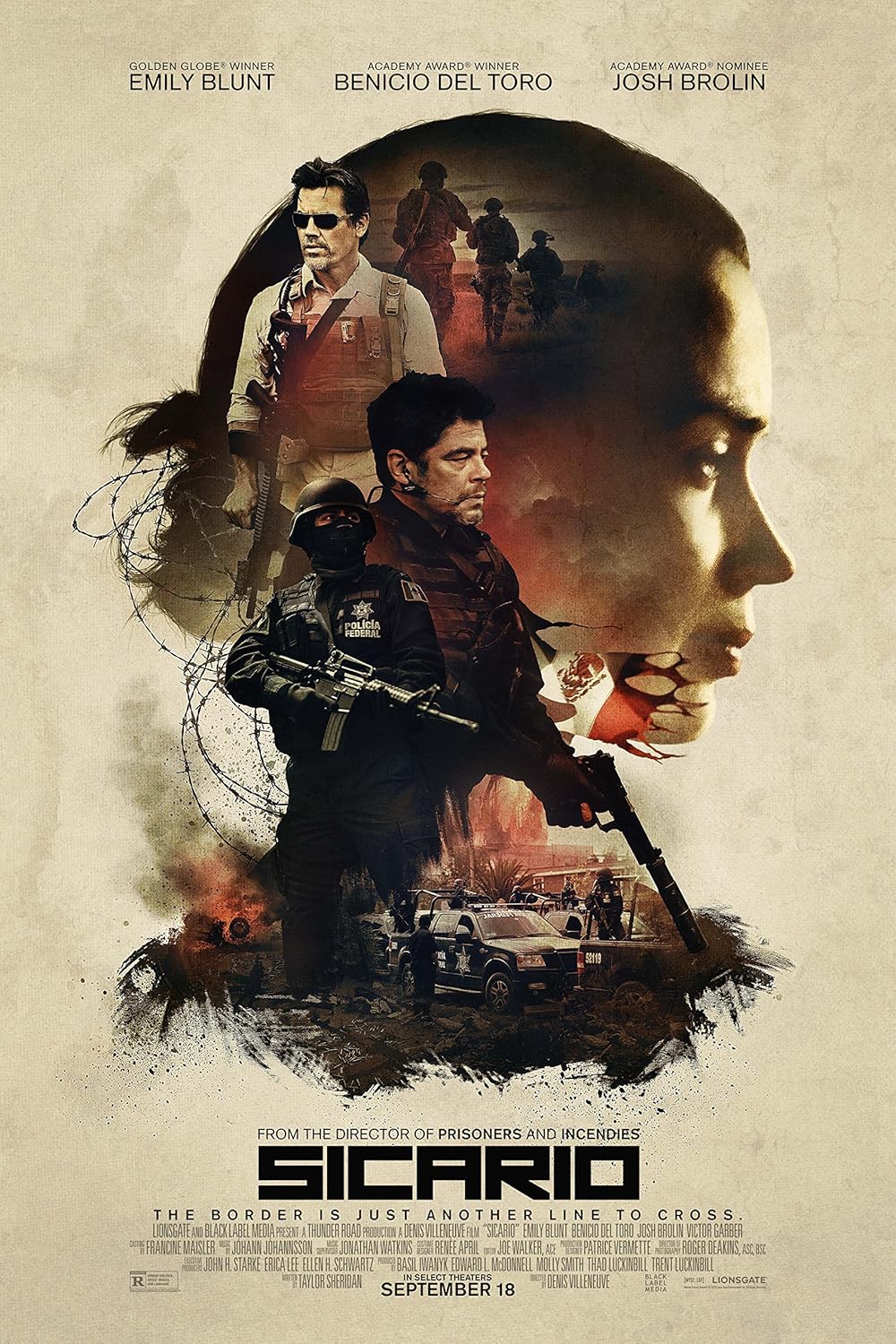
SICARIO review

Starring: Emily Blunt (Edge of Tomorrow), Benicio Del Toro (Guardians of the Galaxy), Josh Brolin (No Country for Old Men), Victor Garber (Titanic), Daniel Kaluuya (Kick-Ass 2), Jon Bernthal (Fury)

Director: Denis Villeneuve (Prisoners)

Writer: Taylor Sheridan

Runtime: 2 hours 1 minute

Release Date: 18 September (US), 8 October (UK)

I’m not usually into films on the dark side, but Denis Villeneuve knows how to hit that spot just right for me. His films, such as Prisoners and Enemy, delve into some pretty nasty subjects and have very pessimistic views of the world, but they never go far enough to become depressing or uncomfortable. Sicario follows this trend and, whilst not Villeneuve’s best work, it’s still a fantastic piece of cinema that you should definitely check out.

Sicario doesn’t spoon feed you its plot, leaving a lot of scenes out of context and generally keeping the audience in the same state-of-mind as protagonist Kate Macer (Blunt). It does have the side effect of making the story a little hard to follow in the first two acts, but as revelations are made the various bits and pieces fit together to create a strong whole in retrospect. But plot isn’t Sicario’s main focus anyway; it’s all about character and environment. The film’s pacing and suspense is excellently tuned, slowly ramping up tension and anxiety before exploding into brief bursts of violent action. A lot of this is thanks to the sparse dialogue, letting the visuals and sound effects carry the suspense, but when the talking does start the writing is surprisingly witty and biting; there are plenty of laughs to be had, but most of them will be nervous ones. Sicario has a very bleak outlook on justice, essentially being a story about warring corruption on both sides of the law, but it thankfully never beats you over the head with it. It’s a very morally grey film with no real winners or losers, but despite this it remains a satisfying and deeply rewarding watch. Just don’t go in expecting to have a lot of fun.

Villeneuve really knows how to get the best out of his actors, and here he’s assembled a quality cast to work with, especially the three leads. Emily Blunt further demonstrates her incredible range as the by-the-book agent Kate, remaining a tough and capable character but not one who’s averse to looking scared or intimidated. Blunt gets across a lot with very little dialogue, letting her expressive face do most of the work, and it’s a performance that ranks among with her best. Josh Brolin’s Matt is certainly a welcome presence, mixing laid-back jokiness and stern brutality to create a character that can shift from friendly to threatening without so much as blinking; he’s almost like “what if The Dude was a government dick?” But it’s Benicio Del Toro’s Alejandro who’s the really eye-catching character. Essentially taking over the movie for a good chunk of the third act, Del Toro’s raspy voice and cold demeanour help create a character who is threatening in mere presence without being cartoonish; you know he’s up to something, you just don’t quite know what. His relationship with Blunt is interesting and layered, with neither ever fully trusting the other, and their final scene together is so simple but done to perfection.

Sicario is one of the most gorgeously grimy films I’ve ever seen, and that’s mainly thanks to the cinematography of the great Roger Deakins. The film’s settings of US border states and Mexico are dirty and barren, but Deakins shoots the film in such a way to somehow make it look appealing. The aerial photography is especially good, with impressive shots of landscapes made to seem haunting, and the film also manages to accomplish the task of shooting an action sequence mostly in night vision and not make it look incomprehensible. Johan Johanssen’s chilling score is also thoroughly excellent, further adding to the film’s palpable tension, as well as some effectively brutal sound design.

Like Villeneuve’s other works, Sicario is not a fun time at the movies but it is an engaging one. It’s a thoroughly rough experience, but never so much that it becomes melancholic, and its brutal impact and style makes the anxiety-ridden ride more than worth it. It’s a must watch for Blunt and Del Toro’s performances alone, but Villeneuve’s sure-handed direction ultimately makes him the real star of the show and I can’t wait to see what he can do with a property like Blade Runner as his project after next.

FINAL VERDICT: 9/10


FINAL VERDICT: 9/10

EVEREST review

Starring: Jason Clarke (Zero Dark Thirty), Josh Brolin (No Country for Old Men), John Hawkes (The Sessions), Emily Watson (War Horse), Keira Knightley (The Imitation Game), Michael Kelly (Chronicle), Elizabeth Debicki (The Man from U.N.C.L.E.), Robin Wright (House of Cards), Sam Worthington (Avatar), Jake Gyllenhaal (Nightcrawler)

Director: Baltasar Kormakur (2 Guns)

Writers: William Nicholson (Gladiator) and Simon Beaufoy (Slumdog Millionaire)

Runtime: 2 hours 1 minute

Release Date: 18 September (US, UK)

For all the disaster movies that Hollywood churns out, rarely do we get one based on a real event; for every The Impossible, there’s about a dozen of 2012 or San Andreas. Everest is that rare exception, depicting the events of the 1996 Mount Everest disaster that claimed the lives of 12 people; the highest death record in an Everest climbing season until very recently. On paper it sounds like a story worthy of cinematic depiction, and whilst Everest is certainly a visual treat worth seeing on the big screen, it’s not going to be remembered as a classic of the genre.

The highlight of any disaster film is the event itself, but the build-up is just as if not more important. However, Everest perhaps takes too much time getting to the point, as the film is already halfway done before sh*t starts to hit the fan. The first half is mainly spent on character, but there’s so many of them that only a few get defined personalities, and even then their traits and goals are quite simple. As a result, a good chunk of the film is just spent watching these people climb up a mountain and just waiting for things to go wrong; there are a few difficulties on the way up, but nothing truly jeopardising. Luckily, things pick up considerably once the storm hits and then the film’s tension couldn’t be any tighter. This portion of the film is especially well directed, as it never feels the need to oversell the drama and lets the action convey the tragedy. It’s some intense nail-biting stuff, and the emotion of the situation thankfully makes up for the previous lack of character investment. But then just as the film hits peak magnitude, it then decides to call it quits. It’s not a sudden or unsatisfying ending, but pacing-wise it felt like it missed a beat. Everest overall feels uneven, and perhaps tightening up the ascent and focusing more on the actual tragedy would have made the narrative flow better.

Everest is jam-packed with stars and, though they fight for space a lot, everyone puts their all into it. Jason Clarke is a strong actor who’s gotten very few chances to lead, and here in the role of Rob Hall he proves he is more than capable of doing so. Though Hall is mainly motivated purely by enthusiasm, that passion makes him a likable figure and when things go awry Clarke really sells the pain and desperation of the situation. John Brolin is also excellent in his role as the absent-minded but stubborn Beck, and the ever-underappreciated John Hawkes delivers another stellar performance as the recklessly determined Doug. Keira Knightley sits out the action as Hall’s wife Jan but she still manages to hold a lot of the event’s drama single-handedly over the phone; her conversations with Clarke are a big emotional bright spot. Everyone else does fine jobs, but there are just too many characters and not enough time. With respect to the real people, it definitely couldn’t have hurt to mash a few characters together to alleviate the numbers; for example, Emily Watson and Elizabeh Debicki are both great in their parts, but there’s no real reason they need to be two separate people. Jake Gyllenhaal is great as always, but his rivalry with Clarke feels undercooked and he ultimately doesn’t play too much into the main drama, whilst Sam Worthington spends half his time in what might as well be a completely different movie before finally showing up to help and then not doing anything particularly noteworthy.

If nothing else, Everest is a beautiful film to look at. Salvatore Totino’s cinematography captures beautiful landscapes of Himalayas but also uses the camerawork to heighten the tension; any shot that shows off scale or a steep drop really makes the danger clear, especially in IMAX. The effort gone into practically shooting this as much as possible is extremely admirable and adds to the authenticity, but occasionally it’s noticeable when they’re on a soundstage rather than the side of a mountain. Dario Marianelli’s score is suitably epic, reminiscent of the scores of the late James Horner, but the real auditory joy is the film’s sound design. The noises of wind, crumbling snow and avalanches is just as engrossing as the visuals, and the film knows when to cut the music and let that atmosphere carry the drama.

Everest is an engrossing cinema experience when it focuses on the intensity and drama of this real-life disaster, but its ultimate downfall is its unmanageable scope. The story spends too much time on getting up the mountain that it cuts into the better part of the film before politely but abruptly ending; it’s like a friend who’s taken way too long telling the unnecessary details of a story, and then wraps it up once he’s realised he’s out of time. If you want to see it, definitely see it whilst it’s still in theatres; similar to Gravity, it probably just won’t play as well at home.

FINAL VERDICT: 7/10