SONIC THE HEDGEHOG – an Alternative Lens review

Starring: Ben Schwartz (Parks and Recreation), James Marsden (Enchanted), Jim Carrey (The Mask), Tika Sumpter (Ride Along), Adam Pally (Iron Man 3), Neal McDonough (Captain America: The First Avenger)

Director: Jeff Fowler (Gopher Broke)

Writers: Patrick Casey & Josh Miller (Transylmania)

Runtime: 1 hour 39 minutes

Release Date: 14th February (US, UK)

Sonic the Hedgehog may be an icon of the video game world so ubiquitous that he’s familiar to even those who don’t play video games, but regardless he is an odd choice to get the movie treatment. He may have a fervent fanbase and a huge library of games, but story and character have never been the strong suit of the franchise no matter how many DeviantArt forums will tell you otherwise. Given those circumstances, seeing the character shoved into a well-worn family movie formula is ultimately not too surprising. What is surprising is how much Sonic the Hedgehog actually works as a movie despite its more unimaginative elements.
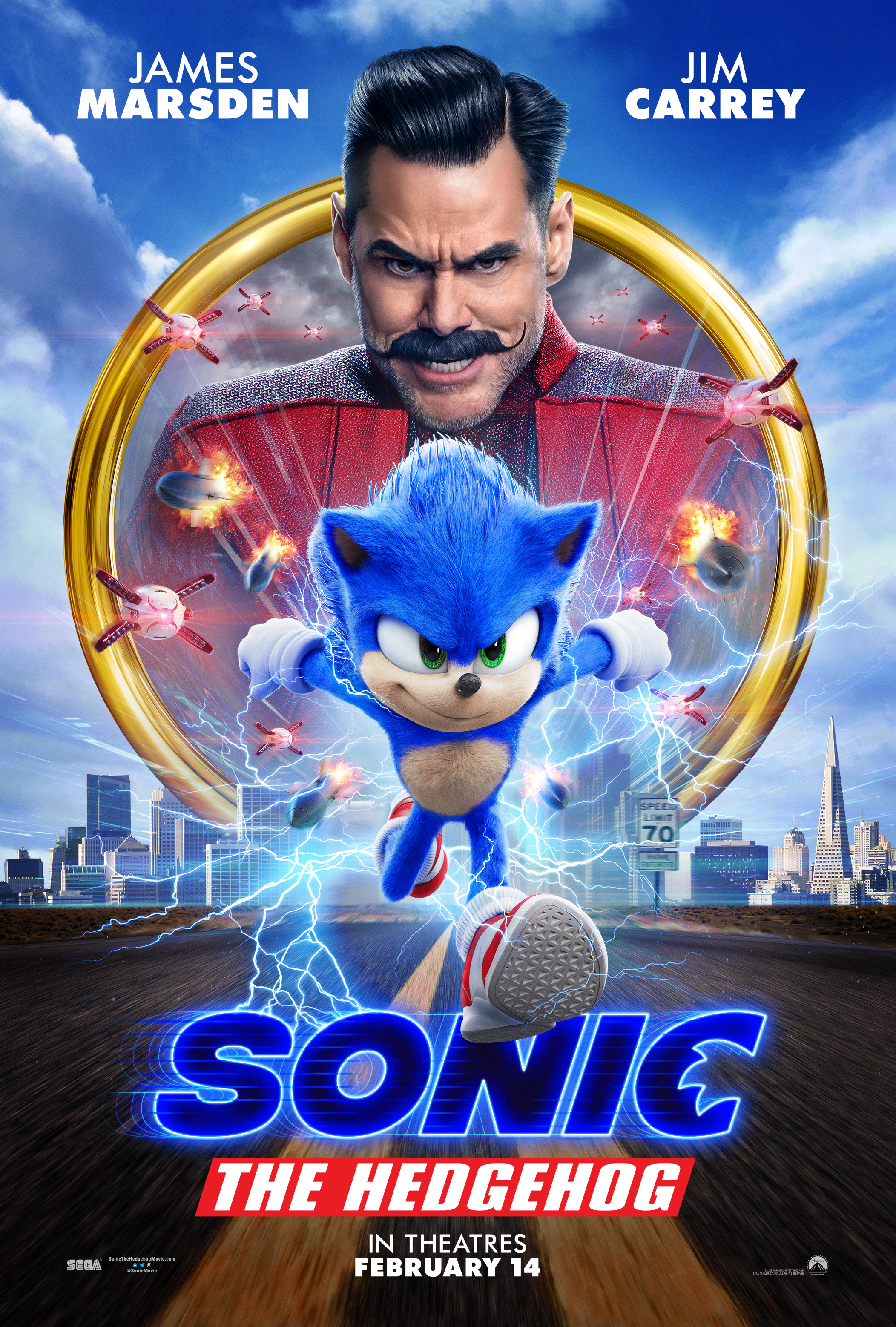
The plot of Sonic is certainly amongst its weaker qualities. It lacks originality and relies heavily on tropes to the point that every development is predictable from a mile away. The film does seem aware of this and attempts to lampshade this by cutting to the chase, but regardless it’s all very workmanlike; nothing is particularly done badly, but none of it stands out either. Whilst no film with this tone and audience needs to be longer than 100 minutes, the story does feel quite rushed and unfinished at points, as if various different drafts were mashed together or chunks were lost in editing. For example, the entire subplot surrounding Tom’s fugitive status is feels tacked-on and barely impacts the narrative, whilst the prologue backstory for Sonic feels like it came from a completely different movie. With all that said, the movie manages to function purely thanks to its enthusiasm, humour and heart. Though it’s all tame and family-friendly, there are a fair few decent gags from the likes of both Sonic and Robotnik, and it generally avoids relying on potty humour or tired pop culture references. More surprisingly, though occasionally trite, the film does mine some pathos out of its themes of overcoming isolation and discovering where you belong. None of it is particularly revolutionary, but there is at least some effort on an emotional level to make this more than just an exercise in brand management.

Though many of the specifics have drastically changed and evolved over the years, Sonic as a character has always been defined by his cheeky demeanour and 90s-brand attitude. In terms of translating that into a three-dimensional character, Ben Schwartz has done a commendable job of making Sonic likable and even relatable. He imbues him with an infectious child-like wonder and a self-deprecating sense of humour that’s quickly endearing, but he also finds some depth in his feelings of desperation and loneliness and how that drives his erratic personality. The material is somewhat limited, but Schwartz consistently finds ways to embellish the base material and keeps the movie lively when the plot feels like coasting.

James Marsden feels a tad typecast playing small-town sheriff Tom and never quite embraces the ridiculousness of the premise, but he is nothing but consistent in his performance and has a decent repartee with Schwartz. Tika Sumpter feels a tad tacked on as Tom’s wife Maddie, but her chemistry with Marsden is strong and their relationship has some interesting kinks to it that avoid making it a cookie-cutter dynamic, whilst both Adam Pally and Neal McDonough are saddled with one-note side characters that don’t really demand actors of even their stature. However, Jim Carrey ultimately steals the show as Dr. Robotnik. Though a bit of a far cry from his video game counterpart, Carrey does embrace the cartoony nature of the character and delivers an unhinged and thoroughly entertaining performance. Much like Schwartz, he manages to elevate the ho-hum material handed to him and adds some intricacy to Robotnik’s motivations, characterising him a crazed narcissist with a single-minded obsession to prove himself better. It’s easily Carrey’s best strictly comedic performance in over a decade, and easily the most appealing element of the film to those not already heavily invested in the Sonic franchise.

Image result for sonic the hedgehog 2020 robotnik

Much of the pre-release chatter about the film was Sonic’s drastic redesign during post-production, which saw the Blue Blur turned from a cartoon hedgehog to an unappealingly lanky Dr. Moreau creature to a happier medium between classic and realistic. Though perhaps not quite as impressive as the character designs in Pokémon: Detective Pikachu, Sonic himself ultimately looks like his iconic self and translates surprisingly well into 3-D space. The visual effects are suitably cartoony without feeling totally unreal, adapting concepts from the games into live-action with surprising adeptness and verisimilitude. The film’s action sequences are disappointingly brief and intermittent, but they’re all executed with good humour and craft. There are some clear cues taken from the Quicksilver sequences in the recent X-Men films, but they’re still a blast to watch and incorporate many of Sonic’s classic moves into the action. Tom Holkenborg’s score is effective if a tad forgettable save for some clever references to music cues from the games, whilst Wiz Khalifa’s tie-in song “Speed Me Up” is honestly a pretty decent track with a catchy and energetic beat; it’s no “Escape from the City”, but it is good workout playlist material.

Sonic the Hedgehog is a pretty by-the-numbers kids’ movie that does the bare minimum in some essential areas, but there are clearly enough people working behind the scenes trying their best to elevate it. It’s a flawed but endearing film with a naïve energy and wry self-awareness, occasionally hitting sparks of genius in the midst of its humdrum narrative. It’ll certainly appeal to Sonic fans with its appealing character design and numerous Easter eggs (if you are a fan, do stay through the credits!), but it’s harmless and appealing enough that a more general audience will find something to like too. There’s a decent backbone here to build a franchise out of, but if they proceed the filmmakers need to embrace the idiosyncrasies of the property. Now the foundations are in place, there’s no need to play it safe with a formulaic plot. Bring in more of the classic Sonic elements and embrace the ridiculousness more. If the sequel to Sonic the Hedgehog can at least be as unapologetically dumb fun as Teenage Mutant Ninja Turtles: Out of the Shadows or the 2017 Power Rangers movie, then I’m all for further adventures with this chilli dog-loving fiend. 

FINAL VERDICT: 6/10

BIRDS OF PREY (AND THE FANTABULOUS EMANCIPATION OF ONE HARLEY QUINN) – an Alternative Lens review

Starring: Margot Robbie (The Wolf of Wall Street), Mary Elizabeth Winstead (Scott Pilgrim vs The World), Jurnee Smollett-Bell (Underground), Rosie Perez (Do The Right Thing), Chris Messina (Ruby Sparks), Ella Jay Basco, Ali Wong (Always Be My Maybe), Ewan McGregor (Doctor Sleep)

Director: Cathy Yan (Dead Pigs)

Writer: Christina Hodson (Bumblebee)

Runtime: 1 hour 49 minutes

Release Date: 7th February (US, UK)

Speaking personally for just a moment, there are several reviews I’ve written in the past that I wholeheartedly disagree with now, and none more so than my original thoughts on Suicide Squad. If you can believe it, I gave the film a 7.5 at the time of release, and on subsequent attempts to watch it, I’ve found it is…nowhere near worthy of that score. To be fair, I saw the movie at a secret advance screening that began at 1am, so…yeah, perhaps my mind wasn’t in the best place and I mistook that film’s horrendous editing for me just being tired. Heck, I even favourably compared it to Fight Club, which…no. Just no. Yeah, past me was kinda dumb sometimes.

That being said, Suicide Squad did have many redeeming qualities, one of which being Margot Robbie’s fantastic performance as Harley Quinn. Even as many audiences disregarded the film itself, the desire for more from The Joker’s ditzy partner-in-crime was immense, and it seems Robbie herself was quick to pick up on what fans were really looking for. So now we have Birds of Prey (and the Fantabulous Emancipation of One Harley Quinn), which partners Ms Quinn with several other badass ladies from the DC Universe for a zany crime caper packed with blood and laughs. In short, it delivers on everything Suicide Squad failed to and so much more.

Mega Sized Movie Poster Image for Birds of Prey (And the Fantabulous Emancipation of One Harley Quinn) (#15 of 18)

Birds of Prey is a movie told from Harley Quinn’s perspective not only on a plot level but a tonal and thematic one too. Telling its story with frequent voice-over, fourth-wall-breaking, fractured timelines and fantasy sequences, there is a frantic and larger-than-life energy to the entire production that simply exudes fun. The plot itself is a fairly simple “everyone wants to find character and/or MacGuffin for different reasons, so protagonist goes on the run to protect character and/or MacGuffin” kind of deal, but it is told with enough flair and idiosyncratic characters that it’s hard to care.

Even though the non-linear structure occasionally ruptures the film’s flow a little too much, its vigour and charm never cease to keep up, and come the third act it all explodes into a satisfyingly joyous girl gang frenzy. The aim of the game here is clearly unbridled entertainment, but there is some added depth to the madness with its themes of breaking free from toxicity and patriarchy and learning to embrace individuality and sisterhood. Superhero movies like Wonder Woman and Captain Marvel may have already delivered strong feminist messages in their stories, but Birds of Prey allows those themes to burst out with anarchic pop-punk relish. It’s not afraid to allow its women to be dirty or foul-mouthed or anything else atypically feminine, and that rebellious spirit is alone worth celebrating for a major studio blockbuster.

Image result for birds of prey stills

Whilst Robbie’s Harley Quinn has been worthily lauded, one of the issues viewers of Suicide Squad and fans of the character over the years have noted is the problematic nature of her relationship with The Joker. Her devotion and dependency on the villain may be an important part of her warped psyche, but unfortunately it also reinforces and makes light of the horrid toxicity of real-life abusive relationships. Birds of Prey handles this issue with tact, building the story and Harley’s arc around her not only getting over The Joker but finding herself again as an independent woman. This allows Robbie to bring some much-needed nuance to the character whilst still being able to embrace her manic and cathartic personality, and she’s clearly having an absolute blast throughout.

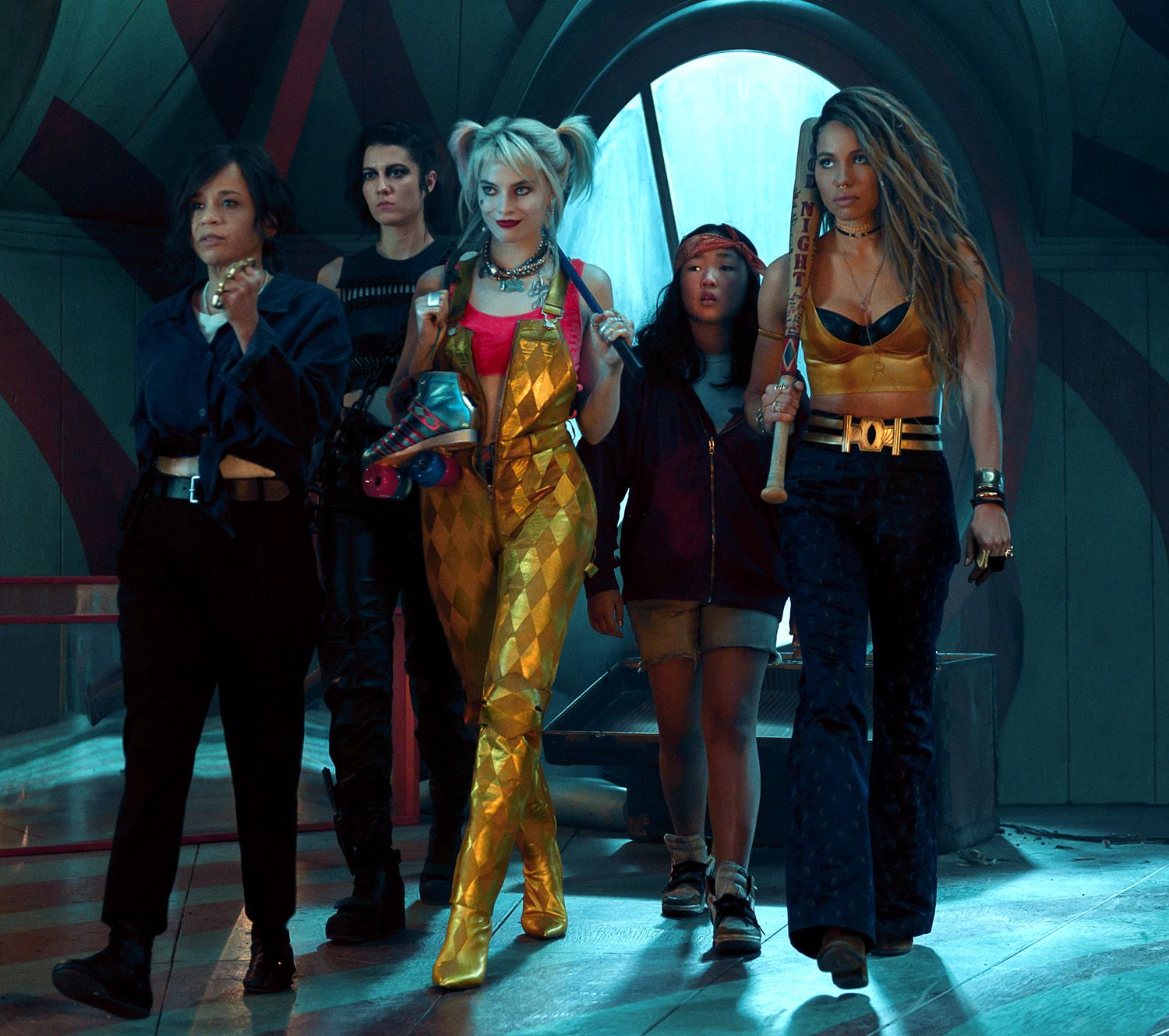
Though this is very much Robbie’s movie, and its biggest flaw is that she ultimately eats up much of the screen time of the actual Birds of Prey to their detriment, the rest of the cast all deliver wildly rapturous and compelling performances. Jurnee Smollett-Bell is a revelation as Black Canary, imbuing the character with a streetsmart attitude and moral code that sets her apart from previous incarnations of the character whilst still unequivocally being Dinah Lance. Though she mostly takes a back seat until towards the third act, Mary Elizabeth Winstead’s Huntress is fascinating being equally stone-cold and endearingly awkward; her social inexperience and one-track mindset make her a gold mine of possibilities for future films. Rosie Perez is finally given her blockbuster due as the abrasive yet gold-hearted Renee Montoya, whilst Ella Hay Basco is delightfully cheeky as Cassandra Cain. Ewan McGregor eats up the scenery and spits it out as the viciously camp crime boss Black Mask, and is ably supported by Chris Messina’s quietly psychotic turn as Victor Zsasz.

Though Suicide Squad’s aesthetic and technical qualities ended up being a garish mess, there were solid ideas at its core that simply got lost or out of control. Birds of Prey fixes up these ideas to deliver a more streamlined yet equally madcap experience. The film is awash in the loud fog and neon of a graphic novel, bolstered by Matthew Libatique’s fantastically flowing cinematography. The whole movie is bursting with punk, femme and queer inspirations, particularly in the film’s gorgeous costume design packed with awesome outfits sure to inspire many cosplays. The action sequences are a bone-crunching delight, packed with superb choreography and ingenious set-pieces with a clear Jackie Chan influence; it should be no surprise that John Wick maestro Chad Stahelski did some second unit punch-up on this. Further bolstering the film’s girl gang ferocity is its soundtrack, packed full of contemporary rap and pop and tuned-up covers of classics, all from female artists. Complimenting Daniel Pemberton’s score, these tracks are intelligently sprinkled throughout and none of them suffer from being obvious needle drops like Suicide Squad’s fevered playlist.

Birds of Prey is a divine blend of superheroics and chaotic catharsis, perfectly embodying Harley’s titular emancipation from not only The Joker but the past sins of the DCEU. From beginning to end, it bursts at the seams with uninhibited enthusiasm and sass, reinforced by a game cast all clearly having so much fun and filmmaking unafraid to be gaudy and unapologetically feminine. As the blockbuster debut of director Cathy Yan, her voice manages to shine throughout and only further emboldens DC’s new approach to making their films individually distinct rather than Marvel’s uniform policy. Even removed from its comic book roots, this is a bold and unique action-comedy that has plenty of potential outside of the typical superhero audience, and hopefully this isn’t the last time we see the Birds of Prey in action. As for Harley Quinn, we only have eighteen months to wait before she we see her return to her old squad. I hear they’re being given quite the makeover… 

FINAL VERDICT: 8.5/10

BAD BOYS FOR LIFE – an Alternative Lens review

Starring: Will Smith (Suicide Squad), Martin Lawrence (Big Momma’s House), Vanessa Hudgens (High School Musical), Alexander Ludwig (The Hunger Games), Charles Melton (Riverdale), Paola Núñez (Dariela los martes), Kate del Castillo (The 33), Joe Pantoliano (The Matrix)

Directors: Adil El Arbi & Bilall Fallah (Black)

Writers: Chris Bremner and Peter Craig (The Town) and Joe Carnahan (The Grey)

Runtime: 2 hours 4 minutes

Release Date: 17th January (US, UK)

Amongst the sea of buddy cop action-comedies, the Bad Boys films certainly have their place in history. It was (and unfortunately still is) uncommon to see a big Hollywood action film with two black leads, and the first film was one of several that helped shoot Will Smith from sitcom star to movie legend. However, much of those films’ legacy lies at the feet of one man: Michael Bay. Bad Boys was his feature directorial debut, and its 2002 sequel in particular ended up defining Bay’s aesthetic for years: loud, gaudy, over-the-top and borderline offensive. The Bad Boys films were never particularly good movies, but they had an entertaining appeal that was distinctively Michael Bay’s. So what do you get when you make a Bad Boys movie without the Bayhem? Well, it’s funny that you should ask…

Picking up in real time from the events of the second film, Bad Boys for Life is very much aware of the age of its two stars and uses that to its advantage. Whilst there are the expected elements like Smith and Lawrence exchanging quips about how old they are or the generational clash with their millennial co-workers, the third film has also tonally matured with its stars and makes a solid play at getting serious. Whilst the plot itself is pretty standard cop movie stuff, the character dynamics and thematic elements feel very fresh, especially for such a notoriously anti-intellectual series. The action, the fun and the laughs are all still there, but there’s an added dimension of heart and sincerity that gives the proceedings an emotional heft much in the same vein as recent Fast & Furious films; it’s not exactly complex, but it’s enough to break up the monotony. Beyond all the chaos and carnage, it explores universal themes of mortality, family and how our traumas define who were are. It all finally adds a dose of humanity to the franchise, giving the characters some character introspection to play with rather than just mugging or being charismatic.

Image result for bad boys for life

Whilst Will Smith may not be quite the movie star he was even five years ago, and Martin Lawrence even more so (he hasn’t had a starring role in close to a decade!), the Bad Boys of Miami PD themselves pick up the roles of Mike Lowrey and Marcus Burnett like they never left. Their character traits and interplay are very much the same, but have been significantly dialled back from their almost caricatured portrayal in Bad Boys II, and that’s ultimately for the better. The film’s greatest asset is that it finds a way to dive into these character’s psyches and gives them a history that adds genuine emotional weight to what were seemingly just clashing buddy cop traits. This level of character development was something Bad Boys was sorely lacking in comparison to its contemporaries, and they now finally feel like real characters rather than vessels for their respective actor’s real-life personas.

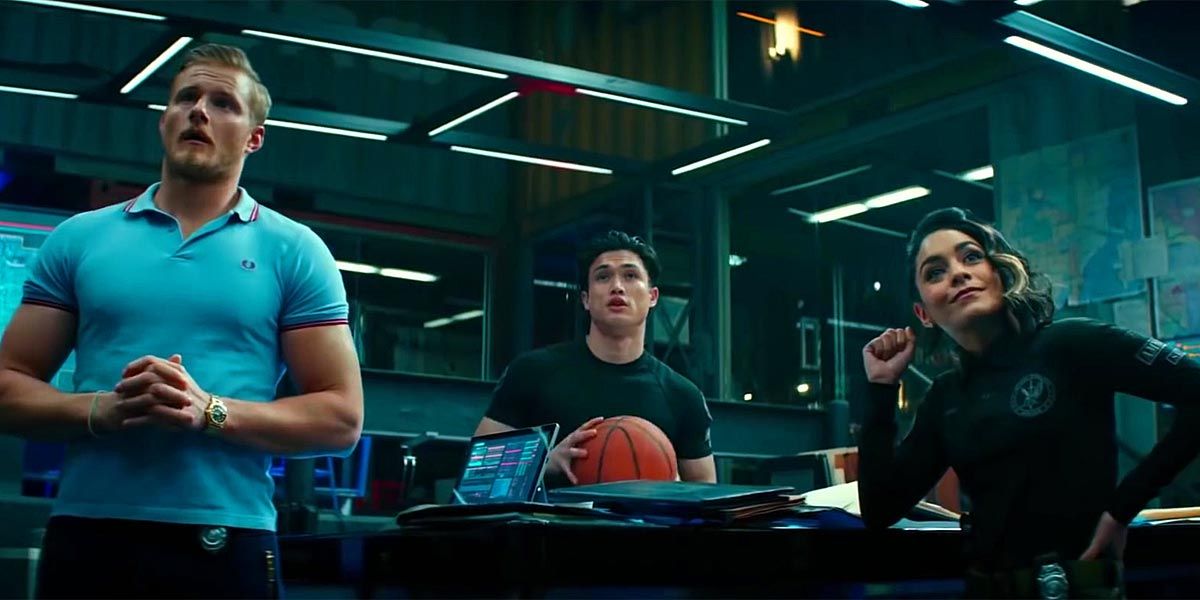
There are a few returning players from the prior films including Theresa Randle as Marcus’s ever-annoyed wife and Joe Pantoliano as the always-required angry police captain, but it’s Bad Boys for Life’s new players that add some real extra flavour. The film’s big new conceit is a young team of officers who use technology rather than brute force to fight crime, and whilst this concept has quickly become cliché the actors themselves acquit themselves well. Alexander Ludwig is quietly amusing as the gentle giant Dorn, Charles Melton is a suitably cocky rival to Mike as Rafe, and Paola Núñez is an instantly-captivating presence as squad leader and Mike’s old flame Rita; Vanessa Hudgens is also present as Kelly, but she unfortunately doesn’t get much focus compared to her co-stars. This is also the first Bad Boys film where the villains feel just as developed and interesting as the heroes, with the mother-son adversaries being not only a physical but emotional challenge. Kate del Castillo is suitably sultry and wicked as femme fatale Isabel, whilst Jacob Scipio gives something of a star-making turn as Armando; if nothing else, he should have a solid career ahead of him playing heavies in action flicks.

Image result for bad boys for life

So what does a Bad Boys film without Michael Bay look like? In many ways, much the same. Directors Adil El Arbi & Bilall Fallah keep true enough to the aesthetic established by Bay to be recognisably part of the same series, but at the same time they have refined and controlled his style into something more visually digestible. Yes, the film is still awash in a high-contrast filter with lots of dynamic tracking shots and slow-motion, but it feels far less frantic and sophomoric. There’s a bit more elegance to the construction of the action sequences, relying less on spectacle and explosions and allowing the stunt work and gunplay to speak for themselves. Whilst in some ways it does lose some of Bay’s more inspired moments of lunacy, it is ultimately far easier to process and remember the action in Bad Boys for Life, and is easily the most successful attempt at copying the director’s style to date.

Watching Bad Boys for Life is like reuniting with your dumb friend from high school and realising they’ve become mature and self-aware with age. It’s still thoroughly ridiculous and pretty disposable, but it has surprising depth and introspection that more franchise revivals need to take notes from. There’s something here even for those who didn’t particularly like the first two films, whilst still delivering on the action and spectacle franchise fans are looking for. It is ideal Friday night entertainment fodder, best enjoyed with a bunch of friends, fast food and maybe a few drinks. People often defend Michael Bay movies by saying you need to turn off your brain to enjoy them. You can do that with Bad Boys for Life, but thankfully you don’t have to.

FINAL VERDICT: 6.5/10

JOJO RABBIT – an Alternative Lens review

Starring: Roman Griffith Davis, Thomasin McKenzie (Leave No Trace), Scarlett Johansson (Marriage Story), Taika Waititi (Thor: Ragnarok), Sam Rockwell (Vice), Rebel Wilson (Pitch Perfect), Alfie Allen (John Wick), Stephen Merchant (Portal 2), Archie Yates

Writer/Director: Taika Waititi (Hunt for the Wilderpeople)

Runtime: 1 hour 48 minutes

Release Date: 18th October (US), 1st January (UK)

We live in troubled times indeed, and what helps us more than anything to get through it all with our sanity intact is laughter. Whilst satire has thrived in recent years through sketch comedy and late night talk shows taking jabs at our socio-economic climate, films taking on the task have been a little fewer and far between. In walks Taika Waititi, fresh off a one-two-three punch of What We Do In The Shadows, Hunt for the Wilderpeople and Thor: Ragnarok, with what is essentially the greatest Mel Brooks film never made. It’s too easy to describe the premise of Jojo Rabbit and end up making it sounds distasteful, but the final product is far from that. On the contrary, it is a master class in taking a horrible tragedy and turning it into something beautiful.

Whilst Jojo Rabbit firmly plants itself within its period setting of Germany at the tail end of World War II, it does a fantastic job of contemporizing its story and themes. Right from its opening titles, which juxtaposes propaganda footage of Germans going crazy for Adolf Hitler to the tune of “I Want To Hold Your Hand” by The Beatles, it firmly makes a point that this more than just a piece of history. However, it is less a comment on fascism as a whole and more the effect it can have on family and a young person’s mind. It is at its core a coming-of-age film about being yourself and overcoming societal conformity, but with Nazis and Jewish refugees in place of the bullies and nerds, and with that collation comes the humour. Jojo Rabbit is a consistently witty and clever story, but it also knows when to take a step back from the comedy and showcase the true horror of its setting. It never attempts to sugarcoat the reality of history for too long, and those moments of genuine tragedy can be gut wrenching to the point of tears. It is the wake-up call this culture needs right now to remember where we have been and what we can try to do to prevent it, and is ultimately an optimistic story of a boy learning to question his beliefs and see the world for what it truly is and could be.

Waititi has already proven himself a remarkable director of child actors with Boy and Hunt for the Wilderpeople, and with Jojo Rabbit he has fostered yet another great young star in Roman Griffith Davis as the titular cowardly Hitler Youth. He brings humour and relatability to Jojo, a character who could have too easily been portrayed as righteous or stupid, instead firmly framing his warped worldview as a manifestation of his fears and naivety. Through his performance, Davis makes clear that Jojo is not a bad person, but simply one who needs to learn more about himself and others. Opposite him as the fugitive hiding within his walls Elsa, Thomasin McKenzie continues to prove herself another actor to watch with her dry and world-weary young woman who has been forced to grow up too fast. Scarlett Johansson brings a different sense of humour to the story as Jojo’s mother, using her assertiveness and kind heart for both comedic and dramatic purposes to play the kind of mum any of us would be lucky to have.

Sam Rockwell gives a surprisingly understated performance as the disgraced Captain Klenzendorf, still infusing plenty of comedy whilst ultimately playing a graceless yet tragically human character. Archie Yates is easily the film’s breakout star as Jojo’s buddy Yorki, providing a mirror to Jojo’s own misguided beliefs, and the likes of Rebel Wilson, Alfie Allen and Stephen Merchant all bring strong performances in their more limited roles. Ultimately though, the director himself is the real scene-stealer, as Waititi himself takes on the role of Jojo’s imaginary friend…Adolf Hitler. Waititi brings much of the same sense of humour he’s brought to many of his other roles, but using that same flippant and laidback comedy whilst playing one of history’s greatest monsters is a tremendously comical middle finger to the real-life villain, and is far more of a nuanced and psychologically rich performance than a simple caricature.

The best way to describe the aesthetic of Jojo Rabbit is “toy box fascist”, as it takes horrendous Nazi imagery and paints it with an idealistic and bright colour palette. It never glosses over the real-life atrocities, but instead uses its twisted aesthetic to lampoon the subtle ridiculousness of fascist iconography. This carries over into the film’s costumes, which lie somewhere on the fine line between historically accurate and outfits from Raiders of the Lost Ark. Michael Giacchino provides a fantastic score as always, and the film’s frequent use of classic rock and pop tunes with German lyrics is a wonderfully quirky touch.

Jojo Rabbit is the movie this ailing world needs right now: a reminder that innocence and humanity can be found in the darkest of places. It is an excellent ridiculing of both the depravity and the machismo of the Nazi Party, and ultimately is a feel-good triumph about love overcoming hatred. It’s confirmation that Taika Waititi is far more than just a quirky clown who never takes anything seriously; he’s a nuanced and talented filmmaker with a unique voice and something to say. This isn’t a film that is immediately going to fix the world or deprogram every alt-right sadboy who happens to watch it, but I hope it leaves an impact and helps someone realise we are not in too dissimilar a situation right now…

FINAL VERDICT: 10/10!

CATS – an Alternative Lens review

Starring: James Corden (Into the Woods), Judi Dench (Skyfall), Jason Derulo, Idris Elba (Beasts of No Nation), Jennifer Hudson (Dreamgirls), Ian McKellen (X-Men), Taylor Swift (The Gift), Rebel Wilson (Pitch Perfect), Francesca Hayward

Director: Tom Hooper (The King’s Speech)

Writers: Lee Hall (Billy Elliot) & Tom Hooper

Runtime: 1 hour 50 minutes

Release Date: 20th December (US, UK)

So………Cats. I, uh…what is there even to say? It’s Cats, but now a movie, and…um, yeah, it’s…it’s kinda bad and weird but also fascinating and laughable and…well, that’s about all I can muster when pressed for comment. It is “a musical experience”, I’ll grant it that, but…what even is this? I honestly feel more confused having now seen the damn thing than when it was just a meme-worthy trailer, so now…I guess I’ll try and review it? I mean, this rambling first paragraph should alone tell you my state of mind after watching it, but…OK. Let me get my critic hat on and suss this one out.

One of the more common criticisms of Cats as a musical is that it doesn’t have much of a plot; it’s more of a mood piece that introduces you to its world and characters, there’s a slight bit of conflict involving Grizabella (Hudson) and Macavity (Elba), and then it kind of resolves itself and ends. The film version massages the limited story into something slightly more cohesive on a structure level, but ultimately the same criticism applies. The plot is just window dressing to set up each song, many of which don’t move the story forward in any way. It’s actually kind of a monotonous and boring series of events that just repeats over and over. A cat introduces themselves, sings about their one thing, Macavity shows up to be evil, rise and repeat for nearly two hours. That…that’s honestly all there is to say. I guess there’s some themes about forgiveness and second chances, but it’s not all that deep. Most of the rest of the dialogue is all psychedelic mumbo jumbo about how cats have three names and are magic or something. I…I really did see the movie, readers. I’m not just throwing this review together for the clicks. It’s about as empty and confusing as I’m making it sound.

Anyway…since the moment the film was announced, adding even more to its perplexing nature is the ludicrous cast they’ve assembled for it, and many of them look about as bewildered as the audience. There’s no real consistency in what level of performance they’re giving, and they range from taking it way too seriously to completely hamming it up. James Cordena and Rebel Wilson are essentially just playing variations of themselves, Jason Derulo is going full-on horndog rockstar, Jennifer Hudson seems to think she can pull an Anne Hathaway with an Oscar bait performance, and Ian McKellen…well, he’s the only one who seems to know how ridiculous this all is and just rolls with it. It’s just kind of surreal for the most part. You’re watching Judi Dench covered in fur curled up in a wicker basket and Idris Elba strutting around essentially naked but not because cat hair. There is no way to take any of this seriously, and everyone seems to be confused about whether they should or not. Nobody gives a bad performance per se. It mainly just comes down to thin material and woefully bad direction.

As soon as footage from the film was released, everyone was freaked out by how bizarre and unsettling the CGI used to turn these actors into cat hybrids. Whilst the final product is far more seamless and well executed than that early trailer suggested, from a design perspective it’s still just a baffling result. The odd choices of what to make feline and what to leave human just creates some utterly bemusing imagery, like how the cats often crawl about on their knees or have hairy hands with human digits they still refer to as paws. From a technical perspective it’s an impressive effect, but regardless it looks gaudy and upsetting and just using costumes and make-up to transform the actors would have probably been less expensive and more palatable. There is a surprising amount of practical elements in the film like the gigantic size-warping sets, but because there is not a single shot without computer enhancement it all looks so sleek and unreal that it might as well be an animated film.

Oh, and because this is a musical, I guess I should talk about the music………I didn’t like it. It has kind of the same problem Les Miserables has in that a lot of the songs are melodically interchangeable, but that musical has lyrics rich in theme and emotion and character conflict whilst Cats has…”I’m a house cat” and “I’m a sexy cat” and “I’m an actor cat” and “I’m a train cat” and…yeah, I think I made my point.

Yeah, not going to lie: this movie has kind of broken me. I have never been this baffled walking out of a movie theatre ever, but oddly enough it hasn’t left much of an impact on my brain. My struggle to write this review is less because of how utterly insane and awful this film is, and more just how underwhelmingly banal and forgettable the whole experience was (honestly, my brain quickly went back to still sussing out what went wrong with The Rise of Skywalker). It’s not even that remarkable in a so-bad-it’s-good sort of way. It’s just…dull. What else did you expect from Tom Hooper, the man who made Les Miserables look dull and pretentious and incompetent? This is easily the worst mainstream Hollywood musical in a long time, and that $95 million budget isn’t going to be made back easily. Now can someone please bring me back to reality? Please?

FINAL VERDICT: 2.5/10

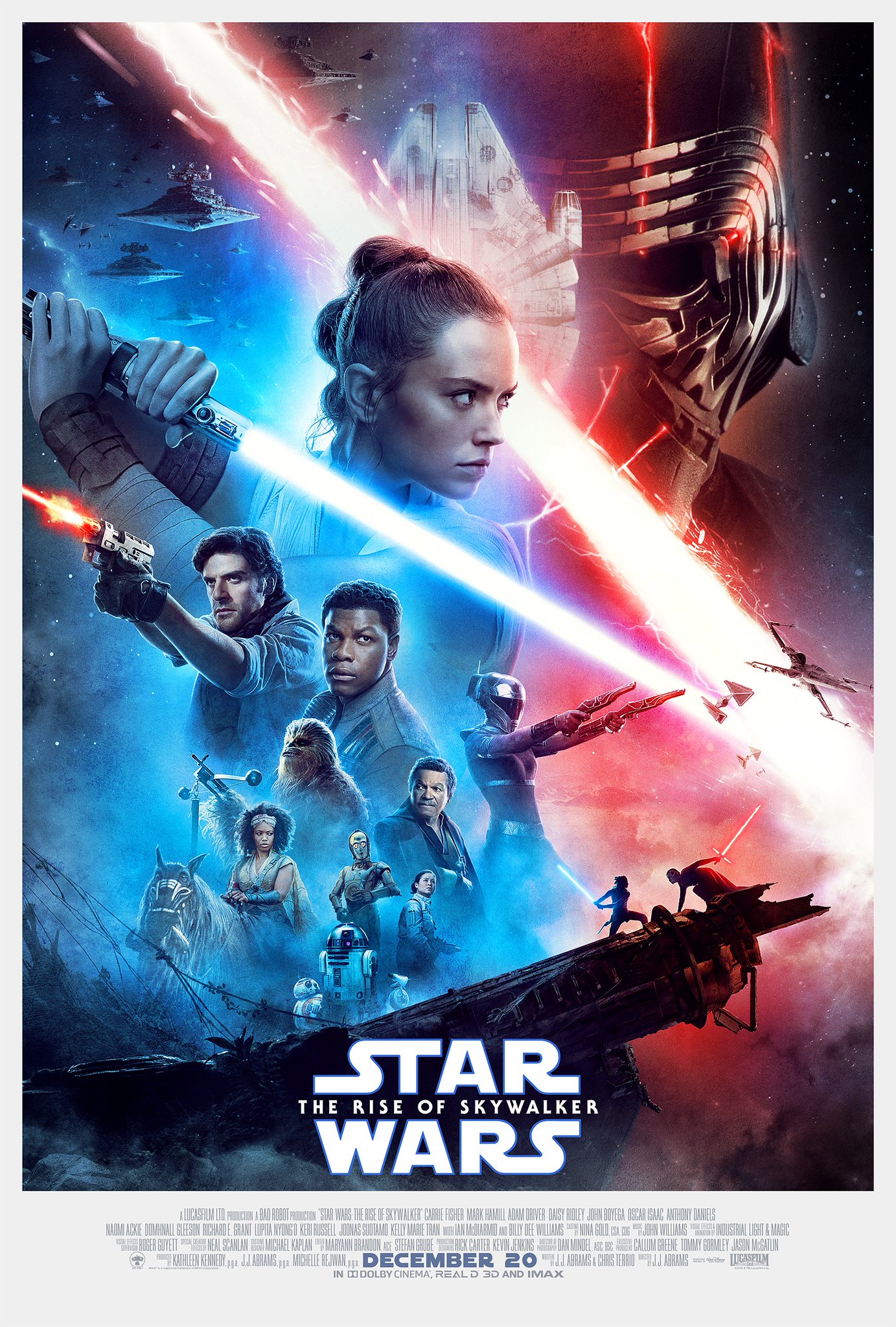
STAR WARS: THE RISE OF SKYWALKER – an Alternative Lens review

Starring: Daisy Ridley (Murder on the Orient Express), Adam Driver (BlacKkKlansman), John Boyega (Detroit), Oscar Isaac (Inside Lleywn Davis), Lupita Nyong’o (Us), Domnhall Gleeson (About Time), Kelly Marie Tran (Sorry for Your Loss), Naomi Ackie (Lady Macbeth), Richard E. Grant (Can You Ever Forgive Me?), Mark Hamill (Kingsman: The Secret Service), Billy Dee Williams (Batman), Carrie Fisher (When Harry Met Sally), Ian McDiarmid (Return of the Jedi)

Director: JJ Abrams (Star Trek)

Writers: JJ Abrams & Chris Terrio (Argo)

Runtime: 2 hours 21 minutes

Release Date: 19th December (UK), 20th December (US)

So for the third time in history, Star Wars comes to an end but not really. We already know there are more movies and TV shows in the works, but The Rise of Skywalker draws a line in the sand and ends what we now call The Skywalker Saga. It’s been a long and rocky road to this finish line filled with production troubles and a divided fanbase that has kept everyone wracked with one question: how do you end Star Wars? Well, The Rise of Skywalker certainly is a way of doing it, though I’m hard pressed to say it’s the best way.

Evident right from how the first paragraph of the opening title crawl drops a huge story-shattering plot point with no build-up, the biggest problem ailing The Rise of Skywalker is pacing. After the deliberate and contemplative The Last Jedi, the ninth instalment constantly feels like it’s trying to make up for lost time and hurries itself at nearly every moment. The film is jam-packed with exposition as our heroes dash from one locale to the next, engaging in an action set piece and a bewildering plot twist at every stop on the journey. Whilst the wit and heart JJ Abrams established in The Force Awakens is still present, there are barely any moments of downtime to appreciate the world or ruminate on our character’s trajectory. What moments of character introspection there are do land, and certain moments may have some long-time fans shedding a tear, but nothing gets a chance to sit still.

As for the story itself, well…I didn’t think they could make a more divisive Star Wars movie than The Last Jedi, but Abrams and co have done it. There’s a lot of smaller plot beats that do really work, particularly those that expand on the trilogy’s themes of defying destiny and withstanding overwhelming odds, but many of the core ideas the film is built around are shaky and best and outright preposterous at worst. It’s hard to deny the passion and devotion Abrams has poured into the film, but ultimately his unbridled fandom is the film’s downfall, as at every turn it takes the easy way out and answers what remaining questions it can with obvious, disappointing answers (oh, and plenty of unanswered questions remain). They certainly do mine plenty of pathos and closure out of these moments, and some of them very much enhance the themes and ideas George Lucas himself established for the franchise, but at their core some of these ideas would not feel out of place in a fan fiction. Whilst I do compliment Abrams for avoiding just recreating Return of the Jedi with a different coat of paint, and the difficulty of ending a franchise this storied and beloved must have been intense, everything wrong with The Rise of Skywalker can be traced back to the screenplay. The film itself is as professionally presented and sculpted as any of the post-Lucas entries, but more now than ever has the lack of planning on Lucasfilm’s part bitten them in the backside. In retrospect, perhaps it wasn’t the best idea to entrust ending one of cinema’s hugest franchises to the guy who co-wrote Batman v Superman?

As a result of the rushed pacing, one of the biggest casualties is how the series’ talented cast gets little time to celebrate their accomplishments and enjoy their characters for one last time. Daisy Ridley and Adam Driver remain the central focus of the film’s story as Rey and Kylo Ren respectively, and their characters are the only ones given much development. Ridley is tasked with playing a much more nuanced Rey, with her optimism in the previous instalments replaced with anxiety and determination, resulting in a trilogy-wide arc that feels conclusive if a little lopsided. Driver too is challenged with the conflict inside Kylo, and his performance ranges from unbridled anger to scared silence; he really knows how to get across a lot with just some subtle facial expressions. Even as their connected storyline pays off in a slightly obvious and tawdry fashion, they perform it with so much gusto that it hits more often than it doesn’t. In stark contrast and despite being present for as much of the film’s story as Rey and Kylo, nowhere near as much care is paid to John Boyega’s Finn and Oscar Isaac’s Poe. Whilst the pair do give it their all and retain their infectious chemistry, they have no discernable arcs other than reaffirming what they already learnt about heroism and sacrifice in The Last Jedi; it’s like how Return of Jedi spent so much time bringing Han Solo back only to do nothing with him all over again.

Lupita Nyong’o’s Maz Kanata has more screen time than she did last time around but somehow has even less to do, Domnhall Gleeson’s General Hux gets a moment to shine before unceremoniously exiting, and Kelly Marie Tran’s Rose Tico is absolutely done dirty by being sidelined until the third act and given little to do but spout exposition. Even the new characters feel like after-thoughts that could have easily been merged with existing players; Richard E. Grant’s General Pryde practically just slots into Hux’s role, whilst Naomi Ackie’s Jannah could have been Rose with a few rewrites. General Leia’s role is handled as gracefully as they can with the limited footage remaining of the late Carrie Fisher, Billy Dee Williams is a tad superfluous as the returning Lando Calrissian but he’s clearly having fun with the role, and Mark Hamill brings back a little of that old trilogy charm as Luke Skywalker one last time. However, the main returning attraction is absolutely Ian McDiarmid as Emperor Palpatine. Though his inclusion in the story will certainly prove divisive, having McDiarmid back in full-on Revenge of the Sith “unlimited power!” force is a devious delight. Oh, and C-3PO actually gets something to do and Anthony Daniels is as blissfully whimsical as ever and everything he says in the movie made me happy, so that’s a solid positive.

On a technical level, The Rise of Skywalker is as beautifully executed as all of Lucasfilm’s recent entries. The return to the original trilogy’s aesthetic with a modern twist is still in full force, and the number of new worlds and creatures on display continues to astonish. The film is a visual delight with striking cinematography and imaginative production design, bolstered by a still-seamless blend of practical and visual effects. John Williams delivers his swan song as composer of the series, beautifully weaving in themes from across all three trilogies into the score whilst still surprising us with new compositions; the theme for the Knights of Ren is especially menacing. However, the topic of pacing continues to be a running theme through this critique, and the film’s erratic editing is another big culprit. The film’s first act is especially muddled and disarming, with the series’ signature wipe transitions ramped up as we swiftly cut from location to location. The editing luckily finds a better rhythm by the halfway point, but it remains an issue throughout, and it all screams of a production that either shot way too much footage or not enough.

Star Wars: The Rise of Skywalker is like being in a one-sided relationship: it keeps doing things that make you want to leave whilst doing just enough to make you stay, and at every point you’re willing to forgive and move on it slights you again. It tries to be everything to every kind of Star Wars fan, hurriedly wrapping up the saga in a convenient bow, but it instead often comes off as trite and sycophantic. As opposed to the prequels, which generally had solid intentions but simply executed them poorly, this is a film riddled with bad ideas that they’ve somehow executed with heart and effort. It’s far from being lazy or boring or even unimaginative; the final product is far too humungous and gaudy to be any of those things. For better and worse, it is absolutely a Star Wars film as made by a Star Wars fan, and as clumsily and perplexingly as it chooses to end the series…it does accomplish those goals.

There’s an adage frequently repeated by characters in this film along the lines of, “If we don’t do this now, everything we have worked for will have been for nothing.” That couldn’t be a more apt metaphor for what happened to this movie. It is the most baffling and disappointing end to a trilogy since The Matrix Revolutions and, whilst it doesn’t negate the quality and accomplishments of The Force Awakens and The Last Jedi, it will leave a bittersweet taste in the mouths of many fans. I do not hate The Rise of Skywalker. I am not demanding that we get a do-over. I do not condone sending abuse in the direction of JJ Abrams, Kathleen Kennedy or anyone else in the cast and crew. It’s merely a subpar entry in a franchise that has already had several subpar entries. Nothing more, nothing less. As frustrated and saddened I am by how it’s all ended up, it does not change how much this franchise means to me and to cinema in general, with all and the ups and downs it has been through over four decades of storytelling. Congrats on making it to the finish line, Star Wars. It hasn’t always been easy, but I’m glad you’re still here.

FINAL VERDICT: 5.5/10

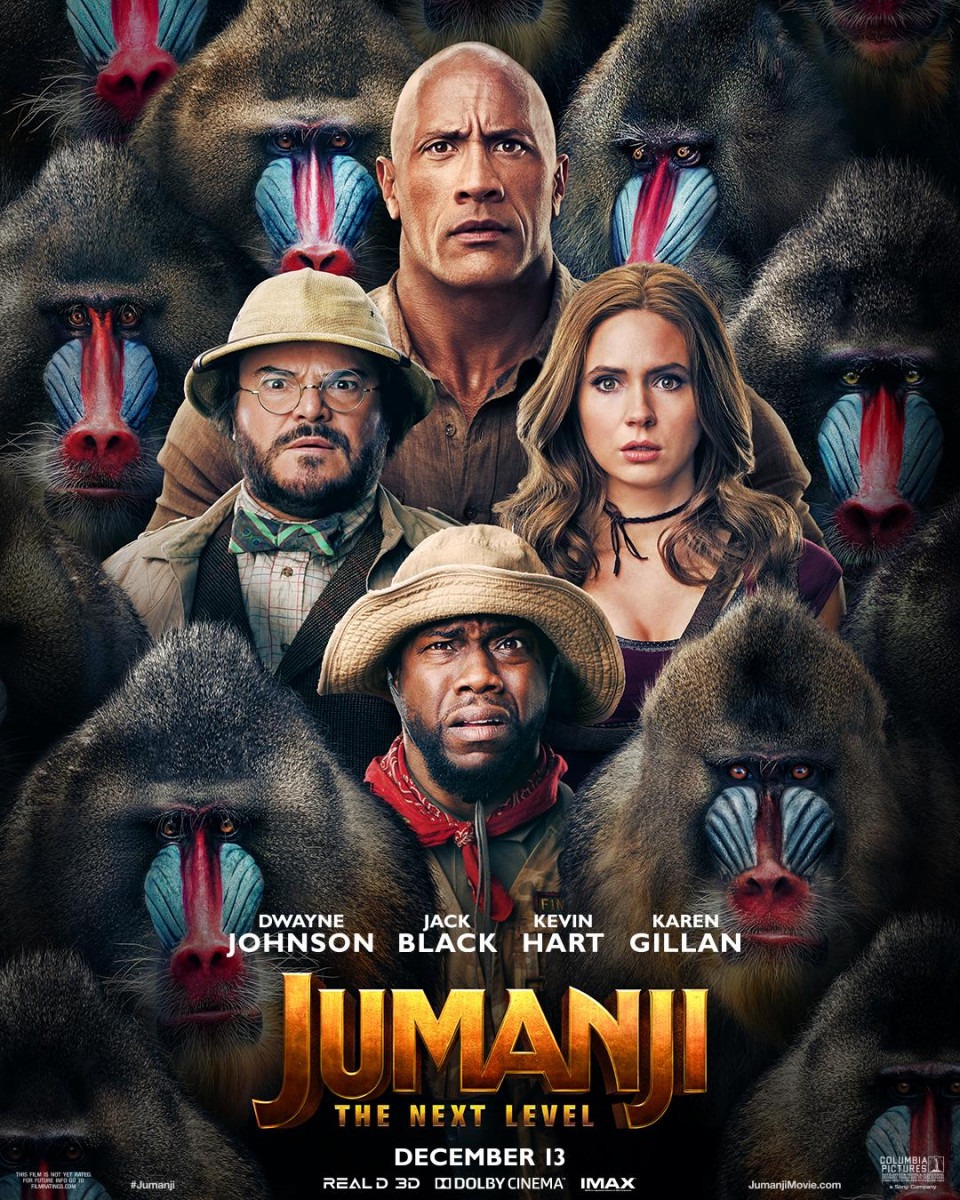
JUMANJI: THE NEXT LEVEL – an Alternative Lens review

Starring: Dwayne Johnson (Rampage), Jack Black (School of Rock), Kevin Hart (The Upside), Karen Gillan (Guardians of the Galaxy), Nick Jonas (Midway), Awkwafina (The Farewell), Danny Glover (Lethal Weapon), Danny DeVito (Matilda)

Director: Jake Kasdan (Walk Hard: The Dewey Cox Story)

Writers: Jake Kasdan and Jeff Pinkner (The Amazing Spider-Man 2) & Scott Rosenberg (Con Air)

Runtime: 2 hours 2 minutes

Release Date: 11th December (UK), 13th December (US)

I don’t think anyone was expecting the reboot of Jumanji to take the world by storm, but for whatever reason Welcome to the Jungle ended up being a near-billion dollar box office smash. An extra sweet surprise is that it was also happened to be a solid action-adventure comedy with a fun premise and plenty of laughs. With both critical and commercial success in the bag, of course another entry was inevitable, but the question then is where to really go with the franchise. That’s unfortunately the main hurdle The Next Level never quite manages to vault. It’s got more than enough new concepts and gags to entertain, but it fumbles the ball with every opportunity it has to go above and beyond its predecessor.

If you could strip back to the chassis of The Next Level like you would a car, it would be plainly obvious that it’s built on the exact same framework as Welcome to the Jungle. Plot structure, narrative beats, character development, even the logical gaps in the video game premise; all of it has been lifted directly from its predecessor. It’s not quite as blatant a rehash as something like The Hangover Part II, but it’s especially odd considering how much the film tries to signal how different it is on the surface. Once you get beyond which avatars our characters now inhabit and the addition of desert and snow levels to the prior film’s jungle, the story has little to offer other than more of the same. Even the character arcs and themes could only be called extrapolations of those explored in the last instalment, with many storylines even having to take steps backwards just to recapture that same drama. There’s some interesting potential for the film to take an introspective and mature look at subjects like depression, frayed relationships and embracing adulthood but, with the arguable exception of one character, they drop the ball. The film doesn’t even seem to realise what it has most of the time, instead defaulting back to the same “teamwork and friendship is good” mantra of so many films of its ilk.

Fortunately, the film’s comedy picks up a lot of the slack and they certainly make the most of what shake-ups there are to the formula. The action set pieces are arguably even bigger and slicker that last time around, particularly a suspension bridge sequence that emulates a platforming puzzle section in a video game, and the film moves at a solid enough clip with plenty of laughs that it’s hard to notice the blatant recycling going on. It’s like going on a rollercoaster you loved again immediately after your last ride; it’s still a lot of fun, but the surprise factor is now gone and you start to notice things that you were never supposed to. Once the film reaches its conclusion with a set-up for a sequel that sounds way more interesting, this entry only begins to feel more and more like a placeholder.

What really sold Welcome to the Jungle was the chemistry between its leads and the hilarity mined from these Hollywood stars having to act so much out of character. That dynamic switch-up is where The Next Level’s innovations mainly lie, and it is absolutely the film’s strongest asset. Dwayne Johnson and Kevin Hart mine a lot of material out of having to act like Danny DeVito and Danny Glover respectively, giving the typical old man jokes new life with their distinct delivery and context. Karen Gillan gets a lot more time to shine, effectively playing the competent straight man to a troupe of wildcards, but she still manages to deliver on the comedic front too. After stealing much of the last film, Jack Black takes a little more of a back seat this time around, whilst Nick Jonas once again feels a little superfluous and bland compared to the rest of the cast; he is very much the Doug of the group.

The only major addition to the in-game cast is Awkwafina, and though her screen time is limited she is absolutely a solid compliment to the returning players. She seems a little wasted on her debut into the story, but once the third act rolls around it becomes clear why Awkwafina was cast and she absolutely steals it from then on. Once again, the film wastes an opportunity for an interesting villain by swapping out Bobby Cannavale as a generic one-note bad guy who has stolen a gem to…Rory McCann as a generic one-note bad guy who has stolen a gem. Honestly, they might as well had Cannavale come back as the same guy and had him do the exact same thing. That’s what they’ve essentially done with Rhys Darby here, and there might have been something comedic to mine out of that concept.

Jumanji: The Next Level is the definition of disposable entertainment; fun while it lasts, but nothing you’re particularly going to remember in a few days. It relies far too much on what worked last time around, resulting a product that has very little to offer you couldn’t gain by just watching Welcome to the Jungle. Sure, the adage goes “if it ain’t broke, don’t fix it”, but it’s also often wise to fix something before it breaks rather than after, and Jumanji’s tyres are now in urgent need of replacing after barely scraping across the finish line. If the film’s sequel hook does pay off, they’ve at least set themselves up for something familiar but different, and hopefully the next entry can now build upon its prior successes rather than just repeating them. 

FINAL VERDICT: 6/10

CHARLIE’S ANGELS – an Alternative Lens review

Starring: Kristen Stewart (Clouds of Sils Maria), Naomi Scott (Aladdin), Ella Balinska (Junction 9), Sam Claflin (Me Before You), Noah Centineo (To All The Boys I’ve Loved Before), Elizabeth Banks (The Hunger Games), Djimon Hounsou (Guardians of the Galaxy), Patrick Stewart (X-Men)

Writer/Director: Elizabeth Banks (Pitch Perfect 2)

Runtime: 1 hour 58 minutes

Release Date: 15th November (US), 29th November (UK)

In some ways, I kind of feel sorry for Sony Pictures. They’ve really, really been trying to launch and relaunch a whole bunch of blockbuster franchises, but still Spider-Man remains their only consistently reliable golden boy (and even he’s essentially a foster child that biological mother Marvel and her new sugar daddy Disney are fighting for custody over). After Men in Black International failed to light up the box office this past summer, Sony has spun their wheel of intellectual properties again and now we have a reboot of Charlie’s Angels. If you’ve seen the numbers of its US opening, you already know the story hasn’t ended well financially, but what about the film itself? Is this a misfire worthy of such a dismal performance, or are audiences sleeping on a franchise worth giving a fair shake?

Whilst the film acknowledges it takes place in the same continuity as the original TV series and the McG-directed films, the new Charlie’s Angels has had a makeover from the ground up and realigned itself for a more enlightened time. The overall mission statement of the film is solid, dropping much of the remaining male gaze aspects of the franchise and fully empowering its female protagonists through confidence and feminine bravado rather than pandering to the male audience. The comedic aspects of the 2000s films remain but have been suitably toned down, and when the film is focused on our characters exchanging banter and bonding as both friends and spies it really shows potential.

Where the film mainly falls apart is in its underwhelming storytelling, which is competently constructed but lacks any flair or depth. The potential for some interesting commentary on tech corporations and women in the workplace is left bare, and its major twist is a little too telegraphed to feel weighty. The characters and humour do just about enough to keep the plot chugging along, but the curtailed and anti-climactic third act puts a real damper on it all; it honestly comes across like they were building up to this really awesome climax and then just ran out of time or money. There’s a great Charlie’s Angels movie inside of this one, and its heart is certainly in the right place, but no film can coast on good intentions alone.

Charlie’s Angels as a franchise rests a lot on the chemistry and characterisation of its three leads, and in the case of the reboot…two out of three ain’t bad. Kristen Stewart is the clear MVP in this line-up, defining Sabina from her first frame with an infectious mix of effortlessly cool yet awkwardly relatable. Every line of dialogue that comes out of her mouth is an absolute gem, and her performance alone is what makes the film worth watching. Naomi Scott is an adorable delight as tech wiz Elena, bringing a much-needed naivety and grounding to a cast full of larger-than-life badasses, though it’s a shame her character is relatively underserved on the action side of things. Compared to these two queens, Ella Balinska as Jane feels unfortunately out of synch. It’s hard to stand out in the revenge-driven stoic role when your two co-stars are brimming with personality and wit, but even when she gets a chance to be funny it never comes off as genuine. It’s unclear whether the issue is ultimately the character as written or Balinska herself, but she’s unlikely to become anyone’s favourite Angel.

The decision to revamp the Boseley role from one character to a rank within the Townsend Agency is a clever move, and one that allows for several Boseleys to take to the stage. Elizabeth Banks (who also writes and directs the film) serves as the film’s principal Boseley and is her usual charming and quick-witted self. Whilst Djimon Hounsou unfortunately feels a little wasted as the French Boseley, Patrick Stewart as Boseley classic is…well, he’s Patrick Stewart, and that’s all I really need to say to let you know he’s having a blast. Sam Claflin and Noah Centineo are both quite fun in their role as Scott’s boss and co-worker respectively, though both are only featured sporadically throughout the plot. Cap it off with a variety of hit-and-miss cameos, and it’s fair to say the cast of Charlie’s Angels is a rollercoaster that cycles a variety of highs and lows.

When making an action comedy, you usually need to pick one genre to focus on and allow the other to mostly add flavour and keep things from getting homogenous. In what is probably the film’s biggest misstep, and despite having pretty solid comedic chops in both in front of and behind the camera, the film aspires to be a credible action flick first and foremost. Unfortunately, the results are professional but generally lack panache or innovation. A lot of it feels weightless and unimpactful, bogged down by inconsistent editing and uninspired choreography. It’s abundantly clear that Banks has never directed an action film before and, whilst you could charitably call it an admirable first attempt, it’s frankly embarrassing to compare it to even other recent films of its ilk like Paul Feig’s Spy or the Kingsman series. When you’ve got Bill Pope, cinematographer of the Matrix trilogy and a slew of other great action movies, shooting your film and even he can’t make the action look dynamic or interesting, your film is in desperate need of an experienced second unit director. Somewhat ironically, the film’s big technical saving grace is another Matrix alum in costume designer Kym Barrett, who expertly mixes style, impact and practicality to make this the most fashion-forward set of Angels yet; seriously, Stewart’s wardrobe and make-up alone is going to make her a style icon to a generation of queer girls who watch this movie.

In spite of its many, many flaws, Charlie’s Angels just about scrapes by as a disposable but enjoyable piece of popcorn fun thanks to its jocular energy, modern feminist viewpoint and the performances of Stewart and Scott. Banks is far from an incompetent filmmaker but she feels a little in over her head in the director’s chair, and either rebalancing the film’s focus to take advantage of her comedy strengths or trusting others to craft the action might have helped save the picture from the messy results. It’s unlikely to get a chance after its meagre box office takings, but there is a solid foundation here for the major female-led action franchise Hollywood needs right now, and the passion and drive for the concept is abundant. What it now needs to do is back up its aspirations and create something that is either completely different to anything else on the market, or can credibly challenge the male-driven competition on terms other than inclusivity.

FINAL VERDICT: 6.5/10

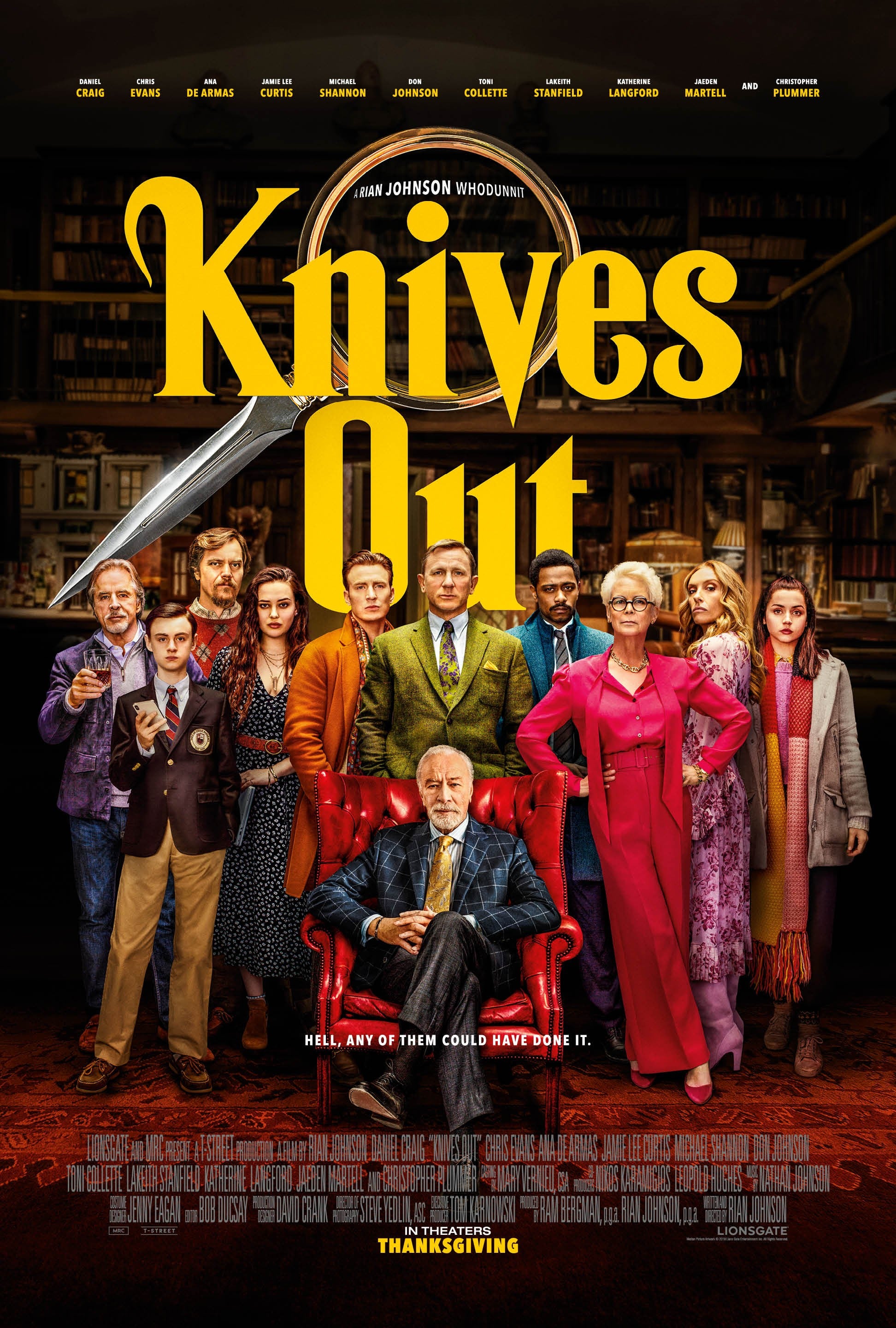
KNIVES OUT – an Alternative Lens review

Starring: Daniel Craig (Casino Royale), Chris Evans (Captain America: The Winter Soldier), Ana de Armas (Blade Runner 2049), Jamie Lee Curtis (Halloween), Toni Collette (Hereditary), Don Johnson (Cold in July), Michael Shannon (Man of Steel), Lakeith Stanfield (Sorry to Bother You), Katherine Langford (13 Reasons Why), Jaeden Martell (It), Christopher Plummer (All the Money in the World)

Writer/Director: Rian Johnson (Star Wars: The Last Jedi)

Runtime: 2 hours 10 minutes

Release Date: 27th November (US, UK)

Much in the same vein as Alfred Hitchcock or Stanley Kubrick, Rian Johnson is not a director who likes being tied down to a genre or aesthetic. He’s a cunning deconstructionist of whatever school he finds himself in, but he doesn’t exactly refashion it in his image like Edgar Wright or Quentin Tarantino tend to. Instead, Johnson slips into a genre like putting on a hand puppet, respects the conventions of the world he’s found himself in, and proceeds to make a spectacular example of that kind of film whilst working in subtle improvements and commentary; the closest comparison I can surmise is that he’s like vintage Shane Black but more quaint and less abrasive.

After delivering his unique takes on film noir, time travel and Star Wars, Johnson now turns his attention to one of the most traditional genres ever conceived: the whodunit. It’s a classic storytelling formula that has been revised and reattempted to the point of parody, and yet somehow Johnson has again struck gold in a well-mined field. Knives Out is not only one of the best films of 2019, but quite possibly Rian Johnson’s greatest cinematic achievement to date.

It’s very hard to discuss the plot of Knives Out without immediately treading on spoilers, but it is undoubtedly one of the most finely crafted and whipsmart screenplays I have ever seen brought to the screen. It’s a story that is very aware that the audience knows the conventions of the murder mystery and seeks to toy with everyone from the totally perplexed to the clue-hunting master sleuths. There is practically a plot swerve every five minutes, constantly keeping you on your toes and questioning again and again every piece of information. The way the film plays with time and perspective to withhold and reveal information is second to none, and no clue ever feels like a concrete certainty.

The pacing and structure is absolutely masterful with never a dull scene or wasted moment, and it’s all held together by corking dialogue at every turn that is sure to be quoted and memed for years to come. Johnson’s knowledge and savviness of not just cinema but of culture and politics is on display on all fronts, coating the film in all kinds of subtext that’ll fuel all manner of think pieces and video essays across the Internet (for example, there is a strong argument to be made that the entire film is simply Johnson’s middle finger to the toxic backlash against The Last Jedi). If there is any way to sum up Knives Out without entirely spoiling it, it is simply this: it is everything you want it to be whilst delivering absolutely nothing you expect.

If you’re going to even attempt a compelling whodunit, you need a varied and fabulous cast of suspects to fill out your cast, and Knives Out has certainly spared no expense in filling out its roster with the perfect actor in every role. As the drawling detective Benoit Blanc, Daniel Craig continues his recent journey into compelling characters with bizarre accents and creates one of the most fascinating and yet down-to-earth cinematic sleuths in recent memory. Blanc is a theatrical and almost ludicrous character, and yet he is far from the master investigator his demeanour would suggest, and Craig balances that weight between fiction and reality to perfect comic effect.

However, Blanc is not the star of the film, with that honour instead unsuspectingly falling to Ana de Armas as the timid nurse Marta. She works as a perfect grounding foil to a cast full of eccentric and larger-than-life characters and, though she plays the role straight as an arrow, Armas still ends up just as charming and hilarious as every other cast member. There is so much more to say about her character arc and her importance to the film’s metatext, but that’s a topic for another spoiler-filled day.

It’s hard to think of it now after nearly a decade of being the all-American golden boy, but Chris Evans used to be the go-to for playing cocky douchebags and it’s fantastic to see him return to that well. As Ransome, Evans is exactly the kind of character you hate to love and he steals every scene he’s in. Toni Collette is a delight as always as a leeching Gwyneth Paltrow wannabe, and the bickering dynamic of Jamie Lee Curtis and Don Johnson could be a movie all on its own.

Michael Shannon is great and responsible for some of the film’s best line deliveries, and though his screen time is brief Christopher Plummer is absolutely perfectly cast as the tired patriarch fed up with his family’s nonsense. The only cast member who feels a little underserved is Jaeden Martell as Shannon’s alt-right preppy son Jacob, especially considering the film’s political subtext, but he does a great subdued job with what he’s given and avoids turning the character into an exaggerated stereotype.

Unlike recent murder mysteries trying to aesthetically distance themselves from the tropes and clichés, Knives Out bathes itself in the iconography of sprawling secret-filled mansions and detectives garbed in tweed in a very tongue-in-cheek manner. Everything feels perfectly crafted to accentuate the grimly playful ambience of the piece, from the extravagance of Plummer’s knife-adorned parlour to the fineness of Evans’ wardrobe of woolly jumpers. Steve Yedlin’s cinematography is lusciously rich in dark wintery colours, Bob Ducsay’s editing accentuates the wit and timing already abundant in the dialogue, and Nathan Johnson’s overly dramatic score keeps you on your toes whilst reminding you not to take any of this particularly seriously.

If the use of a clip from Murder, She Wrote isn’t enough to clue you in that Knives Out is incredibly self-aware, then perhaps this isn’t the movie for you. This is a classic murder mystery caper with a facetious postmodern point of view; it looks and feels timeless and yet its voice is quintessentially 2019. Whilst perhaps not as overt about its themes, it has the same witty and sharp commentary of Jordan Peele’s Get Out as it similarly takes aim at privilege and class. Whilst the idea of further adventures with Benoit Blanc is certainly tempting, Knives Out is absolutely compelling as a standalone story, and overall this could end up being an even greater career-defining piece for Rian Johnson than even The Last Jedi. With that said, I can’t wait to see what he comes up with when he jumps back into that galaxy far, far away…

FINAL VERDICT: 10/10!

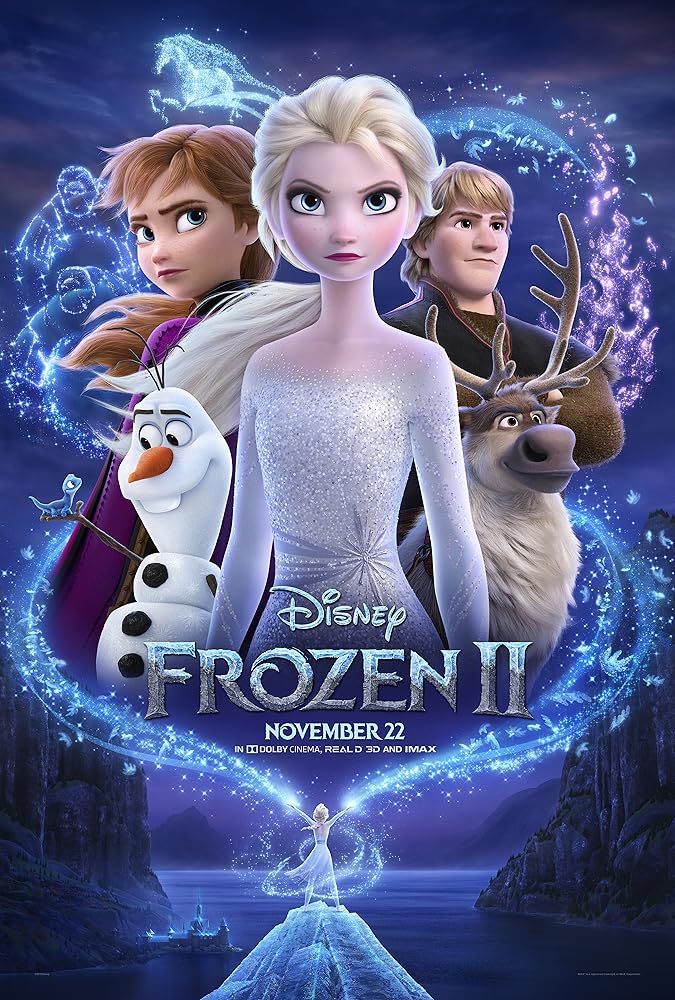
FROZEN II – an Alternative Lens review

Starring: Idina Menzel (Enchanted), Kristen Bell (The Good Place), Jonathan Groff (American Sniper), Josh Gad (Beauty and the Beast), Evan Rachel Wood (Westworld), Sterling K. Brown (Black Panther)

Directors: Chris Buck (Tarzan) & Jennifer Lee (Frozen)

Writer: Jennifer Lee (Wreck-It Ralph)

Runtime: 1 hour 43 minutes

Release Date: 22nd November (US, UK)

So here we are six years later, and the Frozen phenomenon still hasn’t died down. Unlike so many other animated films that fade away until we rediscover them as nostalgic adults, Disney’s loose adaptation of The Snow Queen has taken on a life of its own and essentially became the Beauty and the Beast of the animation studio’s Second Renaissance. However, unlike the films of that last generation, the sequels this time aren’t relegated to direct-to-video. Only the third theatrical follow-up in the company’s history (after The Rescuers Down Under and Ralph Breaks the Internet), Frozen II has an incredibly large pedigree to live up to. It ultimately succeeds by not relying on what made the first film work and strikes out in a bold new direction, even if the transition isn’t as smooth as one would hope.

In much the same way as the Harry Potter series, Frozen II has decided to mature with its audience. It’s still ultimately a family-friendly story, but it steps away from the regular Disney Princess formula and moves the series into something more of an epic fantasy direction. The result is a fascinating and surprisingly seamless blend of tones, as the film drifts back and forth from light-hearted family musical to a surprisingly mature contemplation on colonialism and righting the wrongs of the past. At its core, the film ultimately still focuses on its predecessors themes of sisterhood and arrested development, but the added complexity will certainly give older audience members something to take away too. It beautifully and cleverly expands on the limited mythology set out by the original, crafting a larger story world ripe for expansion, though it disappointingly gets very little time to ruminate on it.

The plot is structurally sound and moves at an effective pace, but the story still often feels rushed from beat to beat. The second act feels especially truncated, introducing a handful of new characters it mostly forgets to develop until the final third, and leaves little room to bask in and enjoy the fantastical new concepts introduced to the world of Arendelle. As films like Warcraft and The Golden Compass have proven before, delivering an epic fantasy adventure in anything less than 135 minutes is a tall order in a genre that demands expansive world building and lore, and though Frozen II excels in many other areas it still can’t help but feel restrained. What’s there is fantastic, and in many facets it exceeds the first film, but it either needed more room to breathe or to drop some ideas and focus in on the key themes. The How to Train Your Dragon films are a top-tier example of how to flesh out and add maturity to a family-friendly fantasy series, and perhaps the creators of Frozen would do well to take some pages out of their book should they decide to return for a third outing.

What made Frozen so endearing to many audiences is the strong bond between Anna and Elsa and the themes of unconditional sisterhood and love that relationship delivered. Frozen II is smart to expand on those ideas and gives the royal sisters more time together to further their tumultuous relationship. The two are given far more equal footing this time around, as Elsa begins to further understand the origins and strength of her powers whilst Anna grapples with maturity and change. Idina Menzel and Kristen Bell are as charming and magnetic as ever, and once again their characters are what make the film so appealing. Jonathan Groff’s Kristoff gets an amusing subplot, though it is unfortunately one of the victims of the film’s truncated second act, whilst Josh Gad manages to stave off the potential for Olaf to become a cloying presence and delivers a surprisingly nuanced performance as the befuddled snowman. Evan Rachel Wood and Sterling K. Brown are great when present, but Wood’s performance is mostly relegated to a prologue flashback and Brown’s character is introduced with a great potential for conflict that never actually pays off.

The songs of the original Frozen quickly became pop culture staples to the point of frustration for many an adult, but it’s hard to deny they aren’t some catchy tunes once you separate them from their overexposure. Whilst there is no song quite as zeitgeist-catching as “Let It Go” to be found in Frozen II, the overall quality and plot-relevance of the music here is far stronger; there are no disposable tunes like “Fixer-Upper” or that one about cutting ice. Obviously positioned as the new flagship song is Menzel’s “Into the Unknown”, which is a fantastic belter ripe with much of the same longing and conflict as her prior hit (and with just as much potential for mining queer subtext). With that said, her second number with Wood “Show Yourself” is arguably even stronger and more heart wrenching. The film’s first big number “Some Things Never Change” is apt and clever way to start off a story all about monumental change, Gad gets another chance to shine with comical “When I Am Older”, and Bell delivers the exact opposite of the blind optimism of “For the First Time in Forever” with “The Next Right Thing”. However, the major surprise there is Groff’s number for Kristoff “Lost in the Woods”, which is a major departure from the film’s otherwise traditional musical aesthetic and is something of a parody of pop movie soundtrack hits in the vein of Peter Cetera or Bryan Adams. It’s a song that is simultaneously sincere and subtly hilarious, but also one likely to split the tastes of the audience.

It’s amazing how quickly the quality of animation evolves over a short period of time, as in only six years Frozen II looks vastly superior to the still technically impressive first. The style has stayed relatively the same but the subtle details are much richer. The fine precision of the texture mapping and physics makes this cartoon world come alive, and if the characters were removed these environments would feel perfectly at home in a live action feature. The production design is as bold and fantastical as ever, and the film’s expanded use of action sequences feel fierce and raw whilst still feeling a part of the same picture as its otherwise Disney-like self. Of course the musical numbers take top billing, but one must not overlook the phenomenal work of Christophe Beck in composing the traditional score, further incorporating Nordic influences into his compositions to create a moody and authentic experience that helps keep the film hopping beyond the usual song-and-dance.

Frozen II is an ambitious and challenging animated film that tries to evolve not only its own story but also the expectations for all of Disney animation. It occasionally feels a little too limited by its tight structure and young audience to go as brazenly out there as it clearly wants to, but what of that intention that is on display is so rich in tonal maturity and subtext that it still delivers a strong emotional impact. It has everything a young audience member wants from a Frozen sequel, but it also has deeper layers for an adult audience to digest and help send a good message about being intersectional and fighting for a better tomorrow. There is clear room left for this world to go on and on and, though the fears of alienating younger viewers and the international market may continue to hinder it, I hope they eventually reach a point where they can drop some of the subtext and embrace the potential this world they’ve created has to offer. For a movie that’s about overcoming fear and prejudice, it’s strange that Disney still has some of that do itself.

FINAL VERDICT: 8/10