OCULUS review

Starring: Karen Gillan (Doctor Who), Brendon Thwaites (Maleficent), Katee Sackhoff (Riddick), Rory Cochrane (Argo)

Director: Mike Flanagan (Absentia)

Writers: Mike Flanagan & Jeff Howard

Runtime: 1 hour 44 minutes

Release Date: 11 April (US), 13 June (UK)

It’s very hard to impress me with horror films, usually because after watching so many I now know all the tricks. They’re fairly simple to make, but extremely difficult to make well, and most don’t cut the mustard. Every year, dozens of horror movies are released but maybe only one or two actually work for me, and even then I often appreciate them for anything but the actual scares. So how does Oculus fare in this crowded market?
Image

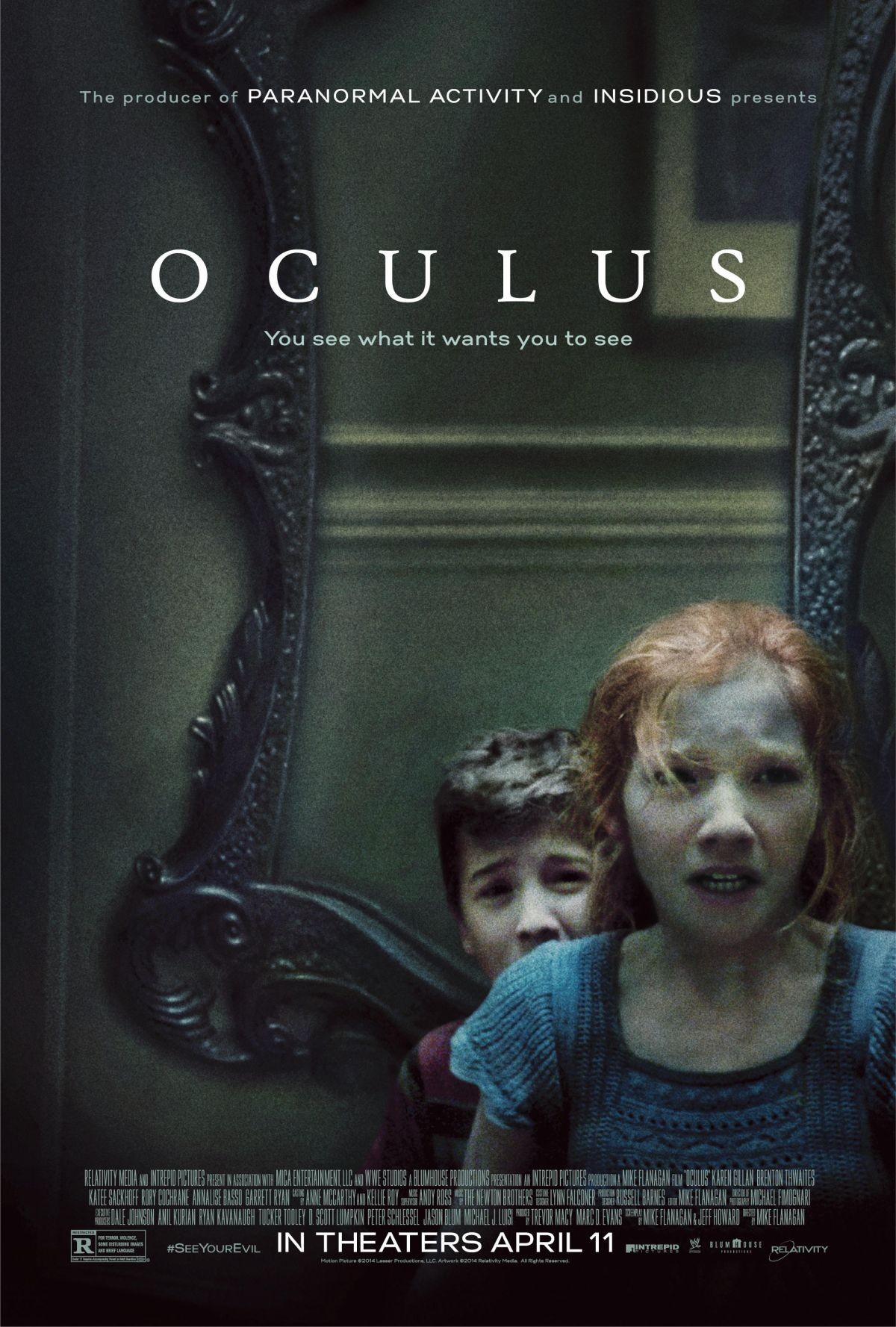
Despite containing some gore and slasher elements, Oculus is a psychological horror film at heart; it wants to mess with your mind as much as it wants to shock you with horrid imagery. The film does have a good set-up and a haunting ambiance about it, helping proceedings greatly. The story is told through two simultaneous narratives, one in the past and one in the present but both following the same characters. These stories often reflect and even cross between each other in odd ways, creating a very disconcerting atmosphere and keeping you in the characters’ mindset of “What the hell is going on?” The story has a classic feel to it, but brings modern technology into the mix which it then uses to further f*ck with the characters; it’s nice to see a horror film actually use phones, computers and cameras to its advantage rather than disregard them. The exposition at times can be a bit clunky, as evidenced by an extended scene where Kaylie (Karen Gillan) literally talks to the camera and explains the history of this haunted mirror. I know they’re trying to get away with it because she’s recording all this information for safety, but it’s not exactly a sound way to get across your back-story. The somewhat stitled dialogue penetrates other scenes as well, such as a scene where Kaylie wakes from a nightmare and her fiancé decides to say, “It’s OK. It’s just one of your night terrors”. Yeah, like we didn’t get that. Also, some of the foreshadowing is a little obvious, including one detail that I saw coming a mile away that actually caps off the story, and the film runs just a little too long for comfort.

I’ve not really watched Doctor Who in a long time so I can’t judge Karen Gillan as a whole but here she’s effective, mainly because Kaylie is thankfully not written as some shrieking scream queen. She’s a confident and determined person, but she’s still human enough to be freaked out by all the events going on around her. Brendon Thwaites fares better here as Tim than he did as Prince Plot Device in Maleficent (yes, I’m still not over that), though his early scenes where he’s constantly doing the whole “rational explanation” bit that I so hate in modern horror films can be somewhat grading. Annalise Basso and Garret Ryan play Kaylie and Tim as their younger selves, and they are surprisingly much more convincing than most child actors. I think the film ultimately works because of the brother/sister relationship between Kaylie and Tim, a dynamic not seen in enough films in general, as they both bond and bicker like real siblings in the midst of this terrifying situation. Katee Sackhoff is allowed to show a lot of range here as the pair’s mother, switching from confident mother to paranoid wreck to possessed monster and doing all very effectively. Rory Cochrane as the father comes off as a little too much at points but still provides a good menacing presence, whilst every other character in the movie is basically just a plot point. I know films often have incidental characters, but when you introduce a character’s fiancé and they end up being a footnote in the plot it’s a bit distracting.

As I said before, Oculus’ atmosphere is thick. Whilst the scares themselves aren’t often anything that special, it’s the build-up and aftermath of them that really sinks in. This is thanks to simple but very effective cinematography and editing, timed acutely to the action and blurring the borders between past, present, imagination and reality. The film’s production design isn’t anything special with exception of the haunted mirror at the centrepiece of it all. The look of this thing strikes the right balance, being different enough to be more than just any old mirror but not so overly designed that you’d question why no one else thinks this thing is evil.

Oculus isn’t a game changer in any way for the horror genre, but it has enough going for it to be worth your time. The acting and characters are solid enough, the general idea of the story is captivating and the atmosphere of the piece is genuinely disconcerting. I just wished it trusted the audience a bit more and didn’t feel the need to feed us clunky exposition and make all the symbolism so blindingly obvious.

FINAL VERDICT: 7/10

22 JUMP STREET review

Starring: Jonah Hill (The Wolf of Wall Street), Channing Tatum (White House Down), Ice Cube (Boyz n the Hood), Peter Stormare (Fargo), Amber Stevens (The Amazing Spider-Man), Wyatt Russell (Cowboys & Aliens)

Directors: Phil Lord & Chris Miller (The LEGO Movie)

Writers: Michael Baccall (Scott Pilgrim vs The World) and Oren Uziel (Mortal Kombat: Rebirth) and Rodney Rothman (Grudge Match)

Runtime: 1 hour 51 minutes

Release Date: 6 June (UK), 13 June (US)

“Sequels, man. They’re rarely ever as good as the original,” said everyone ever. It’s a statement repeated so many times, the statement itself has become a cliché. But for every few inferior sequels, there is that one that equals its predecessor or, in super-special cases, surpasses it. So which camp does 22 Jump Street fall into? Comedy sequels are usually especially tainted to be terrible, so Phil Lord & Chris Miller were really going to have to pull something special to make this movie work. But remember: they are Phil Lord & Chris Miller, so why should we be worried?

Image

Very much like how 21 Jump Street was aware of itself as a reboot of an 80’s property that no one cared about and played with it, 22 Jump Street is aware of itself as a sequel to a highly successful movie with a similar plot and bigger budget and they play with that. The story feels very similar to the first one, but they know it and they both make fun of it and play with your expectations at the same time. It’s a comedy goldmine that keeps giving every time you think it runs dry, though all the great non-meta humour also helps support the film and makes sure the film isn’t just a bunch of deconstructive, self-referential jabs at Hollywood sequels. Taking away the humour, the story itself isn’t quite as good as the first one but the movie works where it really counts, moving at a fast clip and never stooping to crass humour. Oh, and one more hyperbolic note: best end credits sequence from any movie ever. Ever!

The main reason 21 Jump Street worked was because of the fantastic chemistry between Jonah Hill and Channing Tatum and it’s just as sharp here, if not more so. Their bromantic relationship is played to the limits (and I mean THE limits), and the two never seem lost for words as they throw jokes back and forth. They’re a classic comedy duo for the modern age, and I’d love to see these two do more movies together. Ice Cube returns and is even funnier here in what might be the man’s finest performance, even managing to get in on the action this time around. Tatum has a fun subplot with Wyatt Russell as his new BFF, though its resolution feels a bit rushed. Hill’s relationship with new love interest Amber Stevens feels similarly cut short, but the jokes mined from that are so funny that it doesn’t matter. The villains are a bit weaker here than the first, with Peter Stormare’s one joke of being behind the times starts to run thin, but the film quickly wraps up before it starts to get grading. I also wish there was a bit more from cast members of the first film, as Tatum’s old nerd friends only have a couple of walk-ons and Brie Larson’s character isn’t even mentioned; a subject that could have made for a fun self-referential joke, but they totally pass it up. The movie is also super-stuffed with fun cameos, none of which I’ll spoil here, but rest assured they all work extremely well.

Action comedies need to deliver on the action as well as the comedy, and 22 Jump Street manages to deliver on both ends of the bargain. Whilst not exactly as spectacular as something you’d find in a straight-up action flick, the film does have some entertaining set pieces leading to a really fun climax at Spring Break. The cinematography is bright and colourful, and Mark Mothersbaugh’s music brings back a lot of the cues from the first one as well as some fun uses of popular tunes. The visual effects aren’t that important, but their use during the new drug trip sequence is really cheesy in a good way.

22 Jump Street transcends the expectations of the Hollywood sequel by picking it apart bit by bit and then reassembling it into something new but familiar. Everything you loved about the first one is here in spades, and is easily the best comedy of the year so far. Phil Lord & Chris Miller have managed to make two excellent movies in one year, certifying their status as a creative team that can’t be rivalled. Where the franchise goes from here is very much addressed in the film, but I do think it’d be best to stop now whilst they’re on a high or go in a totally new and insane direction for the follow-up. But as for where Lord & Miller go next with their career? That’s the question I wanted answered.

FINAL VERDICT: 9/10

MALEFICENT review

Starring: Angelina Jolie (Wanted), Sharlto Copley (District 9), Elle Fanning (Super 8), Sam Riley (Byzantium), Imelda Staunton (Harry Potter and the Order of the Phoenix), Lesley Manville (Vera Drake), Juno Temple (The Dark Knight Rises) 

Director: Robert Stromberg

Writer: Linda Woolverton (Alice in Wonderland) 

Runtime: 1 hour 37 minutes

Release Date: 28 May (UK), 30 May (US)

Reworkings of classic fantasy stories are all the rage these days. Whether it be Snow White, Little Red Riding Hood, Alice in Wonderland or The Wizard of Oz, there’s always some film that reinterprets an old tale or is a prequel or a sequel or whatever on the market. Sometimes they work, but a lot of the time they don’t. Maleficent is the latest in this trend, retelling the story of Disney’s own Sleeping Beauty, the twist here being that it’s being told from the perspective of that film’s villain; it’s basically Wicked, but with less interesting source material to work from. Based on the few things I’d heard about this film, I didn’t expect much from this film, but what I got was far worse than I could have possibly imagined.

Image

Let’s all be honest here: the original Sleeping Beauty doesn’t hold up very well. Yes, the art direction and animation is beautiful and Maleficent herself remains one of Disney’s most iconic villains, but the story is incredibly bland and the characters are exactly the kind of one-dimensional dopes that Enchanted was making fun of. There is ample room for improvement and embellishment in this story, but Maleficent never really takes full advantage of this opportunity, instead making the bizarre decision to turn this simplistic fairy tale into what is essentially a kid-friendly version of I Spit on Your Grave. No, I am not kidding; more on that disturbing note later. The first act of the story tells Maleficent’s origins, casting her in a good light before showing her descent into darkness. The problem is that her motivations for turning evil are pretty weak and her transformation into the character we all know and love to hate could be kindly described as ‘out-of-f*cking-nowhere’. It would be fine if she then stayed evil throughout, but immediately the film starts backpedalling and goes “No, she’s still actually good. Honest!” By the end of it all, Maleficent comes off as misunderstood not because of her appearance or her actions, but because it’s bloody hard to actually understand what’s going through her head. One minute she’s cursing Aurora to eternal sleep, the next she’s saving her life because…because! The entire film is full on contrived writing and on-the-nose dialogue, making it hard to invest in the story, concluding in an ending that seems like it’s trying to come off as fresh and inventive, but it ends up feeling like a bad rip-off of the end of Frozen. Top it all off with terrible pacing and obnoxiously constant narration that spoon-feeds you the narrative, and Maleficent ends up doing little to make this tired old tale seem any more interesting and actually does more to destroy it.

Angelina Jolie seems to have been born to play Maleficent, and for a brief moment in the film she is truly great. When she’s allowed to go full on nefarious, she oozes with villainy and eats up every moment. Unfortunately, this is only for a few scenes because before and after these fleeting moments the character isn’t that compelling. The film’s way of making her a ‘tragic hero’ is ultimately by making her a woman scorned by romance because her childhood love Stefan (Copley) seduces her, drugs her and rips off her wings. Ignoring for a second the baffling and icky subtext of that entire sequence of events that I could easily write a venomous deconstruction of (it rhymes with ‘schmape’), it’s a poor motivation for this character to suddenly become evil, and her turn back to the light is even more poorly handled. Jolie herself seems to putting her all into it, but the material she’s given just doesn’t give her enough to stand on. Stefan himself is played completely for villainy, his own motivations being he wants the crown because…I guess all humans are meant to be inherently evil or something, and Copley plays the role incredibly hammy and with such a terrible Scottish accent that he seems to be choking on it; he ends up being less a threatening presence and more simply unintentionally hilarious. Aurora herself has been given barely anymore definition than she had in the original, with Elle Fanning playing the empty shell so overly whimsical that she looks more like she belongs in an ad for laundry detergent than a fantasy film. The fairies (Staunton, Manville and Temple), the most competent characters in the original film, have been completely reversed into bumbling waifs who end up being so useless that Maleficent herself ends up subtly doing most of the parenting herself. The idea of giving Maleficent’s crow Diaval a bigger role and making him human half the time is an interesting one, but Sam Riley isn’t given much more to do than be the voice of reason on Maleficent’s shoulder. And don’t get me started on what they’ve done to Prince Phillip (or, as I like to call him, Prince Plot Device), who arrives late in the second act to no fanfare, seems put in just to move the plot towards its majorly ‘revisionist’ climax, and somehow has even less of a character than he did in the original.

Director Robert Stromberg mainly has a background in production design, having won Oscars for his work on Avatar and Alice in Wonderland. Whilst it is painfully obvious the man has no flair for directing actors based on the flat or overdone delivery of the dialogue, at least the movie looks gorgeous. The cinematography and art direction are wonderfully done, capturing the unique style of the original Sleeping Beauty whilst injecting elements of dark fantasy and a healthy dose of Miyazaki-esque whimsy. The costumes are also well designed and fitting, especially those worn by the title character herself, the visual effects are well done (most notably any time Maleficent flies), and the score is fitting if overdone at points.

Maleficent is a baffling mess of a film. The story is contrived and achingly paced, the main character’s motivation is sudden and dripping with bewilderingly mishandled subtext that borders on offensive the more you think about it, and everyone else ends up feeling somehow even more of a bland caricature than the characters in the original. Maleficent was a fascinating character because we didn’t know much about her; she was a purely evil force of nature and that’s all we needed in such a simplistic story. But, like how every remake of a classic horror film does these days, by giving her a back-story and some sympathy the character’s allure gets completely destroyed. I get the impression that if handled by anyone other than Disney themselves, this could have been an interesting deconstruction of the fairy tale, but the whole affair seems neutered by the marketing machine that leaves a battered and confused pile of ‘what?’. All I can say nice about it is that it looks pretty, but looks alone can’t save anything. By the end of the film, I certainly wished the whole endeavour was just a bad dream.

FINAL VERDICT: 2/10

EDGE OF TOMORROW review

Starring: Tom Cruise (Oblivion), Emily Blunt (The Adjustment Bureau), Bill Paxton (Aliens), Brendan Gleeson (The Guard), Noah Taylor (Vanilla Sky)

Director: Doug Liman (The Bourne Identity)

Writers: Christopher McQuarrie (Jack Reacher) and Jez Butterworth & John-Henry Butterworth (Fair Game)

Runtime: 1 hour 53 minutes

Release Date: 30 May (UK), 6 June (US)

Tom Cruise is at it again. Despite his age, he’s still pumping out movies as frequently as ever and, as of late, managed to keep them consistently good for the most part. Cruise is no stranger to sci-fi, but Edge of Tomorrow is possibly the most outlandish of his alien encounters yet. Does this bombast work to the man’s favour and create another hit, or has Cruise’s lucky streak hit a bumper?

edge_of_tomorrow_ver4_xlg

The premise of a character stuck repeating the same events over and over again until they get it right is hardly a new one; Groundhog Day and Source Code are two obvious examples of this type of story. That doesn’t necessarily mean that Edge of Tomorrow is an unoriginal idea, far from it, though it’s hard not to have that kneejerk reaction. But whilst those previous films were a comedy and a sci-fi thriller respectively, Edge of Tomorrow is far more about the action, using the premise as much for creating spectacle as much as crafting funny and tense situations. The film manages to straddle a good tone, injecting just enough humour into the proceedings without losing the intensity of the story. The plot itself is well handled, never falling into the swamp of paradoxes and illogic that time travel stories can often get bogged down in. Other than one plot beat that made me go “Why didn’t you just do that earlier?”, the story manages to chug along at a good clip, allowing plenty of time for both the plot and the characters to develop. The time loop stuff is handled excellently too, mainly because the film never feels the need to always show the loop starting again, sometimes cutting back to the same situation repeatedly for dramatic and comedic effect. I also love a good movie with an ambiguous ending; it’s not exactly Inception, but I do really enjoy how they handled the last few seconds of the movie.

Tom Cruise, as reliable an actor as he is, does often feel like he’s playing the same character over and over with only slight variations. Surprisingly, Edge of Tomorrow eschews this and presents Cruise with a character I don’t think he’s really done since Rain Man: a jackass. Bill Cage is not the all-American badass with the sweet moves and the nice hair. He’s a selfish coward, one trapped in the last place he wants to be, and once stuck in his time loop he is both frightened and bemused by it. It’s great to see Cruise play vulnerable for a change, and he does it surprisingly well, but he also manages to remain a relatable and sympathetic character that you want to see become better; somewhat comparable to Sharlto Copley’s role in District 9. The role of badass is handled by Emily Blunt’s Rita Vrataski and she does that job gracefully, embodying that no-nonsense Ripley-esque demeanour excellently whilst not losing her own natural charm and comedic temperament. Her and Cruise’s relationship works brilliantly, mainly because it is refreshingly not played with attraction at the forefront. It’s rare to see a man and a woman star together in a movie and not have them hook up, and whilst near the conclusion of the story this is somewhat undercut, their relationship ends in a more debatable way that ultimately doesn’t totally undermine their camaraderie. It’s good to see Bill Paxton back, especially in a part so similar to his classic role of Hudson from Aliens, and the man remains as strangely endearing as ever. The rest of the cast isn’t as important but all do fine: Brendan Gleeson gets to be scowly and dim, Noah Taylor works as a good “plot exposition dumper”, and even Cage’s fellow soldiers feel just lively enough that you can remember them all (just maybe not by name), but the film ultimately belongs to Cruise and Blunt.

Edge of Tomorrow is a large-scale film in both story and budget, and for the most part it all works well. I really love the design and atmosphere of the film, crafting a future that seems plausible but still full of sci-fi goodies like mech suits and holographic displays; it’s kind of like Gears of War, but with less steroid abuse. The design of the aliens also feels very unique; mainly I’m glad not to see just the same insectoid blandness all aliens seem to be these days. The action sequences are fun and interesting, mainly because of the abilities the mech suits endow on our heroes, but spotty camera operation and quick editing sometimes spoils them. The visual effects look pretty convincing, mainly thanks to the grounded design of the picture, as is the sound design, and the score keeps the pace flowing but honestly isn’t that memorable.

Edge of Tomorrow manages to be smart and entertaining in equal measure; it’s a sweet blend of smart sci-fi ideas and spectacular action spectacle. The story is riveting and the central performances are top notch, making it a great excursion for those of you who love a good plot, but it’s also got plenty of explosions and gunfire for those looking for pure entertainment. It’s just an all-round solid blockbuster with only minor gripes to pick, which is surprisingly rare in the current cinematic landscape. If you want to go have some fun but don’t want to completely turn off your brain, Edge of Tomorrow should deliver that to you in spades. 

FINAL VERDICT: 9/10

A MILLION WAYS TO DIE IN THE WEST review

Starring: Seth MacFarlane (Ted), Charlize Theron (Prometheus), Amanda Seyfried (Les Miserables), Neil Patrick Harris (How I Met Your Mother), Giovanni Ribisi (Avatar), Sarah Silverman (Wreck-It Ralph), Liam Neeson (Non-Stop)

Director: Seth MacFarlane

Writer: Alec Sulkin & Seth MacFarlane & Wellesley Wild (Ted)

Runtime: 1 hour 56 minutes

Release Date: 30 May (US, UK)

Following up on a huge success is a daunting task no matter what field you’re in. After being a prominent figure on TV for a while with the likes of Family Guy and American Dad, Ted was the feature debut of Seth MacFarlane and it was a glorious one at that. It was funny, endearing and was a box office smash with a sequel on the way. But before returning to familiar ground, MacFarlane has decided to venture out into the frontier for A Million Ways to Die in the West. Does this sophomore effort firmly establish him as a talent to watch, or is it shaky enough to make Ted seem like a lucky shot?

a-million-ways-to-die-in-the-west

Plot wise, Million Ways is pretty standard fare; from the start, it’s obvious how everything is going to play out. What separates the film is, of course, MacFarlane’s unique brand of humour, but unfortunately the comedy doesn’t always work mainly due to the inconsistent tone of the film. Whilst Ted had a very similar feel to MacFarlane’s TV shows so his humour translated with little effort, Million Ways plays it a little more serious and cinematic. When you get right down to it, the film is a sweet little love story surrounded by western trappings, but most of the jokes don’t mesh with the visual and tonal aesthetic. I get that they’re being on-purposely anachronistic, but a lot of the gags feel out of place or, even worse, really juvenile and unpleasant (laxatives and sheep dick, anyone?). Sure, there are plenty of laughs to be had, but there were no huge or quotable knee-slappers and for every chuckle I got there was a groaner or two that killed the vibe. The film is also somewhat hampered by poor structuring. For example, Giovanni Ribisi and Sarah Silverman’s characters and their subplot plays heavy in the first act of the movie but then they disappear until near the end and their story is wrapped up way too quickly, whilst Liam Neeson similarly disappears after one early scene before showing up for the final act. I will say the film is decently paced and I was never bored, but Million Ways has far too many bumps in the road for it to be a consistently pleasant journey.

Seth MacFarlane is certainly a very talented person, and after hiding behind a CG bear in his last outing he takes centre stage here to…mixed results. MacFarlane is not a terrible actor and he remains a charming and likable screen presence, but my issue is less with the performance and more with the character MacFarlane has written for himself. Albert Stark often feels less like a rounded comedic character and more like a self-insert ‘woobie’ of a protagonist; Stark is constantly told what a kind, funny, stand-up guy he is whilst he constantly makes dry remarks and observations, and beyond gaining a little courage and hindsight he doesn’t change much by the end. MacFarlane ultimately lacks edge and comes off as way too simpering for his own good. Charlize Theron is a far more interesting character, managing to balance the serious and the comedic very deftly, but despite good chemistry with MacFarlane I never really got why she fell for this guy beyond “he’s nice”. Ribisi and Silverman’s subplot is one ripe for comedy, but the film constantly throws them under the bus and feel somewhat pointless by the end. Neil Patrick Harris’ snooty Foy got the most laughs out of me, though I felt he lacked a proper comeuppance by the end, whilst Amanda Seyfried feels like little else other than a plot device (somewhat intentionally, sure, but still bland). Liam Neeson plays the whole movie straight, which certainly works in his favour, but he lacks enough screen time to become a truly threatening presence. The film is also chock full of cameos; some of them are funny, but many of them feel inorganic and stop the movie out of nowhere with no relation to what is actually going on.

Million Ways certainly makes the effort to look like a classic Western, and on a technically level it certainly feels much more unique than most comedies. The music creates the perfect vibe, the costumes and production design feel authentic to the period, and even the cinematography evokes the cowboy tales of old (though I think shooting on film rather than digital would have helped add to rustic aesthetic they were going for).

A Million Ways to Die in the West certainly isn’t a complete miss, but it barely passes by. The plot is basic and sloppy, the characters aren’t the best defined, and the humour throws far too many misses. But despite all of the obvious flaws I did find myself caught up thanks to MacFarlane and Theron’s chemistry, and there were just enough genuine laughs to keep me entertained. Fans of MacFarlane will probably enjoy it enough, especially those with less discerning tastes, but it’s nothing you need to see in the theatre and it certainly comes nowhere near the quality of the man’s previous efforts.

FINAL VERDICT: 6/10

X-MEN: DAYS OF FUTURE PAST review

Starring: Hugh Jackman (Prisoners), James McAvoy (Wanted), Michael Fassbender (12 Years A Slave), Jennifer Lawrence (The Hunger Games), Nicholas Hoult (Jack the Giant Slayer), Peter Dinklage (Game of Thrones), Patrick Stewart (Star Trek: The Next Generation), Ian McKellen (The Lord of the Rings) 

Director: Bryan Singer (The Usual Suspects) 

Writer: Simon Kinberg (X-Men: The Last Stand) 

Runtime: 2 hours 11 minutes 

Release Date: 22 May (UK), 23 May (US)

The X-Men film franchise has had its ups and downs over the past 14 years, with quality ranging from some of the best comic book movies out there to some of the worst. If only there was a way to fix all of these issues, getting rid of the plot holes and misconceived storylines that the lesser films have given us. Or is there? Bryan Singer, the man who started it all, has come back to the series to tie together two timelines and adapt one of the most beloved storylines from the comics in Days of Future Past. With such enormous hype and insurmountable goals, can this seventh instalment be as good as it possibly sounds?

Image

Having read the original “Days of Future Past” storyline, I can say the film’s plot is certainly not a direct adaptation but does take a lot of the key elements as well as the spirit of the tale; comparable to how X2 was a loose adaptation of “God Loves, Man Kills”. But as a story on its own, it works tremendously well. The time travel element is a welcome addition to the X-Men flavour and it never feels like a cheap gimmick, evoking both The Terminator and Back to the Future in execution and style. The film is packed to the brim but it never feels overstuffed or weighty like some comic book movies do, and the pacing is so air-tight that it both breezes you through the story and leaves you wanting more (in a good way). I only have two minor gripes with the plot. Firstly, I felt the balance between the two timelines was a little imbalanced. Once Wolverine (Jackman) travels back, it’s a long time before we see the future cast again and they unfortunately don’t get as much to do. What we do get is great, but I would have loved to see maybe just a few more character moments or another action scene with them. And secondly, the method of time travel isn’t really explained too well: Kitty Pryde (Elliot Page) has suddenly gained the power to send people’s consciousnesses back in time with nary an explanation. They could have maybe put a few lines in to explain this, but they don’t and it bugged me a bit; it felt like little more than an excuse to keep Kitty an important part of the plot (as in the original story, she was the one who got sent back in time). But besides these niggles, Days of Future Past is a rollicking good time and one of the better stories from the X-Men series, especially with its sentimental ending that could easily move devout fans to tears (it nearly did fore me). By the way, there is an after credits scene, but unless you’re a serious comic nut you are going to have no idea what it means (perhaps even more confusing to the uninitiated than Thanos’ appearance in The Avengers).

What the bad X-Men movies always forgot is that, at the heart of it all, the series is an ensemble piece about these complex and interesting characters and not just an excuse to throw special effects around. Days of Future Past remembers this key fact and makes it the centre of the entire piece. Whilst Wolverine is a key part of the story and Jackman himself is still as ace in the role as ever, the real focus still remains on the main trio from First Class: Xavier (McAvoy), Magneto (Fassbender) and Mystique (Lawrence). Their characters and their triangular relationship is so fundamental for the film to work and thankfully it does. McAvoy delivers the standout performance of the film, portraying a Charles Xavier far more bitter and sorrowful than we’ve ever seen. His contemptible attitude makes him almost unlikable at points, but McAvoy manages to balance it out well enough that we don’t forget the kind man we know he was and will become again, as shown in a wonderful scene where he meets his future self (Stewart). Fassbender and Lawrence’s characters have certainly advanced much more towards their characters’ demeanours in the original trilogy, but also still keeps those slivers of humanity that made them so sympathetic in First Class. It’s these three that really make the movie what it is and, not to detract from everyone else in the movie, that’s how it really should be. As cool as it is to see all these characters from the comics, X-Men shouldn’t be treated like a Roland Emmerich film with a cast of thousands of unimportant characters. When it comes to the other mutants in the story, they all play their part but none of them detract from the core cast nor do they feel like wasted fan service like certain characters did in The Last Stand or Origins. In terms of new players, the key ones are Peter Dinklage’s Bolivar Trask and Evan Peters’ Quicksilver. Dinklage is always great to watch and he delivers a fine performance, though as an antagonist he lacks the menace of, say, Brian Cox’s Stryker from X2. Peters doesn’t get a whole lot of screen time, but when he’s there he’s one of the film’s surprising revelations, adding some clever and much needed comic relief to the proceedings.

Days of Future Past is easily the most visually distinctive of the X-Men films. The design of the apocalyptic future owes as much to Terminator as the film’s plot does, but it feels just unique enough to separate it from that classic franchise. Plenty of detail has also gone into the 1970s section of the film, creating a similar atmosphere to First Class with a slightly different twist. The action sequences continue to find new ways of exploiting all the impressive powers on display, key highlights being Blink’s (Fan Bingbing) ability to create portals (any fans of the Portal series will clearly have some fun here) and Quicksilver’s superspeed. The cinematography manages to keep these two disparate eras distinct but unified, as well as making fun use of Super 8 footage during certain scenes. The visual effects are better than ever, and it’s so wonderful to hear John Ottman back doing the score and to hear a remixed version of his excellent theme from X2.

X-Men: Days of Future Past is one of the best of the franchise, ranking up there with X2 and First Class easily, as well as one of the better comic book movies in recent memory. It weaves a great story that respects the source material whilst giving it a new spin, the cast put in tremendous work in both big and small parts, and it reveres the series’ past whilst remembering its mistakes and leaves you with a warm nostalgic feeling inside. The franchise could easily stop here and I would be satisfied, but they are continuing and as long as they stay this consistently good I think we never have to fear anything as horrible as Brett Ratner’s dirty fingers ever again.

FINAL VERDICT: 9/10

GODZILLA review

Starring: Aaron Taylor-Johnson (Kick-Ass), Ken Watanabe (Inception), Elizabeth Olsen (Kill Your Darlings), Sally Hawkins (Blue Jasmine), David Strathairn (Good Night, and Good Luck), Bryan Cranston (Argo)

Director: Gareth Edwards (Monsters)

Writer: Max Borenstein

Runtime: 2 hours 3 minutes

Release Date: 15 May (UK), 16 May (US)

The self-proclaimed King of the Monsters has returned to the big screen after a ten year hiatus (his last appearance being 2004’s Godzilla: Final Wars), and this time the Americans are taking another shot at it. After Roland Emmerich’s 1998 disaster of a disaster film, Monsters director Gareth Edwards has been given the reigns to try and salvage Godzilla’s reputation in the western world. In a land inhabited by Cloverfield, Transformers and Pacific Rim, is there room anymore for the original giant movie monster?

Image

Right off the bat, I can easily get this out of the way: yes, this is a much better film than the Emmerich version and a much more accurate representation of Godzilla himself. He looks like Godzilla, he sounds like Godzilla, and he does the things you expect Godzilla to do. But getting that part right alone won’t make this a good movie, so how does the rest of it pan out? Godzilla certainly takes itself very seriously and strikes a good tone. It’s pensive enough that you can buy the somewhat ridiculous premise, but not so po-faced that it sucks the enjoyment out of the picture. The film takes the right approach by being coy about showing us the monsters at first before unleashing them onto the world, but I felt the pacing consistently lagged. It takes just a tad too long to get to the action, and even once the plot gets really going there’s too much time spent away from the main event. The film has about enough plot for a 90 minute romp, but it feels needlessly stretched out to just over two hours. When the film finally gets to its big climax it does deliver on its promise, but it feels less like a treat for your patience and more like an apology for the delay: you’re glad it’s finally here and you feel satisfied by the quality, but you can’t shake the fact that it should have come sooner.

I could accept the long stretches spent on the human characters if they were interesting, but that’s the problem: they’re not. The film’s cast is impressive and they give it their all at every chance they can get, but their roles all feel a bit thinly drawn. Taylor-Johnson’s Ford Brody is your basic stock protagonist with no flourish: the brave hero with a family to get back to, a connection to the crisis at hand, and with just the right skills needed to help avert it. He feels too much like a passive observer of the narrative; an avatar for the audience to inhabit while they watch all of the excitement but doing very little to engage with it. Up until the climax, Brody never impacts the plot in a significant way and he’s only given the barest of motivations to keep going. That motivation happens to be played by Elizabeth Olsen, who shares good chemistry with Taylor-Johnson but their screen time together is minimal and we aren’t given enough time to connect with them as much as the film thinks we are. Pretty much everyone else feels like an archtype, but ones cast with really good actors. Ken Watanabe and Sally Hawkins play the classic “scientists that initially hide the truth as they try to avert disaster”, whilst David Strathairn is stuck with the old reliable “military man who will take drastic measures that threaten others in order to end the disaster earlier and ignores the scientists’ better solution”. They all do it very well, but it’s hard to excuse stereotypes especially when they play them so straight. Only Bryan Cranston manages to break this mould and he delivers a powerhouse performance despite the script’s deficiencies. Sure, he’s also stuck playing the traditional “crazy scientist who saw it all coming but nobody believes him” role, but Cranston sells it through sheer force of personality. He’s easily the acting highlight of the movie, and it’s a shame his screen time is fairly limited.

Where Godzilla thankfully shines is all in the spectacle. On a technical level, this gets everything pretty much right. The action sequences, when they decide to show up, are phenomenal. The scope and choreography of them is stupendous to behold, packed with plenty of crumbling buildings, fiery explosions and monsters throwing each other about. The cinematography really shows off the scale of the entire production, and the moody colours and lighting help sell a world in peril. The visual effects are top notch, creating the most believable and accurate representation of Godzilla on screen so far, and the design of him and the other creatures are interesting and unique. The sound design is masterful, with thunderous thumps and reverberant roars kicking in at all the right moments, and Alexandre Desplat’s score is saturnine and oozing with dread. If you can see this movie in IMAX, do so; the size of it all alone is worth the price of admission.

Godzilla is an enjoyable film for the most part. The tone is well balanced, the action scenes are exhilarating and it represents Godzilla himself in the way he should be. But the story’s pacing issues and bland characters do put a serious damper on the fun. I understand that the film needs human characters, as Godzilla himself doesn’t have a personality to hold the entire film, but the humans don’t seem to have much persona either so it doesn’t work. Next time around, either give us more compelling characters or just make the movie about Godzilla; a remake of Destroy All Monsters done in this style would be much appreciated.

FINAL VERDICT: 7.5/10

SABOTAGE review

Starring: Arnold Schwarzenegger (The Terminator), Sam Worthington (Avatar), Olivia Williams (The Sixth Sense), Terrence Howard (Prisoners), Mireille Enos (World War Z)

Director: David Ayer (End of Watch)

Writers: Skip Woods (A Good Day to Die Hard) and David Ayer

Runtime: 1 hour 49 minutes

Release Date: 28 March (US), 7 May (UK)

Arnold Schwarzenegger has had a surprisingly hard time since coming back to the movies. Aside from The Expendables franchise (where he only makes glorified cameos anyway), his recent fare has been either critically panned, done poorly at the box office, or both; a real step down for the man who helped define a generation of action movies. So does teaming up with the man behind End of Watch and Training Day seem like a good idea? On paper: sure. But in execution? Unfortunately no.

Image

Skip Woods, easily the worst screenwriter working in Hollywood right now, has struck again with this one, but with Ayer doing rewrites and directing you’d hope he could do something to make Sabotage watchable. But he hasn’t, and what ends up on screen is a sloppy mess. The plot outline seems good in concept, mixing hardcore action with mystery-thriller, but the actual script lets everything down. The pacing is horrendous, making what should feel like edge-of-your-seat thrills feel like a chore. The plot feels needlessly complicated and goes on for too long, and the reveals are so obvious because the film doesn’t cover its tracks well enough. Note to Mr. Woods: when you want to create a mystery, you make it seem plausible that it could be anyone. You don’t go sticking flashing arrows over the culprits, because it not only makes all the other characters look like idiots but it bores your audience to tears. The film’s tone is all over the place too, mixing crude humour with extremely violent imagery but in a way that doesn’t work at all, and even the film’s morals seem mangled and confusing.

Woods seems to only have two character archetypes that he keeps using over and over again: bland or obnoxious. He made Wolverine a stodgy brute, he wrote John McClane as an ignorant blockhead, and now he’s managed the impossible: making Arnold Schwarenegger boring. The man just has nothing to work with here, and so he’s left feeling cold and uninteresting. I get that he’s played a much darker individual than usual, but Schwarzenegger doesn’t pull it off and his character’s motivations are left unclear until so late into the film that you just don’t care. The rest of his DEA team are just as flat. Sam Worthington continues to be the blandest man in movies despite his attempts to look tough, Mireille Enos comes off as so batsh*t insane that you can’t believe this woman would ever work for the government, and everyone else is just forgettable. When Josh Holloway’s name popped up in the credits, I had genuinely forgotten that he was in the movie. That’s how unmemorable most of the characters are. All you will remember about this band of twats is that their banter is annoying beyond belief. The only person I felt any connection to was Olivia Williams, mainly because she spends most of her time calling out all these character on their bullsh*t.

The film has that same gritty look that all of Ayer’s films have, utilising a lot of grimy locales and handheld photography. When the film finally gets to the action scenes, which are spread way too thinly across the runtime, they’re actually not too bad; a car chase near the end of the film I’d even call pretty fun. But it’s not worth sitting through everything else to get to it.

Sabotage holds the honour of being one of the most boring and irritating films I’ve seen in a long time. The story is messy and fails to follow up on its intriguing premise, the characters are one-dimensional and contemptible, and…you know what? That’s all I need to say. You fail at story and character, you fail overall by default. I don’t care if the action’s decent. David Ayer has done much better than this, and hopefully will continue to. As for Skip Woods? All I have to say is: who keeps hiring this schmuck?

FINAL VERDICT: 2/10

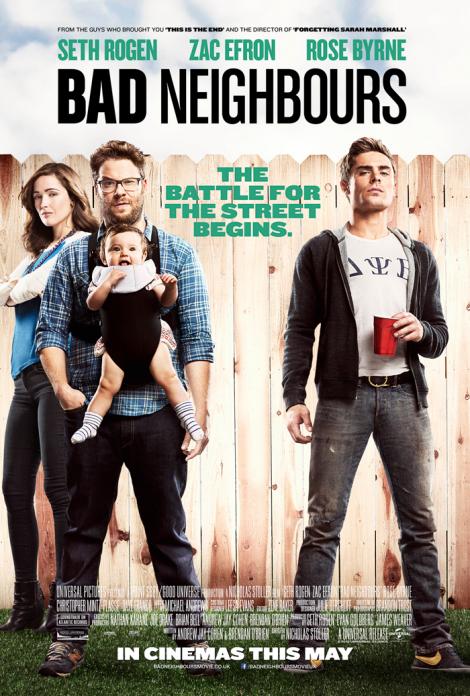
BAD NEIGHBOURS review

Starring: Seth Rogen (Pineapple Express), Zac Efron (Hairspray), Rose Byrne (X-Men: First Class), Dave Franco (21 Jump Street), Ike Barinholtz (The Mindy Project), Lisa Kudrow (Easy A)

Director: Nicholas Stoller (Forgetting Sarah Marshall)

Writers: Andrew Jay Cohen & Brendan O’Brien

Runtime: 1 hour 36 minutes

Release Date: 3 May (UK), 9 May (US)

The frat house comedy is a subgenre that just never dies. Ever since John Landis kick-started the trend with Animal House, every couple of years there comes along a movie that tries to become its generation’s Animal House. Revenge of the Nerds, Van Wilder, Old School, the list goes on. So how does Bad Neighbours (or just Neighbors as it is called in the US, changed overseas likely to avoid confusion with a certain Australian soap opera) fare against such a wide fair of similar offerings? Does it pass the test and join the fraternity, or is this one pledge that’s going to chicken out?

Image

Bad Neighbours is a breath of fresh air for the genre mainly because it views the proceedings from a fresh perspective. The film is primarily from the point of view of the sensible adults for once but without making them look like spoilsports. They call out the frats on their behaviour, but they also get in on the fun every once in a while and even end up doing some devious stuff themselves. But that’s not to say that the frats themselves are one-dimensional obnoxious twats, no sir. Their perspective is painted with just enough sympathy that you never hate them completely even when they go over the line. The film manages to strike a good balance between the two sides, never making either one seem too despicable whilst still making both of them funny and entertaining. The story even manages to have morals better written than most comedies of this ilk, with Seth Rogen and Rose Byrne’s characters learning to be responsible adults without becoming curmudgeons, and Zac Efron coming to realise that his life as a party animal is coming to a close. It’s effort like this that makes Bad Neighbours that much more entertaining and not just a lazy hodgepodge of sex and stoner gags.

Seth Rogen may not have much range as an actor, but he’s dependable and always worth a few laughs. He is playing a somewhat more responsible character with a job, a wife and a kid on his shoulders, but he’s still the pot-smoking dunderhead we’ve all come to love. His chemistry with Byrne is surprisingly good, working off each other both comedically and emotionally well enough that I bought them as a couple. Zac Efron, much like Rogen, has also been somewhat typecast as the pretty boy for most of his career and he’s always been, somewhat unfairly, thrashed about. Sure, he was in those High School Musical movies, but every other Hollywood teen crush was in a similar position at some point in their careers. Efron has proven himself to be a pretty decent actor at points (see the criminally underrated Me & Orson Welles for proof of that), and in Bad Neighbours he both transcends expectations and does well doing so. He manages to be everything you want from a stereotypical bro-douche, but imbues his role with enough character and motivation that he comes off like a somewhat real person and not someone you want to punch in the face, and he even plays off against Rogen startlingly well. It’s the most surprising comedic turn I’ve seen from an actor since Channing Tatum in 21 Jump Street, and I’d be happy to see him continue in this fashion. The rest of the cast works but don’t get a lot of focus. Dave Franco is pretty good; especially when opposite Efron (a scene where they exchange plentiful variations of the “bros before hoes” mantra is a particularly good moment). Ike Barinholtz also gets some good laughs, but everyone else just comes and goes. Lisa Kudrow is relegated to two brief scenes, Submarine’s Craig Roberts melds into the background for half the movie before being given something to do, and Christopher Mintz-Plasse feels completely wasted. His subplot with Barinholtz and Carla Gallo is seriously underdeveloped and mostly pointless. Why even hire McLovin if you’re not going to do anything with him?

Comedies aren’t usually where you go looking for a technical extravaganza, but Bad Neighbours does manage to look a bit more distinctive. The party scenes in particular look great, with lots of neon and pastels flying around to give these sections a different feel to the rest of the movie. Brandon Trost has become one of my favourite cinematographers lately, and he again proves he can make anything look cool. This is the guy who shot Crank 2, what else would you expect?

Bad Neighbours works because it puts in far more effort than you’d expect. It’s got all the laughs you want from a frat house comedy, but sweetens the deal with a well-conceived screenplay, relatable human characters, and excellent performances to carry it all. It’s not exactly revolutionary, but it is a lot of fun.

FINAL VERDICT: 8.5/10

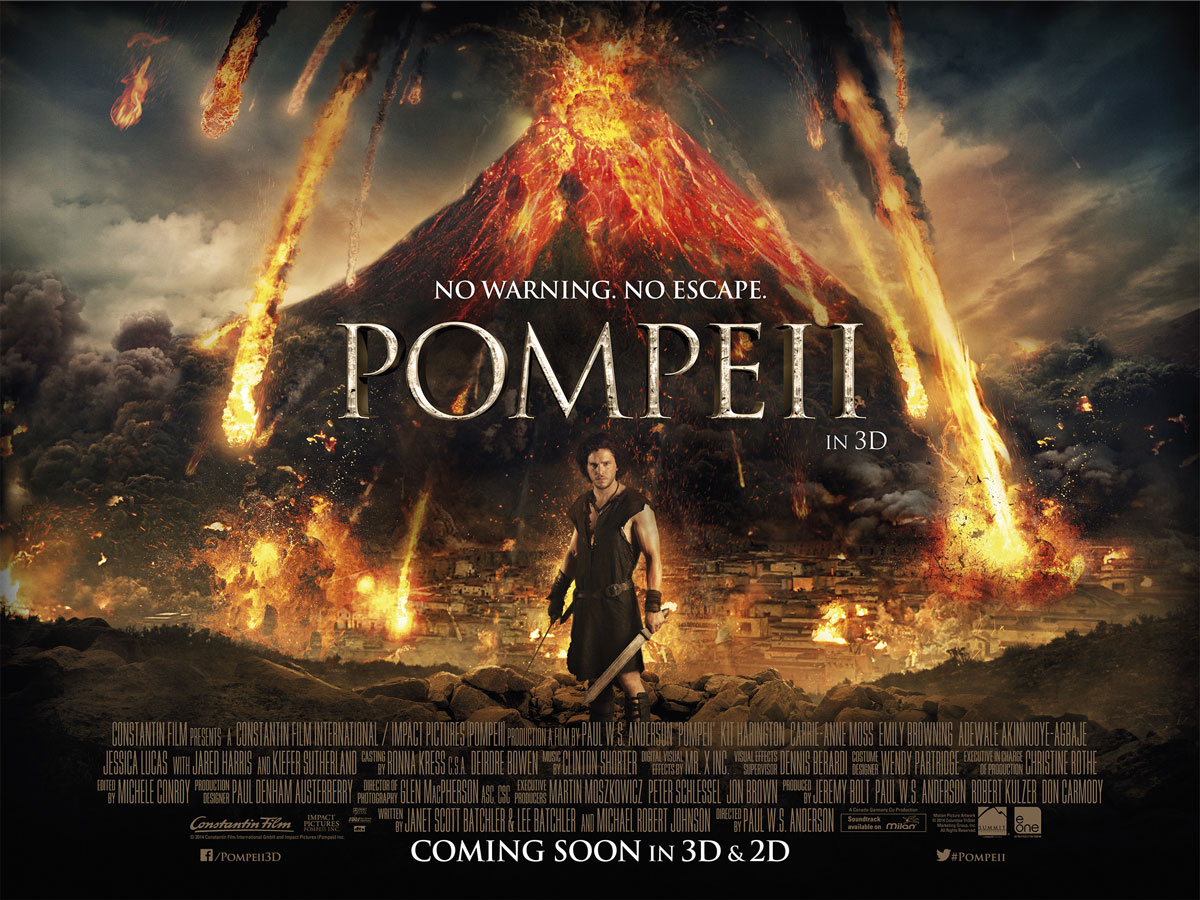
POMPEII review

Starring: Kit Harington (Game of Thrones), Emily Browning (Sucker Punch), Adewale Akinnuoye-Agbaje (Lost), Jared Harris (Sherlock Holmes: A Game of Shadows), Carrie-Anne Moss (The Matrix), Kiefer Sutherland (24)

Director: Paul W.S. Anderson (Resident Evil)

Writers: Janet Scott Batchler & Lee Batchler (Batman Forever) and Michael Robert Johnson (Sherlock Holmes)

Runtime: 1 hour 45 minutes

Release Date: 21 February (US), 30 April (UK)

Films based around real events are tricky, doubly so when those events are very well known so everyone knows how it ends, and quadruply so when that ending is “everyone dies” (don’t you dare say that’s a spoiler). Pompeii is all of these things, and it would take truly deft hands to manage to make a film like this enthralling and worthwhile. Unfortunately, Paul W.S. Anderson lacks those hands.

Image

The story of Pompeii is so simple and derivative, it can be summed up in no more words than it would take to do an elevator pitch: it’s Gladiator meets Titanic. No need for more than that. Just take all the major elements from those two films, mash them together, and fill in the blanks with other clichés. That is it. It feels this script was written to cash in on the success of those two Best Picture winners, but it’s been made way too late for it to be relevant. Everything in this film is taken wholesale from other better movies that you’ve most likely seen, but without any semblance of depth or investment. You spend most of the movie going through drab, uninteresting drama just waiting for that volcano to finally go off, and if you forget it’s there the filmmakers have been kind enough to ominously cut to it every ten minutes or so to remind you “Oh yeah. It’s coming.” The film at least moves at a decent clip, making sure your boredom is short-lived.

A film as generic as this could be carried by some strong lead performances, but Pompeii can’t even muster that much. Kit Harington is already one of the weaker links on Game of Thrones, but as a leading man here he is just terrible. His stone-faced demeanour and emotionless voice add nothing to a character that is already as uninteresting as a water biscuit. Faring even worse is Emily Browning, who seems to be playing a doll whose been magically brought to life but lacks a human soul. I don’t know; it’s only explanation I could come up with that explained her painfully wooden delivery. Her and Harington completely lack chemistry, not helped by the fact that these star-crossed lovers barely share three scenes together before disaster strikes. Kiefer Sutherland is at least interestingly bad, hamming it up to dangerously high Jeremy Irons-levels of scenery chewing, playing a bad guy so unquestionably evil that all he’s missing is a scene where he kills a henchman who “failed him for the last time”. Only two actors escape out of this disaster somewhat respectfully. The first is Jared Harris, mainly because he looks confident and dignified enough to make this tripe sound convincing. The other is the great Adewale Akinnuoye-Agbaje (names like that make me glad these reviews are written, not spoken), who manages to provide the only pieces of humanity this film has. Sure, he’s basically playing the exact same character Djimon Hounsou played in Gladiator, but he’s convincing enough in the part that the film gains a small amount of credibility whenever he’s on screen.

I will give Anderson this much: he does have a decent understand of the technical stuff. The film looks fine on a cinematography level, if a bit generic. The editing can be choppy, especially during fight scenes, but is otherwise OK. The music is a bit repetitive but does give it a good sense of scale, and the production design is colourful and sets the scene well. The special effects department is clearly where the money went on the picture, as all the stuff with the volcano and the destruction caused by it does look pretty nice. But without a solid foundation, all of these details feel like a fine curtain used to mask a shoddy product.

Pompeii is bad, but not at all in the interesting way. It’s derivative and tedious, without an original thought in its head on any level. The story is bland, the acting is stiff, and the dialogue is laughable. Paul W.S. Anderson isn’t a completely talentless hack, he’s made some entertaining movies in his time like the genuinely creepy Event Horizon and the enjoyably cheesy Mortal Kombat (still the best video game movie ever), but too often he ends up making uninspired dreck like this. Skip this movie, because more than likely you’ve already seen a much better version of it.

FINAL VERDICT: 2.5/10