ONCE UPON A TIME IN HOLLYWOOD – an Alternative Lens review

Starring: Leonardo DiCaprio (The Revenant), Brad Pitt (The Big Short), Margot Robbie (The Wolf of Wall Street), Emile Hirsch (Speed Racer), Margaret Qualley (The Nice Guys), Timothy Olyphant (Deadwood), Austin Butler (Yoga Hosers), Dakota Fanning (Man on Fire), Bruce Dern (Nebraska), Al Pacino (Scarface)

Writer/Director: Quentin Tarantino (Pulp Fiction)

Runtime: 2 hours 39 minutes

Release Date: 26th July (US), 14th August (UK)

Quentin Tarantino, love him or hate him, is always going to be a legend of cinema. He’s a man whose zest for and knowledge of the form is all encompassing down to the tiniest detail, and that unbridled passion has made him the messiah figure of many a film fan. Now (supposedly) coming to the end of his cinematic career with his penultimate film Once Upon a Time in Hollywood, an ode to the era and style of filmmaking he loves so much, it feels like a perfect time and subject matter for Tarantino to really lay down his thesis on his career and film itself. In reality however, Once Upon a Time in Hollywood isn’t that movie. It’s trying to be at times, but it’s simultaneously trying to be several other movies too, and in trying to be about everything it ends up being about nothing.

Set in the world of film and television circa 1969, Tarantino’s latest is an unfocused and ambulating affair that never quite sets a tone other than “Tarantino flick”. Clocking in at over two and half hours, the film spends much of that runtime meandering through several storylines connected by mere threads, with their relevance to each other and the ultimate point of the film only becoming clear right as the credits start rolling. The first two acts are quite slow and deliberate, with much time spent on quieter, dialogue-free scenes of characters just driving and listening to tunes woven between the usual Tarantino banter. However, just as the pacing seems to settle into a good grove, the third act suddenly leaps it into high gear as we are rocketed through a massive time jump with excessive narration that feels somewhat unnecessary.

The whole affair feels haphazardly put together, with large swaths of story clearly left on the cutting room floor (with the end credits even noting major actors who’ve been excised), and yet the final product still feels unwieldy. Taking many scenes on their own merits, they are fantastically well put together and deserving of a far better movie than this. There’s a brilliant story in here about a Hollywood has-been trying to come to terms with his status in the industry, with some great introspection into not only the Hollywood machine but Tarantino’s career itself. Unfortunately, it seems like the director couldn’t let go of his own vices, with the film leaping into full-on fantasy in the third act in a way that makes complaints about the finales of Inglourious Basterds and Django Unchained seem pithy. The way it weaves in real world events feels far less justified than Tarantino’s previous historical efforts, and it might have been better if that subject matter had been the focus of its own film or just cut entirely. With it, we have a self-indulgent and esoteric conclusion that will leave viewers unfamiliar with the true events confused, whilst leaving those who do know with a lot of questions about not only how but also why. As the film comes to a close and the film’s message finally dawns, what you’re left with is an egocentric and juvenile piece of revisionist fan fiction that is completely oblivious to its own contemplative possibilities.

When Quentin Tarantino says he’s going to make a new movie, pretty much everyone in the industry wants a role, and with his career coming to an end it seems like he just decided to cast everybody in case he never got to work with them. This is a film jam-packed with stars, with many barely even getting a line before their role is over, but luckily the acting is what ultimately saves Once Upon a Time in Hollywood from being a complete waste of time. Taking centre-stage is Leonardo DiCaprio as washed-up heavy Rick Dalton, and his performance is absolutely fantastic from start to finish. There are so many layers and nuances to his character, making him an endearing yet unpredictable character to follow. It’s just a shame that his arc feels thrown off-course by the film’s end, and ultimately his story would have been better served if you excised it from the rest of the film and cut off before the third act. Brad Pitt is equally brilliant as Dalton’s stunt double and best friend Cliff Booth, bringing a laid-back affableness to a darkly funny character; he’s exactly the kind of guy you love even though he kind of scares you too.

Margot Robbie gives a sweet and understated performance as Sharon Tate, but from a plotting level the film gives her very little to do other than be a symbolic figure. The rest of the cast is so overstuffed it’d take forever to go through everyone, so just be rest assured that no one gives an especially bad performance. However, there are a few names that deserve shout-outs. Firstly, Margaret Qualley is utterly charming and yet unnerving in the role of Pussycat, holding her own against Pitt and once again proving herself a young actor to watch. Then there’s Mike Moh, who gives a spot-on turn as Bruce Lee and has fun with playing an exaggerated version of the legendary martial artist’s persona. However, the star that comes out of nowhere and steals every scene she’s in is Julia Butters as the precocious young method actor Trudi. Her scenes with DiCaprio are among the film’s best, and made me wish the whole movie was just about these two actors at opposite ends of their careers learning from each other.

If you know the aesthetics of a Tarantino movie, you know what to expect here. So many of his film’s have adopted the aesthetics of 1960s B-movies in the past, making one set in the period around the world of B-movies is basically second nature to him. Everything from how the locations have been retrofitted to the fashion of the costume design and even the poster art for Dalton’s fictional films is all beautifully brought to screen with love and attention. There’s some fantastic camera work and editing throughout, with the sequences emulating period films being the main standout in how they emulate the cinematography and artifacting of those old prints and TV broadcasts. Of course, no Tarantino movie would be complete without a fantastic soundtrack, and this film is plenty packed with contemporaneous rock hits both well known and obscure, and I’m sure many a film fan will start associating these songs with the scenes from this movie as a point of reference.

There is so much to like and even love about Once Upon a Time in Hollywood within the details, but when put all together with the film’s narcissistic thesis, the final product is far from the sum of its parts. There’s a much, much better movie hiding in plain sight within this, and it feels like Tarantino either didn’t know what he had or didn’t care. He feels like a slave to his own aesthetics and influences, constantly reaching back to not only his reference films but also his own work instead of forging out something new. It’s easily his weakest film to date, and with only one more supposedly to go, one would better hope he goes out with a bang and not a whimper.

FINAL VERDICT: 5/10
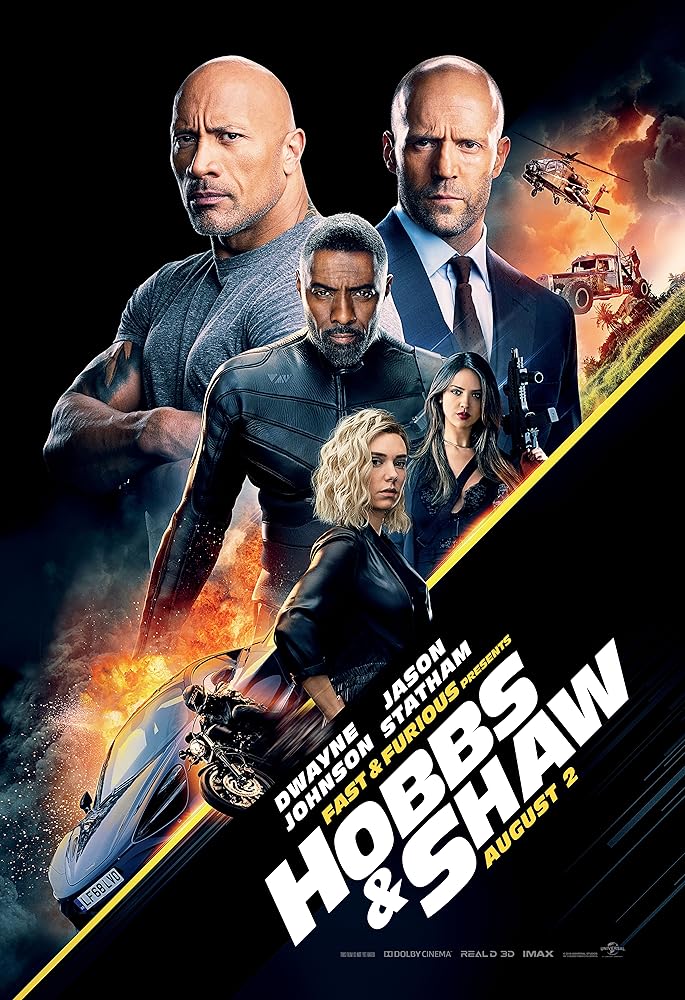
FAST & FURIOUS (PRESENTS): HOBBS & SHAW – an Alternative Lens review

Starring: Dwayne Johnson (Jumanji: Welcome to the Jungle), Jason Statham (Crank), Idris Elba (Thor), Vanessa Kirby (Mission: Impossible – Fallout), Eiza Gonzalez (Baby Driver), Helen Mirren (The Queen)

Director: David Leitch (Deadpool 2)

Writers: Chris Morgan (Wanted) and Drew Pearce (Iron Man 3)

Runtime: 2 hours 15 minutes

Release Date: 1st August (UK), 2nd August (US)

So Fast & Furious 8 (The Fate of the Furious for you Yanks) was a pretty decent movie, eh? I mean, it was hardly the best film in the franchise, but it was a lot of fun and proved the series still has plenty of interesting sharks left to jump. For many audiences, the big surprise was the unexpected chemistry between Dwayne Johnson’s Luke Hobbs and Jason Statham’s Deckard Shaw, so much so that many thought a spin-off just about them would be a neat idea. Well, it seems Universal had the same thought, and so now we have Hobbs & Shaw. Does the focus on these two bickering knuckleheads bring new life to the franchise, or can you really have too much of a good thing?

For the first time since arguably Tokyo Drift, Hobbs & Shaw is thoroughly understandable without prior investment in the franchise (though familiarity with it, especially the eighth instalment, does help). Now less constrained by the car-centric perspective of its mother series, the story now feels more opened up to dabble in all kinds of ridiculous blockbuster spectacle, and with it the series trajectory towards the fantastical has only increased. This film has now leapt into the territory of superhero movies, with biomechanically enhanced soldiers, viral super weapons and Darwinian technology cults now thrown into the mix without an eyelid bat. The film wastes no time throwing these leaps in logic at you either, and if you’re willing to roll with the punches it only makes the experience that much more ridiculously enjoyable. Anybody going into this movie expected anything other than an implausible extravaganza in Hollywood excess is completely missing the point.

With that said, that jump in irreverence does come with a less-welcome leap into self-depreciation. Hobbs & Shaw is easily the most overtly comedic entry in the series thus far, with barely a scene going by without some kind of one-liner or sly wink at the audience. In moderation, this twist in tone helps to differentiate the film from its forbearers, but at many points it oversteps the mark into cloying and unnecessary. The new framing inevitably throws off the film’s balance, which results in not only an oversaturation of comedy but the story’s actually sincere moments coming off far cheaper. The Fast & Furious franchise since the fifth instalment has thrived not just because they’ve grown increasingly ridiculous, but because they’ve retained a po-faced sensibility in spite of it, and that’s ultimately far funnier because it’s not overtly trying to be.

If you liked the way Johnson and Statham played off each other in Fast & Furious 8, you certainly get more of that in Hobbs & Shaw. Their never-ending squabbling and one-upmanship is certainly still entertaining, and the two actors share a much more natural chemistry than Johnson ever has with Vin Diesel, but their rapport also feels stretched to the absolute limit here. Their relationship fails to evolve satisfyingly, with the pair cycling through the same set of jabs over and over again until the third act, when their differences are ultimately resolved because the plot needs them to. Lacking their own tangible evolution or identity, the film simply falls back on the “it’s all about family” themes of the other films, and as is it’s basically just two hours of these two trading yo mamma jokes interrupted by the most ridiculous action scenes this side of Con Air.

As the villainous Brixton, Idris Elba absolutely knows what kind of film he’s in and relishes the opportunity to go full ham. He’s just as naturally charming as ever, but there’s a sadistic joy to his performance that makes him a perfect adversary for Hobbs & Shaw, but I wish there was a little more to his motivations than just “I believe I am a supreme human and the world must be culled because this mysterious cult person says so”. Stealing much of the film away from even our leads is Vanessa Kirby as Shaw’s secret agent sister Hattie. She’s an absolute delight from her first moments on screen, matching (if not besting) the boys not only in the action but in the comedy too. The film occasionally runs the risk of just turning Hattie into a plot token/damsel, but the film does its best to fight against those expectations and so much of that is down to Kirby’s performance. Seriously, she deserves to not only come back in future Fast & Furious instalments, but someone please give Kirby her own blockbuster franchise. As for the rest of the cast, it’s mostly just an avalanche of cameos from a wide spectrum of Hollywood talent, with some of them arguably having more screen time than credited cast members. I won’t spoil them all given the marketing hasn’t, but much like the rest of the film their wink-and-nudge presence constantly threatens to push the entire film into outright farce.

David Leitch has more than proven himself as a talented action director by now through John Wick, Atomic Blonde and Deadpool 2, and with Hobbs & Shaw he finds the perfect balance between his own penchant for grounded, tightly-choreographed brawls with Fast & Furious’ tendency to ignore all the laws of physics. Every set piece here would be the standout in any other summer blockbuster, but that’s just a testament to Leitch’s ability to stage action with an attention to detail most of his contemporaries don’t even aspire to. There’s the occasional moment when the film succumbs to quick cuts and tight cinematography, but for the most part this is a fluidly shot and executed piece of action cinema. Tyler Bates’ score for the film is suitably bassy and rock-influenced, but as usual it’s the film’s soundtrack that takes centre stage, and this film threatens to rival Suicide Squad at points for the number of needle drops throughout its runtime. Heck, Idris Elba even raps on the soundtrack! How much more 90s action blockbuster can you get?

The best Fast & Furious movies know they’re stupid but try not to act like it. Hobbs & Shaw admits its stupidity early on, and your mileage with its tone may vary from there. This is undoubtedly the most brazen and flat-out insane film the franchise has offered thus far, and within it are some of the best moments of the series period. However, the movie is often too high on its own supply, stuffing its overlong running time with self-aware digs at itself and celebrity cameos that somewhat detract from the delusional fun of it all. If you’re a fan of the franchise or either of the film’s stars, you’re probably going to have a blast with this, and it certainly needs to be seen on a big screen for the full effect. However, if they’re going to continue on with Hobbs & Shaw as their own sub-franchise, we need to get past the childish quarrelling and give the characters somewhere else to grow. The next film could involve them fighting space iguanas on a guacamole planet whilst riding unicycles for all I care about story logic, but there needs to be more to them than just The Odd Couple hopped up on Mountain Dew.

FINAL VERDICT: 7/10

THE LION KING – an Alternative Lens review

Starring: Donald Glover (Solo: A Star Wars Story), Seth Rogen (Long Shot), Chiwetel Ejiofor (12 Years a Slave), Alfre Woodard (Luke Cage), Billy Eichner (Difficult People), John Kani (Black Panther), John Oliver (Community), Beyoncé Knowles-Carter (Dreamgirls), James Earl Jones (Coming to America)

Director: Jon Favreau (Iron Man)

Writer: Jeff Nathanson (Indiana Jones and the Kingdom of the Crystal Skull)

Runtime: 1 hour 58 minutes

Release Date: 19th July (US, UK)

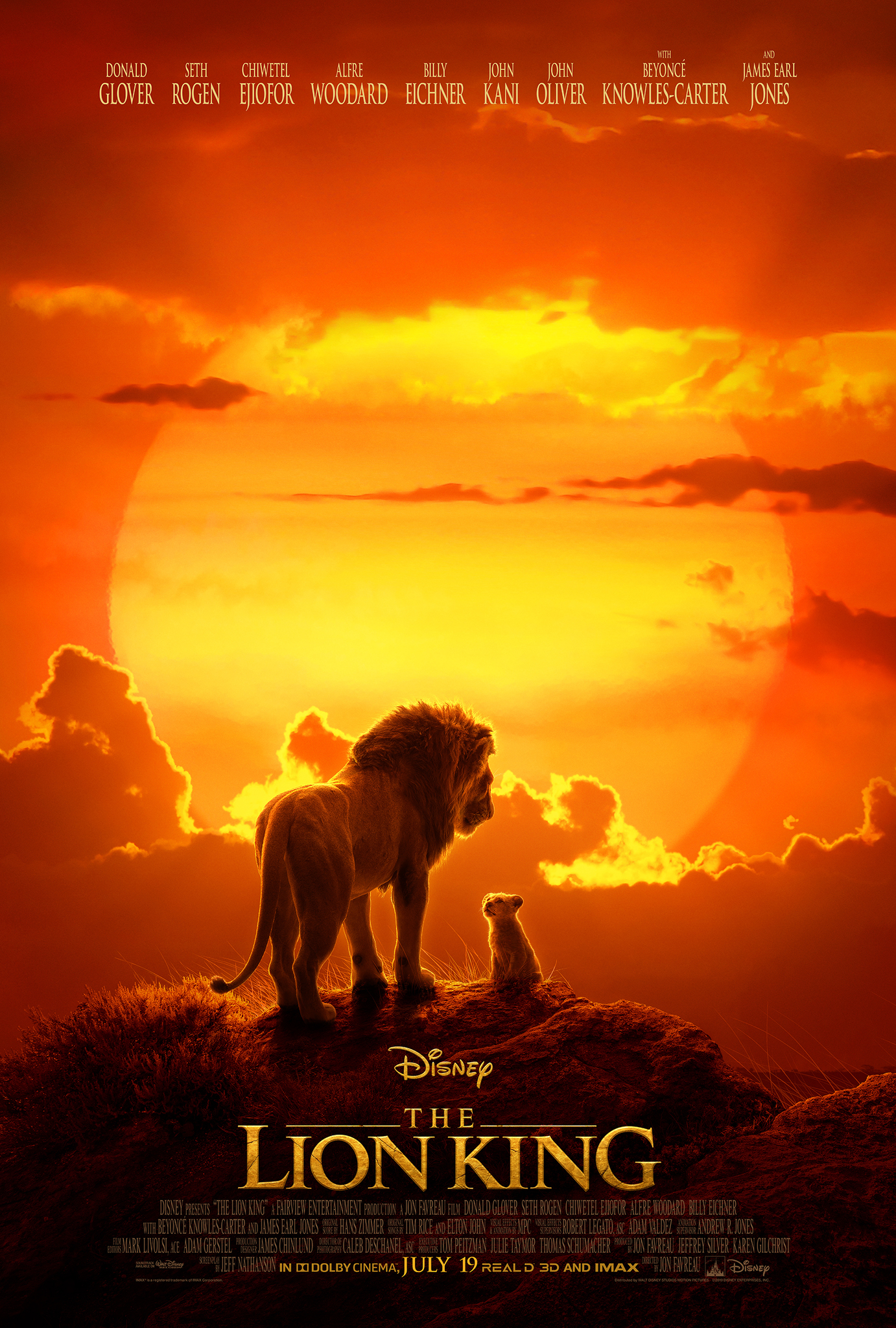
A lot of people like to make the hyperbolic statement that Disney’s live-action remakes are literally shot-for-shot, and so far that has not been the case at all. Some like Aladdin and Beauty and the Beast have stuck very close to the script whilst also making (for better or worse) slight alterations, but there are just as many like Cinderella and Dumbo that have taken the original film and expanded them into something new; not that examples of the latter have always been necessarily better.

However, Jon Favreau’s reimagining of The Jungle Book balanced that line perfectly, crafting a beautiful and unique film that many would argue was an improvement on the original. Jumping from that success to remaking one of Disney’s most iconic films in a similar fashion makes sense in many ways but is also absolutely insane. Whilst The Lion King isn’t an absolutely perfect film (no film is), to many it is a childhood classic with few meaningful issues to be addressed, and it doesn’t exactly lend itself to a traditional live-action adaptation. Beyond adding more fuel to the Disney machine, what purpose does this remake serve? Having now seen the final product, I can say the film never delivers a satisfying alternate answer.

If you’ve seen The Lion King before, there is pretty much nothing in the 2019 version that will surprise you. More so than any previous Disney live-action adaptation, this is a film that beat-for-beat follows its progenitor, right down to using much of the same dialogue. Though the film now runs half an hour longer, not much has been added of significance; the only noticeable additions are some extended nature sequences and a lot of ad-libbed gags. The story itself is still well told and briskly paced, and the themes about reconciling your past with your future and learning the responsibilities of leadership are as timeless as ever, but the film makes little effort to make you forget about what you already know and see the story in a new light. If anything, the film only draws attention to your memories of the 1994 classic, only making it easier to draw comparisons and rarely does the remake come out the victor in those. For members of the audience unfamiliar with the original, most of these issues won’t be applicable and those viewers will likely have a far more enjoyable experience, but for the initiated watching this film is like having constant déjà vu for two straight hours.

From a casting perspective, Disney has admittedly done a fantastic job of recasting all of these iconic characters. It is especially welcome that (unlike the original) this feature set in Africa has a predominantly black cast and, though on paper the story is much the same, there is certainly an effort amongst many of the actors to give these characters a different dimension. Donald Glover makes for a charming and relatable Simba, giving the character a slightly more jaded millennial edge, whilst his childhood counterpart JD McCrary is spirited and childlike in all the right ways. Though hardly a scratch on Jeremy Irons’ fabulous performance, Chiwetel Ejiofor has a more menacing take on Scar that reframes the character as less incompetent and more imperious; much like with Jafar in this year’s Aladdin, the removal of the queercoding aspects of the character does make the character less problematic but also robs him much of his charm.

Beyoncé Knowles-Carter feels a bit underused as Nala, as does Alfre Woodard as Sarabi, but they do well with the material given to them, whilst John Kani gets far less to do as Rafiki as his counterpart did in the original. Much of the film’s best moments come from its comedic characters, as its clear the actors have been let loose to improvise and have fun with the material. Keegan-Michael Key and Eric André are quite fun as a pair of bickering hyenas, and John Oliver is an absolutely genius piece of casting as Zazu, but the film is easily stolen from the moment they appear by Billy Eichner and Seth Rogen as Timon and Pumbaa. Whilst their performances do owe a lot of debt to their originators Nathan Lane and Ernie Sabella, the bickering pair do make the characters their own and are responsible for every unique and memorable moment this film has to offer.

Much has been made about the unique way this new Lion King was made and whether to classify the film as live action, animated, or something new entirely. From a technical perspective, the film is basically flawless. The quality of the animation and visual effects is so precise and lifelike that it’s hard to believe not a single live-action element was used. Much of the production is shot in a manner to evoke a nature documentary, and for certain sequences that framing absolutely adds to the film’s verisimilitude. However, as much as the new technology impresses at first glance, not only does its splendour wear off quickly but it also hampers the film’s storytelling.

Yes, giving the film a grounded, photo-real aesthetic does look gorgeous at first, but doing so immediately means sacrificing everything visually appealing about the film’s musical sequences. Yes, the fact that all the characters are animated exactly like their real animal counterparts is an impressive feat, but those restrictions mean no range in their facial expressions to humanise them. There’s no denying what the filmmakers have done here is an impressive feat for modern filmmaking technology, but if anything retelling this story in such a naturalistic way only goes to highlight why the original was told in the animation style it was.

Of all the soundtracks of the Disney Renaissance, The Lion King easily has the most iconic; there’s not a song on that playlist that hasn’t become a classic. For the most part, the new film’s reinterpretations are solid if not exactly remarkable. “Circle of Life” is practically indistinguishable from its previous incarnation, whilst “I Just Can’t Wait To Be King” is given some freshness mainly thanks to Oliver’s new interjections and greater infusion of African harmonics. “Hakuna Matata” is as funny as ever and again Eichner and Rogen’s performances lend it a lot of charm, whilst Glover and Beyoncé have a surprising amount of musical chemistry in “Can You Feel the Love Tonight”.

The only classic song to be drastically reworked is “Be Prepared”, which has totally lost its bombast and become more of a more subdued sing-talk interlude; it’s obvious it was a last-minute addition after there was some backlash it was going to be cut. There are two new songs, but neither are actually numbers weaved into the narrative. Beyoncé’s “Spirit” simply plays in the background during one quick sequence, whilst Elton John’s “Never Too Late” plays over the credits. Both are perfectly fine examples of songs by their respective artists, and I do somewhat prefer this approach to shoving a new song in just to bait a Best Original Song nomination at the Oscars, but neither are a patch on the originals.

2019’s The Lion King is basically just a feature-length tech demo that tells its story competently but without any of the magic traditional animation allows. Compared to many of the other Disney remakes, this one has almost too much reverence for the original, resulting in a film that’s inoffensive but absolutely unnecessary. When compared to the original, there’s nothing this film does that is distinctly better than its predecessor, and because of that I can only recommend this to absolutely diehard Lion King fans. Otherwise, if you want that nostalgia kick or are thinking of introducing your kids to this story, just go watch the original instead. It’s a timeless film, whilst this will doubtlessly age as all CGI eventually does. I mean…have you actually tried watching Avatar again lately?

FINAL VERDICT: 5.5/10

BLINDED BY THE LIGHT – an Alternative Lens review

Starring: Viveik Kalra (Next of Kin), Kulvinder Ghir (Bend It Like Beckham), Aaron Phagura, Dean-Charles Chapman (Game of Thrones), Nell Williams (London Town), Rob Brydon (Swimming with Men), Hayley Atwell (Captain America: The First Avenger)

Director: Gurinder Chadha (Angus, Thongs & Perfect Snogging)

WritersSarfraz Manzoor, Paul Mayeda Burges (Bride & Prejudice) and Gurinder Chadha

Runtime: 1 hour 57 minutes

Release Date: 9th August (UK), 14th August (US)

It seems the summer of 2019 is becoming a hot bed for movies where a single musician or band’s discography serves as a focal point for the narrative. We’ve already seen Rocketman and Yesterday give us cinematic extravaganzas to the tunes of Elton John and The Beatles, but instead of a flashy Hollywood number for Bruce Springsteen’s turn we instead get the indie Brit flick Blinded by the Light. Something of a spiritual successor to director Gurinder Chadha’s breakout hit Bend It Like Beckham, it too focuses on a teenager from a South Asian background living in England and finding themselves through a western pastime their parents disapprove of. However, even with those comparisons, Blinded by the Light does just as much to differentiate itself from Chadha’s previous work and the recent crop of musician-based films, and it’s those differences that make it stand out and proud.

Based on the memoir by co-screenwriter Sarfraz Manzoor, Blinded by the Light paints a vivid portrait of a Thatcher-era Britain rife with unemployment, far right nationalism and xenophobia; a stark reminder that the country has been where it is now before. Much of the base plot should be familiar to anyone who has seen a coming-of-age story, but the particular way it expresses itself feels refreshing and true-to-life. Protagonist Javed’s journey from repressed Muslim boy to rebellious Springsteen stan doesn’t immediately solve all of his problems, and it acknowledges that his newfound passion doesn’t make him better than anyone else. After so many stories where these kinds of characters are portrayed as prodigies in a backwards community who have all their problems solved by a mantra, it’s relieving to see one where it recognises this kind of obsession cannot completely dominate one’s life, and should ring true to anyone who found a musician/author/filmmaker/artist that spoke so closely to them in their youth. This honest portrayal of fandom not only helps ease the film over its more formulaic plot elements, it emboldens the film’s ultimate message about how music can transcend all barriers and can inspire anyone to do anything.

For his leading debut, Viveik Kalra is perfectly suited to the timid and ingenuous Javed. He’s occasionally too naïve for his own good and Kalra is still clearly a relatively rookie actor (his performance isn’t helped by some occasionally clunky on-the-nose dialogue) but his sincerity and boldness propels his performance greatly. Aaron Phagura is also endearing as Javed’s fellow Springsteen fan Roops, and Nell Williams feels astutely cast as his civil rights activist love interest Eliza, whilst Dean-Charles Chapman (near-unrecognisable from his days as Tommen on Game of Thrones) is equally solid as childhood mate Matt. Rob Brydon adds some charming comedic relief as Matt’s father, and Hayley Atwell as Javid’s teacher adds that required dose of Dead Poets’ Society-like inspiration and encouragement. Even some of the smaller supporting roles, like David Heyman as Javid’s neighbour Mr. Evans and Marcus Brigstocke as Eliza’s conservative father, add a lot of welcome flavour. However, the film’s MVP is absolutely Kulvinder Ghir as Javid’s demanding father Malik. Though he fulfils many of the stereotypes of the traditionalist South Asian patriarch, there’s a depth and pain to his performance that humanises him, and the film never wisely paints him as an outright villain.

Just as much as the film captures the atmosphere of 80s Britain, it also captures it visually. There are plenty of films and TV shows set in the 1980s these days, but so many of them feel like an exaggeration of the period, whilst Blinded by the Light grounds the iconic fashion statements and music trends as close to reality as it can. There’s an authenticity to every detail of the design, and for every Flock of Seagulls hairdo and leg warmer on display there’s a Margaret Thatcher poster and some Islamaphobic graffiti that brings it all back to reality. There are plenty of other great 80s tunes on the film’s soundtrack, but obviously there is a heavy focus on Bruce Springsteen. Featuring many of his period-appropriate hits, the film accentuates The Boss’ words through its visual storytelling by letting them speak for themselves, highlighting how his lyrics speak to Javed’s life without being cloying. I can see not only fans of Springsteen getting a kick out of hearing his songs in a new light, but also younger viewers being turned on to his music through it; it certainly has had me playing “Born to Run” on repeat since watching it.

Blinded by the Light is a joyous summer romp that celebrates creativity, freedom, and learning to define one’s own destiny. Its reflection upon Thatcher’s Britain feels raw and more relevant than ever, and uses Springsteen’s words to deftly dispute the conservative mindset of the era. It perhaps has some wind taken out of its sails by how familiar many of its narrative turns are, especially to Chadha’s previous work, but everything new it has to say absolutely needs to be heard. If you need a break from either the glut of Hollywood blockbusters and/or the degrading political climate, this is exactly the feel-good flick you need in your life right now.

FINAL VERDICT: 8/10

MIDSOMMAR – an Alternative Lens review

Starring: Florence Pugh (Lady Macbeth), Jack Reynor (Sing Street), William Jackson Harper (The Good Place), Vilhelm Blomgren, Will Poulter (Detroit)

Writer/Director: Ari Aster (Hereditary)

Runtime: 2 hours 27 minutes

Release Date: 3rd July (US, UK)

Horror is one of the easier genres to learn as a first-time filmmaker, but it’s also arguably the hardest to master. There’s a reason the genre has become so homogenous over the years, with hundreds released every year but only a select few standing the test of time. It takes a unique perspective and a vivid imagination to stand out amongst the pack, and writer/director Ari Aster is among the latest to be lauded as a horror auteur thanks to his debut feature Hereditary.

Now I’m going to say something that I think might get me mauled in most critic circles: I didn’t particularly like Hereditary. I think it’s a very well made film with some fantastic visuals and performances, but in terms of story and character it was derivative and underdeveloped; at its core, it’s just another possession movie. For a first-time director, these kinds of faults can be forgiven, and it’s hard to deny from a stylistic point-of-view that Aster hasn’t established himself a trademark aesthetic. For his ambitious follow-up Midsommar, one would hope that the director would mature and grow to rely less on tropes and references. Sadly, I fear all of the praise Aster received for Hereditary may have blinded him to his faults, as Midsommar proceeds to make every mistake its predecessor made on an even grander scale.

If you’ve seen any horror movie involving a vacation and/or a cult, the plot of Midsommar is not going to surprise you in the slightest. From the moment our protagonists arrive at the eerily pleasant commune, every plot beat is practically laid out for you, and it becomes less a game of figuring out what will happen and more when; given the film’s intentionally slow pacing, the answer is usually “as late as possible”. There’s certainly an intention in the way the film signals towards twists and makes blatant references to other movies, but not in a fashion that feels particularly profound or unique. The entire story essentially feels like one giant drawn-out joke, but you figured out the punchline hours ago and it’s not even very funny. There are admittedly a few strong out-of-nowhere disturbing moments, but they are few and far between when most of them are telegraphed from a mile away. Judging by the abundant number of abandoned plot threads and irrelevant lore thrown in, the entire production simply feels like the filmmakers had way too many ideas and didn’t know what to do with most of them.

Hereditary’s main saving grace was its awards-worthy leading performance by Toni Collette, and here rising star Florence Pugh delivers a similarly haunting portrayal of an anxiety-ridden woman on the brink of sanity even before she arrives in this perpetually sunlit nightmare. As Dani, Pugh does a fantastic job of mining every raw emotion out of her character, so it’s a shame that there’s actually very little on the page for her to work with. Outside of her aforementioned mental state and faltering relationship with boyfriend Christian (Reynor), there’s not much to Dani as a character and she has very little agency in the story; everything just sort of happens to her.

Jack Reynor does a fine job playing the boyfriend who knows it’s too awkward to break up right now, but his story outside his relationship with Pugh feels unnecessary and slapdash; it doesn’t even get properly resolved or amount to anything. Rounding out the main cast are Christian’s friends, who are all arch character types only made somewhat distinctive by the actors playing them. William Jackson Harper’s Josh is basically just a less neurotic version of Harper’s character on The Good Place, Vilhelm Blomgren is little more than a vessel for exposition dumps and obvious foreshadowing, whilst Will Poulter’s sex-obsessed Mark is so unlikable and so obviously dead meat that he feels like he walked out of an Eli Roth movie.

As much as Midsommar doesn’t satisfy on a story level, it is admittedly a gorgeous-looking movie. Much of that credit lies at the feet of cinematographer Pawel Pogorzelski, who paints every frame with a beautifully ornate palette; any shot from this movie would be the best shot in any other movie. The detail that’s gone into the production design is equally astounding, even if some of its attempts to combine creepy with quaint come off as too obvious. With that said, there are a lot of visual ideas blatantly copied from other movies; obscure ones, yes, but obvious to any hardcore cinephile out there. The editing, though torturously drawn-out at times, always knows exactly when to cut for maximum effect, with its effectiveness in the scene transitions being especially solid. The film’s score by The Haxan Cloak is also at the right level of disturbing, combining Swedish folk music with eerie strings to create the ideal creep factor.

Some are going to claim I simply didn’t get Midsommar. My retort: I did get it. I just didn’t like it. With both this and Hereditary, what Ari Aster is aspiring to is obvious and somewhat admirable. He’s essentially seeking to revitalise the aesthetics of arthouse horror films of the 1970s (specifically films like Suspiria, The Wicker Man and Don’t Look Now) but with a modern self-awareness. However, the results are so unfocused as to be rendered neither particularly scary nor clever, and what’s left is an experience that flits between being tedious and being unintentionally hilarious. To craft a film this elaborate and aesthetically stunning and yet feel so hollow, Aster has to be either a massive troll or incredibly conceited, and I’m not sure which I’d prefer to be the truth. All in all, Midsommar is less akin to the classic Wicker Man and more like the Nicolas Cage remake, and not just because both of them feature a bear costume.

FINAL VERDICT: 4/10

SPIDER-MAN: FAR FROM HOME – an Alternative Lens review

Starring: Tom Holland (The Impossible), Samuel L. Jackson (Captain Marvel), Zendaya (The Greatest Showman), Cobie Smulders (Jack Reacher: Never Go Back), Jon Favreau (Chef), J.B. Smoove (Uncle Drew), Jacob Batalon (Blood Fest), Martin Starr (Adventureland), Marisa Tomei (My Cousin Vinny), Jake Gyllenhaal (Nightcrawler) 

Director: Jon Watts (Cop Car)

Writers: Chris McKenna & Erik Sommers (Jumanji: Welcome to the Jungle)

Runtime: 2 hours 9 minutes

Release Date: 2nd July (US, UK)

It was only a few months ago that the Marvel Cinematic Universe seemingly ended but, like the comics that inspired them, the story keeps on going and going and going. As the first one out of the gate in this new realm, Spider-Man: Far From Home has a lot of weight on its shoulders. Not only does it have to serve as a follow-up to both Spider-Man: Homecoming and Avengers: Endgame, but it also needs to reassure audiences that this universe isn’t going anywhere just yet. Any other franchise would look at expectations like that and decide to leave on a high, but Far From Home dares to leap off that cliff edge to not only survive, but fly high.

Picking up not long after the events of Endgame (and tidily dealing with the consequences of that film without dwelling on it too much), Far From Home takes Peter Parker out of his comfort zone swinging around New York and off on a pan-European trip, all whilst still juggling his high school dramas with saving the world. Much like Homecoming, the film has a heavy meta narrative about Spidey’s place in the MCU, particularly where he stands as a hero post-Infinity Saga, and it’s all handled very deftly. Most pleasingly, Far From Home takes some welcome notes from the Sam Raimi playbook and ups the heart factor massively, giving it that necessary distinctive quality that Homecoming lacked; this is a Spider-Man movie that takes place in the MCU, not an MCU movie that happens to star Spider-Man, and that’s the way it should be.

The story moves at an energetic pace, retaining that John Hughes quality to deliver one of the funniest entries in the MCU, whilst also delivering some of the best action sequences ever in a Spidey flick. Though the film only vaguely gestures towards the future of the greater franchise, it does intelligently play with established lore to fuel its story, paying off moments you never even knew were left dangling. All in all, this is more of a victory lap for the MCU rather than a preview of things to come, but it’s a well-earned and brilliantly executed success.

Now in his fifth performance as the webbed wall crawler, Tom Holland has had more opportunity to explore Peter Parker now than any other feature film actor, and here he’s better than ever. This is easily the most relatable Spidey has been since Raimi’s Spider-Man 2, and Holland absolutely nails Peter’s insecurities and anxieties about being a hero whilst also being a charming leading man and a gifted comedian. Whilst there is a disappointing lack of screen time for Tony Revolori’s Flash and Marisa Tomei’s Aunt May this time around, plenty of other returning characters get their deserved chances in the spotlight. Chiefly, Zendaya’s MJ gets a lot more to do this time around than just stand in the back of scenes and make quips, and she is absolutely hilarious and endearing in every moment she has. Jacob Batalon is as goofy and adorkable as ever as Peter’s best friend Ned, and his subplot with Angourie Rice’s Betty adds a cute little undercurrent to the grander story.

Martin Starr and J.B. Smoove make for great comedic relief as the trip’s bumbling chaperones, Jon Favreau adds a much-appreciated sentimental quality in his return as Happy Hogan, and though Samuel L. Jackson and Cobie Smulders are relatively underused as Nick Fury and Maria Hill, the payoff to their roles is absolutely worth it. However, there is not denying that Jake Gyllenhaal’s outstanding performance as Quentin Beck/Mysterio absolutely steals this movie. I wish I could gush about why he’s so great, because there is a lot to say and praise, but I won’t because the marketing has rightly kept his role tight-lipped. Instead, I’ll just say this: if you love Mysterio from the comics, you will not be disappointed.

Homecoming was director Jon Watts’ first big-budget feature and his inexperience showed in places, but here he seems far more comfortable orchestrating on this scale. Far From Home is a visually spectacular piece of entertainment, only rivalled by Into the Spider-Verse in terms of delivering a page-accurate translation of a Spidey comic book. The action sequences take full advantage of the hero’s abilities and physicality more than any previous live-action interpretation, and the globetrotting nature of the story gives a greater sense of variety after so many films stuck with the same New York backdrop. The Mysterio sequences are especially jaw dropping, taking some cues from Doctor Strange to deliver some mind-bending imagery that feels ripped straight from the comic pages. Michael Giacchino returns again to score and deliver yet another rousing series of Spidey anthems, whilst Watts’ soundtrack choices are yet again an inspired collection of rock and pop classics both obvious and obscure.

Spider-Man: Far From Home is maybe not the best Spider-Man movie, but it is perhaps the most Spider-Man movie. It’s not as quintessential as Spider-Man 2 or as imaginative as Into the Spider-Verse, but it makes a strong case for itself as the most fun Spidey adventure yet. It does everything that made Homecoming great and fixes its few remaining flaws, and is easily the best second entry in an MCU sub-franchise since Captain America: The Winter Soldier. There are so many more places for Spider-Man to go in this universe, and this film absolutely promises that the story isn’t stopping any time soon.

FINAL VERDICT: 9/10

YESTERDAY – an Alternative Lens review

Starring: Himesh Patel (EastEnders), Lily James (Baby Driver), Kate McKinnon (Ghostbusters), Ed Sheeran (Games of Thrones), Joel Fry (Paddington 2)

Director: Danny Boyle (127 Hours)

Writer: Richard Curtis (Notting Hill)

Runtime: 1 hour 56 minutes

Release Date: 28th June (US, UK)

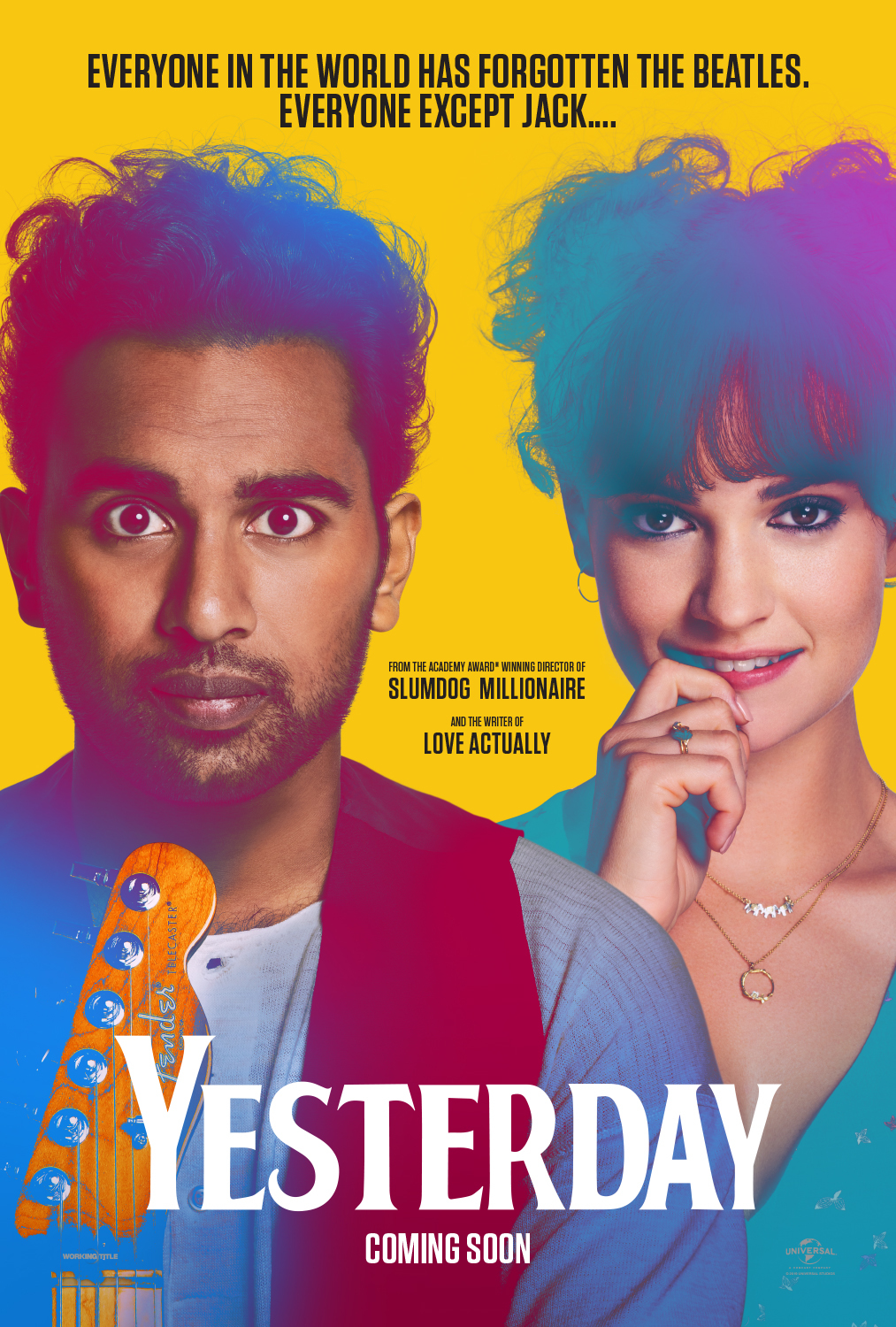
A movie directed by Danny Boyle, written by Richard Curtis, and featuring the music of The Beatles? If this film were any more British, you’d probably have to crown it king or something. Those credentials would be enough to sell many film fans sight unseen, but Yesterday’s premise of a musician who is the only one in the world who remembers the legendary Liverpudlian band that makes this team-up that much more special. Unfortunately, whilst there are individual elements of Yesterday that shine, the final product is a cinematic trifle with conflicting flavours.

Yesterday wastes no time in getting to its killer hook, but it’s in so much of a rush it forgets to satisfactorily establish its main players. It’s plainly obvious from even the opening scenes that the film has been heavily trimmed in the edit, with transitions between beats often feeling abrupt, along entire scenes and even characters featured in the marketing being nowhere to be seen. The individual pieces are fine enough, but it doesn’t help make the story flow in a natural and satisfactory way. Additionally, once you take away its unique selling point, this is a little more than a standard rags-to-riches music industry story. In a landscape currently overcrowded with films like Bohemian Rhapsody and Rocketman to name a few, there’s little other than its cute fantastical twist to set it apart.

Luckily, what the film lacks in storytelling it makes up for with humour and heart. There’s thankfully no attempt to explain how or why The Beatles (and several other mainstays of pop culture) have been suddenly wiped from existence, and it’s a gag that manages to keep evolving every time it about to get stale. It also takes its fair share of jabs at the music industry and British culture in general, some of which are expected whilst others are hilarious gag marathons. When the film decides to get sentimental, there’s a lot of the usual tugs at heartstrings Curtis is known for, and as tired as they are they’re still surprisingly effective. However, there is one reveal towards the end that I expect will floor certain people, which I won’t dare spoil here.

If nothing else, Yesterday should serve as a starmaking turn for lead Himesh Patel, who shines in the lead role of Jack Malik. His befuddled British everyman charm brings to mind the best parts of early Hugh Grant, but he gives them a modern cynical edge that works equally for both comedy and drama. Lily James is as charming as ever and has fantastic chemistry with Patel, though her character feels a little underwritten at points and their romance often comes off as contrived. Kate McKinnon also feels neglected as conniving manager Debra Hammer, delivering a performance that neither lets her be her usual unhinged self nor shows us a new dramatic side; she’s just the expected asshole music exec with little requirement for McKinnon’s idiosyncratic talents. Surprisingly, the two most enjoyable performances come from Joel Fry as Malik’s dimwitted roadie Rocky, and Ed Sheeran playing himself. Sheeran is by no means a great actor, but his reserved and matter-of fact performance often delivers quietly comedic gold, and his willingness to lampoon his own persona and career adds a needed layer of self-deprecation.

From a filmmaking perspective, Danny Boyle and Richard Curtis are actually very different when you think about it. Whilst Boyle loves to experiment with genre and technique, rarely delivering an expected product, Curtis is usually quite happy with the basics whilst letting the writing and actors take focus. These two styles sometimes blend brilliantly in Yesterday, whilst at other points they fail to mesh. There’s a lot of visual flair like gaudy scene transitions and constantly varying lighting and colour grading, which often clashes with the conventional content of most scenes and lacks motivation. For example: when Malik and Rocky first meet in the story, there’s a quick scene establishing their friendship whilst walking through a music festival. So far, so basic. But for some reason, this basic character exposition scene has been entirely shot at an extreme Dutch angle for no real reason. Nothing said is eerie or odd, nothing fantastic is going on screen. It’s just two guys walking and talking about their lives. Why does this scene need to be shot this way, other than to show off?

Now for a movie featuring extensive covers of classic Beatles tracks, you’d hope the filmmakers would do something really special with the material. The result is respectful and occasionally daring, but is mostly pretty unremarkable. There’s a few tracks that have been modernised in a cool way, but otherwise they don’t sound that distinct from any average bloke strumming them on their own guitar. None of them particularly ruin the song, but very few manage to stand out either, and for a movie about music that’s a big letdown. The film doesn’t do a great job of weaving them into the narrative either, settling to do either the expected (playing “Back to the USSR” when they go to Russia, for example) or just throwing in a song somewhere because it’s recognisable. The plot does make the point that Malik doesn’t fully understand the context of many of the songs, but it’s hardly an excuse to just throw songs in without proper motivation.

Yesterday shows so much potential to be fun and joyous when moments are taken in isolation, but as a whole the experience is jumbled hodgepodge. The humour is spot-on, the actors give it their all, and even if the covers aren’t spectacular it’s still The Beatles, but it just never adds up to something greater than the sum of its parts. Ultimately, the film feels like yet another victim of post-production meddling, yet from the final product it’s actually hard to pinpoint what was the source of the disruption. If I had to guess, I’d say it comes to down to Boyle and Curtis’ styles not meshing, and I think the film might have ended up feeling more cohesive if it fully belonged to one filmmaker or the other. If the premise has you sold or you’re a Boyle/Curtis completionist, I can’t say you’ll have a bad time. For everyone else, maybe it’s best to just let it be, at least until the home release.

FINAL VERDICT: 6.5/10

CHILD’S PLAY – an Alternative Lens review

Starring: Aubrey Plaza (Safety Not Guaranteed), Gabriel Bateman (Lights Out), Brian Tyree Henry (Widows), Tim Matheson (The West Wing), Mark Hamill (Star Wars: The Last Jedi)

Director: Lars Klevberg (Polaroid)

Writer: Tyler Burton Smith (Quantum Break)

Runtime: 1 hour 30 minutes

Release Date: 21st June (US, UK)

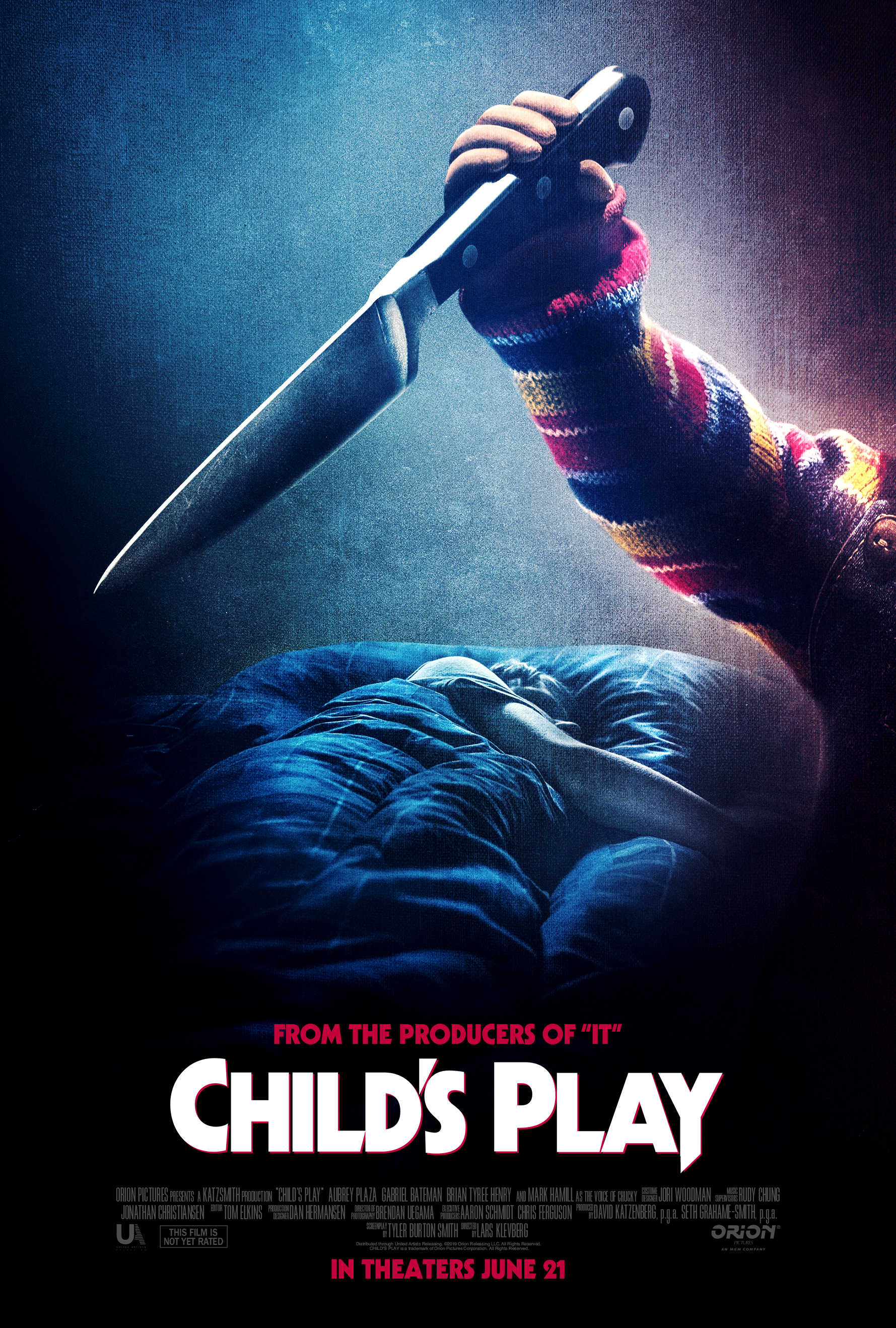
The original Child’s Play and the Chucky series as a whole is a fascinating little piece of horror history, representing one of the weirdest and more idiosyncratic franchises the genre has ever produced. Evolving from a simple but well-executed killer doll story into a sprawling saga that varies wildly in tone, those movies are still going strong to this day still under the wing of creator Don Mancini, with not only more sequels but a television series and a potential crossover with A Nightmare on Elm Street actively in the works. However, because Mancini doesn’t actually own the rights to the original film, the folks over at MGM have been able to remake it themselves without even his express permission; I’ll let you guess how he feels about that. That lack of respect from the outset is an immediate demerit for this new incarnation, so it has a real uphill battle in proving it has a right to exist. But despite itself, Child’s Play ends up being a solid little horror/comedy on its own terms, delivering more of an alternative take on the original rather than an attempt to supplant it.

Junking the supernatural premise of the original film in favour of a technophobia-fuelled angle, the film at least deserves some credit for not just being a beat-for-beat rehash of the original, whilst still having just enough threads of the original remaining to not feel completely removed. Though the new approach robs the film of some of its unique identity, it certainly hasn’t lost the tongue-in-cheek value of the original and is in many ways more overtly comedic (at least when compared to the first film). If you’ve seen any film about technology gone wrong, you won’t be particularly surprised by where Child’s Play goes, but it certainly has fun getting there and makes some witty observations about humanity at present on the way. There is some weak plotting in spots, with the whole “morally-detached tech company in control of everything” aspect feeling a bit staid, and the prologue detailing Chucky’s new origin is especially lame and meaningless; it would have been far better off giving a simpler, more matter-of-fact explanation. But getting past that, there’s a sick sense of childlike glee underneath it all as it dishes out gory kills and twisted jokes, which makes it more than clear that the filmmakers are rightly not taking this too seriously. Let me put it this way for the horror buffs out there: at one point, the characters watch The Texas Chainsaw Massacre 2. If you know that movie’s tone, you should know what to expect from the new Child’s Play.

When it comes to iconic slasher movie villains, Chucky may not be one of the most famous but he is easily one of the more distinctive, and a lot of that is rightly owed to Brad Dourif’s performance as the character. Unlike many of his peers who rely on stature and an iconic look, Chucky is a personality-driven killer in the vein of Freddy Krueger, and finding someone else to fill those shoes effectively is incredibly difficult. Thankfully, Mark Hamill is more than up to the task of making Chucky his own. Rather than an outright monster from the start, this Chucky’s descent into serial killing is more gradual and comes from a place of irreconcilable computer logic and misplaced ethics rather than simple psychopathy. Hamill’s performance is just as simultaneously scary and funny as Dourif’s, but in more of a deadpan childlike way. Rather than the shock of a foul-mouthed voice coming from an innocent toy, Hamill’s has more the eeriness of a toy saying increasingly messed-up things in a credulous manner. It’s a performance that stands up to the original whilst being its own thing, though I do question where exactly they can take this Chucky that could rival the wild evolution the original has gone through should they keep this incarnation going.

On the human end, Gabriel Bateman makes for a relatable and compelling update of Andy Barclay. Rather than an innocent 6-year-old, this Andy is a socially awkward teen whose bond with Chucky is far more nuanced and deeply fraught, and Bateman does a good job of escalating his performance from adolescent apathy to a frenzied pitch of anxiety. This version of Andy is also hearing-impaired, which at first seems like an interesting touch but unfortunately the plot doesn’t take much advantage of this. Aubrey Plaza plays to her deadpan strengths but also manages to put in some genuine profundity as Karen Barclay, and she makes the mother-son relationship with Bateman feel really sweet and unique especially given the minute age difference. Brian Tyree Henry adds some nice comedic flourishes as Detective Norris, whilst Beatrice Kitsos and Ty Consiglio are also a lot of fun as Andy’s newfound friends Falyn and Pugg.

It’s easy to generalise that all remakes these days end up gutting the more taboo elements of their source material, but this Child’s Play is not only gorier than the original but also has far more devious sense of humour. The film takes a fair bit of influence from the Saw franchise, with Chucky’s antics relying more on manipulating technology than just running around with a knife, which leads to some fun kills that’ll make you laugh and squirm in equal measure. It’s a shame there aren’t enough of them, especially in the promising climax that doesn’t go nearly as batsh*t as it clearly wants to. The new design for Chucky is a little off, making him feel like a store brand knock-off of himself, but the practical animatronics used to create him are impressive enough to overcome it. Bear McCreary’s score is also suitably moody, though there is an annoying reliance on horror music clichés and riffs; after he so ably avoided falling back on this in his score for Godzilla: King of the Monsters, that’s quite disappointing.

When you stack the two films against each other, both versions of Child’s Play are about as good as each other. This is thankfully a remake that isn’t just trying to copy its inspiration, and actually uses the premise to communicate new ideas. At the same time, even though it brings many fresh concepts to the franchise, many of those aren’t wholly original in and of themselves. More than anything, the new Child’s Play is essentially Joe Dante’s Small Soldiers with an R rating and a more vicious comedic edge, but that’s not necessarily a mark against it. The original film never hid the fact it was a homage to the cheesy horror films of the 1950s (that film and its sequels frequently pay direct tribute to Ed Wood movies after all), and so in turn it only makes sense for this film to emulate the spirit of the genre films of the 1980s. If you go into Child’s Play knowing that, you are probably going to have a good time. It’s hardly the most necessary remake, and I do fear how it will affect the future of Mancini’s still-ongoing series, but taken on its own terms it delivers a faithful throwback horror experience.

FINAL VERDICT: 7/10

TOY STORY 4 – an Alternative Lens review

Starring: Tom Hanks (Saving Mr. Banks), Tim Allen (The Santa Clause), Annie Potts (Ghostbusters), Joan Cusack (School of Rock), Wallace Shawn (The Princess Bride), John Ratzenberger (Cheers), Tony Hale (Arrested Development), Keegan-Michael Key (The Predator), Jordan Peele (Keanu), Keanu Reeves (John Wick), Christina Hendricks (Drive)

Director: Josh Cooley (Riley’s First Date?)

Writers: Stephany Folsom (Star Wars Resistance) and Andrew Stanton (WALL-E)

Runtime: 1 hour 40 minutes 

Release Date: 21st June (US, UK)

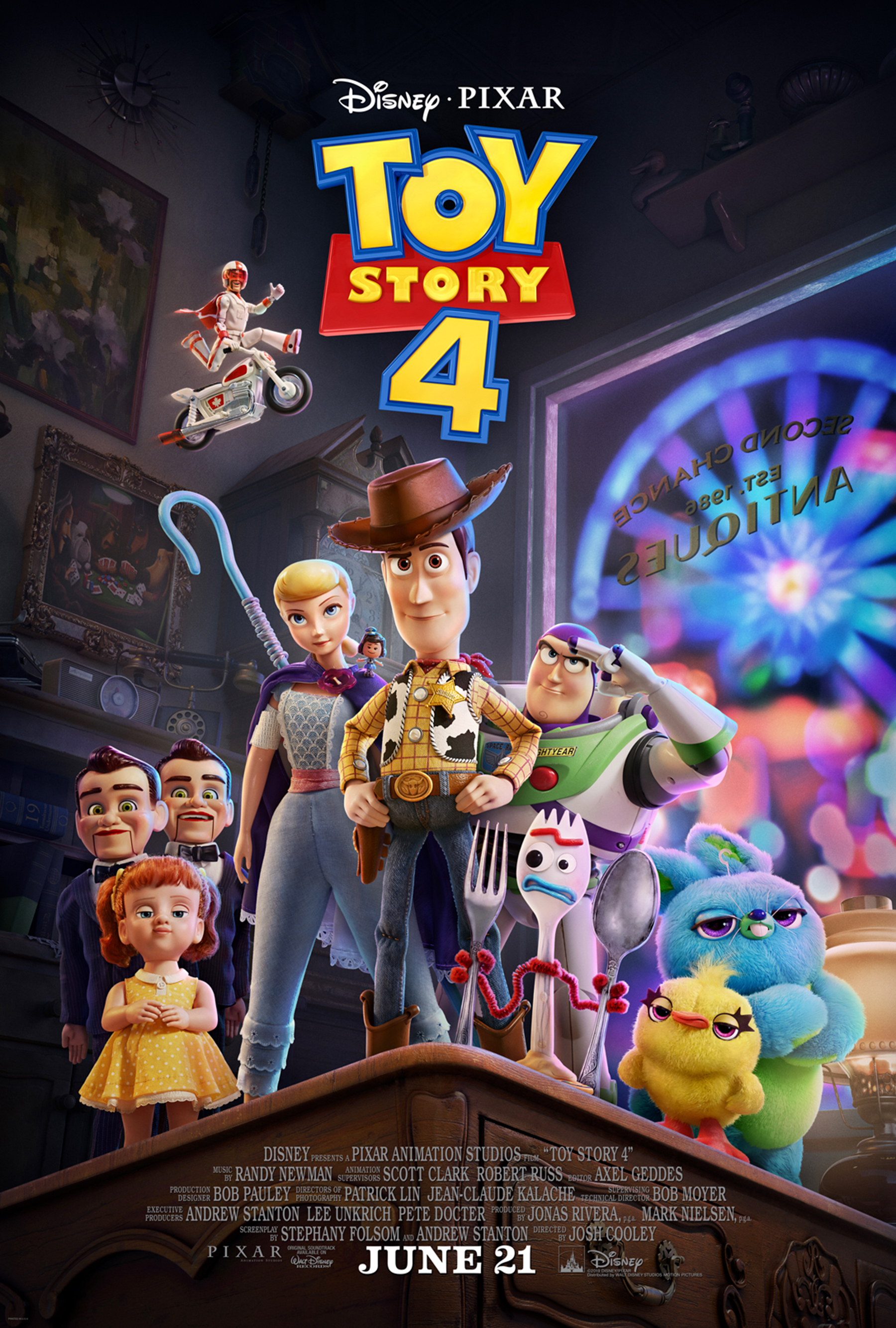
From the moment Toy Story 4 was announced, the reaction was predictable and absolutely justified. After Toy Story 3 had so perfectly tied up the series in a perfect bow, it seemed like saying anything more would just be unnecessary. Pixar’s run of sequels since the third entry has also been spotty, ranging from fun but inferior to serviceable to…Cars 2, so I’m not at all surprised by the backlash; no one wants to ruin a perfect streak. However, having now finally seen it, I’d say that the scepticism of many fans may end up playing to the film’s favour, because Toy Story 4 defies expectations yet again to prove it has more than enough reasons to exist.

After a brief but heart-wrenching prologue, the film picks up not long after the events of Toy Story 3 and once again finds Woody in the middle of another philosophical conundrum. There are certainly past themes echoed throughout the film, ruminating again on the role of toys to humans and whether they can serve a different purpose, but despite this Toy Story 4 never feels like a rehash. The plot structure will be relatively familiar to long-time fans, with the usual constant ticking clock and ever-present threat of being lost or destroyed, yet it keeps things moving so briskly and introduces you to so many adorable new characters and contemplative ideas that it’s hard to care. In true series fashion, it puts the emotional stakes above everything else, and absolutely finds new ways to make audiences cry. Though it admittedly doesn’t quite have that same sense of greater existential crisis and nostalgic finality as its direct predecessor, it wisely instead aims to drive a smaller, character-focused point home. To go too into the specifics would ruin the impact, so I’ll put it more esoterically: if Toy Story 3 was the cinematic equivalent to tearfully saying goodbye to your childhood, Toy Story 4 is like finally putting your life into perspective and realising what you actually want to do with it. That’s a lesson adults should be learning just as much as kids.

If I can muster any significant criticism for this movie, it’s that a lot of the returning supporting characters don’t get much to do; most of them don’t even leave the home point at the end of the first act. If you were hoping for a lot of screen time from the likes of Jessie or Rex or anyone not named Woody or Buzz, you may be somewhat disappointed, but in the grand scheme of things it doesn’t really matter. Toy Story 4’s narrative demands a more focused perspective, specifically on Woody, and presents him with his most significant character development since Toy Story 2. His arc directly questions everything he’s fought for over the series, and its resolution absolutely feels earned over not just this film but also the franchise as a whole. Tom Hanks has never been better as the character, with even his noticeably gruffer, aged voice feeling like a poetic reminder of Woody’s storied life. Tim Allen’s Buzz is afforded less depth, with his subplot feeling a little antithetical to some of his previous growth, but it ultimately makes sense on a thematic level if not necessarily on a logistical one. Bo Peep’s return after her absence in the third instalment has been the driving force behind the film’s existence since its announcement, and the filmmakers have done a fantastic job of revitalising her character for the modern era. Reshaped as a kid-friendly nod to the likes of Sarah Connor and Imperator Furiosa, she’s a perfect encapsulation of the film’s messages about reinvention and letting go, and Annie Potts certainly strikes the right balance between delivering a spunky new attitude and the Bo Peep we all remember.

In regards to new characters, Toy Story 4 offers plenty of them that are sure to become fan favourites. Forky is the most prominent, and Tony Hale’s panicked performance perfectly sells a character that could have easily become annoying. The film thankfully lampshades the question about how and why he comes to life, and his relationship with both Woody and the mere concept of free will is constantly amusing and heart-warming. Keegan-Michael Key and Jordan Peele are basically let loose as themselves playing Ducky & Bunny to deliver consistent laughs, Keanu Reeves is a deadpan delight as the Evel Knievel-inspired Duke Kaboom, and even smaller characters like Ally Maki’s Giggle McDimples or Carl Weathers’ Combat Carl get ample moments to shine. Christina Hendricks’ Gabby Gabby is perhaps not as well developed or menacing as prior series antagonists, but she’s easily the most endearing and again precisely compliments the film’s ideas; if I were to nitpick, I’d just say she needed a little more screen time in the second act and she’d be right up there with Stinky Pete and Lotso.

Watching the Toy Story films is like seeing an encapsulation of the evolution of computer animation, chronicling the beginnings of the form right up to the pinnacle of what is possible in the present day. Toy Story 4 is gorgeous from start to finish, and it’s both a nostalgic delight and a reminder of how far we’ve come to see this world realised in such vibrant detail. The concept of a CG film based around toys was chosen because the plastic textures and exaggerated proportions of toys were easier to animate back in 1995, and now with modern advancements the amount of detail ever-present now makes it feel like we were watching the old movies through a layer of Vaseline. It wouldn’t be a Toy Story movie without Randy Newman music, and he once again delivers a jovial but emotionally fraught score, and the film’s accompanying song “The Ballad of the Lonesome Cowboy” is a simple country ditty that packs a lot of hidden punch and feels like an appropriate antithesis to the classic “You’ve Got a Friend in Me”.

Put aside the pessimism for a moment and embrace your inner child, because Toy Story 4 will make your heart melt all over again. Though on the surface it may seem like another trip back to the well, it is acutely aware of its own age and doesn’t try to retcon anything that hasn’t already been perfectly resolved. If more sequels (and, to a greater extent, any film riding the coattails of an established property) took the same level of care in crafting themes as Toy Story 4, we’d be complaining about franchise fatigue far less. In a summer full of sequels and remakes that have underwhelmed critically and/or commercially, it’s a reassuring sign that such a venerable series can still be excellent in this climate, and just goes to prove a point: it’s never that audiences are simply done with a story or a character or a world or a genre. People just want good movies, and if you have good ideas and put consistent effort into them, you can make a good movie out of anything and keep making them until you’ve said everything you need to.

FINAL VERDICT: 10/10!


MEN IN BLACK: INTERNATIONAL – an Alternative Lens review

Starring: Chris Hemsworth (Rush), Tessa Thompson (Creed), Liam Neeson (Taken), Rebecca Ferguson (Mission: Impossible – Fallout), Kumail Nanjiani (The Big Sick), Rafe Spall (The Ritual), Emma Thompson (Love Actually) 

Director: F. Gary Gray (Straight Outta Compton)

Writers: Art Marcum & Matt Holloway (Iron Man)

Runtime: 1 hour 58 minutes

Release Date: 14th June (US, UK)

The original Men in Black is one of those near-perfect blockbusters that still hasn’t been matched in over two decades, delivering all the spectacle you expect from top-tier Hollywood but having a unique identity and premise that quickly cemented it as a pop culture mainstay. The two sequels, however, did little more than try to recapture the magic of the original, with Men in Black II being a mess of lazy ideas and incompetent plotting, whilst Men in Black 3 was a marked improvement but fairly forgettable. For a franchise with infinite galaxies of possibilities, it felt remarkably shy to try new things, so a fresh perspective was probably the best way to go. Enter Men in Black: International, a spin-off/soft reboot that seeks to majorly switch up the formula and bring the franchise to a new generation. The final result is a fun ride while it lasts and easily the best entry since the original but, though it at least tries to do some new tricks, ultimately it is yet another disposable sequel.

With just one returning cast member and only the slightest wink to the explits of Agents J and K, International finally breaks away from the standard MIB set-up and instead throws our newly-introduced agents into a globetrotting mystery and gives the series a welcome tonal shake-up. It very much takes for granted you already know the rules of the world and jumps right in, allowing it to spend ample time introducing its own twists on the mythology, and in the age of reboots that’s a relieving approach. However, there are still a lot of the bad hallmarks of the prior films here, along with plenty of clichés borrowed from other buddy cop franchises. What mostly works about International is its characters and the interpersonal dynamics between them, but the pacing moves too fast at points for this to be given room to breathe. The film is also structurally a mess, especially the first act (like, why do we start in a flash back to three years ago, then flashback to twenty years ago, and then finally get to modern day?), almost as if the film is in a rush to get to the action. There are a few compelling mysteries within the narrative, but none of them pay off particularly surprisingly and get little time to sink in before the incredibly rushed third act. What International offers in theory is strong, and the plot itself does serve as competent connective tissue for the film’s many set pieces, but everything of substance feels a little undercooked.

Chris Hemsworth and Tessa Thompson made for a great pair in Thor: Ragnarok, so it only makes sense for Hollywood to find them another vehicle to further explore their playful chemistry. Whilst the actors’ natural comedic chemistry is absolutely still in force here, the roles of Agents H and M simply aren’t as strong as their prior sci-fi characters. Hemsworth is basically playing his character from Ghostbusters again, once again nailing the oblivious doofus persona, but even though his general incompetence is a key factor to the plot it never feels justified enough. Thompson fairs a lot better, giving a similar streetwise edge to Will Smith’s J but with a modern feminine edge, and her backstory and motivation make her an immediately compelling POV character. The relationship between H and M is an immediate breath of fresh air after three instalments of the now-stale J and K dynamic, but though it hints at some greater connection down the line their bonding doesn’t feel anywhere near as tight; they do learn from their experiences together, but their arcs feel far from satisfyingly tied up.

The supporting cast is something of a disappointment too. Liam Neeson does what Liam Neeson does best as MIB London head honcho High T, but the opportunity for him to do something truly different is briefly promising then pulled away. Rebecca Ferguson feels tragically underused as an intergalactic arms dealer, whilst Rafe Spall makes the most of a clichéd role as H’s bitter rival Agent C. As the only returning cast member (not counting brief cameos from supporting alien characters), Emma Thompson’s role as Agent O is brief mainly serves to bookend the film; then again, she probably ends up with more screen time here than she had in Men in Black 3. The film’s real stand-out instead proves to be Kumail Nanjiani as the diminutive sidekick Pawny who, whilst serving little plot relevance, is a welcome comic relief presence who always has something funny to say. However, if the character sticks around for a sequel, I’d hope they don’t overuse him.

As much as the original Men in Black was remember for its humour and characters, the world it built was the real showstopper and much of that imaginative design is what kept the later sequels at least visually fascinating. Unfortunately, the lack of director Barry Sonnenfeld and creature designer Rick Baker is blatantly obvious from a visual perspective. Though F. Gary Gray has a firm grasp on the action, delivering slick set pieces with plenty of laughs interjected in between the spectacle, his eye simply lacks the quirkiness that gave MIB its unique identity. The aliens this time around are almost entirely CGI creations, losing the tangibility of the practical effects that made the world feel that much more real. On top of that, the designs often feel too cartoony and even lazy; for instance, all that makes Rebecca Ferguson’s character an alien is an extra arm and a wacky hairdo. Danny Elfman returns to do the score with the assistance of Chris Bacon, bringing back the recognisable themes along with new eerie tunes that fit right in line with the classics, but where’s the tie-in rap song for this movie? I mean, not even Pitbull this time? C’mon, Tessa, couldn’t you have roped in your buddy Janelle Monae to throw a track together or something?

Men in Black: International is that exact kind of blockbuster that’s fun while you’re watching it, but quickly shows its flaws once you actually think about it. There’s a lot that does work here, mainly thanks to the efforts of its capable lead duo and their boatload of natural chemistry, but in the hands of any other team this could have easily been a disaster. Nevertheless, this is certainly the right direction for the Men in Black franchise to go in, but it still hasn’t quite learned to let go of its laurels yet. Next time around, I want to see a return to the dark weirdness of the first film blown up on a larger scale, taking the series in even bolder new directions and creating something wholly unlike its predecessors. The likelihood of that actually happening is slim to none given the track record, but one can hope, right?

FINAL VERDICT: 6/10