WHIPLASH review

Starring: Miles Teller (Divergent), J.K. Simmons (Spider-Man), Paul Reiser (Aliens), Melissa Benoist (Glee), Austin Stowell (Dolphin Tale)

Writer/Director: Damien Chazelle (The Last Exorcism Part II)

Runtime: 1 hour 47 minutes

Release Date: 10 October (US), 16 January (UK)

You can wring intensity out of anything in film; even the simple act of reading can be made nail biting if enough stakes and drama are put behind it. And yet there are so many films where explosions go off and the fate of the world is at stake…and you don’t feel a thing. Whiplash is certainly a film made by someone who understands the power of intensity, and uses it to make a film about jazz drumming so gripping and ferocious that you’ll be on the edge of your seat more firmly than you would during any overblown action sequence.

We’ve all heard the story of the underdog rising the ranks to greatness, where everyone underestimates him and he has to prove himself to become the greatest. Yeah, Whiplash is that story but with any sentimentality or sweetness ripped out through the chest. This is a film that pulls no punches. In fact, it practically assaults you with punches. It is a story that shows the painful cost of pushing yourself too far, but also somehow manages to encourage you to do so. By no means does it encourage the behaviour on display, but it does show that there is a method to the madness. It’s an ambiguous film in message, but not in a vague “eh, I’m not sure” kind of way and that’s refreshing to see. The pacing here is pitch perfect, keeping the threat high but always slowing down at just the right moments to let it sink in. The film does at one point feel like it’s come to its climax and then keeps going, but you’ll be glad it does. The final ending may seem abrupt to some, but it just drives the themes home so well that any more at that point would have been overkill. I know I’m being vague, but you need to go into Whiplash as blind as possible if you want the best effect. Just don’t go in expecting sunshine and rainbows, or you’ll just come out feeling more abused than you should.

Whiplash is really a two-man show, and you couldn’t ask for much better performances than those given by Miles Teller and J.K. Simmons. Teller has been doing solid work for the past few years but mostly in below-average movies, and here he’s finally given some material that allows him to how much talent he actually has. He imbues Andrew Neiman with a lot of complexity, creating a character that is sympathetic but not always likable. You understand where he’s coming from but that doesn’t stop him from being an arsehole sometimes. He’s a flawed human who is being asked to be perfect, and even if he didn’t have a superiority complex that would an impossible task. A scene at a family dinner really drives this home, as Tellar manages to balance that fine line between underappreciated artist and self-aggrandising wannabe. It’s a performance that very much sums up this generation; one full of ego-filled youngsters who think they’re already the “next big thing” and are therefore better than everyone else, unaware that all of them have the exact same idea and have yet to get anywhere near that dream. But as great as Teller is, he’s got nothing on Simmons’ career-defining performance as Terence Fletcher. His ferocity, his demeanour, his crude wit, the way he moves his hands to silence people; all help to create a character that, whilst somewhat OTT, is still a conceivable human being and it’s both wonderful and frightening to behold. But much like how Andrew can fall into being selfish, Simmons also manages to weave bits of sympathy into Fletcher to balance him out too. A scene where he explains his methods and goals to Andrew actually has you getting on his side, but never to the point where he’s redeemed. Simmons most certainly deserves all the buzz he’s been getting for his performance, but to completely overshadow Teller’s efforts would be a crime and he deserves just as much praise.

It’s hard to describe how great Whiplash is, especially when I’m still in awe of it. It’s just something you have to experience for yourself. Damien Chazelle’s directorial feature debut is a simple but engrossing masterpiece of cinema, and I can’t wait to see what he has in store for the future. Miles Teller and J.K. Simmons deliver the best work of their respective careers, ably supported by a sharp script, a jazz soundtrack that can be both electrifying and ominous, and some of the best editing I’ve seen in a long time. But above all, it’s a necessary cautionary tale for anyone aspiring to greatness that never sugar coats itself for one moment. It’s one of the best films of 2014 and my personal pick of the Best Picture nominees as of now, and fans of film, music, or any form of art need to see this movie right away. It may cause you to question your dreams, but it may also encourage you to try that much harder at achieving them.

FINAL VERDICT: 10/10!

BIG EYES review

Starring: Amy Adams (American Hustle), Christoph Waltz (Django Unchained), Krysten Ritter (Breaking Bad), Danny Huston (The Aviator), Jason Schwartzman (Scott Pilgrim vs. The World), Terence Stamp (Superman II)

Director: Tim Burton (Edward Scissorhands)

Writers: Scott Alexander & Larry Karazewski (Ed Wood)

Runtime: 1 hour 46 minutes

Release Date: 25 December (US), 26 December (UK)

Remember when Tim Burton’s filmography was, well, not so weird? Granted, Burton’s never really made anything completely grounded in reality, but there was a time when not everything he touched had to have pale faces, German Expressionist art design, a kooky score with a child choir and the presence of Johnny Depp. Big Eyes is Burton’s return to his slightly less eccentric days and, in many ways, it’s a spiritual successor to Ed Wood (which, if I haven’t mention before on this blog, is my all-time favourite film). Not only does it have the same directing and writing team, but both are also period piece biopic dramadies about an unappreciated artist. Does Burton have the chops to return to more innocent times and tell a realistic tale, or has he spent far too much time in Wonderland to connect with us mortals anymore?

At its core, Big Eyes is essentially about creative expression and its importance to art and artists. Margaret (Adams) is an artist who paints her peculiar portraits in order to express herself. Walter (Waltz) sees the beauty in art, but doesn’t really get the meaning behind it and is more interested in cashing in. It’s a clash of ideals more than simple ownership, and it’s that conflict that keeps Big Eyes alive and interesting. The story is structured in more of an episodic way rather than as a flowing narrative, often relying on large time jumps to get to the juicier action, which does unfortunately make the pacing feel a little stop-start. The film does also sometimes feel a little overstretched even with its modest runtime, but I wouldn’t say I was ever bored. In terms of tonal balance, it’s definitely more of a drama but the comedy does shine through consistently, especially in the final courtroom scenes when the ridiculousness of the situation really comes to light. However, as good as the third act is, I thought the ending was a little abrupt and lacked payoff. After spending three quarters of the film watching this woman living this lie under threat, she finally breaks free…and then the whole thing is satisfyingly resolved but at an alarmingly fast pace that makes the conclusion lose a bit of impact. It’s certainly an entertaining story and one that hits the key beats well, but I think it just needed a bigger kick at the end to really drive it home.

On Burton’s merits, Big Eyes is a fine enough film, but it’s the efforts of Amy Adams and Christoph Waltz that really stands out. Adams’ Margaret may be weak-willed and frightened at first, but there is always that strong moral centre shining throughout that keeps us on her side. Sure, you may want to yell “leave this bastard already” at her several times throughout, but I feel that’s kind of the point and it makes the moment when she finally does that much more powerful. It’s a more subtle and dainty performance from Adams, one that contrasts well with the more slimy Walter. However, Waltz does a great job of not portraying the man as a complete monster from the start; much like how Margaret is swept up by his initial charm, so are we. But when he turns from man of romance to scheming money-grubber to downright despicable, Waltz transforms at the snap of a finger without making a big deal of it and the real power of his performance kicks in. But whether delightful or vicious, Waltz also always manages to inject humour into the character; his final scenes in particular are full of comedy gold as his confidence and lies begin to cause his downfall. His and Adams’ chemistry is fantastic whether deep in love or deep in argument, and their friction is what really makes Big Eyes work especially in those final moments. The rest of the cast is fun though relatively unimportant; Jason Schwartzman has some funny lines as a rival art dealer, and Terence Stamp channels Peter O’Toole’s performance in Ratatouille as a snobby critic who gets into an entertaining conflict with Waltz.

Burton’s pulling back of the gothic is certainly most obvious in the film’s presentation in what is easily the most normal looking movie in his catalogue. That’s not to say it’s bad though, as the work on display here is still excellent and Burtony enough to be recognisably his. He has done an excellent job of mimicking the look and feel of the 50s and 60s not just the authentic production design and costumes, but also through simple but elegant cinematography. Though shot digitally, it retains a vintage look through the use of camera set-ups, lighting and colour grading; it looks so good that I would have thought it was shot in film otherwise. In a similar tonal dampening, Danny Elfman’s score is far more subdued that his usual collaborations with Burton, creating music that is far more fitting to the story’s tone and period setting.

Big Eyes is a welcome return to more conventional filmmaking for Tim Burton, and it’s great to see he hasn’t fully lost touch with reality. Adams and Waltz’s performances ultimately overshadow Burton in terms of wow factor, but that’s not to demean his solid efforts here. The story is inspiring and well-told, though I think it just needed a little more emotional impact to reach those Ed Wood levels of heart and pathos. It’s certainly worth a watch for both Tim Burton fans and those interested in the arts, and I’d certainly prefer to see more films like this from Burton rather than see him return to his old, worn-out habits.

FINAL VERDICT: 8/10

BIG HERO 6 review

Starring: Ryan Potter, Scott Adsit (St. Vincent), Daniel Henney (X-Men Origins: Wolverine), T.J. Miller (How to Train Your Dragon), Jamie Chung (Sucker Punch), Genesis Rodriguez (Tusk), Damon Wayans Jr. (Let’s Be Cops), Maya Rudolph (Bridesmaids), James Cromwell (Babe), Alan Tudyk (Frozen)

Directors: Don Hall (Winnie the Pooh) & Chris Williams (Bolt)

Writers: Jordan Roberts (You’re Not You) and Daniel Gerson & Robert L. Baird (Monsters University)

Runtime: 1 hour 42 minutes

Release Date: 7 November (US), 30 January (UK)

Having acquired Marvel back in 2009, the idea for Disney to use one of the comic book company’s properties as the basis for an animated feature seemed like a no-brainer. The idea to pick a property so obscure it makes the Guardians of the Galaxy seem mainstream is an odd choice, but then again using a lesser-known set of characters allows for a lot more wiggle room; from what I’ve heard, the adaptation is incredibly loose anyway. Regardless, this isn’t really a Marvel movie. It’s a Disney movie, and I’m judging it based on those criteria. How does it fare?

In certain ways, Big Hero 6’s story is very typical of the superhero genre and in others ways it’s very different. On one hand, it follows the basic structure in several key facets: the tragic backstory, the rise of the seemingly unstoppable supervillain, and our hero learning to overcome his problems in order to save the day. It’s predictable for sure, with several major reveals that will probably shock children but seem ho-hum for knowing adults, but the superhero action and breezy comedy helps soften the somewhat cliché narrative. But at its core Big Hero 6 is very much a Disney film, in that it’s more about sending a strong message to kids. In this case, Big Hero 6 is about dealing with loss; the symptoms it causes, what happens when that loss makes you do bad things, and how to move on comfortably. It’s an interesting subject and one that is handled well throughout most of the film thanks to the strong relationship between Hiro (Potter) and Baymax (Adsit). However, the message feels kind of undercut during the third act of the film. I can’t say too much without spoiling the ending, but all I’ll say is that it affects the motivation of the villain and the film ends without giving proper character resolution to his relationship with both the hero and what he was fighting for. It’s a shame, because the topic is handled with maturity and reality with no sugar coating otherwise, and I felt the ending takes an out that mars what the story is trying to get across.

Where Big Hero 6 mainly shines is in its characters and the comedy that is derived from them. Hiro is a simple but likable and intelligent character who acts just right for his age, being curious and imaginative but still prone to childlike faults. On his own he’s perfectly fine, but it’s when he has to interact with his robotic ally Baymax that the fun really kicks in. Adsit’s voice is perfectly attuned and is what mainly sells the character, getting down the robotic annunciation and inflections that so much of his humour is based around but without losing a human touch. Combined with the way the character is designed and animated, and Baymax is a character that I’m sure many children will fall in love with. If nothing else, I’m sure plenty of kids will start doing their fist bumps in a more ridiculous manner because of him. The rest of the superhero team is well balanced and entertaining as well. They do rely on simple archetypes (the tough one, the excitable one, the scaredycat and the doofus), but their personalities play off each other to humorous effect and they all get enough screen time to be distinctive and memorable characters. Maya Rudoplh’s Aunt Cass isn’t given too much to do, but she’s a joy in every scene she gets as the put-upon but chipper matriarch who can’t help but be pleasant even in anger. It’s a strong cast of characters voiced by perfectly cast actors, and my only real fault in this area is the aforementioned lacking villain.

Where Big Hero 6 probably takes most of its cues from its superhero roots is in the design area. The look of the city of San Fransokyo in particular has a very comic book look to it with cartoonish designs and bright colours, which also translates beautifully to the character designs as well. It’s a very appealing film to look at in still frames, but when in motion it really shines. Disney has certainly taken as many cues from Japanese anime as much from superhero movies in terms of the animation, which is awesome to see implemented in a western film without going too far in a Speed Racer-esque way. It’s fast, funny and full of tiny quirks that show the effort the animators put into constructing these environments and characters. Henry Jackman’s music for the film is also strong, combining traditionally uplifting Disney music, the epic feel of superhero movies (of which Jackman has composed several) and tiny pieces of oriental tunes.

Big Hero 6 isn’t quite on par with either Disney’s latest efforts or 2014 in animation, but that is some hard competition to beat. On its own, it’s a fun and highly enjoyable film for all ages that sends an honest and needed lesson for the younger audience. However, the message does feel somewhat undermined by certain events near the end, and the film does suffer from predictability and an undercooked antagonist. The way the ending played out did bother me a fair bit, but the rest of the film works so well that I can overlook it for the most part. 

FINAL VERDICT: 8/10

PS: Stay through the credits, especially if you’re a Marvel fan.

PPS: The short that plays before the film, Feast, is amazing. Adorable, charming and beautifully animated, it’s almost worth the price of admission alone.

THE HOBBIT: THE BATTLE OF THE FIVE ARMIES review

Starring: Martin Freeman (Sherlock), Ian McKellen (X-Men), Richard Armitage (Captain America: The First Avenger), Evangeline Lilly (Lost), Lee Pace (Guardians of the Galaxy), Luke Evans (Dracula Untold), Orlando Bloom (Pirates of the Carribean: The Curse of the Black Pearl), Benedict Cumberbatch (Star Trek Into Darkness)

Director: Peter Jackson (The Lord of the Rings)

Writers: Peter Jackson & Fran Walsh & Philippa Boyens (The Lord of the Rings) & Guillermo Del Toro (Pacific Rim)

Runtime: 2 hours 24 minutes 

Release Date: 12 December (UK), 17 December (US)

Well, the circle is now complete. Peter Jackson’s days telling the tales of Middle Earth are over, and will never see the likes of Bilbo Baggins, Gandalf and the rest ever again. It truly is a closing of the book on many levels, and to think it took thirteen years to bring these six films to the screen makes me feel really old. But in the midst of all of these milestones, I still don’t quite feel the impact, and I think that’s mainly because The Hobbit: The Battle of the Five Armies, for all of its scale and impact, is the least of the entire series.

The final chapter in The Hobbit saga picks up right where The Desolation of Smaug left off and, as entertaining as it is, it resolves itself rather quickly and really does feel like it’s something that should have happened in the last film. The story begins proper about ten minutes later as the build-up to the titular battle begins, and it’s here where once again the series’ severe pacing problems kick in. I get that tension needs to build, but it takes an hour to finally get to the action and all of that build-up is essentially characters repeatedly stating their goals and motivations. It feels dragged out and could have been summarised a little quicker. But then the battle finally begins and, for a good chunk of it, it feels great. The tension pays off, the pacing picks up considerably, and the action on display comes ever so close to Helm’s Deep levels of awesome. But then the battles just keep going and going and going and going and it just becomes exhausting. A good 60% of the film is essentially one giant battle sequence that rarely ever lets up, jumping from one set piece to another at rapid pace, but after so long even that level of ferocity becomes monotonous. Once the battle is finally over (with once again the assistance of the series’ favourite bunch of living deus ex machinas), the film proceeds to wrap itself up quickly and nicely leads into The Fellowship of the Ring, but the ending made me think something I thought I’d never say about a Hobbit film: I think it needed more. Partly because certain plot elements are swiftly wrapped up or forgotten about (what exactly did happen to the Arkenstone?), but mainly because it lacks a sense of closure. After so much time spent with these characters, especially considering this is the last film (even if it isn’t chronologically), I felt the ending really needed a bigger punch. I don’t know if it exactly needed the same extensive epilogue The Return of the King had, but a bigger emotional kick beyond being nostalgic would have helped to make this final adventure feel like a closing of the book.

As much as the films often forget about him, these movies really do belong to Martin Freeman’s performance as Bilbo Baggins. As always, he manages to capture the naivety, honesty and bravery of the character to a T but without losing that complexity brought on by his growing fixation on a certain magic ring. Ian McKellen’s Gandalf never ceases to provide joy, even if his subplot from the last film is quickly resolved and his importance to the plot here is relatively minor; it wouldn’t be a Middle Earth movie without him. I’ve never been too keen on Richard Armitage’s Thorin, mainly because he just seems like an amalgamation of Frodo and Aragorn to me, and I found his corruption shtick here to be a bit tired for the most part. But whenever he and Freeman get a moment together, it really pays off and gives Thorin that sense of humanity (or would that be dwarfity?) he often lacks. Evangeline Lilly puts her all into Tauriel, but her subplot with Kili (Aiden Turner) feels just as tacked-on as it did in the last film and her resolution feels a bit lacking; similar sentiments can be made to Orlando Bloom’s return as Legolas. There’s a lot to cover, so I’ll speed through the rest: Lee Pace as Thranduil is cool but his motivations are weak and unresolved, the importance Lee Evans’ Bard dissipates as the film goes on, Benedict Cumberbatch’s Smaug gets very limited screen time, characters like Galadriel (Cate Blanchett), Elrond (Hugo Weaving), Radagast (Sylvester McCoy) and Saruman (Christopher Lee) are mere cameos, Ryan Gage’s Alfrid is now the film’s major source of comic relief and is otherwise completely disposable, and like always the other 11 dwarves are just kind of there (seriously, most of them don’t even do anything in this one).

Even if I found the action sequences to be overlong, they are still impressive on many levels. The scope of the choreography never ceases to amaze and every blow feels satisfying, amplified by plenty of those OTT feats of action that just make you want to cheer; there’s nothing quite like single-handedly taking out an oliphant, but it’s still pretty cool. I didn’t bother to see the film in 48 frames this time around, but I still found the digital cinematography to be a bit distracting, as it lacks the grit and age of celluloid that a film like this needs. Regardless, the camera work is still fantastic and the production design and costumes look as good as ever. Once again, I’m disappointed by the overreliance on CGI considering how well Lord of the Rings balanced between practical and digital effects, but the quality of it is still up there with some of the best.

The Hobbit: The Battle of the Five Armies gets by mainly thanks to its impressive action sequences, good performances and strong technical feats, but the same pacing issues that dogged the first two instalments are still here. Now that I’ve seen the entire trilogy, I can safely say that stretching out the book to three movies was an unnecessary move that has only harmed the story; I think the originally-planned two film spread would have worked far better and I’d like to see if fans could find a way to edit them into something that more closely resembles that vision. It’s the easily the weakest of the Hobbit films and the entire franchise, but it’s certainly still worth a watch. Topping the original trilogy was something that was never going to happen, and whilst I certainly think these prequels could have been handled better in several aspects, I do think they manage to hold up on their own fairly well. Unless they get a hold of the rights to make The Silmarillion or some idiot decides to reboot the series down the line, this is the last we are ever going to see of Middle Earth. Much like Frodo sailing off into the Grey Havens, it is a sad but necessary end to one of the most notable sagas in film history.

FINAL VERDICT: 7.5/10

BIRDMAN OR (THE UNEXPECTED VIRTUE OF IGNORANCE) review

Starring: Michael Keaton (Batman), Edward Norton (Fight Club), Emma Stone (Zombieland), Zach Galifianakis (The Hangover), Andrea Riseborough (Oblivion), Naomi Watts (King Kong), Amy Ryan (Gone Baby Gone)

Director: Alejandero Gonzalez Inarritu (Babel)

Writers: Alejandero Gonzalez Inarritu, Nicolas Giacobone (Biutiful), Alexander Dinelaris & Armando Bo

Runtime: 1 hour 59 minutes

Release Date: 17 October (US), 1 January (UK)

Films about celebrity status can be a real pain when handled poorly. Too often, they are made by people who are so caught up in their own bullsh*t that they don’t realise that their issues are pathetic when compared to the rest of the world’s; the purest definition of ‘first world problems’. Birdman does tackle the issue of celebrity, but does so from a dissolusioned perspective, and then proceeds to also tackle subjects like the Hollywood system, criticism, the art of acting, social media and society at large in general. Birdman leaves no stone unturned, no topic undiscussed. It is a brave and beautifully crafted piece of cinema that balances that perfect line of appealing to the cinephile and the general moviegoer.

Birdman is an incredibly cynical film from the word go, but that’s the entire point and it doesn’t even shy away from criticizing that element of itself. The tale of Riggan Thompson (Keaton) and his struggle to find relevance is not for those wanting a simple laugh, though it does have more than enough great humorous scenes. This is about as black as a movie can get without moving into morbid territory, but the film is at its best when it’s bitter. Scenes like Riggan’s argument with his daughter Sam (Stone) or a snobby theatre critic (Lindsay Duncan) are highlights that really dig deep into the rich subject matter before ripping every detail to shreds. All in all, it’s less a story about a man trying to reclaim his glory days and more about a man trying to figure out if that glory was any good to begin with. It’s this spiteful but honest and tongue-in-cheek tone that really defines Birdman as a movie unlike any you’ve seen before. It certainly does delve into clichéd and predictable moments, but it almost seems self-aware of that fact and it plays with it. It could also have been trimmed a little, as Riggan’s relationship with his girlfriend (Riseborough) or Sam’s with Mike (Norton) don’t end up going anywhere, but for the most part Birdman is a brutal but sincere and ingenious satire of a number of media and societal problems that really do deserve a good kicking up the arse like this.

The casting of Michael Keaton in the role of an aging film star whose most famous for playing a superhero in the early 90’s is no coincidence, and whether drawn from real life or pure invention it is the performance of a lifetime for the venerable actor. Keaton has always been good at playing charming but off-kilter and somewhat disturbing characters, and Riggan Thompson effectively works as a summation of his entire career; every great element from all his performances meshed into one character to create a figure made of pure ego and insanity. He’s a character you completely understand yet can’t always comprehend as he switches from calm and intellectual to self-centred egomaniac to fits of deluded, self aggrandising anger, all of which coalesce to create one hell of an act. Always keeping up, though, is the equally brilliant Edward Norton as a pretentious but empty-headed and difficult actor who is so lost in his performance that the real world seems fake to him. Again, how much of this is drawn from Norton’s own notoriety for being hard to work with is up for debate, but he holds his own with Keaton in every scene and both are certainly worthy of the awards buzz they’ve been getting. Emma Stone is also fantastic as Riggan’s recovering drug addict daughter; her scene where she bursts out at her father and calls him our for his selfish ambitions in an impressive monologue ranks up with some of her best work. The rest of the cast is also impressive but not quite as noteworthy mainly due to a lack of focus, but it’s great to see Zach Galifianakis stretch into some more dramatic territory and to see more of Andrea Riseborough in general (seriously, she needs more work).

Plenty of films have done the gimmick of making themselves look like they’ve been done in one take, but Birdman is by far the most ambitious example I’ve ever seen accomplished. The cinematography rarely stops moving as it floats around our characters, getting every single angle and detail on screen without breaking the flow, and the transitions between scenes are some of the best I’ve seen this side of an Edgar Wright movie. It’s not completely seamless, as it’s obvious at certain points where they’ve cut or you can tell when footage has been stabilised in post, but it never becomes too distracting and the effect is otherwise seamless and beyond creative; kudos to Inarritu and cinematographer Emmanuel Lubezki for having the balls to even try it. The special effects are impressive for a film of this size (even though the flight effects are a little iffy at times) and the jazz-infused soundtrack is impressive but a little loud and distracting at times, but it’s mainly the astounding camerawork on display that makes Birdman such an impressive technical feat.

Birdman is a film that needed to be made in this current cultural climate and it accomplishes its goals with high honours. The screenplay is sharp and quotable, the cast is impeccable in every way, the direction is imaginative and the cinematography is among the best of its kind. It’s a movie that goes beyond asking “what does it mean to be famous?” and delves into the far more interesting question of “what does it mean to be human?” without becoming the same pompous, over bloated piece of arthouse that it itself criticizes. If you’re a fan of cinema in any facet, this one certainly deserves your viewing pleasure.

FINAL VERDICT: 9.5/10

PADDINGTON review

Starring: Ben Whishaw (Skyfall), Hugh Bonneville (The Monuments Men), Sally Hawkins (Godzilla), Nicole Kidman (Eyes Wide Shut), Peter Capaldi (Doctor Who), Julie Walters (Harry Potter), Jim Broadbent (Hot Fuzz)

Writer/Director: Paul King (Bunny and the Bull)

Runtime: 1 hour 35 minutes

Release Date: 28 November (UK), 16 January (US)

Films made for children can be a wonderful thing that fill their burgeoning imaginations with fantastic ideas that appeal to their sense of wonder and irreverent lack of logic. However, they can also be pandering nonsense made by blind corporate types who take kids for granted, treating them like idiots and feeding them obnoxious movies disguised by bright colours and tired humour. This is especially depressing when they take a beloved property and dumb it down for a “modern audience”; see most adaptations of Dr. Seuss books for a good example of that. Paddington Bear has been a fixture in British culture since the 1950s, and it would have been easy to treat the beloved character in a similar fashion. However, I’m happy to report that Paddington, whilst certainly not without its fault, is a charming and delightful film that respects the source material and appeals to all ages.

Much like any book aimed at children, Paddington tells an incredibly simplistic and well-worn story but does so with a lot of imagination and heart. The plot is extremely predictable and so full of clichés that it ticks almost every single box on the definitive list of clichés, but it manages to get away with it because everything else is handled with so much care and integrity. The film respects everything about the original Michael Bond stories, no matter how bizarre. They could have easily trimmed out the more out-there concepts or treated them with sardonic disdain, but the filmmakers embrace the absurdity and the film is far better for it. Though its old-fashioned and very British sense of humour may be lost on an American audience, that Britishness is an important part of the books and it’s been kept relatively intact. Instead of trying to appeal to a “modern audience” by pointlessly updating it with pop culture references or throwing pop songs on the soundtrack, it honours what it is supposed to be: a Paddington Bear film. That kind of honesty is what really makes Paddington so enjoyable, and it’s something that should really be taken note of. Could a more inventive plot with less reliance on tropes have helped? Possibly. Does its reliance on slapstick and farcical humour wear thin at points? Sometimes. Are the film’s messages and themes of acceptance and family a little too saccharine? At points, yes. But just as Paddington Bear is defined by his own unbridled sense of optimism and kindness, that simplicity and sweetness is what defines these stories and Paddington captures that near perfectly.

But any film with a basic narrative can be made wonderful by adorning it with a colourful cast of characters, and those found in Paddington are very archetypical but filled with so much enthusiasm and humour that you grow to love them by the end. Paddington himself is voiced wonderfully by Ben Whishaw, inhabiting the naïve and clumsy but well-meaning bear of the books to a T; from his first few minutes of screen time, it’s hard not to like and even feel sorry for him. Hugh Bonneville is well cast as the crotchety but caring Mr Brown, taking could be (and is at points) a very cookie-cutter and predictable character and delivers a very sincere and amusing performance; similar compliments can be made to Sally Hawkins’ Mrs Brown and Julie Walters’ Mrs Bird. Nicole Kidman looks like she’s having a ball playing the cartoonishly sinister villain Millicent Crane, who often seems a little OTT even for this film but is still given enough humanity and even a somewhat understandable back story; it’s little touches like that that make the film that much better. Peter Capaldi and Jim Broadbent’s roles are small but crucial, supplying some great humour during their brief appearances, and the rest of the film is full of recognisable faces from the British film and television industry. The only characters I feel get short shrift are the younger Browns, Jonathan (Samuel Joslin) and Judy (Madeleine Harris), who are amusing but could have been given a bit more focus. Otherwise, much like the story, the cast of Paddington may be given familiar characters to play, but each one is just earnest enough to feel human.

What’s probably been keeping Paddington Bear away from the silver screen for a while is technology, but the wait has been worth it. Paddington himself has been wonderfully animated; his expressions and movements give him a distinctive character without making him look like anything other than a bear. Too many times has this effect produced a cartoony and unbelievable effect (see Scooby-Doo or Alvin and the Chipmunks), but here it’s seamless and even award worthy. But it’s not just the effects that impress, because the rest of the visuals are very distinct too. The film captures London in a very candid but exaggerated way, not too dissimilar to its depiction in Mary Poppins, and that approach is very much appreciated. Sometimes the visuals can be a bit much, especially when it ventures into overly stylistic, Wes Anderson-esque territory, but your mileage may vary.

Paddington may well be the biggest surprise of 2014, and a prime example of how to adapt material aimed at young children right. It’s a funny, sweet and heartfelt little adventure, completely unashamed of its childish roots and embraces what makes the original stories so timeless. It’s certainly not anything game changing and the story could have used perhaps more unique elements and less farce, but you could equally argue that it wouldn’t be the same movie without those elements. If you’ve got a kid or are a big kid yourself, I can heartily recommend Paddington. Much like the bear’s coveted marmalade, it may be sickeningly sweet but that doesn’t stop it from being a treat.

FINAL VERDICT: 8.5/10

HORRIBLE BOSSES 2 review

Starring: Jason Bateman (Arrested Development), Charlie Day (Pacific Rim), Jason Sudeikis (Hall Pass), Chris Pine (Star Trek), Jennifer Aniston (Office Space), Jamie Foxx (The Amazing Spider-Man 2), Kevin Spacey (House of Cards), Christoph Waltz (Django Unchained)

Director: Sean Anders (That’s My Boy)

Writers: Sean Anders & John Morris (Hot Tub Time Machine)

Runtime: 1 hour 48 minutes

Release Date: 26 November (US), 28 November (UK)

If you remember back to my 22 Jump Street review, I mentioned how sequels to comedies are the hardest to pull off and the most likely to fail. A joke is never as funny the second time you tell it, and the best way to get people laughing again is to change it up in a way that makes it feel like an extension of the joke rather than just the same joke. Horrible Bosses 2 doesn’t do that, at least not enough.

In terms of formula, Horrible Bosses 2 doesn’t stray too far from the ideas established in the first film, which isn’t necessarily a bad thing. If they kept the same structure but then mixed up key plot points in unexpected ways, the sense of familiarity would be kept whilst still providing opportunity for new material. Whilst the film does have one key plot development when Chris Pine’s character becomes a bigger part of the story that does shake things up nicely, the story is otherwise mostly the same but bigger and crazier; the classic mistake of the comedy sequel. The samey plot could be excused if there were laughs to be had, but Horrible Bosses 2 is surprisingly short on those too. I laughed hard maybe once as well as a few chuckles sprinkled throughout, but that’s nowhere near enough for a film that runs nearly two hours long. Without enough good gags, the pacing slows to a crawl far too often and makes the whole experience feel even longer. I remember checking my watch at one point, thinking the film was nearly over, but it was only halfway through; that is never a good sign. Combine all that with the same amount of “lame excuses to cover up plot holes” like in all dumb comedies, a checklist of jokes that come off as both sexist, homophobic or both, and an abrupt ending that leaves our heroes in a state arguably worse than the one they started out with, and you’ve got yourself Horrible Bosses 2.

Any great comedy relies far more on its characters than its plot, and that’s Horrible Bosses 2’s main problem: its characters just don’t work anymore. In the first film, the trio of Bateman, Day and Sudeikis were naïve and inept but more believably so. They would do stupid things, but it came off as more natural. In the sequel, however, everything has been over-exaggerated to the point of annoyance, and our main characters feel more like they belong in a bad sitcom than a feature film. 75% of their humour involves Day and/or Sudeikis saying something stupid and getting caught up in themselves, Bateman pointing out how stupid they are, and then either the pair calm down or they go too far and cause trouble. It’s a routine that gets tired super quick, and the fact that our heroes have become so cartoonish that they’re now unrelatable puts a major damper on the fun. Meanwhile, the rest of the supporting cast is given barely anything to do and most of it is just padding. Jennifer Aniston’s character has gone from hilarious to genuinely creepy and her role could have easily been cut, Kevin Spacey is only in two equally pointless scenes just to pick up a pay check, Jamie Foxx basically does the exact same shtick he did in the last one with no change, and the great Christoph Waltz is completely wasted in a role that could have been played by anyone. Only Chris Pine seems to be trying in an archetypical but humorous role, but he doesn’t become important enough until about halfway through and then he ends up doing exactly what you expect him to do. There’s just a general lack of passion throughout, and if our main characters don’t seem that into what’s happening on screen, why should we be invested?

I will give Horrible Bosses 2 this: some of the visual gags are well executed. A scene where Day’s character has to keep changing his hiding spot in a cupboard is funny, a certain character reveal near the end is cleverly done through good camera work, the film’s twist on the “planning a heist” cliché is unique and full of flair like overly flashy cinematography and transitions, and a car chase near the end is interrupted by a snicker-worthy moment of awkward silence. It is elements like these that make me wonder where all this ingenuity was for the other 85% of the film. Otherwise, it looks and feels like generic comedy filmmaking, with the same bland colour scheme, forgettable score and an heavy reliance on overplayed Top 40 pop and rap songs for the soundtrack (a running gag in the film involves Katy Perry’s “Roar”. I don’t know what’s worse: how obvious that it’ll play into the plot later, or how annoying it is to have to hear that bloody song over and over again).

Horrible Bosses 2 changes things up enough to avoid being in a The Hangover Part II-type situation, but it still makes plenty of the same mistakes that all bad comedy sequels do. It sticks far to close to the formula of the first, the only major change is that everything is bigger and more exaggerated, and by doing so it makes its characters so dumb and annoying that completely negates the humour. I did laugh a few times, but I equally found myself smacking my forehead in annoyance of how stupid these characters were sometimes. If you’re a fan of the first film, it might be worth a look when it comes out on Blu-Ray, but other than that you should stay far away.

FINAL VERDICT: 4.5/10

THE HUNGER GAMES: MOCKINGJAY – PART 1 review

Starring: Jennifer Lawrence (Silver Linings Playbook), Josh Hutcherson (The Kids Are All Right), Liam Hemsworth (The Expendables 2), Woody Harrelson (True Detective), Julianne Moore (Boogie Nights), Phillip Seymour Hoffman (Capote), Elizabeth Banks (Pitch Perfect), Jeffrey Wright (Source Code), Natalie Dormer (Game of Thrones), Sam Claflin (Snow White & The Huntsman), Donald Sutherland (Invasion of the Body Snatchers)

Director: Francis Lawrence (I Am Legend)

Writers: Peter Craig (The Town) and Danny Strong (The Butler)

Runtime: 2 hours 3 minutes

Release Date: 20 November (UK), 21 November (US)

The Hunger Games: Mockingjay – Part 1 is a different experience for me than with the first two films because it’s the first one I’ve seen having read the book in advance. I don’t want to let my knowledge of the where the story goes get in the way of my opinion, but my perspective has been irrevocably changed and it makes Mockingjay – Part 1’s main flaw even clearer: the decision to follow in the footsteps of Harry Potter and Twilight (with Divergent following too) by deciding to split its final instalment into two movies. The move is somewhat of an annoying trend with novel adaptations as it majorly messes with the pacing and structure of a story, leaving you with the feeling that you’ve paid full price for only half a movie. I’d love to say Mockingjay – Part 1 manages to avoid this problem, but it doesn’t. That’s not to say it isn’t good, as it has plenty of qualities that help alleviate its issues, but an uneven film it most certainly is.

The sparks of war were fired at the end of The Hunger Games, they spread in Catching Fire, and now those flames are being harnessed as we head into the beginning of the end in Mockingjay – Part 1. Without the Games, the film becomes more about the political intrigue and its parallels to modern society; those here just to watch teenagers kill each other need not apply. The story’s look into subjects like the nature of propaganda, the tribulations of war and the effects of post-traumatic stress are well-handled and important to learn for the target audience, but the more restless in the audience may find it a bit tedious at times. The film is easily the most accurate adaptation of the novels so far, though there are still some liberties taken for the sake of cinema. The film series’ change to a third-person perspective is taken advantage of more than ever here, allowing the events of the Districts’ rebellion to be actually seen rather than just heard of. Sure, our heroine Katniss (Lawrence) is rarely present in these events, but the filmmakers have done a good job of making sure these scenes are connected to and inspired by her actions, not just asides to add some more explosions. This is good, because without them Mockingjay – Part 1 would essentially have next to no action sequences. With the entire climax saved for the second part, the film is essentially like a two-hour version of the first half of the other films. Whilst what is there is good, the lack of excitement is still numbing and I found myself checking my watch several times throughout (never, ever a good sign). I’m sure when watched in tandem with its sequel, these problems will be quelled somewhat but that option isn’t available for another year. Considering how lacking in intensity this first half is, I honestly would have much preferred they condensed it a bit and made one Return of the King-sized epic. I would be sitting there for nearly four hours, but it probably would feel a lot faster. That said, the cut-off point was well chosen and I’m sure those who don’t know what happens next are going to be clamping at the bit to find out. Whether that’s due to anticipation or frustration will be a case-by-case situation.

The cast of The Hunger Games has always been of top quality, and they continue to shine here despite the somewhat stretched material. The ever-wonderful Jennifer Lawrence is as excellent as ever, her rise to figurehead of the rebellion handled with honesty, humanity, and even a little humour. Josh Hutcherson’s screen time is scattered, but he delivers his best work in the series so far as a tortured and broken version of Peeta; I can’t wait to see how he handles his substantially bigger role in Part 2. Harrelson, Wright, Claflin, Sutherland and the late Phillip Seymour Hoffman all deliver the same stellar work they’ve delivered before, and the decision to add Elizabeth Banks’ Effie into the mix is a great move that simplifies the story and allows for more of Banks’ wonderfully OTT dramatics. Even Hemsworth, the series’ main acting drawback, is finally given enough screen time to connect and manages to prove he has some chops. New cast members are low this time around, but major fresh faces Julianne Moore and Natalie Dormer are fine additions to the cast whose roles in the next one I anticipate in seeing play out.

Being set mostly in an underground bunker, Mockingjay – Part 1 is the most muted film in the franchise in the technical department. The production design and costumes are pretty decrepit and dull, though that’s kind of the point; the only real highlight in this area is Katniss’ Mockingjay suit, which is simple but elegantly designed. The cinematography doesn’t get a whole lot of chances to look pretty, but when it does it looks great (especially love the final shot of the film). James Newton Howard’s score continues to be rousing and fitting, his interpretation on The Hanging Tree song being especially moving.

Whilst it lasts, The Hunger Games: Mockingjay – Part 1 is just as rich and enthralling are ride as its predecessors. But then it ends, and there lies the problem: it’s only half a movie. Francis Lawrence’s direction since Catching Fire has not waned, but splitting this book into two was unnecessary and it causes the adaptation to feel like its stalling for time. I don’t exactly expect the third film in a sprawling series to be able to stand on its own, but Mockingjay – Part 1 could really use a pair of crutches. Aside from the pacing issues, it is otherwise as good a movie as the first two, but a film’s ultimate crime is being boring and I can easily see this one being a bit tedious for some. I still do recommend it regardless, but I don’t think I’d ever want to watch it again without going straight into the final chapter afterwards.

FINAL VERDICT: 8/10

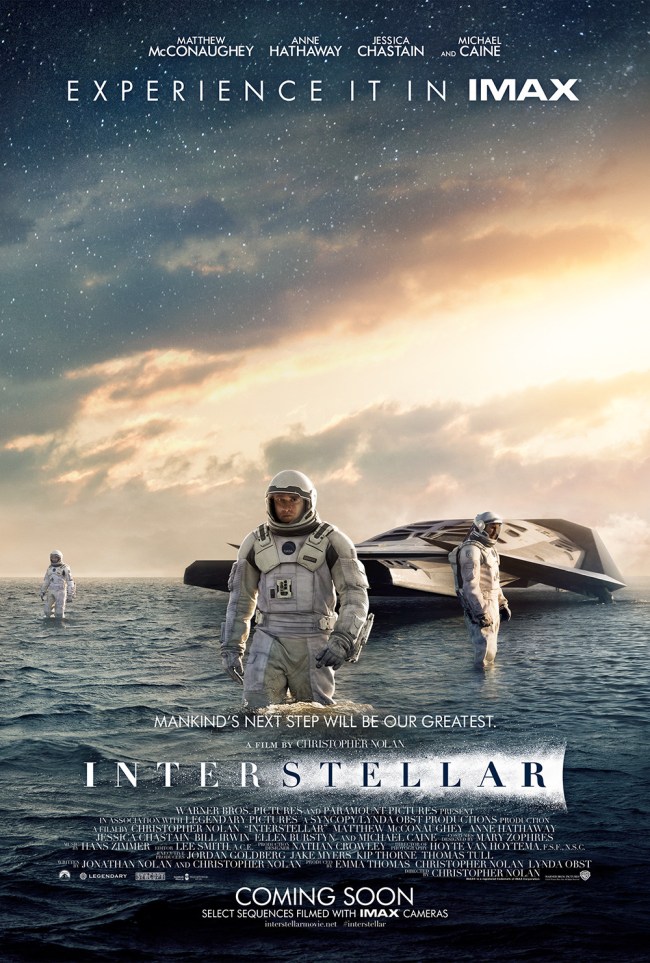
INTERSTELLAR review

Starring: Matthew McConaughey (Dallas Buyers Club), Anne Hathaway (Les Miserables), Jessica Chastain (Zero Dark Thirty), Mackenzie Foy (The Conjuring), Casey Affleck (Gone Baby Gone), Wes Bentley (The Hunger Games) David Gyasi (Cloud Atlas), John Lithgow (Rise of the Planet of the Apes), Topher Grace (Spider-Man 3), Michael Caine (Children of Men)

Director: Christopher Nolan (Inception)

Writers: Jonathan Nolan (The Dark Knight) and Christopher Nolan

Runtime: 2 hours 49 minutes

Release Date: 7 November (US, UK)

Christopher Nolan’s greatest skill, in my opinion, is that he can bridge the gap between the general audience and the devout cinephiles. He makes films that can be enjoyed by anyone whilst holding deeper meaning behind them and raking in profit; a true example of how you can be smart in Hollywood and still make money. But like an imperfect artificial intelligence, what Nolan’s films lack is heart: they are full of interesting ideas and intricate detail, but they can often feel a bit empty and his attempts at imbuing emotion can come off as false and mishandled. Interstellar magnifies Nolan’s style to a tremendous degree, but that also means enlarging his own flaws too.

What Interstellar does phenomenally is world building. Earth as depicted in this not-too-distant future feels unique but real, filled with just enough tidbits of information to make the world feel fleshed out and lived in. The film’s themes old vs. new, safe vs. right, pessimism vs. optimism, all feel relevant and fascinating; material ripe for debate and mirrored in our own lives today. The film runs for nearly three hours, but it’s needed in order to get across all of these details and the pacing is solid enough that you don’t really feel it. The imagination and scope of the world and its ideas are what carries Interstellar into being an experience worth partaking in, but that’s mainly because the actual narrative is where all the major flaws lie. The set-up to get Cooper (McConaughey) on his mission feels a little contrived, there are several plot revelations I saw coming ages before they occurred (mainly due to Interstellar’s obvious sci-fi influences like 2001: A Space Odyssey, Solaris and Silent Running), and the exposition-heavy dialogue can often feel like a science lecture. But where the film really pulled me out is something I can’t talk about without spoiling the entire movie. All I’ll say is that after two hours of setting up a world built on sound logic, the third act begins to dive into more fantastical and treacly territory and somewhat goes against everything we’d built up to. It doesn’t come out of nowhere, as the seeds for it were set up beforehand, but it seems out of place from both the story and Nolan’s own sensibilities. Interstellar was initially conceived with Steven Spielberg in line to direct, and knowing that somewhat makes the film’s problem clear: Nolan himself. In a similar vain to when Spielberg tried to make a Stanley Kubrick film with A.I., Nolan is trying to make a Spielberg film but has tried to disguise it as a Kubrick film. In the process, Interstellar doesn’t quite feel like any of those three great filmmakers’ works, but instead a slightly deformed hodgepodge. A fascinating hodgepodge that has plenty of merits, but a hodgepodge nonetheless.

Pretty much every working actor would do anything to work with Christopher Nolan. That means Interstellar gets an all-star cast but it also means a lot of them aren’t left with a lot to do. The ones who do get their time in the sun, however, take every moment they can to be great. Matthew McConaughey feels perfectly cast in his lead role, playing a likable and relatable character but one smart enough to not feel out of place in his situation. His relationship with his daughter (Foy) in his early scenes really sells, making both characters’ motivations soar and selling the emotional beats that Nolan himself can’t. Anne Hathaway gives it her all as usual and continues to prove she is an actress to be taken seriously, but for such a prominent character I couldn’t help but feel she was still underwritten. Her personality and motives were there, but they felt a little brushed over and so she ends up feeling less important than the movie thinks she is. It’s not at all Hathaway’s fault, but it does reflect badly on her. Jessica Chastain’s screen time is brief but she seizes every moment, exuding that same mix of confidence and emotion she gave in Zero Dark Thirty to great effect. The cast is so massive that I can’t go into detail with everyone, but they are all excellent; special mentions go to John Lithgow, Nolan regular Michael Caine, and a certain other actor whose identity I’ll keep a secret in case you didn’t know he’s in it.

Nolan’s other great border-crossing skill is that he can make a slick and modern film without losing the classic ambience all of his work has. Interstellar might be his most effects-driven film yet, but like so many of his movies you barely even notice them. The detail in every set and costume, the acute nature of every shot and every cut; it all creates an engrossing and unparalleled cinematic experience that needs to be seen at a theatre. Commiserations in particular must go to the designers and animators of the robots in the film, which look cumbersome at first glance but are imbued with such ingenuity and life that they blend right in with their carbon companions. My only real gripe is that Hans Zimmer’s score, whilst as excellent as usual, feels like it takes a few too many cues from the likes of Phillip Glass and 2001’s selection of classical music, enough that it often feels like a cheap imitation.

As much as I’ve harped on its many flaws, I do still recommend you see Interstellar in a cinema because of its rich world, abundance of fascinating thoughts, phenomenal performances from the entire cast and near-perfect technical execution. But Nolan’s attempts to be more sentimental don’t gel with his cerebral nature and its third act ends up making what was an excellent film just pretty good. Sometimes, maybe we shouldn’t try to make our machines more human.

FINAL VERDICT: 8/10

TEENAGE MUTANT NINJA TURTLES review

Starring: Megan Fox (Transformers), Will Arnett (The LEGO Movie), William Fichtner (Drive Angry), Pete Ploszek, Noel Fisher (The Twilight Saga: Breaking Dawn Part Two), Jeremy Howard (Galaxy Quest), Alan Ritchson (The Hunger Games: Catching Fire)

Director: Jonathan Liebesman (Wrath of the Titans)

Writers: Josh Appelbaum & André Nemec (Mission: Impossible – Ghost Protocol) and Evan Daugherty (Divergent)

Runtime: 1 hour 41 minutes

Release Date: 8 August (US), 17 October (UK)

It took them long enough, but this day was inevitable. Our favourite heroes in a half-shell have been rebooted by Michael Bay for a modern audience complete with all the trappings you’d expect. Then again, TMNT is a property that has been reimagined several times over the years in even more outlandish ways for a concept that’s already pretty ridiculous, so in context this one shouldn’t seem so bizarre. The film has received bad press from its inception, and from what I’d heard from its US release I was expecting a Transformers 4 level stink bomb. What I got instead isn’t exactly good either, but certainly not awful.

OK, going back on that last statement for a sec, I will say that the story is pretty damn awful. The origins of the turtles have been meddled with in the past before, but this new version feels so hackneyed and ridiculous that it makes the original concept seem far more plausible in comparison. So many of the tropes of gritty reboots and modern blockbusters are pulled here that it often feels like a parody video off YouTube lampooning these clichés but without any sense of irony. Off all its stolen pieces, the most prominent is The Amazing Spider-Man of all things; not only is the new origin very similar, but the Shredder’s plan and the final action sequence are near identical to that film. The story is full of contrivances and plot holes, with rushed character development and the weakest villains I’ve seen in a major motion picture in a long time. On the plus side, the film is decently paced and is thankfully kept to under two hours, avoiding the fatigue that plagues most Bay productions, and the third act does pay off with two engaging and well done action sequences despite some of the obvious derivativeness. The film is at its best when it doesn’t take itself too seriously and has some fun. Whilst some of the humour is sophomoric and typically Bay, there are some chuckle worthy moments such as a scene where Splinter tempts the Turtles with a pizza or a humorous musical moment in an elevator. There are even a few Easter eggs for TMNT fans to watch out for. If the film had tried a bit harder in this area, maybe this review would be a little more positive.

Another positive TMNT has going for it is that the Turtles themselves do feel more like active participants in the film compared to Bay’s Transformers films. They can be grating at times and their personalities have been amplified a bit much, but they are still recognisably the characters many of us grew up with and they all get at least one cool action moment or amusing line each. It’s not exactly what I would have wanted, but it is a step in the right direction. Then again, maybe the Turtles don’t seem so bad is because the human characters are so uninteresting. Megan Fox couldn’t feel more miscast as April O’Neill, her feign attempts at being more than the manufactured eye candy she is failing with every attempt; considering her character’s main motivation is trying to prove herself as a serious journalist and be more than just a pretty face, her poor and uninvolved performance seems to go against everything she says. The brilliant William Fichtner has absolutely nothing to work with as Eric Sacks, a villain whose own motivations makes no sense and lacks any sort of threat. Even worse is the Shredder himself, who is given no characterisation at all and is just a hulking brute for the Turtles to fight. I mean c’mon, the original Shredder was hardly that great a villain but he had more to him than being a lifeless wodge of metal and testosterone. Will Arnett is the film’s only human salvation; despite being given some truly horrendous dialogue at points, he manages to skate by mainly thanks to his own natural charm.

Though it does have some of the veneer of the typical Bay production, the film is thankfully nowhere near as explosion-happy. The action sequences, especially the mountain escape and the final confrontation, do have some inventive choreography and fun camera tricks whilst also never becoming as incomprehensible as most Hollywood action sequences. Whilst I do prefer the original designs, I wasn’t too put off by the look of the new Turtles: they are a little busy and I question how some of their accessories stay on during the hectic fight scenes, but at least I can tell them apart. However, I hate the design of the new Shredder, which is exactly everything I loathe about Bay-ification. It’s clunky and excessive, trying way too hard to make it ‘cool’ and missing the point of the original. The CGI work is decent if a little dated, as I was never as convinced these characters were there as I was even in the Transformers films, and I found Brian Tyler’s score to be too bombastic and overly heroic. Also, give me “Ninja Rap” any day over that processed junk “Shell Shocked”.

Teenage Mutant Ninja Turtles is fundamentally flawed on so many levels, but I’d be lying if I said it was completely without merit. The film’s plot is derivative nonsense that needlessly messes with the mythology, Megan Fox’s performance is so oxymoronic that it’s almost hilarious, and the villains are criminally insipid. However, the Turtles themselves shine through and the film does have its inspired moments of humour and action spread unevenly throughout. I can safely say I was never bored at any point nor did anything really piss me off, but there were a fair few groans of disappointment. As a casual fan of the franchise, it wasn’t the cowa-blunder I was fearing nor is it even the worst thing the Turtles have been in (The Next Mutation, anyone?). If nothing else, there’s plenty for them to improve on in the already confirmed sequel. Then again, we all know how the second Transformers film turned out…

FINAL VERDICT: 5/10