SPY review

Starring: Melissa McCarthy (The Heat), Jason Statham (Crank), Rose Byrne (X-Men: First Class), Miranda Hart (Miranda), Allison Janney (Juno), Bobby Cannavale (Blue Jasmine), Peter Serafinowicz (Shaun of the Dead), Jude Law (Sherlock Holmes)

Writer/Director: Paul Feig (Bridesmaids)

Runtime: 2 hours

Release Date: 5 June (US, UK)

I have very mixed feelings about Melissa McCarthy. Sometimes she can be hilarious (Bridesmaids), other times she’s simply tolerable (The Heat), but a lot of the time she’s painfully obnoxious (Identity Thief). Considering a scattershot track record like that, it’s hard for me to go into a movie like Spy with any preconceived notions; it could honestly go either way. Thankfully, Spy goes the right way and delivers a safe but still hilarious action-comedy ride.

Spoofs of the James Bond formula have been around as long as the franchise itself, and from its globe-trotting plot to its opening title sequence, Spy makes no bones about the field it is playing in. The story is pretty generic all around and, save for one well-played plot twist, is also incredibly predictable. But telling a thrilling narrative is clearly not Spy’s main goal. Its goal is to make you laugh, and on that level it succeeds admirably. The plot is mainly an excuse to throw Susan Cooper (McCarthy) into 007-style situations and see what happens, and though some more original narrative ideas could have spiced things up, what they have is perfectly serviceable. The humour is hardly ever insightful or deep, but the laughs come consistently hard and fast, keeping a smile on your face throughout and making the somewhat bloated two-hour runtime fly by.

A big reason why I don’t always like Melissa McCarthy is because the characters she usually plays are loud, brash and don’t know when to shut up. Gratefully, this isn’t the case with Susan Cooper, who’s more sensitive and insecure than her usual characters. She’s clearly a genuinely nice person, and her fits of rage and abuse feel more like a reaction to the situation she’s in rather than a core part of her personality. Instead of her usual abrasive shtick, McCarthy feels a lot more restrained here and that’s for the better, making those moments where she does burst into a flurry of insults that much funnier. Backing her up is a strong supporting cast of actors both comedic and dramatic, and all of them are more than up to the task. Rose Byrne balances threatening and funny very well as main villain Raina, with her condescending comments on McCarthy’s character and a running gag where she forgets people’s names being highlights. Like McCarthy, Miranda Hart sometimes feels like she’s relying on her usual persona but the movie uses her just enough before she gets grading. Jude Law gets the chance he never got to play a 007-style character and he works perfectly in his small but pivotal role, whilst Peter Serafinowicz’s Aldo is amusing if a little one-note at times. The real standout, however, is Jason Statham’s Rick Ford. Playing an exaggerated version of his usual action star image, Statham steals every scene he’s in with his terrifically deadpan performance that turns him from one of the toughest actors of our age into a guaranteed hilarious punchline. He unfortunately feels underutilised, as he drops out of the movie on several occasions (between this and Fast and Furious 7, Statham’s been doing that a lot lately), but that only makes those times when he is on screen that much more golden.

Whilst Paul Feig is clearly a good director of actors and knows how to wring a good verbal joke out, he could stand to put the same amount of effort into the visuals. Spy is certainly the most action-heavy of his films so far but, though the fight choreography is well-handled on both an action and a comedy level, the cinematography and editing feels a little flat during those same scenes. Other than some fun use of slow motion, the film lacks a strong visual identity; it has that same generic feel that a lot of comedies have these days and I’m getting kind of sick of it. Considering Feig’s next project is the Ghostbusters reboot, where design and style matters just as much as the jokes, I certainly think he could stand to get a bit more visually creative when it comes to his directing.

Spy is hardly a game changer for the spy comedy subgenre, but it’s a fun and amusing time nonetheless. If you’re a fan of McCarthy and Feig’s previous films, then you’re probably going to like this one too. It’s not quite in the same league as Bridesmaids, but I’d say it’s a lot better than The Heat. If you’re in the mood for a laugh, it’s certainly worth checking out for Jason Statham’s performance alone; he really is that good and it makes me want to see him do more comedies in the future.

FINAL VERDICT: 7.5/10

TOMORROWLAND review

Starring: Britt Robertson (The Longest Ride), George Clooney (The Descendants), Raffey Cassidy (Snow White and the Hunstman), Hugh Laurie (House)

Director: Brad Bird (The Incredibles)

Writers: Damon Lindelof (Prometheus) and Brad Bird

Runtime: 2 hours 10 minutes

Release Date: 22 May (US, UK)

It may be the popular thing to say, but it’s true: Brad Bird is kind of a genius. All of his movies so far have been nothing less than excellent, combining imagination, wit and heart in equal measure to make classic films that stand the test of time and will do for generations to come. After years of working in animation, Mission: Impossible – Ghost Protocol served as a great testing ground for Bird in the world of live action, and now he’s ready to take on something a little more daring. Tomorrowland (slapped with the subtitle A World Beyond here in the UK for nonsense copyright reasons) has had a lot of build-up through Bird’s name value and an effectively conservative marketing campaign, so expectations are high; after all, Bird turned down Star Wars for this. Whilst I am glad to report that Tomorrowland does hold up Bird’s impeccable track record and you should most certainly go see it, it’s nigh impossible to live up to such lofty ambitions.

The story of Tomorrowland is a simple but imaginative story, one that evokes that magical sense of wonder found in the early works of Steven Spielberg. The plot does follow a lot of conventions (protagonist picked from obscurity and told they are the super-special saviour of the world, anyone?), but this familiarity plays into the retro feel of the movie and ultimately uses these devices to say something different and relevant. It’s a fun ride for sure full of interesting characters and creative set pieces, but Tomorrowland is mostly a film about ideas, and those ideas are definitely worth considering. Though it is a film inspired by the past and about the possibilities of the future, it is ultimately a film about our present, what’s wrong with it, and what we need to do to fix it. The film touches on the subjects of optimism vs. pessimism, the degradation of our world, and society’s growing disinterest in the possibilities of progress; having the dissolution of the NASA space program play into the plot is certainly no coincidence. It’s this honest but hopeful and determined look at our world that really makes Tomorrowland click, but I’d be lying if I said the film didn’t have problems. The main culprit is the film’s first ten minutes which, whilst helping set up the world and some key characters, does feel tacked on and sets a bad first impression; you could cut it out and work some of the more important details into the story later, and the film would be far better for it. Once the ball does get rolling on the main plot, the movie improves immensely but other issues do occasionally rear their heads. The dialogue can become very exposition-heavy during the quieter scenes, the pacing and structure feels a little off-balance at certain points, and though the withholding of certain information makes sense from the perspective of the audience in regards to creating mystery and suspense, in context you sometimes question why they’re holding back this important information other than “because the plot says so.”

Though the marketing would have you believe George Clooney is the star of this movie, Tomorrowland ultimately belongs to Britt Robertson’s Casey Newton. Acerbic and stubborn but full of positivity and with a passion for creativity, the character of Casey is a wonderfully charming and relatable protagonist and Robertson carries the character and the movie effortlessly; her performance is a joy from start to finish. The character of Frank Walker is essentially Clooney playing a broken version of himself: charming and witty, but with a tired, defeatist edge. Contrasted against Robertson’s unflinching optimism, this already makes for a fun on-screen combo. But throw Raffey Cassidy’s Athena into the mix also, and the fun only increases; I can’t say much without spoiling, but Cassidy’s performance is perfectly attuned and heartfelt, and her character is the source of some of the film’s best action and comedy. Hugh Laurie feels disappointingly underutilised as Nix (not counting the prologue, he’s not introduced until the third act), but he makes the most of his limited screen time, especially in a speech near the end that essentially sums up why the world is screwed. The rest of the cast is mostly inconsequential, but there are some worth mentioning; Kathryn Hahn and Keegan-Michael Key have a lot of fun with their brief roles, whilst it’s also nice to see Looper’s Pierce Gangon is still getting some work.

In both The Iron Giant and The Incredibles, Brad Bird proved he had a penchant for retro and that rings as true as ever in Tomorrowland. Everything about the sets, props and costumes feels ripped straight from the pages of a 1950s sci-fi comic strip, but all of it is done in a way without feeling cheesy or childish. There are a lot of fun ideas on display in regards to the sci-fi technology, creating for some inventive action beats that play around with these toys. A brief skirmish in a geek store is a particular highlight not just for action, but it’s also a visual and auditory delight thanks to all the Easter eggs thrown into the scene; be sure to keep a close eye on those store shelves. The cinematography is crisp and vivid with strong colours, bright lighting and clean camera operation, and Michael Giacchino’s score is uplifting and well attuned to the film’s buoyant disposition.

Tomorrowland is a really, really good movie, and for most movies that would be enough. But Tomorrowland is so close to perfection it can practically taste it, but it falls just short of becoming an instant masterpiece, and that’s enough to make it feel a little disappointing. The intriguing premise, the strong performances, the ingenious visuals and, most of all, the fascinating ideas about society and progress are all excellent, but it doesn’t quite hit it home the way a lot of Brad Bird’s other films have done so effortlessly. Whether it was studio interference or the script being taken out of the oven too early, Tomorrowland’s issues certainly seem fixable and I wish these kinks in the narrative had been ironed out before cameras started rolling. Don’t get me wrong, I still think it’s a film most certainly worth seeing and it does nothing to dissuade my feelings about Bird’s reputation as a filmmaker, but it really is that damn close to being something extraordinary and doesn’t quite make it.

FINAL VERDICT: 8.5/10

MAD MAX: FURY ROAD review

Starring: Tom Hardy (Locke), Charlize Theron (Monster), Nicholas Hoult (X-Men: Days of Future Past), Hugh Keays-Byrne (Mad Max), Zoe Kravitz (Divergent), Rosie Huntington-Whitely (Transformers: Dark of the Moon)

Director: George Miller (Mad Max 2: The Road Warrior)

Writers: George Miller and Brendan McCarthy and Nick Lathouris

Runtime: 2 hours

Release Date: 14 May (UK), 15 May (US)

In what is possibly the biggest gap between instalments of a franchise, it’s been thirty years since Mad Max last rode across the wasteland in Beyond Thunderdome, but whilst original star Mel Gibson may now have retired the role, director of the original trilogy George Miller is still holding on at the grand age of 70. Miller has actually been planning Fury Road for over a decade now, with various false starts over the years and, even after getting the ball rolling (shooting began in 2012), some reshoots and a long post-production process have further delayed its release. But now Max is finally back, and goddamn was it bloody worth the wait. Mad Max: Fury Road has more of a premise than a cohesive narrative, and what’s there is mainly to set up a series of action sequences. On first examination, this seems like a really bad idea but, much like the ragged machines the people of the wasteland drive, it works beyond all reasonable expectations. Once the wheels literally get rolling and things start going boom, everything clicks into place and the patchwork nature of the story becomes incredibly cohesive and durable. The pacing is expertly handled, weaving from set piece to set piece with just enough breathing space in-between the carnage. Though dialogue is sparse, Fury Road’s flawless handling of visual storytelling gets across everything you need with just raw emotions and reactions; you don’t need to be told what’s happening is crazy, it’s plainly obvious. The film hits every note possible, creating a film that is thrilling, funny, thought provoking, and even heart wrenching. No joke, I was close to tears near the end of this film, and any film that manages that is clearly doing its job at maximum efficiency.

Though Gibson’s portrayal of Max will probably still be the de facto face of the character for generations to come, Tom Hardy’s interpretation certainly lives up to the legend. Much like his predecessor, Hardy’s Max is a man of few words and defines himself instead with his tough but fair attitude. His tragic back-story is only hinted at, the only real point where knowledge of the previous films may be helpful, but that only adds to the mystique of the character. But in many ways, the film doesn’t actually belong to Max himself. That honour falls to Charlize Theron’s Imperator Furiosa, and she knocks it out of the park. Furiosa’s past is equally vague and her dialogue clipped, but again we get more than enough just from Theron’s pitch-perfect performance. She commands the screen with nothing more than a determined glare and a badass prosthetic arm, and for stretches of the film you’ll forget that Max is even there…and that’s not a bad thing. Furiosa’s posse of runaway breeders (yes, that’s what they’re called in the movie) are just defined enough by distinct looks, personality and crazy names (one of them is called The Splendid Angharad. ‘Nuff said.), and the gang of gun-toting grannies they meet up with later are equally fun characters. In the midst of all the explosions and testosterone, Fury Road has a surprisingly strong feminist message. At its core, it’s a story about a group of women who are tired of being treated as objects and decide to fight back against their oppressors, and Max just happens to be along for the ride. Nicholas Hoult’s Nux adds a surprising amount of heart to the film, mainly because he goes through the biggest arc over the course of the story. Starting out as a devout worshipper of antagonist Immortan Joe (Keays-Bryne), his development from there is surprisingly touching and you’ll be rooting for the skull-faced nutter by the end. Immortan Joe himself is as ridiculous a villain as you’d expect from a Mad Max film; though not quite as memorable as the likes of Lord Humungous or Master Blaster, he is a vile and threatening foe with a cool look and an awesome voice, and that’s all you really need.

As mentioned before, most of the attention has been paid on the spectacle of the film and it’s a risk that pays off with interest. There is not a single frame in Fury Road that is dull, no matter the situation. When cars aren’t flipping and guns aren’t firing, there’s always something to look at: the beautifully pristine desert landscape, the intricacies of the production and costume design, the gorgeous use of colour, or even just an interesting camera move or angle. DOP John Seale’s work here is just phenomenal, a true gem in his already long and stellar career, and it certainly puts the camerawork on almost all blockbusters to shame. Along with the cinematography, the editing is excellently attuned, cutting to increase impact but also allowing shots to hold when needed, as well as great use of both slow motion and sped-up footage. The score by Junkie XL is a monster befitting of this movie, combining metal, rock, electronic and orchestral music to craft a soundscape that accentuates the action unfolding onscreen, rounding out this impeccably crafted piece of movie magic.

Mad Max: Fury Road is an adrenaline shot of filmmaking from start to finish. Its unorthodox approach to storytelling eschews traditional structure and pacing to craft a tale in a new and exciting way, relying on pure imagery to convey its bombastic narrative. The characters are drawn with broad but striking strokes, and you’ll be strongly connected to them despite most of them barely uttering a word. The action sequences are some of the best in recent cinema history, avoiding all the clichés and failures of the genre to create a rollercoaster experience both in terms of thrills and emotion. It’s like an insane 80’s B-movie, but one made with thought, effort, and enough of a budget to match its deranged aspirations. After it was all over, all I wanted to do was turn back around and experience it again. I cannot recommend this movie enough, so get out to your local cinema and support this movie with your hard-earned cash. It doesn’t just deserve your time. It demands it.

FINAL VERDICT: 10/10!

AVENGERS: AGE OF ULTRON review

Starring: Robert Downey Jr (The Judge), Chris Evans (Scott Pilgrim vs The World), Chris Hemsworth (Rush), Scarlett Johansson (Under the Skin), Mark Ruffalo (The Kids Are All Right), Jeremy Renner (The Hurt Locker), Aaron Taylor-Johnson (Kick-Ass), Elizabeth Olsen (Godzilla), Paul Bettany (Priest), James Spader (Secretary), Samuel L. Jackson (Pulp Fiction)

Writer/Director: Joss Whedon (Serenity)

Runtime: 2 hours 21 minutes

Release Date: 23 April (UK), 1 May (US)

It’s hard to believe that the concept of an Avengers movie was absurd only a few years ago. Now, it’s a benchmark that all other Hollywood movies use as an example; everybody now wants their own shared universe franchise, but still nobody does it quite like Marvel. Topping the first movie is a daunting but certainly achievable task, especially now that the groundwork has been effectively laid, and so Earth’s Mightiest Heroes have reassembled to fight the good fight once more in Age of Ultron. Does it push the Marvel Cinematic Universe to new heights, or is it merely a placeholder as they bide time for their other plans?

Picking up right where Captain America: The Winter Soldier left off, Avengers: Age of Ultron jumps right into the action and doesn’t let up from there. The film’s plot is a bit more complex and personal than the first Avengers film, giving all the main characters their own personal stakes and arcs in the narrative, but it’s still primarily an old-fashioned “stop the bad guy from the destroying the world” story. There’s definitely some interesting thoughts regarding the automating of world security and man’s own destructive nature possibly being our downfall, but it doesn’t go political with it the way The Winter Soldier did. The story’s pacing feels a little rushed in the first act, a symptom of starting the film mid-action sequence, and leaves an uneasy feeling like we’ve missed something; perhaps a slightly more relaxed opening to ease us back into this world would have felt a little less jarring. However, once Ultron (Spader) makes himself known and the plot gets fully rolling, the breakneck pace feels far more natural and makes that two-hour-plus runtime blow by real fast. Joss Whedon’s sharp writing skills are on top form here, with plenty of his classic witty banter but also some really strong character moments and a few really nice surprises. The film’s ending is also strong, setting up the future of the MCU neatly but without resorting to a “to be continued” style cliffhanger, and that future is looking as bright as always.

I think after so many films, you’re all pretty familiar with the quality of the acting amongst these heroes, and everyone is as reliable as you’d expect. Downey’s smugness, Evans’ optimism, Hemsworth’s theatricality and Johansson’s allure are all in check and provide plenty of great moments of drama and humour. Mark Ruffalo’s Hulk gets some much needed screen time after disappearing since the last Avengers film, with his scenes with Johansson being among the film’s best emotional moments, whilst Jeremy Renner finally gets a chance to shine as Hawkeye after getting short shrift last time around. In terms of new faces, Taylor-Johnson’s Quicksilver and Olsen’s Scarlet Witch are welcome additions; their development at the start is limited, but what is there shines through and they fit in well with the rest of the cast. Paul Bettany’s Vision is similarly limited in screen time, but in very little time he leaves a strong impression and there’s certainly plenty of room for more in the future. But it’s James Spader as Ultron that is ultimately the real standout newcomer, effortlessly pulling off a villain that balances superiority and determination with empathy and wit. He’s far from a simple bad guy who wants to destroy the world because he can. He’s deluded, yes, but his actions come from an understandable place, and his personality is also a far cry from the typical “emotionless automaton who sees humanity as weak” character. He’s a fitting villain for The Avengers and easily among the best villains in the MCU so far.

As great as the first Avengers film was, its staging was a little flat at times in regards to cinematography and production design. In Age of Ultron, the ante has certainly been raised and this sequel’s technical presentation is far more impressive than its predecessor. The camerawork is far more engaging and frenetic this time around, and the film’s good mix of international locales also creates for a far more varied picture. The action sequences are also far more inventively choreographed, with characters interacting with each other more frequently in battle to create some wonderful little action beats; the Hulk vs. Hulkbuster sequence in particular is a standout scene that really shows off how far these fight scenes can go. The visual effects are very strong, especially in regards to Iron Man, Vision and Ultron, and Brian Tyler’s score does a good job of mixing themes from previous MCU films with new compositions.

I wouldn’t say Avengers: Age of Ultron tops the first film, but it certainly matches its quality, which still means it’s pretty damn fantastic. The story is fun and takes some interesting turns, the character interactions are wickedly funny and engaging, and the action scenes have been pumped up immensely for maximum popcorn entertainment. Whedon has certainly become more comfortable with blockbuster filmmaking since the first film, resulting in a far more fluid and visually engaging movie, but the first act’s impatience leaves a somewhat troubling first impression. Once past that initial stumble though, Age of Ultron delivers exactly what you want from a Marvel film and then some. We’ve still got a hectic summer movie season ahead of us, but the bar has certainly been set high already.

FINAL VERDICT: 9.5/10

FAST & FURIOUS 7 review

Starring: Vin Diesel (Guardians of the Galaxy), Paul Walker (She’s All That), Jason Statham (Crank), Dwayne Johnson (Hercules), Michelle Rodriguez (Avatar), Tyrese Gibson (Transformers), Chris “Ludacris” Bridges (Max Payne), Nathalie Emmanuel (Game of Thrones), Djmoun Hounsou (Gladiator), Jordana Brewster (The Texas Chainsaw Massacre: The Beginning), Kurt Russell (Escape from New York)

Director: James Wan (The Conjuring)

Writer: Chris Morgan (Wanted)

Runtime: 2 hours 17 minutes

Release Date: 3 April (US, UK)

As ridiculous as it is that we now have seven films in the Fast & Furious franchise, you can’t fault them considering they’ve actually been getting better. What began as basically a rip-off of Point Break with cars has now gone full bananas and turned into essentially Mission: Impossible with cars. I wouldn’t call myself a fan of the series, as I only got into them around the time Fast Five came out, but this recent re-invention of the concept is certainly convincing me to become one. Fast & Furious 7 has had a tough production owing to the tragic passing of star Paul Walker but, with some extra tinkering and a whole load of insurance money, the film has finally hit the streets and its engine is roaring loader than ever.

If you’re actually trying to analyse Furious 7’s plot, you’ve immediately missed the point. The story is a flimsy hodgepodge, full of plot holes, questionable logic and a complete disregard for the laws of physics, but the movie moves so fast that you’re not given enough time to care about such matters. Much like Mission: Impossible, the plot is an excuse to visit some exotic locales and smash cars into them, and Furious 7 does that job in exceptional form. The action set pieces are just beyond ridiculous, to the point where me describing them would sound like a six-year-old on a sugar rush, but even in their lunacy you can’t deny that they’re being creative. I’ll leave the jaw dropping moments for you to discover, but cars are crashed, punches are thrown, public property is destroyed, and most of it is followed by so-bad-it’s-good one-liners. The film runs for nearly two and half hours, but if you’re enjoying yourself as much as I was, you will not notice your watch over the massive grin plastered over your face. That is, until, the film’s final moments. I won’t say much more but, even if you’ve never seen a Fast & Furious movie, it’s hard not to feel emotional about how they pay tribute to Paul Walker. It’s not a flawless send-off, as that could have only been done if Walker was alive to film it, but the heart is in the right place and the filmmakers have done the best job they can to honour the man’s legacy.

The franchise has assembled an incredibly diverse cast over the years, and Furious 7 is no exception. Diesel’s Dominic Toretto and Walker’s Brian O’Connor haven’t changed much, but their chemistry remains strong and the franchise will certainly never be the same without Walker’s presence. Rodriguez, Ludacris and Tyrese aren’t much different either, but they fulfil their respective roles of the tough chick, the tech genius and the butt of all jokes as reliably as ever. Jordana Brewster and Dwayne Johnson are pushed to the sidelines for this outing, but in the latter’s brief screen time he leaves a hell of an impression; every moment Johnson has an opportunity to steal a scene, he will take it. Having Jason Statham as the new villain is about as awesome as you’d expect, kicking off the movie in the most nonchalantly badass way, but I wish he was in it more. He disappears for sizable stretches of the movie, before inevitably showing up out of nowhere in the middle of an action sequence like Nemesis from Resident Evil 3; he’s great when he’s around, but for the main bad guy he really should stick around more. In terms of other fresh blood, Nathalie Emmanuel adds some more diversity to the cast as hacker Ramsey, whilst the presence of Kurt Russell should certainly please fans of classic action flicks.

With Justin Lin’s departure from the series so he can go venture where no man has gone before, horror director James Wan takes the driver’s seat of the franchise and doesn’t miss a gearshift. For a director inexperienced with action movies, let alone one this massive, he’s acclimated to the genre tremendously. It never really feels like a James Wan film, but that would probably be inappropriate anyway. Fast & Furious has had a distinct flavour since its inception that simply grows rather than changes, and Furious 7 has all those same trappings. The name of the game here is bright colours, blisteringly fast editing, ear-piercing sound effects, a deluge of rap and electronica songs, and cinematography that will take any opportunity to show off the rims of an automobile or the posterior of a scantily clad woman. It’s not exactly refined or progressive, but it’s a style that works.

If judged with the mind of a serious person, Fast and Furious 7 is a shoddy, insane and downright idiotic film. But this film was not made for serious people. I know this is so often used as an excuse, but it is genuinely true here: if you go into this movie expecting it to be anything other than what it is, you’re the idiot. This is honestly the most fun I’ve had watching a movie so far this year (barring Kingsman, of course), and I say that with very little embarrassment. It’s an entertaining and carefree party of a movie from start to finish, screaming nonsense at the top of its voice and paying no attention to the obvious illogic in its thinking. If this is not your sort of movie, you probably already know that and should walk the other way. But if you’re in this movie for what it is, you are going to have so much fun.

FINAL VERDICT: 8/10

CINDERELLA review

Starring: Lily James (Downton Abbey), Cate Blanchett (Blue Jasmine), Richard Madden (Game of Thrones), Stellan Skarsgard (The Girl with the Dragon Tattoo), Derek Jacobi (Gladiator), Helena Bonham Carter (Les Miserables)

Director: Kenneth Branagh (Thor)

Writer: Chris Weitz (About a Boy)

Runtime: 1 hour 45 minutes

Release Date: 13 March (US), 27 March (UK)

And so Disney’s trend of adapting their animated classics into live-action films continues, and they’re showing no signs of stopping. New versions of The Jungle Book, Beauty and the Beast and Dumbo are all in various stages of development, and I’m sure even more will come as long as the people keep paying. Why they keep paying is still a mystery to me, as Alice in Wonderland and Maleficent were gaudy, ill conceived and just all around missed the point. Cinderella seemed destined to walk the same path from the word go, and I was all set endure another lame rendition of a childhood story. But, to my surprise, Cinderella is actually…OK. It didn’t blow my mind and it’s still somewhat pointless, but it was OK.

Of all the fairy tales, “Cinderella” is the one that holds up the least well under modern scrutiny. The messages about kindness and perseverance still work, but its antiquated vision of the feminine ideal and the lack of a proactive protagonist don’t do it any favours. This new version, for the most part, tells the story straight with only embellishments to pad out the runtime to feature length. Whilst this reverence to the source material does give it a charming old-school vibe (and I’ll certainly take it over the misguided revisionism of its forbearers), the extended length does make the original story’s flaws that much more apparent. With a fresh perspective and more time to tell the story, it would have been nice if the contrivances of the fairy tale were explained with some logic or at least commented upon for their lunacy, but all of it is taken with a straight face. Many of Maleficent’s flaws are felt here too, such as the inconsistent tone and use of pointless narration to drive home the obvious, but it at least feels cohesive and doesn’t attempt any forced symbolism. But for as much as Cinderella doesn’t do much to fix the source’s flaws, it compensates by driving home what does still work about the story. The whole “be brave and kind” message is shoved down your throat a bit too much, but it’s certainly sincere about it and that’s why it ultimately works. By the film’s conclusion, even with all the holes in logic and questionable lessons for the female audience, it’s still hard not to smile.

There’s not much to the character of Cinderella on the page, but Lily James is earnest enough in her portrayal that you can buy it for the most part. She does nail the persistence of the character, always doing her best to stay kind even under the most heinous of circumstance but still showing enough humanity underneath to understand her torment. These moments make those when she finally gains her freedom to feel earned, and James’ whimsy and excitement in these moments really pay off. However, it still would have been nice if she had a little more to do. There is still no moment where she directly impacts the plot, as everybody else still either does things for her or she does exactly as she’s told. Her words do have a strong impact on the prince and she does eventually lash out at her stepmother, but other than that she is still a passive presence in her own story. Cate Blanchett’s Lady Tremaine is somewhat cartoonish at first, as are the stepsisters, and their behaviour becomes more unbearable than necessary by the time the ball arrives. However, when the story finally explains Tremaine’s motivations, combined with Blanchett’s go-hard-or-go-home performance, it does finally make the character work and turns her into more of a Machiavellian string-puller than just a shallow woman. Richard Madden’s Prince Charming is as pleasant as his character’s namesake and his chemistry with James makes the prospect of these two falling in love so quickly seem plausible. However, I wish there was more to his relationship with his father (Jacobi) and the scheming duke (Skarsgard). Helena Bonham Carter gives a very expected performance, but her screen time is brief and her quirks are reined in enough to avoid completely destroying the already shaky tone.

Disney always throws a lot of money into their productions, and rarely do they waste their expense. Cinderella’s visuals are very ornate, packed full of colour and detail, which gives it that striking fairy tale feel. All of it is certainly along the right lines, but I think a lot of it goes too over the top. The costumes often look sickly and overdesigned, the visual effects too cartoony and glittery, and Patrick Doyle’s score often emphasises the emotional beats a little too forcefully. I appreciate all the effort that’s gone into the production, but there is such a thing as doing too much work.

Cinderella certainly isn’t a film that needed to exist, but I wouldn’t call it a waste of anyone’s time. The movie’s simplistic charm combined with some welcome changes, assisted by strong performances from all the main cast, make this a version of the story told a thousand times one that may be worth sitting through once more. I still feel more could have been done to make the story more relevant to a modern audience or comment upon the more dated parts of the source, but it doesn’t soil the memory of the original either. I know a lot of this review has been me essentially saying “it’s not as bad as Maleficent” over and over, but really I’m just that thankful that it isn’t. I wouldn’t urge anyone to rush out and see it, but if you’ve got kids or you’re curious enough, it may be worth a watch.

FINAL VERDICT: 6.5/10

PS: The short Frozen Fever that plays in front is charming and it’s nice to see those characters again, but it is very brief and probably would have been more at home as an extra on the Frozen Blu-Ray. I’ve not been one to be bothered by Frozen’s never-ending popularity, but this and the announced sequel I think is too much at this point. But that’s a discussion for another day…

CHAPPIE review

Starring: Sharlto Copley (District 9), Dev Patel (Slumdog Millionaire), Ninja, Yo-Landi Visser, Jose Pablo Contilla (Crank), Hugh Jackman (The Wolverine), Sigourney Weaver (Aliens)

Director: Neill Blomkamp (Elysium)

Writers: Neill Blomkamp & Terri Tatchell (District 9)

Runtime: 2 hours

Release Date: 6 March (US, UK)

When District 9 hit the scene in 2009, Neill Blomkamp was suddenly hailed as “the next big thing”, and I was among those people heralding the film and its director as exactly what science-fiction cinema needed. In retrospect, that hyperbolic attitude seems a little childish now. Whilst I did enjoy Blomkamp’s sophomore effort Elysium, it paled in comparison to its predecessor (especially when the tone, message and aesthetic of both pictures are so similar). The mild letdown of Elysium has even led to Blomkamp recently admitting he felt the film was made prematurely made and without enough thought. A brave thing for any director to do, but perhaps he should have saved his apology, because his new film Chappie is an even bigger step down for the promising director.

Chappie’s plot could easily be summed up as a reverse-RoboCop: instead of a human becoming robotic, it’s a robot that learns to be human. However, the comparisons to the Paul Verhoeven classic don’t end there, with several scenes and characters feeling directly ripped from it with little change. A city overrun by crime, a corporation gaining control over law enforcement, a bitter employee trying to push his inferior product, and many others are elements shared by both pictures. Blomkamp is certainly known for paying homage to other sci-fi films, but he’s very much stepped over the line into blatant now. But putting those obvious similarities aside, there are a lot of good ideas under the surface of Chappie. Topics such free will, nature vs. nurture and transhumanism are certainly interesting areas to explore, but the film either glosses over them too quickly or tackles them in morally questionable ways. This is especially true of the film’s third act, which I personally think was interesting direction to go, but it’s way too heavily foreshadowed and is then quickly rushed through to an abrupt and unsatisfying ending. But I think the main reason Chappie ends up faltering is not so much in the story it’s trying to tell, but in the characters that inhabit it.

I’ll get the exception to this out of the way first: Sharlto Copley as Chappie himself does a great job. There’s such a warm naivety and endearing nature to Copley’s performance, made clear in even the slightest change in posture or hand gesture. His voice can be a little grading at first, as can his childish attitude, but you quickly warm to the character and Copley manages to gain the most (and possibly only) sympathy of any character in the film. Dev Patel’s Deon is the only other character that comes close to being relatable, but he’s far too weak and pernickety; he only ever once gains the high ground in a scene, and he has to resort to using a gun to do so. Ninja and Yo-Landi Visser, members of South African rap group Die Antwoord, ostensibly play themselves here (and if the fact their character’s names are their own isn’t enough, the film is full of their music and they often even wear their own merchandise), and their inclusion is just baffling. Ignoring the fact that Ninja is just an outright bad actor (Visser is passable at best), their characters are irredeemable and vulgar. I get the idea of the childish Chappie being easily swayed into malicious deeds by them and learning a lesson about morality from it, but it takes up a huge portion of the movie and fails in that time to establish any redeeming qualities about these characters; by the time sh*t hits the fan, I was actively rooting for Ninja to die. Faring even worse is Hugh Jackman, whose stock villain is so lacking in motivation that it kills the otherwise serious tone of the picture. Seriously, why is this guy so dead set on getting his death machine of a contraption on the streets despite the obvious flaws in logic that even the movie points out to him? Why is he going to such ridiculous lengths to do so, endangering the lives of countless innocents in the process? Why is he taking so much glee in the rampant destruction he’s responsible for in the third act? And why doesn’t Sigourney Weaver just fire him? Oh yeah, Sigourney Weaver’s in this movie. I had totally forgotten, and you probably will too because she’s essentially pointless.

Even in all of this mess, at least Blomkamp’s skills as a visual director have not deteriorated…much. Despite having a very similar look to both his previous films, Chappie remains a visually compelling film through strong production design and flawless visual effects. The design and animation job on Chappie synchs perfectly with the live action environments, and combine with Copley’s performance beautifully. However, Blomkamp’s need to constantly pay reverence to his influences butts in here too; whilst Chappie’s bearing likeness to the robot from Appleseed is somewhat subtle, the resemblance between Jackman’s MOOSE robot and ED-209 from RoboCop is so blatant that it’s all you’ll think about when you see it. Hans Zimmer’s score is decent but feels lost under the noise of the constant Die Antwoord songs used throughout which, and I know this is just my musical taste, sound overly produced and just downright annoying. But it’s not just our stars’ products being constantly shoved in our face, as distributor Sony once again feels the need to shove their various products in our face with numerous Sony phones, laptops and PlayStation 4s seen constantly throughout. Sony has been especially guilty of product placement lately (see The Amazing Spider-Man 2 for the most egregious example of this) and they really need to stop being so obvious with it.

Chappie isn’t outright bad, but it is heart-wrenchingly disappointing. The film has plenty of potential with its themes and ideas, but other than its titular character there is no one participating in this story to care about. The morals the film espouses are questionable to say the least, and the similarities to other pieces of sci-fi fiction are Oblivion-level obvious. I said in my review of Elysium that I feared Neill Blomkamp might become the new Andrew Niccol. He’s certainly on that path now, and he’d better make sure that new Alien film he’s making is good or he’ll be stepping on M. Night Shyamalan’s turf pretty soon.

FINAL VERDICT: 4.5/10

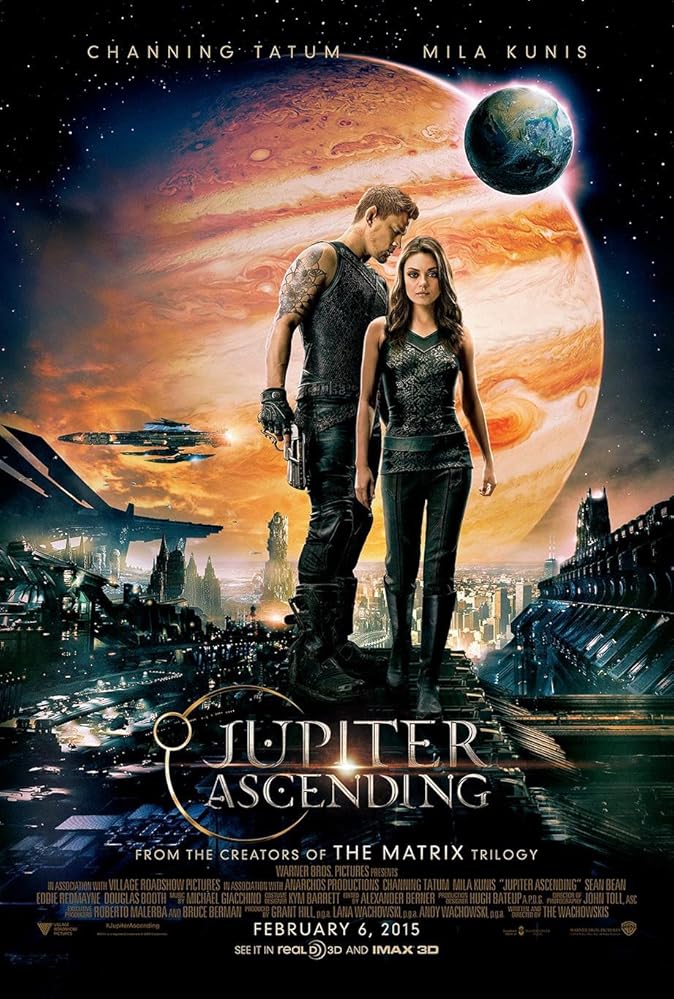
JUPITER ASCENDING review

Starring: Mila Kunis (Black Swan), Channing Tatum (Foxcatcher), Sean Bean (Game of Thrones), Eddie Redmayne (The Theory of Everything), Douglas Booth (Noah)

Writers/Directors: The Wachowskis (The Matrix)

Runtime: 2 hours 7 minutes

Release Date: 6 February (US, UK)

Over fifteen years later, The Wachowskis still owe their entire career to the success of The Matrix. Other than their criminally overlooked debut Bound, it is their only consistently good film. The Matrix sequels were enveloped by the worst aspects of the original and became convoluted philosophical nonsense, Speed Racer was an admirable attempt to bring an anime to life but ended up being sickeningly trite, and Cloud Atlas was a muddled mess of tones that never melded together cohesively. But despite these constant failures, they still seem to get funding for their elaborate projects. A Matrix fan myself, I really want the Wachowskis to make another good movie and I was hoping desperately that Jupiter Ascending could be the one to restore faith to their name. But once again I find myself leaving the cinema disappointed, and I don’t think I can keep it up any longer.


Jupiter Ascending’s plot is simple at first glance: yet another hero plucked from obscurity to realise they are destined for something greater and must go on an adventure to save the world. However, despite the straightforwardness of the narrative (which I have no problem with if told effectively), the film feels the need to bombard proceedings with endless scenes of expository dialogue that spoonfeeds every minute detail of the universe it inhabits. It never becomes impenetrable like some of the dialogue in The Matrix Reloaded, but it does have the banality of what you might find in the Star Wars prequels; lots of talks about inheritances, contracts, profit margins, and all sorts of other needless details that bog down a lot of escapist fiction these days. However, it’s that same tiresome exposition that holds up the limp narrative. Despite the amount of detail that has gone into creating this world, Jupiter Ascending doesn’t do anything new on a storytelling level. There’s not a single plot reveal or character moment that doesn’t feel worn or strained, and the film’s lack of awe and wit despite the bizarre surroundings just make it feel that much more dull. I get the strong impression that a lot of material was cut from the movie considering the rushed storytelling and hanging threads (for example, what was the point of Sean Bean’s daughter and where did she disappear to after her two scenes?), but even with those scenes restored I doubt the film could be any less engaging.

In terms of performance, I cannot fault the cast of Jupiter Ascending. They do well with what they are given, but that material does reflect excruciatingly badly on them. Channing Tatum comes out of this the most unscathed, managing to inject a lot of his natural charm into a character that completely lacks any on the page. Sean Bean also manages to keep his head high, but he’s not given enough screen time to leave a lasting impression and is mostly there for expository purposes. Meanwhile, Mila Kunis tries hard but the character of Jupiter Jones is a terribly ineffective protagonist that, whilst I wouldn’t class as sexist, doesn’t reflect well on the role of women in film. For most of the film’s crushingly stretched runtime, she completely lacks any strong motivation or urgency; she is merely dragged from scene to scene to have the plot explained to her. She is constantly thrust into situations that she never does anything to get out of, and is always (and I mean ALWAYS) reliant on Tatum to rescue her at the last second. I get that she’s a fish out of water, but a little more of a take-charge attitude would have alleviated this issue. By the climax she does become a little more proactive, but otherwise you could replace her character with a very important teapot and the plot would make about as much sense. Kunis’ chemistry with Tatum is dreadfully forced, mainly because their relationship is sporadic and unnecessary, and like the film itself she also lacks the right amount of wonder considering her bizarre predicament. The rest of the cast is mostly forgettable or extraneous, but current Oscar frontrunner Eddie Redmayne is a complete and utter embarrassment here. Tasked with playing one of the most unthreatening villains in recent cinema history (who doesn’t even meet our heroine until the story’s climax), Redmayne reads every line in a comically raspy whisper that I guess is supposed to be threatening, occasionally mixing it up by bursting into a shouting fit like a wimpy Al Pacino. Again, I think the problem lies more with the Wachowski’s direction that Redmayne himself, but it is a sadly sour note for the actor in the midst of what may be the defining moment of his career.

Whether the film is good or bad, you can always at least rely on the Wachowskis to make a visually striking film, and in that respect they don’t fail. Jupiter Ascending does look very impressive on a technical level with vibrant cinematography, impeccable visual effects and a fantastic orchestral score by the great Michael Giacchino. There are some cool concepts on display like boots that let you skate on air or instant spacesuits, but I do have to question the bizarreness of the production design. Everything from the sets to the props to the vehicles looks unnecessarily garish and overly busy, with more attention being paid to whether it looks cool over whether it makes aesthetic sense. Even more outrageous are the costumes, which would make those seen in The Hunger Games seem subdued. I get that it helps separate these alien worlds from our own, but too often I found myself questioning why any sane person would design these things this way. The Wachowskis do have a strong love for anime and a lot of that spirit can be found here, but after Speed Racer you think they would have learnt that not all of its odd embellishments translate to live action effectively.

Jupiter Ascending is sadly another mess of a film from the Wachowskis. There are redeeming qualities here and there, but the core components of story and character just don’t work. The narrative is riddled with intricately dull dialogue and predictable plot turns, our protagonist is essentially a prop in her own story, and all the supporting roles are either underdeveloped or laughably overplayed. At this point, the Wachowskis have seriously dipped their toes into Shyamalan territory and it’s going to take something really impressive to get them out of this rut.

FINAL VERDICT: 4/10

KINGSMAN: THE SECRET SERVICE review

Starring: Taron Edgerton (Testament of Youth), Colin Firth (The King’s Speech), Samuel L. Jackson (Pulp Fiction), Mark Strong (Sherlock Holmes), Sophie Cookson, Sofia Boutella (StreetDance 2), Michael Caine (Get Carter)

Director: Matthew Vaughn (X-Men: First Class)

Writers: Matthew Vaughn & Jane Goldman (Kick-Ass)

Runtime: 2 hours 9 minutes

Release Date: 29 January (UK), 13 February (US)

As Kingsman: The Secret Service points out, spy movies have been quite serious as of late. Gone are the days where plots hinged on crazy gadgets and world domination, and in its place are government conspiracies and leaked documents. That’s not to say that the modern spy movies are bad, films such as The Bourne Identity and Casino Royale helped revitalize the genre, nor am I exactly pining for the days of such ludicrous nonsense as xXx or Die Another Day. What is needed, however, is something to balance the scales. Kingsman is that much needed balance, and you need to see it right now.

Based on the comic book by Mark Millar, Kingsman is similar to Matthew Vaughn’s other adaptation of a Millar series, Kick-Ass, in many ways. Not only does it have the same irreverent, self-referential tone and humour, but also it also similarly treats the source material as more of a guideline than a blueprint. It takes the broad strokes of the story, changes up certain key details, cleans off the excess and creates something that is both recognizably Kingsman but also very much Vaughn’s own film. In general terms, the film’s plot is very simple and takes a lot of cues from both classic spy movies and typical hero’s journey stories, but is surrounded by so many of Vaughn’s flourishes that it feels fresh and new. The plot moves at a brisk pace, jumping between the stories of Eggsy (Edgerton) and Harry (Firth) swiftly to tell the whole story and balancing time between character bits and brutal action sequences. It is unapologetically ridiculous and crude, but it also has a solid core to it and knows when to pull on the heartstrings. Additionally, in the midst of all the espionage action, Kingsman also manages to be a movie about something relatable and timely: classism. Whilst neither the rich nor the poor are painted in a bad light, it does touch on the injustices of the class system and creates a hero in Eggsy that shows that greatness can come from any walk of life.

Whilst the marketing has played up Colin Firth as the star of the film, who is excellent in his role as he effortlessly pulls off the gentleman spy routine, he is neither the main character nor the standout performer of the movie. Those honours belong to relative newcomer Taron Edgerton, whose role here may well define his career. Gary “Eggsy” Unwin is a very typical protagonist, but also unique enough to stand out from the crowd. He’s an aimless chav who wastes his talents doing stupid things (kind of like a South London Will Hunting), but behind that tracksuit are a witty mouth, a sharp mind and an honest heart. He’s a hero for the common man who sees through the elitism of his fellow agents, and Edgerton pulls it off with flying colours through genuine charm and strong comedic timing. He’s a wonderfully entertaining protagonist, and also an actor certainly worth keeping an eye on for the future. Among the rest of the Kingsmen, Michael Caine plays a very typically Michael Caine role but does it as well as you’d expect, Mark Strong surprisingly doesn’t play a villain and is very amusing as the mentor Merlin, and fresh face Sophie Cookson is charmingly pleasant as fellow new recruit Roxy (major points also for teaming her with Edgerton and not having a romantic subplot). Samuel L. Jackson plays villain Valentine very atypically and creates a bizarrely appealing and memorable antagonist, whilst his henchwoman Gazelle is played coolly by Sofia Boutella and certainly stands out as the film’s most visually appealing character.

Matthew Vaughn’s fingerprints are all over this movie, which means plenty of humorous violence and seamless blending of old school trappings and modern techniques. The film’s action sequences are entertaining to the max, not only thanks to wonderfully inventive and intricate fight choreography but also effective cinematography and editing. Vaughn shoots the action with longer takes and fewer cuts, instead using rapid camera movement and sped-up footage to increase pacing and impact rather than relying on cheap tricks like shakycam and fast cuts. The overall effect creates action that is just as gripping as any fight from a Bourne film but without losing comprehensibility, and action directors should really take notice of how it’s executed here. Vaughn already showed his love of 60’s cinema in X-Men: First Class, and that same sensibility shines just as brightly here in Kingsman. From the colourful set design to Henry Jackman’s score that very clearly evokes the work of John Barry, it’s a film that owes a lot to the past but is also very much of its time. The film’s soundtrack is also put to great use in several scenes, including what might be the best use of Lynyrd Skynyrd’s “Free Bird” in anything ever. My only real complaint is that the visual effects look a bit naff at times, but that is a very minor issue in what is otherwise a fantastically executed picture.

The real sign of a great movie for me is that it gets me to smile. Kingsman: The Secret Service managed to do that for me before the opening credits were even over, and that smile sustained for the next two hours. Matthew Vaughn does it again as he takes another good comic book and turns it into a fantastic movie, and is the start of what could be a potentially amazing franchise. The story is simple but effective, mainly thanks to Vaughn’s energetic direction and Edgerton’s endearing performance, the action sequences are some of the best I’ve seen in recent memory, and it wraps it all up with an effective message about the nature of class. It may seem hyperbolic to declare a movie one of the best of the year when the year has barely even started, but I’m calling it now: if Kingsman doesn’t make my top ten of 2015, it will have been one bloody great year for cinema.

FINAL VERDICT: 10/10!

EX MACHINA review

Starring: Domhnall Gleeson (About Time), Alicia Vikander (A Royal Affair), Oscar Isaac (Drive), Sonoya Mizuno

Writer/Director: Alex Garland (28 Days Later)

Runtime: 1 hour 48 minutes

Release Date: 21 January (UK), 10 April (US)

Alex Garland has had his hands in many of the great genre films of the past decade or so. With screenwriting credits like 28 Days Later, Sunshine and Dredd, it’s surprising that it’s taken him this long to jump into directing. His freshman effort is Ex Machina, which explores the subject of artificial intelligence and the many questions we’ve asked about it over the years. It’s a topic that’s been done many times before, but it hasn’t been done by Alex Garland, and the result is (much like 28 Days Later) something familiar but also different in all the right ways.

Though a moody and often slow picture, Ex Machina never wastes your time for a second. It throws you straight into the plot and gets across all necessary information through natural story progression and imagery rather than a text dump that says “this is the future and there are robots and stuff.” From there, the story unfolds slowly but intriguingly, putting you in the mindset of protagonist Caleb (Gleeson) and making you question every plot turn. Ex Machina also does a great job of throwing you the unexpected; it never gives you the obvious answer even when it seems like it’s going to. This teasing and the atmosphere create a story that feels easy to predict but isn’t, and that kind of playfulness just makes the twists the story takes that much more impactful. The film explores many of the key questions about the nature of AI that have been explored before, but it does so cleanly and without too much technobabble (even Nathan (Isaac) has to keep reminding Caleb to stop speaking in technical terms). But just because a film is ponderous doesn’t mean it can’t have a heart, and Ex Machina never gets too serious for it to become emotionless. The relief is sporadic, but among these moments include Ghostbusters references and a disco dance number; I’ll let you ponder how those fit in.

The cast of the film is small but excellent, allowing for both more time to be spent with these characters and the actors to develop them. Domhnall Gleeson’s Caleb is a typical but likable protagonist, who’s smart enough to be proactive but no so smart that it’s unbelievable. He’s flawed and human, making more mistakes than the average main character would but in a way that is completely relatable given his circumstances. Oscar Isaac gives a subdued but powerful turn as Nathan, yet another example of cinema’s recent obsession with making Steve Jobs-like figures the antagonist. But Nathan isn’t your typical threat in any way, as not only does he act completely friendly throughout most of the film but, in many ways, he is completely justified in his actions. He’s not exactly a totally sound human being, but there is logic to his methods and you can sympathize with his frustrations. But it’s Alicia Vikander as Ava that is the real star of the film. Giving arguably the best performance of an AI character since Alan Tudyk in I, Robot, Vikander balances that fine line between believable and artificial to create a convincingly inhuman character. A lot of that syntheticness comes through her eyes, which manage to give that “uncanny valley” effect you often see in CG characters but for real. Her blank, ethereal face often creates something of a Kuleshov effect; are we actually reading an emotion on her face or are we just reading one reflecting from Gleeson’s face? There’s a real depth to the performance that I can’t go much more into without delving into spoilers, but it’s certainly a major standout in a film that has many standout elements.

Ex Machina serves as great example of how to do sci-fi on a limited budget. Based on the small cast and enclosed location, it’s clear that there wasn’t too much money to throw around but they’ve spent it in all the right places. The set of Nathan’s house is futuristic but simple, creating for a believable environment but one still slightly otherworldly. The cinematography is simple but effective, with slow camera moves and cool colour pallete that add to the threatening ambience of the picture, whilst the music is minimal and oozes in at just the right moments. But once again it’s Ava who steals the show with her fascinating design and the effects implemented on Vikander to make it happen. I’m sure a lot of it is through green screen and rotoscoping, but it’s still very hard to see the seams in the illusion. It’s a very impressive effect and clearly where the money went on this film (and deservedly so).

I cannot recommend Ex Machina enough. It’s a tightly told, intriguing and bold film that does everything a great sci-fi film needs to do. It’s a grand idea done with simple methods, and serves a solid template for how the British film industry should handle genre pictures. Gleeson and Isaac put in solid performances, but really you’ll just be waiting for Alicia Vikander to appear on screen again. If you love sci-fi stories that keep you guessing and don’t give simple answers, then this is certainly one for you. 

FINAL VERDICT: 9/10