JURASSIC WORLD: FALLEN KINGDOM – an Alternative Lens review

Starring: Chris Pratt (Guardians of the Galaxy), Bryce Dallas Howard (The Help), Rafe Spall (Life of Pi), Justice Smith (Paper Towns), Daniella Paneda (Sleeping with Other People), Isabella Sermon, James Cromwell (Babe), Toby Jones (Captain America: The First Avenger), Jeff Goldblum (Thor: Ragnarok)

Director: J.A. Bayona (A Monster Calls)

Writers: Derek Connolly (Safety Not Guaranteed) & Colin Trevorrow (Jurassic World)

Runtime: 2 hours 8 minutes

Release Date: 6 June (UK), 22 June (US)

I haven’t bothered to rewatch Jurassic World since it came out it theatres three years ago. In fact, what little I remember about it at this point is all the negative stuff; invisible dinosaurs, raptors being trained for military service, Bryce Dallas Howard running through the jungle in heels, etc. I had to look at my old review of it to even remember I gave it a 7/10, but reading my thoughts then suggest it probably should have been a lower score. Without even seeing it again, I think this is another Star Trek Into Darkness situation for me.

Whatever the case, the fact I haven’t exactly been compelled to revisit it shows how much of an effect it had on me. But the film made a bajillion dollars based purely on nostalgia, so of course a sequel was inevitable, but at least my expectations were much lower going in this time. Maybe with this one, they could address the problems of the first and make a film truly deserving of comparison to the original Jurassic Park. Well, scratch all those expectations, because Jurassic World: Fallen Kingdom doubles down on the stupid and easily takes home the title of worst film in the franchise. Yes, worse than the third one with the talking dinosaur dream sequence.

Picking up three years after the events of the previous film, Fallen Kingdom in its initial premise just seems like a retread of The Lost World, but quickly reveals itself to be something much different and, well, dumber. It seems like nobody got the memo that everybody thought the whole “dinosaurs as weapons” malarkey from Jurassic World was ridiculous, because they’ve taken that concept and made the whole sequel about it. The film takes absolutely no time in hijacking the story away from the familiar and into its bizarre new approach, in the process losing everything that made the film even remotely feel like a Jurassic Park movie. This could at least be OK if it acknowledged how outrageous it was getting; the last movie at least attempted to lampshade itself a bit. But nope, the movie treats it all completely seriously. Not an ounce of irony. At its best, this movie feels like Alien: Resurrection but without the fascinating quirkiness. At its worst, it’s a Sharknado movie that was accidentally given a blockbuster budget.

The script is so haphazard in its pacing and plotting, I swear it must have been hashed out in a hurry based on a rough outline thrown together over a weekend…on cocaine. Plot threads are introduced and go nowhere, characters make Prometheus-level stupid decisions purely to force a gag or move the story forward, and what isn’t ludicrous about the film is just boring and uninspired; I predicted a good chunk of the story within the first act. By the time it reached its preposterous climax, I had basically checked out. There was nothing it could do to save itself at that point. I know all of this sounds really vague without context, but trust me. If for the sake of morbid curiosity you go see this thing after reading my thoughts, I want you to experience the audacity of this movie without spoilers. My words won’t do it justice.

The characters in Jurassic World were already paper thin, but they at least hired charismatic actors in the lead roles who could carry it all. But here, all that charm has worn off, and now it is blindingly clear there is nothing going on under the engine. Chris Pratt comes across like he’s on autopilot, throwing out smarmy quips like afterthoughts, whilst Bryce Dallas Howard feels like she’s trying but the script gives her nothing to work with. The two of them barely even feel like the same characters from the previous film; they have no chemistry comedically or romantically, their motivations are limp and basic, there’s barely even any sign of a character arc for either of them. Heck, even calling them characters at this point is generous. They’re just chess pieces with pretty faces on them.

In terms of new faces, there’s not much to rave about here either, as they’re all pretty much reduced to stereotypes too. Here, I’ll run them down for you. You’ve got Rafe Spall as the generic “I’m totally not a bad guy, honest” rich guy, Justice Smith as the geeky comic relief who is just here to scream a lot and be a coward, Daniella Paneda as the “strong independent woman” who you know is such because she has, like, glasses and a short hair cut and stuff, James Cromwell as Not John Hammond, Ted Levine as Muldoon but evil, and Toby Jones as…the other evil guy who…talks loud and…runs the auction in the third act. I mean, wow. Way to waste your Toby Jones, movie.

Oh, and there’s also Isabella Sermon as the generic precocious kid, but she deserves special mention because of what they do with her. See, they constantly build up that there’s going to be this big twist with her; they try to hide it, but it’s obvious from her first glimpse on screen. They keep building it and building it, and when they finally reveal it, it’s…really underwhelming and has absolutely no impact on anything other than a way to justify its facepalm-inducing ending. It…I mean…seriously? This script got approval for filming?

Ah, and also before I forget: remember how they’ve been really playing up that they got Jeff Goldblum back to play Dr. Ian Malcolm again? Remember how he’s been all over the marketing and doing the press tours and that, and this was giving some people hope he’d be getting some kind of important role? Well, sorry, but nope. He’s in two short superfluous scenes as bookends. You could cut them out of the movie and you’d lose nothing. Well, except for getting to hear Goldblum’s dulcet tones. Really, we need to get this guy in more good movies instead of just rehashes of his 90s heydays. I mean, the fact that this movie makes Independence Day: Resurgence look decent by comparison is giving me hives.

I’ll give this movie this much: it has a couple of shots that made me go, “Oh, that’s a clever shot”. That’s about it though. On all other technical levels, Fallen Kingdom falls short. For all the pretty little moments it captures, the cinematography completely misses the mark in feeling like a Jurassic Park movie. Even in broad daylight, the whole picture feels murky and dour, which isn’t especially helpful when most of the film takes place at night or indoors. (Yes, they made a Jurassic Park movie mostly set indoors. Still think this sounds any good?) That’s not even mentioning the decision to shoot the film in 2.39:1, the widest aspect ratio in the series so far, which completely robs all the dinosaur action of the sense of scale and immersion all the other movies created with their fullscreen presentations; yes, aspect ratio choice is pretty damn important for this kind of thing. But it doesn’t matter ultimately. It’s not like better camerawork would have made any of these generic and/or absurd action sequences any better.

[Damn, I’ve not gotten this angry writing a review in a long time. Then again, a movie hasn’t ticked me off like this in a while.]

Jurassic World: Fallen Kingdom is maybe not the worst summer blockbuster I’ve seen, but is easily one of the laziest and most absurd I’ve seen in a long time. It takes everything that didn’t work about the last movie and makes that the focus, telling an incoherent and laughable story that feels like it was written by an eight-year-old; if this is the same quality of writing Colin Trevorrow & Derek Connolly were offering on Star Wars Episode IX, no wonder they got fired. It can’t even rest its laurels on nostalgia factor like the last movie did, because it barely even feels like a Jurassic Park movie to begin with.

Just to be clear, that necessarily isn’t a bad thing. The Last Jedi recently proved you can make a movie that completely upends everything about your series and still create something amazing, but that movie did two key things Fallen Kingdom doesn’t: it paid respectful homage to its forbearers, and what it gave us in return was intelligent and brought a whole new perspective to the material.

I am still in awe of how much this movie completely misses the mark. I can’t believe what I just watched. I didn’t think I’d ever see a franchise collapse this spectacularly after Alien: Covenant, at least not for a while, but here we are.

Please, just let his franchise die before it embarrasses itself any more. Only the first one was any good. But just watch. They’re already planning another one, and if this film does even semi-decently we’ll be seeing it in about three years. And when that almost inevitably gets greenlit, ask me about it then. For now, if you need me, I’m going to be screaming into a pillow.

FINAL VERDICT: 2.5/10

cropped-screen-shot-2017-10-01-at-19-46-22.png

SOLO: A STAR WARS STORY – an Alternative Lens review

Starring: Alden Ehrenreich (Hail, Caesar!), Woody Harrelson (Zombieland), Emilia Clarke (Game of Thrones), Donald Glover (Community), Thandie Newton (Westworld), Phoebe Waller-Bridge (Fleabag), Joonas Suotamo (Star Wars: The Last Jedi), Paul Bettany (Avengers: Infinity War)

Director: Ron Howard (Rush)

Writers: Jonathan Kasdan (In the Land of Women) & Lawrence Kasdan (The Empire Strikes Back)

Runtime: 2 hour 15 minutes

Release Date: 24 May (UK), 25 May (US)

Up front: this movie does not need to exist. Origin films, especially for characters who work precisely because we don’t know that much about them, are inherently flawed from the get-go, especially so in the Star Wars universe where the fact it feels lived in is negated if we know where all the scratches and grooves came from. So from even the mere concept stage, Solo: A Star Wars Story shouldn’t be a good movie, and that’s what had me far more worried than all of the behind-the-scenes trouble with the change in directors. But somehow, against all odds, it is good. Actually, it’s really good. Funny that.

Getting the bad out of the way, the worst parts of Solo are the parts you’d expect to be bad: all the callbacks and unnecessary explanations for innocuous details about Han Solo. Some of the more character-based elements do provide some fun and illuminating depths, like the beginnings of his relationships with Chewbacca and Lando, but did anybody really need to know where Han got his gun? I didn’t think so. Solo is at its worst when it is actively trying to be a prequel, as most prequels are. However, when the film puts that aside and is just its own thing, it improves exponentially. The film gets off to a rough start with some cringe-worthy character exposition and wonky pacing, but by the time Han is off on his adventure all the fat has been dropped and the film moves at a solid clip from there. The story balances a lot of genres from mafia movie to heist flick to western, but they all blend together fairly seamlessly. What gives Solo an extra kick is the hidden depths to its story and characters; themes of trust, optimism vs. pessimism, and the blurry morality of crime are constantly discussed. Heck, there’s even something of a subplot about the autonomy and discrimination of droids in the Star Wars universe! None of it is exactly as deep as some of the stuff The Last Jedi discussed, but its those little details that give Solo something more to say than just “this is why Han is Han”.

Harrison Ford is Han Solo and forever will be but, if anyone is worthy enough to captain the Falcon in his stead, Alden Ehrenreich gives it his best shot. He avoids outright imitating Ford, giving the character a more buoyant outlook and affect, but he definitely captures the confidence and conceitedness that define the character. Woody Harrelson does what he does best and blends surprisingly well into the Star Wars universe as Solo’s mentor Beckett, whilst Emilia Clarke brings a tragic and fascinating femme fatale edge to Qi’ra. Joonas Suotamo has been doing great standing in for Peter Mayhew on the sequel trilogy so far, and now given full reign of Chewbacca here he delivers a physically impressive performance worthy of the legendary Wookie. There’s also some great smaller turns from the likes of Thandie Newton and Jon Favreau as Beckett’s crew, as well as a few surprising faces I won’t dare spoil. The only real sour note is Paul Bettany, who is interesting as the film’s gangster antagonist Dryden Vos, but his screen time is unfortunately cut short which diminishes him greatly as a threat. However, the real MVPs of the movie are Donald Glover as Lando Calrissian and Phoebe Waller-Bridge as L3-37 respectively. Glover absolutely captures the suave magic of Billy Dee Williams’ performance but gives it a youthful edge that makes the character feel fresh again, whilst Waller-Bridge brings an interesting new take on the droid sidekick that’ll have you laughing, cheering, and perhaps even shed a tear. I know we don’t need more origin films, but if they ever do one about these two, I’m totally in just so I can see more of them interacting.

From the first frame, it’s clear that Solo is a Star Wars movie but it still brings its own distinctive twists to the aesthetics. The cinematography certainly sets it apart, with Bradford Young giving the film a distinct palette and wonderful camerawork that balances classic and modern filmmaking whenever the mood calls for one or the other. The design work from the sets to the costumes to the make-up is all top-notch as expected, and the pre-rustbucket Millennium Falcon is an especially nice touch. The visual effects work is fantastic, with CG characters like L3 and Favreau’s Rio Durant blending effortlessly in with the live-action elements, and John Powell’s compositions avoid the mistakes made by Michael Giacchino on Rogue One by being undoubtedly a Star Wars score whilst still being distinctive and memorable.

Solo never does make the case that it needs to exist but, in terms of quality of execution, it’s possibly the best movie one could hope for given the brief it has to fulfil. It accomplishes the base level of being an entertaining romp through the Star Wars universe, but sweetens the deal with some memorable new characters, great performances, and a surprising amount of profundity in its underlying themes. Your mileage may vary, but for me what this film got right was more than enough to outweigh the hereditary faults of the concept itself. I encourage Lucasfilm to expand their horizons with the spin-offs more rather than just making more origin stories, but if they’re going to do them anyway, Solo stands as a solid example of how to do them right.

FINAL VERDICT: 8.5/10

cropped-screen-shot-2017-10-01-at-19-46-22.png

DEADPOOL 2 – an Alternative Lens review

Starring: Ryan Reynolds (The Hitman’s Bodyguard), Josh Brolin (Sicario), Morena Baccarin (Serenity), Julian Dennison (Hunt for the Wilderpeople), Zazie Beetz (Atlanta), TJ Miller (Ready Player One), Brianna Hildebrand (Tragedy Girls)

Director: David Leitch (Atomic Blonde) 

Writers: Rhett Rheese & Paul Wernick (Zombieland) & Ryan Reynolds

Runtime: 1 hour 59 minutes

Release Date: 15 May (UK), 18 May (US)

It’s hard to imagine that just a few years ago, 20th Century Fox wasn’t even willing to make Deadpool. But one leaked test video and a million screeching fans later, it became not only one of the most successful R-rated films of all time but more successful than any of its X-Men cousins. With Deadpool 2, the training wheels have been taken off but the infamous Merc with a Mouth had an even more difficult task ahead of itself: blow our minds all over again…with a magic trick we’ve already seen. The final result is a film that matches it predecessor consistently, even exceeding it in certain areas, but probably won’t set the world on fire or anything.

In comparison to other recent comic book sequels, Deadpool 2 most resembles Guardians of the Galaxy Vol. 2. Both are attempting to recapture the same sense of fun and quirkiness that defined their predecessors but, for better or worse, ultimately put most of their efforts into upping the emotional bar over spectacle or humour. That’s not to say that Deadpool 2 isn’t a hilarious action-packed ride. This movie jumps from zero to sixty within the first three minutes and stays there throughout the brisk two hours it has to tell its story, packing the proceedings with set pieces and comedy routines galore. However, where the film falters is in how it tells its story. Whereas the first film was a relatively simply revenge/love story made unique by its non-linear structure and self-deprecating humour, the sequel aims a little higher and doesn’t quite stick the landing. Saying much more would spoil it, but to summarise I’d say Deadpool 2’s main failure is that doesn’t reconcile its irreverent core with its emotional intentions quite as well.

Ryan Reynolds was born to play Deadpool and he is as obnoxious and in-your-face here as he was in the first whilst still somehow remaining relatable and endearing. Even if the film itself struggles to balance tone, Reynolds himself does and delivers a phenomenal performance that develops the character in fascinating ways. Josh Brolin is perfectly cast as Cable and bounces his gruff demeanour off of Reynolds’ antics to consistently comical effect, whilst Zazie Beetz is effortlessly cool and charming as the perpetually fortunate Domino; they practically deserve movies of their own. Morena Baccarin’s Vanessa has a smaller but just-as-vital role here, once again acting as Wade Wilson’s moral compass, whilst returning supporting players like Leslie Uggams, Karan Soni, Brianna Hildebrand and Stefan Kapicic continue to bring the laughs as their respective characters. The only recurring actor to feel undercooked is TJ Miller’s Weasel, with the character given little to do and not much funny to say. Given his lack of importance and Miller’s recent…um, “public difficulties”…I wonder why he was kept around at all. The film’s new MVP is easily Julian Dennison as the fiery teen Russell who, whilst essentially playing his Hunt for the Wilderpeople character again, adds both a new layer of comedy and emotional depth to the film and is arguably a better foil to Deadpool than Cable even is. The film’s main character weakness is (and I’ll avoid saying exactly who they are) its villains, who feel a little too generic and undercooked especially when compared to the simple but effective adversaries of the first film. They serve their purpose, and one of them is a really fun surprise at first, but they lack a sense of personality or an element of subversion that would have really set them apart.

As opposed to original director Tim Miller, who relied much more on his VFX expertise to deliver the action, David Leitch’s experience with stuntwork on the likes of John Wick and Atomic Blonde leads to Deadpool 2 being a more practical affair than its predecessor. There’s still a ton of CGI and it’s all done on par with the average superhero blockbuster, but the fight choreography here is far more visceral and tangible this time around, and not just because the gore factor has been turned up to eleven too. There are some great standout action sequences to behold here that are often just as funny as they are entertaining, and they are all shot and cut sharply and without incoherence. Tyler Bates’ score for the sequel is not as memorable as Junkie XL’s tunes for the first, but the film’s soundtrack choices more than pick up the slack.

If you liked Deadpool, you will also more likely than not like Deadpool 2. It is just as inherently funny and entertaining as the first, and I could certainly see some declaring it to be superior to the original. From my perspective, I don’t think there’s much else they could have thrown in to make this a better movie, so I can’t exactly say they didn’t try or failed in any spectacular way. Deadpool 2 is just another sequel to a nearly perfect movie that can’t help but feel like a letdown in some ways. It’s a movie that delivers everything it promises, but doesn’t offer that same sense of surprise that only the first film could ever pull off. Then again, if they did anything too radically different, it wouldn’t be Deadpool anymore. If you’re already interested, you’re going to have a great time, almost guaranteed. I just personally don’t see this one having the staying power or the pop culture impact the first one did.

FINAL VERDICT: 8.5/10

cropped-screen-shot-2017-10-01-at-19-46-22.png

AVENGERS: INFINITY WAR – an Alternative Lens review

Starring: Robert Downey Jr (Sherlock Holmes), Chris Hemsworth (Rush), Mark Ruffalo (Begin Again), Chris Evans (Gifted), Scarlett Johansson (Ghost in the Shell), Benedict Cumberbatch (The Imitation Game), Tom Holland (The Impossible), Chadwick Boseman (42), Chris Pratt (Jurassic World), Josh Brolin (Sicario) 

Directors: Anthony Russo & Joe Russo (Captain America: Civil War)

Writers: Christopher Markus & Stephen McFeely (Captain America: Civil War)

Runtime: 2 hours 32 minutes

Release Date: 26 April (UK), 27 April (US)

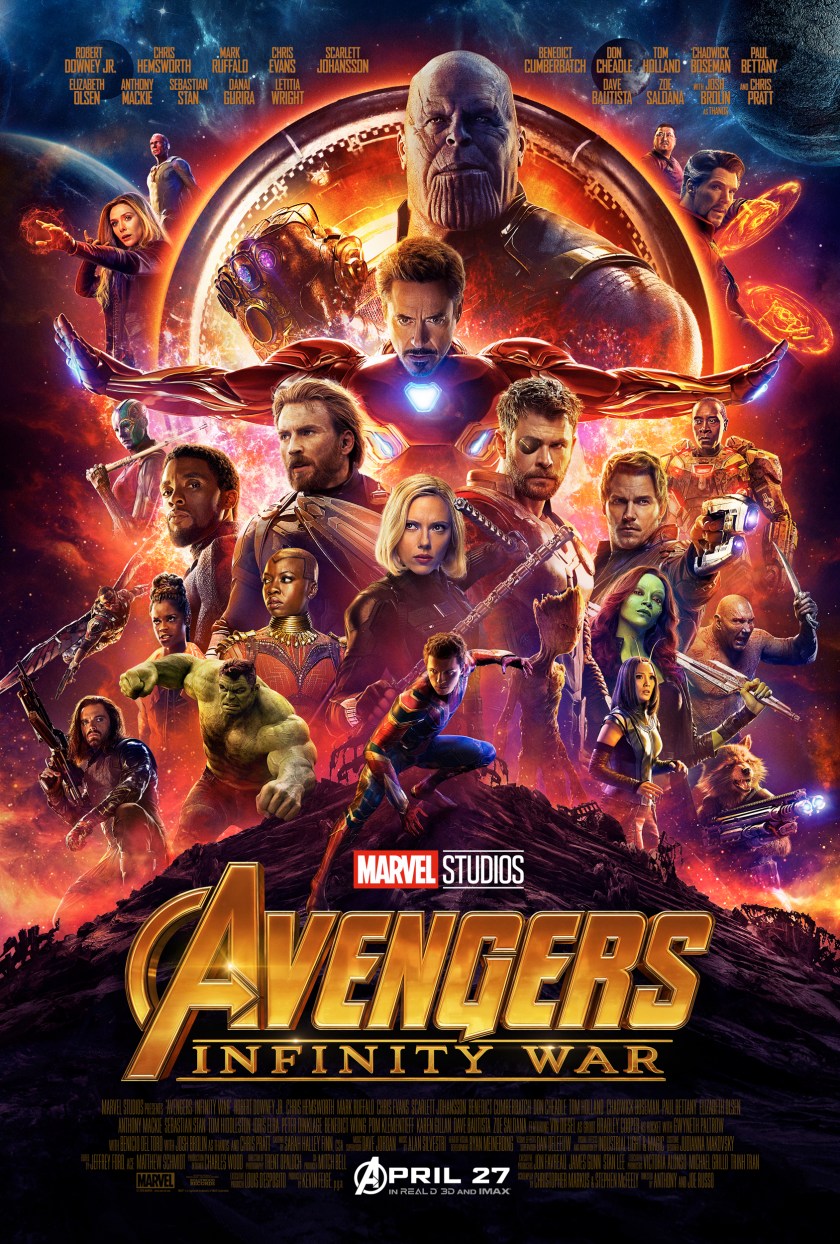
So…it’s all been leading to this. Ten years after Samuel L. Jackson turned up in an after-credits sequence and mentioned “The Avengers Initiative” to the confusion of anyone who has never picked up a comic book, the Marvel Cinematic Universe has now transcended nerd culture and become more essential to pop culture than some of its longest-running franchises. Avengers: Infinity War is testament to how expansive yet accessible these films have become, bringing together nearly all characters and plot threads developed through eighteen preceding films and expecting you’re all reasonably kept up. However, as much as some of the marketing makes it out to be, the story is far from being over. What Infinity War represents more accurately is the beginning of the end of this current incarnation of the MCU, and it does so in ways no other movie could even dare to attempt without the immense build up it has had.

Avengers_Infinity_war_poster

Though you don’t have to have memorised a Marvel encyclopaedia to make sense of this film, being reasonably familiar with all the major events of the previous MCU movies is pretty much required to get the desired experience. Rather than being just one big mash-up of all the characters thrown into one place, Infinity War follows a more fragmented narrative, with different teams of heroes off on their own quests to solve the larger problem; plenty of characters weave in and out of these various plotlines, but there are definitely distinct delineations. As a result, the film truly feels like it spans the whole scope of the MCU rather than consolidating everything on Earth, better matching the stakes and scale of The Empire Strikes Back than Age of Ultron previously tried to do. Speaking of, Infinity War captures a similar sense of hopelessness and defeat as that landmark Star Wars entry but on a phenomenally larger scale. It’s hard to say much without spoiling everything, and the film is best experienced going in as dark as possible, so I will surmise as follows: the pacing is tireless, the banter as sharp as ever, there are too many standout scenes to count, and your expectations are probably far off what truly unfolds.

Infinity War has such a gargantuan cast that listing them all in the starring section would probably take up half the review. With the exception of a few smaller characters, every cast member here has already had ample time to shine in the previous films and all deliver performances at least on par with their previous efforts. Whilst that means not every character gets the focus you might hope for, the film still does an impressive job of balancing everything just right enough that the story remains cohesive and the characters engaging. Again, it’s hard to pick standouts without potentially giving away the game, but what I will say is that I really appreciate how the film actually gives more focus to some of the smaller characters. We’ve seen time and again these stories from the point of view of major figures like Captain America and Iron Man, and as such following them too much might have felt redundant; we already understand them well enough and they don’t have anywhere else to go at this point. To instead bring a little more focus to the likes of Gamora or Scarlet Witch not only allows them much-needed development, it makes the story feel less consolidated to the same three main characters yet again. And hey, that’s not to say that characters served less by this film won’t be fairly compensated in the imminent sequel.

But what ultimately makes the bloated character list and delicate smattering of character development work is that the film, when you look at the bigger picture, isn’t about the heroes at all. They are on the morally righteous side and our sympathies clearly lie with them, but all they can really do is delay and be obstacles to the inevitable. The film’s genius ploy is that our protagonist, the one who has the clearest motivations and personal journey, is actually the tyrannical Thanos himself. Whilst perhaps not as charming as Loki or as relatable as Erik Killmonger, Thanos proves himself as more than just another big bad and brings depth to a character archetype that never moves past those world-ending clichés; he truly put similar figures in the genre recently like Apocalypse and Steppenwolf to shame. A lot of this is thanks to Josh Brolin’s magnetic performance, bringing an effortless menace and convincing internal logic to the galactic madman. It’s very easy to hate him, but there’s an undeniable sense of tragedy to what he has to do, why he thinks he has to do it, and what he completely misunderstands as a result. Even in his most despicable moments, it’s hard not to understand his motives and even sympathise with his emotional turmoil. On reflection, it’s really the heroes who serve as his obstacles, in turn bringing a unique perspective twist to the traditional superhero story.

Audiences have seen these characters clash on screen multiple times before, but the metahuman melee is still just as fun to watch. After the phenomenal airport sequence in Captain America: Civil War set the bar for large scale superhero battles, Infinity War does its utmost to live up to those expectations and succeeds far more often than not. With the film itself feeling like a gigantic third act in and of itself, the action is constant from the get go and every skirmish feels appropriately epic. They are fast-paced, packed with fantastic stunt work and visual effects magic, and the choreography that makes these characters’ fisticuffs bounce off each other as beautifully as their quips keeps things constantly entertaining. The film does an excellent job of combining all the radically different design corners of the MCU together whilst keeping everything aesthetically consistent, and after some patchy effects work in the last few films the VFX here is pretty exemplary; the performance capture work on Thanos is especially fantastic. Wrapping up the entire package is a bravura yet haunting score by Alan Silvestri that summarises the film all on its own: heroic and dynamic, but with a constant reminder of dread and collapse.

It’s best not to think of Avengers: Infinity War as only half of a movie. Instead, think of it more like the penultimate episode of a season of television; everything has been building to this point, all bets are off, and now all we can do is wait for the finale. Much like Star Wars: The Last Jedi, it’s a film that doesn’t seem to hold up when viewed through a traditional lens. However, when seen from a deconstructive perspective and viewed on its terms rather than those of a more traditional movie, it’s a unique and entertaining emotional rollercoaster. It is a monument to everything Marvel Studios has accomplished to this point whilst also eschewing many of the expectations and clichés it helped build about the genre. It is not only a reflection of what has passed, but also a glimpse through the keyhole of what is to come for the universe, and I personally cannot wait to see how everything pans out from here. Unfortunately, we have a whole year of waiting now ahead of us…

FINAL VERDICT: 10/10!

cropped-screen-shot-2017-10-01-at-19-46-22.png

UNSANE – an Alternative Lens review

Starring: Claire Foy (The Crown), Joshua Leonard (The Blair Witch Project), Jay Pharaoh (Saturday Night Live), Juno Temple (The Dark Knight Rises), Amy Irving (Carrie)

Director: Steven Soderbergh (Ocean’s 11)

Writers: Jonathan Bernstein & James Greer (The Spy Next Door)

Runtime: 1 hour 38 minutes

Release Date: 23 March (US, UK)

Well, Steven Soderbergh’s retirement didn’t last long, but he’s certainly come back with a slightly different mindset. Instead of going through the usual studio rigmarole, he’s taken the Robert Rodriguez way and has instead been homegrowing his own projects. His first film back, last year’s Logan Lucky, was an excellent film but didn’t manage to find a large audience despite its star power. For his next effort, Soderbergh has thought even smaller and taken on the new indie filmmaker trend: shooting the entire movie on a smart phone. However, Unsane is far from being defined by this production gimmick.

unsane

Going into Unsane as blind as possible is the best course of action; the trailers don’t reveal the big mysteries, but they are still best avoided. Most easily surmised as “One Flew Over the Cuckoo’s Nest meets Fatal Attraction”, the story isn’t especially original in its core components but does create a fantastic sense of dread and unease. From the moment Sawyer (Foy) senses something is wrong about her predicament, the tension is tighter and only grows more uncomfortable as her sanity continues to be pushed to the limit. The film also takes the opportunity to comment upon the dark underbelly of the health industry in topical fashion, making the story’s hellish environment seem that much more possible.

Claire Foy ably carries the film as Sawyer, balancing her performance well enough that she can never be a fully trustworthy narrator whilst remaining sympathetic. Her character’s actions are somewhat questionable (I mean, how many fits does she have to pull for she realises it’s only making her situation worse), but otherwise it’s a captivating and solid role to break her out of her current prim-and-proper image. Jay Pharoah also gives a surprising dramatic turn as Sawyer’s only ally in her predicament, but the real MVP here is Joshua Leonard. I can’t say too much about his role, but he threatens to steal the movie from right under Foy.

Unsane is far from a gimmick film, using its DIY production aesthetic more for efficiency’s sake than for attention. It’s a dark and sickening experience that may leave you feeling as distressed as its protagonist, and for this kind of film that’s a great feeling to leave with.

FINAL VERDICT: 8/10

cropped-screen-shot-2017-10-01-at-19-46-22.png

A WRINKLE IN TIME and PACIFIC RIM: UPRISING – Alternative Lens Reviews


A WRINKLE IN TIME

Starring: Storm Reid (Sleight), Levi Miller (Pan), Deric McCabe (Stephanie), Oprah Winfrey (The Colour Purple), Reese Witherspoon (Wild), Mindy Kaling (Inside Out), Zach Galifianakis (The Hangover), Michael Pena (Ant-Man), Gugu Mbatha-Raw (Belle), Chris Pine (Star Trek)

Director: Ava DuVernay (Selma)

Writers: Jennifer Lee (Frozen) and Jeff Stockwell (Bridge to Terebithia)

Runtime: 1 hour 49 minutes

Release Date: 9 March (US), 23 March (UK)

A Wrinkle in Time is a difficult novel to adapt, as it needs to impart a lot of complex scientific and emotional concepts whilst still being easily consumable for its target audience of young minds. Ava DuVernay proves with her adaptation that she not only understands and is passionate about the material but, after years on the indie scene, she is more than capable stepping into the blockbuster realm; I cannot wait to see what she does with The New Gods. However, Wrinkle shows more potential than a complete proof of concept, as the final product is rough around the edges.

DuVernay’s intentions are clear and noble, but the film’s delivery is somewhat haphazard in how it accomplishes them. The screenplay does a solid job of moulding the novel’s story into a more conventional adventure narrative, but the stop-start pacing in the first half means the film takes far too long to find a solid groove. The dialogue also comes off as cumbersome at times, with characters switching between well-enunciated technobabble and witty remarks in between lines, which often makes light of the artifice far more than the film’s outlandish design work ever does.

But even in spite of the narrative shortcomings, DuVernay’s command over the film remains strong, and the film is at its best when it abandons the spectacle and goes straight for the heart. The way the film imparts its core themes of unconditional kindness and pursuing light in the darkness is sure to inspire its young viewers and bring tears to the eyes of their elders. The impressive cast, led ably by relative newcomer Storm Reid in a star-making turn as Meg, further buoys the feels along. The Three Mrs as played by Winfrey, Witherspoon and Kaling go hard on their oddball characters but thankfully stay on the endearing side of kooky, whilst Gugu Mbatha-Raw and Chris Pine help ground the story back into reality.

All in all, A Wrinkle in Time doesn’t fully stick the landing but it hits hard where it counts, delivering a sweet and timely sci-fi adventure for all the little warriors in us. 

FINAL VERDICT: 7/10


PACIFIC RIM: UPRISING

Starring: John Boyega (Star Wars: The Last Jedi), Scott Eastwood (Fast & Furious 8), Cailee Spaeny, Tian Jing (Kong: Skull Island), Rinko Kikuchi (47 Ronin), Burn Gorman (Crimson Peak), Charlie Day (Horrible Bosses)

Director: Steven S. DeKnight (Daredevil)

Writers: Steven S. DeKnight & Emily Carmichael & Kira Snyder (The 100) and T.S. Nowlin (The Maze Runner)

Runtime: 1 hour 51 minutes

Release Date: 23 March (US, UK)

The original Pacific Rim was first and foremost a juicy slab of popcorn entertainment for sure, but it was far more complex than most give it credit for. Guillermo Del Toro’s film was indeed chock full of giant robots fighting giant monsters, but it also imparted a strong globalist message about uniting to save our planet and better ourselves in the process. But without the now Oscar-winning director at the helm here, that balance has been definitely swung away from its intellectual undertones. Luckily, that doesn’t stop it having a blast in spite of that.

Uprising touches on similar beats and concepts from the first film, focusing more on developing the series mythology rather than character or theme. The story as a result rests a lot on tropes and is more an excuse to string together all of the new creature concepts and action sequences they’ve come up with. At times, the experience is so simplistic that it honestly feels more like the first few episodes of a non-existent animated series strung together. It fully embraces its anime and tokasatsu inspirations and goes straight for the awesome factor, and when the action is that passionate and imaginative, intellectual shortcomings can be forgiven.

John Boyega is a fantastic new face for the franchise, bringing a fairly generic character on paper to life with a double dose of charisma and enthusiasm. Newcomer Cailee Spaeny is also a lot of fun as Boyega’s rebellious trainee, and this is easily the most appealing Scott Eastwood has ever been as a performer. In regards to returning cast, Charlie Day and Burn Gorman’s chemistry is as strong as ever, best recapturing in their brief scenes the energy of Del Toro’s original, whilst on the flipside finding little to do for Rinko Kikuchi than quickly pass the torch to Boyega.

Pacific Rim: Uprising often feels more like a product than a feature film, but it retains enough of its forbearer’s soul to be worthwhile for fans. What it lacks in originality it makes up for in charm and fun, so it’s ultimately up to you if that’s enough.

FINAL VERDICT: 7.5/10


cropped-screen-shot-2017-10-01-at-19-46-22.png

READY PLAYER ONE – an Alternative Lens review

Starring: Tye Sheridan (Mud), Olivia Cooke (Me and Earl and the Dying Girl), Ben Mendelsohn (Rogue One), Lena Waithe (Master of None), T.J. Miller (Deadpool), Simon Pegg (The World’s End), Mark Rylance (Bridge of Spies)

Director: Steven Spielberg (Raiders of the Lost Ark) 

Writers: Zak Penn (The Incredible Hulk) and Ernest Cline (Fanboys)

Runtime: 2 hours 20 minutes 

Release Date: 28 March (UK), 29 March (US)

If you spend a lot of time on the Internet, you’ve at least heard of Ready Player One and how its quality and content is a fervent debate amongst all corners of the web. Some see it as a celebration of pop culture, others see it as nothing but a fanboy nostalgia drool-fest, whilst others are more focused on Ernest Cline’s lack of nuanced prose and questionable perspective. My personal relationship with the book is a little more…complicated. After the watching the film, I honestly would rather discuss my history with it in more detail on another platform, but in summary my opinion in retrospect on the novel is that it’s “fun but problematic”, and I think that conclusion fits pretty well with the film adaptation too.

The film’s narrative has been heavily simplified from the novel into a more traditional adventure narrative and is ultimately much better for it. All the key aspects of the original story are still there, whilst other elements that either lacked focus or were troublesome have been addressed satisfactorily; these changes may even assuage those who were irked by them in the book. In a surprising change from most adaptations, it’s the new elements added to the story that are honestly the best parts, such as an insane race sequence and a creepy trip through a classic film. Where Ready Player One really struggles in its jump to the big screen is in building its world. The first fifteen minutes is just a deluge of sloppy exposition delivered in voice-over and flashbacks, spoon feeding information that could have easily been delivered in a less abrasive fashion. Once all the cards are laid out, the film becomes far more enjoyable, but the artifice does still come back due to its imbalanced structure and glossing over plot details until they are suddenly important. However, for every slip-up the film makes, it bounces back on pure entertainment and feel-good vibes, delivering that classic Spielberg energy and heart. Of the key changes to the film, the one that feels most necessary is giving it a more defined message. It delivers a tale that feels incredibly timely for our technology-obsessed age, but one that at the core is also timeless and sweet. What else would you expect from Steven Spielberg?

Of all the criticisms that befall the novel, the big one is that protagonist Wade Watts isn’t particularly likeable; he’s simultaneously everything wrong with fanboy culture and an earnest if unintentionally conceited defence of that mindset. The film version of Wade is slightly more likeable, but only in the sense that he’s called out on his sheltered and obsessive bullsh*t and has to actually learn from it, but yet he ultimately falters because we don’t really get to know the real Wade. Much of his screen time is spent inside the virtual world seeing his aggrandised online persona, so anytime we spend with him in the real world we’re asked to connect with a character we don’t really know. Additionally, Tye Sheridan feels woefully miscast. Whilst an immensely talented performer, he plays Wade a little too straight instead of giving him the misguided boyish earnestness he requires; after this and X-Men: Apocalypse, it’s clear he’s more comfortable as an indie character actor rather than a Hollywood leading man.

Luckily, the film’s supporting cast more than picks up the slack of its awkward lead. Olivia Cooke makes for a charming and kick-ass second lead as Art3mis, constantly stealing the movie away from Sheridan for the better, and Lena Waithe equally demands attention as Aech; if she doesn’t her own shot at leading status after this, that would be the real crime. Ben Mendelsohn gives some much-needed depth to antagonist Nolan Sorrento, creating a threatening but all-too-human villain; he’s like if the bad guy from a Paul Verhoeven movie was also an Electronic Arts executive. T.J. Miller is amusing as iRok, the Otis to Sorrento’s Luthor, expanding a fairly inconsequential character from the book into a solid lampooning of the self-serious edgelord. Hannah John-Kamen’s F’Nale Zandor was created for the film but is ultimately unnecessary, having no real clear character and handling tasks that should have really been composited into either Sorrento or iRok. Win Morisaki isn’t too compelling as Daito, but young Phillip Zhao is adorable in his brief scenes as Shoto; he’s like a modern day Short Round. Simon Pegg doesn’t get much to do as Ogden Morrow but is his usual likable self whilst he’s there, whilst Mark Rylance is utterly pitch-perfect as James Halliday, playing the “Steve Jobs mixed with Willy Wonka” role fairly on-the-nose but still giving him a sense of magic and charm.

Ready Player One can get away a lot with in the visuals department both good and ill because it mostly takes place in the virtual world, and the filmmakers have clearly spared no expense in crafting a cinematically spectacular experience. The world of the OASIS truly does feel like an unlimited space of imagination and creativity in how vast and visually diverse it can get. I’d best sum it up as like a Spielberg movie from the 80s that took all of the drugs and is now obsessively munching on Doritos whilst playing NES games (you know, in a good way). The film is packed full of background references and gags, which are generally far more easier to swallow than the ones they shove in your face, but they’ll certainly have hardcore fans going back frame-by-frame to catch everything for years to come. It’s a shame that the same attention to detail didn’t go into the real-world environments, which end up looking like sets and props for a dystopian future pack you can buy on a video game asset store. Tying the entire experience together is a solid if predictable selection of 80s pop hits and a magically nostalgic score by Alan Silvestri; who else could create a score that inimitably captures the sound of 1980s movies than one of the composers who helped define it?

If I had seen Ready Player One when I was fourteen, I probably would have declared it the greatest movie I had ever seen. That part of me that still exists wants to love this film as much as that kid, and for chunks of the film’s runtime it succeeded in bringing them back. However, as an adult who has finally stepped away from an arrested development, I can’t fully embrace the film as much as I would like. It’s an adaptation that clearly understands the faults of its source material and does its best to work with them whilst still having fun, but it can be hard shake away the sense it is ultimately a Frankenstein of misguided memberberry wistfulness and corporate intellectual property-gasm. It’s certainly a far more nutritious experience than the book, mainly thanks to Spielberg mining the feels for all their worth, and I certainly wouldn’t begrudge anyone wanting to escape the depressing world we live in for a few hours to enjoy it. After all, as the film makes clear itself, the real world matter most, and our fantasies can just as easily be used to better reality as they can be used to run from it. So yeah, I think my ultimate appraisal of the book still applies.

FINAL VERDICT: 6/10

cropped-screen-shot-2017-10-01-at-19-46-22.png

BLACK PANTHER – an Alternative Lens review

Starring: Chadwick Boseman (42), Michael B. Jordan (Creed), Lupita Nyong’o (12 Years a Slave), Danai Gurira (The Walking Dead), Martin Freeman (The Hobbit), Daniel Kaluuya (Get Out), Letitia Wright (Humans), Winston Duke (Person of Interest), Angela Bassett (Malcolm X), Forest Whittaker (Rogue One), Andy Serkis (War for the Planet of the Apes)

Director: Ryan Coogler (Fruitvale Station)

Writers: Ryan Coogler & Joe Robert Cole (American Crime Story)

Runtime: 2 hours 14 minutes

Release Date: 13 February (UK), 16 February (US)

Full on disclosure: Black Panther is not the first superhero movie to have a lead of colour. Sure, we can sweep movies like Steel and Spawn under the rug, but Blade practically started the modern superhero movement; why do people keep constantly forgetting that important fact? However, that by no means diminishes Black Panther’s importance. It’s not just the first of the current generation of comic book movies to have a black lead, but it’s the first to be so steeped in that culture and brought to life on a scale equalling its cousins. Much like Wonder Woman last year, there is a lot riding on Black Panther’s shoulders in regards to minority representation in Hollywood and, with very few exceptions, it delivers an experience long overdue for that underestimated slice of humanity.

Though knowing the events of Avengers: Age of Ultron and Captain America: Civil War help the experience, Black Panther is very much a self-contained Marvel adventure and would work just as well in a vacuum. The plot is simple but incredibly well executed, mainly thanks to pitch-perfect world building and an appropriate balance of gravitas and levity. The whole experience is swift and engaging from its opening minutes, but there is a lot of down time away from the superheroics. Thankfully, these scenes of interpersonal conflict and political intrigue are often more entertaining than the action sequences themselves, and they show a level of political commentary and dramatic gravity often lacking in Marvel’s other films. More so than many of films of the genre, Black Panther is a socially conscious film that delivers an important message about uniting nations and fighting for the betterment of all peoples. It gives the disenfranchised a hero they can look up to, but also reminds us that the pendulum can swing the other way when the oppressed gain power. Even more so than the Thor films, it delivers a tale of Shakespearean levels but through a fantastical lens, and even though the individual pieces are familiar they are used to build a truly original hole.

Chadwick Boseman got a chance to show us what he could do with the character of T’Challa in Civil War, but now with his own film he truly gets to run the show and does so with flying colours. His dry sense of humour and subdued charm help set him apart from the usually quip-happy heroes of the MCU, and the added dimension of him being not just a superhero but king of an entire nation creates a whole new set of complications for his character; talk about “with great power comes great responsibility”. But more than most other solo Marvel movies, Black Panther is very much an ensemble movie that wouldn’t stand as strong without its fantastic supporting cast. Michael B. Jordan’s Killmonger is easily the best antagonist in the MCU since Loki, not only because of his charismatic performance but because his motivations are clear, understandable and even somewhat empowering. I genuinely understand why people would follow this guy, though his methods do occasionally veer on Baron Zemo levels of questionable plotting. Lupita Nyong’o is fantastic as Nakia, sharing fun romantic chemistry with Boseman that rivals Tony Stark and Pepper Potts for awkwardly adorableness. Danai Gurira is an undeniable badass as Okoye, stealing pretty much every action sequence she is in, and Winston Duke makes for a surprisingly entertaining rival fro T’Challa as M’Baku. Angela Bassett and Forest Whittaker provide excellent mentor roles, their mere presence giving the film a lot of credibility, whilst returning players Martin Freeman and Andy Serkis get to expand on their respective characters of Everett Ross and Ulysses Klaue in fun and interesting ways. But the film’s real MVP is Letitia Wright as T’Challa’s spunky tech genius sister Shuri. Not only does she have all the best lines and incredible comedic chemistry with Boseman, but to see a young woman of colour essentially be the Marvel Universe’s equivalent to Q is an empowering feat all on its own.

What Black Panther achieves on a technical level almost outshines what it does elsewhere, delivering a cinematic experience that feels like a true glimpse into a possible ethno-diverse future of the medium. The production design work that has gone into bringing Wakanda to life is just gorgeous to behold, mixing traditional African designs with advanced sci-fi to truly define the modern definition of “Afro-futurism”. The cinematography is vibrant and sweeping, effectively covering not just the intense and wildly choreographed action sequences but the sweeping beauty of the film’s lushly detailed environments. The visual effects work is on par with what you’d expect from Marvel on both positives and negatives; the design and animation is fantastic, but the final execution sometimes comes off as too cartoony (and there’s way too much obvious green screen work). The film’s music also deserves a boatload of praise. The Kendrick Lamar-curated soundtrack is fantastic and incredibly catchy, but Ludwig Goransson’s compositions are also incredible in how they weave African choir into a typical superhero score.

Black Panther is an incredibly enjoyable blockbuster movie that delivers everything you want from a Marvel movie, but it’s so much more than that. It goes above and beyond the expected MCU template by giving the characters more complex relationships, crafting visuals unlike any others in modern cinema, and sends a message of empowerment and progressivism that is desperately needed in today’s culture. For me, it’s simply yet another excellent entry in the superhero genre, but for others it will be far more than that. There are plenty of other comic book movies to come this year, but I doubt any other will capture the cultural zeitgeist and inspire more people than Black Panther.

FINAL VERDICT: 9/10

cropped-screen-shot-2017-10-01-at-19-46-22.png

STAR WARS: THE LAST JEDI – an Alternative Lens review

Starring: Daisy Ridley (Murder on the Orient Express), Mark Hamill (Kingsman: The Secret Service), Carrie Fisher (When Harry Met Sally…), Adam Driver (Frances Ha), John Boyega (Detroit), Oscar Isaac (Inside Llewyn Davis), Andy Serkis (Dawn of the Planet of the Apes), Domnhall Gleeson (Ex Machina), Kelly Marie Tran, Laura Dern (Jurassic Park), Benicio Del Toro (Sicario)

Writer/Director: Rian Johnson (Looper)

Runtime: 2 hours 32 minutes

Release Date: 14 December (UK), 15 December (US) 

Star Wars is back and it’s probably not going away any time soon. As much as both The Force Awakens and Rogue One have received praise for recapturing the magic of the original trilogy in ways the prequels never managed, they have also been criticized for relying too much on nostalgia instead of carving out their own identity. As a result of this, The Last Jedi has an incredibly fine line to tread on; it has to move the franchise forward whilst maintaining that classic Star Wars feel. The final result is probably not the movie you wanted, but one that makes you realise what you wanted probably wasn’t the best idea.

Picking up right where The Force Awakens left off, The Last Jedi wastes no time in getting the ball rolling on an extended but exhilarating and tightly paced adventure. Despite being the longest film in the franchise to date and filled with plenty of emotional character moments, the film never feels like it comes to a complete halt. Much like The Empire Strikes Back, the film follows a multi-strand narrative with our heroes off on separate adventures, but all the storylines parallel and converge with each other much more smoothly; they compliment each other in a way that makes the narrative feel more cohesive. The second act is perhaps stretched a little too far, especially in regards to Finn and Rose’s storyline, but the movie knows when to cut away and progress another story when things start to drag. But what really makes The Last Jedi stand out is how it plays with the core tenants of the Star Wars franchise, making strong use of canon and nostalgia but twisting it to its own means rather than just making cute references. It lovingly questions what fans know and have come to expect, making it the first film in the franchise since Return of the Jedi where I genuinely didn’t know where it was going. You could almost say it’s intentionally unsatisfying in how it plays with your expectations, but what it delivers in return is superior upon reflection and is ultimately what you really came for: Star Wars for a new generation.

Though some get more focus than others, every major character in The Last Jedi gets a moment to shine and the entire cast puts in everything they have throughout. Daisy Ridley gets ample room to explore the character of Rey, giving her an internal conflict far more intricate than any previous Star Wars protagonist and dissuading those Mary Sue arguments that erupted from The Force Awakens. John Boyega continues to excel as Finn, and pairing him with newcomer Kelly Marie Tran as Rose Tico makes for a sweet new double act. Oscar Isaac’s Poe Dameron is given a more important role here and the character now feels fully fleshed out, with a character arc unique to the franchise so far and promises that Poe will continue to be a key player throughout. Adam Driver really gets to sink his teeth into Kylo Ren, proving himself to be easily the most complex villain in the franchise thus far; not necessarily the most imposing or badass, but that vulnerability is what makes him so fascinating.

Mark Hamill’s return as Luke Skywalker is more than worth the wait, showing the character in a drastically different light but who still has echoes of the plucky farm boy we once knew and loved. This is easily Hamill’s best performance in the series, perhaps even his entire live-action career, and his role perfectly encapsulates the film’s themes of uncertainty and breaking the cycle. The late Carrie Fisher’s swansong performance as General Leia is also fantastic, giving the character a grandiosity and world-weariness but retaining her perseverance and sense of humour; the franchise will never be the same without her. Domnhall Gleeson’s General Hux remains a lot of fun, and Andy Serkis’ Supreme Leader Snoke is used sparingly but brilliantly. Gwendoline Christie still ends up with the short end of the stick as Captain Phasma, but at least she gets involved in the action this time around, whilst Lupita Nyong’o has little more than a cameo this time as Maz Kanata. Laura Dern really shines as Admiral Holdo, a character begging for more stories in the extended universe, as is Benicio Del Toro’s DJ; both new characters are somewhat familiar archetypes, but with a complexity and motivation you wouldn’t expect from a typical Star Wars film

The Last Jedi looks and feels like a classic Star Wars movie, but Rian Johnson more than injects his own unique flavour into it. The film offers far more new elements from a design perspective than its predecessor with unique planets, new ship and creature designs, and other aesthetics that feel fresh but still very much within the Star Wars brand. The film’s cinematography moves and breathes on a different wavelength to previous films, bathing the visuals with richer colours and playing with the camera work in a more modern but controlled way. The sound design is absolutely fantastic, using and revitalising classics sounds from across the saga whilst also creating new ones that slot perfectly into the canon. John Williams’ score this time around reuses a lot more themes from the previous films, but they all have a new edge to them and all the new tunes are more memorable for the most part than his compositions for The Force Awakens.

Star Wars: The Last Jedi does what no film in the franchise has done in 34 years: it genuinely surprised me. The film breaks many franchise traditions on all levels, but it does so with a lot of respect and with the ambition to build something new and exciting from what remains. It really is the Empire Strikes Back of this new trilogy, but not in the same way The Force Awakens was essentially A New Hope. It is structurally and tonally similar to that movie, but the meat of it is wholly new material to the franchise. It’s certainly the best film in the saga since Empire, and perhaps with time it may even surpass it. Rian Johnson sets a new precedent for what you can do with a mainline Star Wars film, one I fear JJ Abrams won’t live up to in the next instalment, but I’m excited for it all the same simply because we are now moving into uncharted territory. The franchise no longer feels burdened by the traditions of the past and, in a sense, now feels truly reborn.

FINAL VERDICT: 10/10!


cropped-screen-shot-2017-10-01-at-19-46-22.png

JUSTICE LEAGUE – an Alternative Lens review

Starring: Ben Affleck (The Town), Henry Cavill (The Man from U.N.C.L.E.), Gal Gadot (Fast & Furious 6), Ezra Miller (The Perks of Being a Walflower), Ray Fisher, Jason Momoa (Conan the Barbarian), Amy Adams (Arrival), Jeremy Irons (Die Hard with a Vengeance), J.K. Simmons (Whiplash), Ciaran Hinds (Road to Perdition)

Director: Zack Snyder (300)

Writers: Chris Terrio (Argo) and Joss Whedon (The Avengers)

Runtime: 1 hour 59 minutes

Release Date: 17 November (US, UK)

The DC Extended Universe (or whatever it’s supposed to be called) has been uneven, to put it lightly. It has a lot of good elements going for it, but it also has had a deluge of problems that generally all link back to poor planning and a misunderstanding of audience expectations. There still remain a lot of apologists for the series out there, and I’ll admit to being one of them, but even I’ll say all the films (Wonder Woman being an exception) don’t hold up under scrutiny. You can go ahead and knock a few points off of my reviews of Batman v Superman and Suicide Squad; I was far too generous at the time. But whilst Wonder Woman wowed audiences this past summer, the real test of whether this series can remain afloat comes in the form of what this has all been leading to: Justice League. The film itself has been through a troubled production of near-constant reworking since production began, but all that ultimately matters is whether the final product delivers. Does Justice League show promise of a new beginning for the DCEU, or does it succumb to the sins of its predecessors? Well, the answer is complicated, so bear with me.

justice-league-poster

A lot has changed in regards to story and tone in Justice League when compared to its predecessors. The grim-dark atmosphere has been lightened considerably, the plot has gone from needlessly overcomplicated to refreshingly simple, and the overbearing themes have been simplified down to the basics of good vs. evil. It’s not exactly groundbreaking or exemplary what they’ve done, but it’s a promising step in the right direction. The film’s pacing is also much improved, with a simple two hour runtime that breezes by effortlessly. It’s not a totally smooth ride, as there have clearly been concessions made to the story to attain its length, but it’s closer to ideal than before. What Justice League finally gets right and ultimately makes it an enjoyable experience is that it embraces fun without completely aping the Marvel formula. It embraces the sandbox of the DC Universe and has a blast playing with its toys with the time that it has, and that sense of exuberance makes it easier to forgive the basic plot and bumpy structure. It sets forth a brighter and more promising future for the future of the series, made clear by its optimistic conclusion and a fun set of post-credits sequences no fan will want to miss.

What the film also thankfully succeeds at is crafting an entertaining team of heroes to follow and, though the film doesn’t take full advantage of their potential, what’s there is a solid start. Ben Affleck’s Batman has been softened up a bit from his almost-barbaric portrayal in BvS and continues to be one of the more faithful interpretations of the character brought to screen; he’s the closest to Kevin Conroy any live-action actor has gotten. Gal Gadot continues to effortlessly shine as Wonder Woman, stealing almost every action sequence and bringing a lot of the lightness of her solo movie with her; even if you don’t end up liking the movie, you’ll at least like her. Ezra Miller as The Flash makes for some solid comic relief and does more than enough to differentiate himself from the likes of Grant Gustin from the TV series or either of the Quicksilvers. Jason Momoa as Aquaman is a nice surprise, with his macho surfer approach giving the character a fun edge that most interpretations fail to balance. Ray Fisher’s Cyborg is a bit of a weak link, which is a shame considering how vital he is the plot, but at least he isn’t annoying or without purpose. And then, and don’t say this is a spoiler because we all knew it was happening, there’s Henry Cavill’s Superman. I won’t say much more, but if you’ve been disappointed by the series’ treatment of the character thus far, this film may give you some hope.

It’s a good thing the League itself is so entertaining to watch, because the supporting cast feels either wasted or completely lacklustre. Amy Adams and Diane Lane aren’t given much to do as Lois Lane and Martha Kent, with their involvement in the plot being sprung out of nowhere before disappearing once their usefulness is up. J.K. Simmons, Billy Crudup and Amber Heard are practically just here for glorified cameos here as Commissioner Gordon, Henry Allen and Mera respectively, not doing much but promising to be more important in future instalments. Jeremy Irons continues to be a solid Alfred, and seeing Connie Nielsen pop up as Hippolyta with the Amazons for a quick action beat is a nice touch, but that’s really about it. What really drags the film down unfortunately is the villain, who manages to make even the weakest of Marvel Studios’ stable of adversaries look varied and complex in comparison. Steppenwolf is a cookie-cutter antagonist with barely any motivation or characterisation, showing no real interaction with the team and just single-mindedly following the “destroy the world” evil plan without even a single unique flair. He seems a paltry offering for what is supposed to be the great evil that brings our heroes together, and not even the promise of what may come in the future as a result of his actions can make up for how bland he is.

Justice League makes all the right decisions on a technical front, but none of them quite add up in practice. The film looks vibrant and distinctive, like a comic book come to life, but often the colour grading does feel eerily saturated and can make certain elements look too artificial. The action sequences are well paced and spread generously throughout, but the film never quite pulls out a standout sequence. The costumes are designed well and effectively capture their comic book counterparts with a cinematic twist, but they sometimes look a little too costumey in certain lights. The visual effects are grand and ambitious, but they don’t feel like they’re ready for prime time yet; this is a problem when there’s nary a shot in the film that doesn’t involve visual effects, even during scenes that don’t really call for them. The only element that works solidly is Danny Elfman’s score, which junks the sombre, thudding music of Hans Zimmer and brings a more traditionally heroic soundtrack to the table. It’s a welcome change, and hardcore fans will probably even pick out a few echoes of classic tunes mixed into the new compositions.

Justice League may not bring DC to exactly where it wants to be, but at least it’s trundling in the right direction. It doesn’t do anything spectacularly original, yet it doesn’t embarrass itself with baffling creative decisions either. Its biggest crime is being a bit too safe from a storytelling perspective, however it does its main characters justice (pun sort of intended) and that counts for a lot. If you want what is essentially a live-action version of an above-average episode of Justice League Unlimited, or have been sated by Marvel’s lesser offerings like Iron Man 2 or Thor: The Dark World, then Justice League should entertain you enough. I’d best compare it to eating takeout at 3AM. You know in the moment it’s not the best idea and won’t give you any nutrition, but you’re hungry, it fills a hole, it’s tasty while it lasts, and you’ll probably indulge in it again under similar circumstances.

FINAL VERDICT: 7/10

cropped-screen-shot-2017-10-01-at-19-46-22.png