
JUPITER ASCENDING review

Starring: Mila Kunis (Black Swan), Channing Tatum (Foxcatcher), Sean Bean (Game of Thrones), Eddie Redmayne (The Theory of Everything), Douglas Booth (Noah)

Writers/Directors: The Wachowskis (The Matrix)

Runtime: 2 hours 7 minutes

Release Date: 6 February (US, UK)

Over fifteen years later, The Wachowskis still owe their entire career to the success of The Matrix. Other than their criminally overlooked debut Bound, it is their only consistently good film. The Matrix sequels were enveloped by the worst aspects of the original and became convoluted philosophical nonsense, Speed Racer was an admirable attempt to bring an anime to life but ended up being sickeningly trite, and Cloud Atlas was a muddled mess of tones that never melded together cohesively. But despite these constant failures, they still seem to get funding for their elaborate projects. A Matrix fan myself, I really want the Wachowskis to make another good movie and I was hoping desperately that Jupiter Ascending could be the one to restore faith to their name. But once again I find myself leaving the cinema disappointed, and I don’t think I can keep it up any longer.
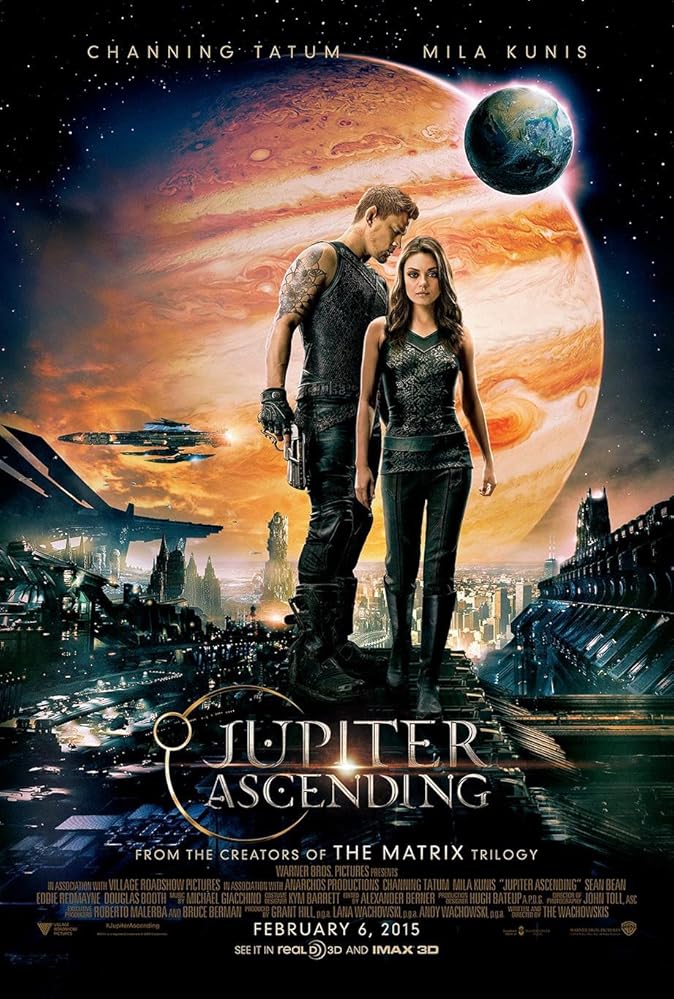
 

Jupiter Ascending’s plot is simple at first glance: yet another hero plucked from obscurity to realise they are destined for something greater and must go on an adventure to save the world. However, despite the straightforwardness of the narrative (which I have no problem with if told effectively), the film feels the need to bombard proceedings with endless scenes of expository dialogue that spoonfeeds every minute detail of the universe it inhabits. It never becomes impenetrable like some of the dialogue in The Matrix Reloaded, but it does have the banality of what you might find in the Star Wars prequels; lots of talks about inheritances, contracts, profit margins, and all sorts of other needless details that bog down a lot of escapist fiction these days. However, it’s that same tiresome exposition that holds up the limp narrative. Despite the amount of detail that has gone into creating this world, Jupiter Ascending doesn’t do anything new on a storytelling level. There’s not a single plot reveal or character moment that doesn’t feel worn or strained, and the film’s lack of awe and wit despite the bizarre surroundings just make it feel that much more dull. I get the strong impression that a lot of material was cut from the movie considering the rushed storytelling and hanging threads (for example, what was the point of Sean Bean’s daughter and where did she disappear to after her two scenes?), but even with those scenes restored I doubt the film could be any less engaging.

In terms of performance, I cannot fault the cast of Jupiter Ascending. They do well with what they are given, but that material does reflect excruciatingly badly on them. Channing Tatum comes out of this the most unscathed, managing to inject a lot of his natural charm into a character that completely lacks any on the page. Sean Bean also manages to keep his head high, but he’s not given enough screen time to leave a lasting impression and is mostly there for expository purposes. Meanwhile, Mila Kunis tries hard but the character of Jupiter Jones is a terribly ineffective protagonist that, whilst I wouldn’t class as sexist, doesn’t reflect well on the role of women in film. For most of the film’s crushingly stretched runtime, she completely lacks any strong motivation or urgency; she is merely dragged from scene to scene to have the plot explained to her. She is constantly thrust into situations that she never does anything to get out of, and is always (and I mean ALWAYS) reliant on Tatum to rescue her at the last second. I get that she’s a fish out of water, but a little more of a take-charge attitude would have alleviated this issue. By the climax she does become a little more proactive, but otherwise you could replace her character with a very important teapot and the plot would make about as much sense. Kunis’ chemistry with Tatum is dreadfully forced, mainly because their relationship is sporadic and unnecessary, and like the film itself she also lacks the right amount of wonder considering her bizarre predicament. The rest of the cast is mostly forgettable or extraneous, but current Oscar frontrunner Eddie Redmayne is a complete and utter embarrassment here. Tasked with playing one of the most unthreatening villains in recent cinema history (who doesn’t even meet our heroine until the story’s climax), Redmayne reads every line in a comically raspy whisper that I guess is supposed to be threatening, occasionally mixing it up by bursting into a shouting fit like a wimpy Al Pacino. Again, I think the problem lies more with the Wachowski’s direction that Redmayne himself, but it is a sadly sour note for the actor in the midst of what may be the defining moment of his career.

Whether the film is good or bad, you can always at least rely on the Wachowskis to make a visually striking film, and in that respect they don’t fail. Jupiter Ascending does look very impressive on a technical level with vibrant cinematography, impeccable visual effects and a fantastic orchestral score by the great Michael Giacchino. There are some cool concepts on display like boots that let you skate on air or instant spacesuits, but I do have to question the bizarreness of the production design. Everything from the sets to the props to the vehicles looks unnecessarily garish and overly busy, with more attention being paid to whether it looks cool over whether it makes aesthetic sense. Even more outrageous are the costumes, which would make those seen in The Hunger Games seem subdued. I get that it helps separate these alien worlds from our own, but too often I found myself questioning why any sane person would design these things this way. The Wachowskis do have a strong love for anime and a lot of that spirit can be found here, but after Speed Racer you think they would have learnt that not all of its odd embellishments translate to live action effectively.

Jupiter Ascending is sadly another mess of a film from the Wachowskis. There are redeeming qualities here and there, but the core components of story and character just don’t work. The narrative is riddled with intricately dull dialogue and predictable plot turns, our protagonist is essentially a prop in her own story, and all the supporting roles are either underdeveloped or laughably overplayed. At this point, the Wachowskis have seriously dipped their toes into Shyamalan territory and it’s going to take something really impressive to get them out of this rut.

FINAL VERDICT: 4/10

KINGSMAN: THE SECRET SERVICE review

Starring: Taron Edgerton (Testament of Youth), Colin Firth (The King’s Speech), Samuel L. Jackson (Pulp Fiction), Mark Strong (Sherlock Holmes), Sophie Cookson, Sofia Boutella (StreetDance 2), Michael Caine (Get Carter)

Director: Matthew Vaughn (X-Men: First Class)

Writers: Matthew Vaughn & Jane Goldman (Kick-Ass)

Runtime: 2 hours 9 minutes

Release Date: 29 January (UK), 13 February (US)

As Kingsman: The Secret Service points out, spy movies have been quite serious as of late. Gone are the days where plots hinged on crazy gadgets and world domination, and in its place are government conspiracies and leaked documents. That’s not to say that the modern spy movies are bad, films such as The Bourne Identity and Casino Royale helped revitalize the genre, nor am I exactly pining for the days of such ludicrous nonsense as xXx or Die Another Day. What is needed, however, is something to balance the scales. Kingsman is that much needed balance, and you need to see it right now.

Based on the comic book by Mark Millar, Kingsman is similar to Matthew Vaughn’s other adaptation of a Millar series, Kick-Ass, in many ways. Not only does it have the same irreverent, self-referential tone and humour, but also it also similarly treats the source material as more of a guideline than a blueprint. It takes the broad strokes of the story, changes up certain key details, cleans off the excess and creates something that is both recognizably Kingsman but also very much Vaughn’s own film. In general terms, the film’s plot is very simple and takes a lot of cues from both classic spy movies and typical hero’s journey stories, but is surrounded by so many of Vaughn’s flourishes that it feels fresh and new. The plot moves at a brisk pace, jumping between the stories of Eggsy (Edgerton) and Harry (Firth) swiftly to tell the whole story and balancing time between character bits and brutal action sequences. It is unapologetically ridiculous and crude, but it also has a solid core to it and knows when to pull on the heartstrings. Additionally, in the midst of all the espionage action, Kingsman also manages to be a movie about something relatable and timely: classism. Whilst neither the rich nor the poor are painted in a bad light, it does touch on the injustices of the class system and creates a hero in Eggsy that shows that greatness can come from any walk of life.

Whilst the marketing has played up Colin Firth as the star of the film, who is excellent in his role as he effortlessly pulls off the gentleman spy routine, he is neither the main character nor the standout performer of the movie. Those honours belong to relative newcomer Taron Edgerton, whose role here may well define his career. Gary “Eggsy” Unwin is a very typical protagonist, but also unique enough to stand out from the crowd. He’s an aimless chav who wastes his talents doing stupid things (kind of like a South London Will Hunting), but behind that tracksuit are a witty mouth, a sharp mind and an honest heart. He’s a hero for the common man who sees through the elitism of his fellow agents, and Edgerton pulls it off with flying colours through genuine charm and strong comedic timing. He’s a wonderfully entertaining protagonist, and also an actor certainly worth keeping an eye on for the future. Among the rest of the Kingsmen, Michael Caine plays a very typically Michael Caine role but does it as well as you’d expect, Mark Strong surprisingly doesn’t play a villain and is very amusing as the mentor Merlin, and fresh face Sophie Cookson is charmingly pleasant as fellow new recruit Roxy (major points also for teaming her with Edgerton and not having a romantic subplot). Samuel L. Jackson plays villain Valentine very atypically and creates a bizarrely appealing and memorable antagonist, whilst his henchwoman Gazelle is played coolly by Sofia Boutella and certainly stands out as the film’s most visually appealing character.

Matthew Vaughn’s fingerprints are all over this movie, which means plenty of humorous violence and seamless blending of old school trappings and modern techniques. The film’s action sequences are entertaining to the max, not only thanks to wonderfully inventive and intricate fight choreography but also effective cinematography and editing. Vaughn shoots the action with longer takes and fewer cuts, instead using rapid camera movement and sped-up footage to increase pacing and impact rather than relying on cheap tricks like shakycam and fast cuts. The overall effect creates action that is just as gripping as any fight from a Bourne film but without losing comprehensibility, and action directors should really take notice of how it’s executed here. Vaughn already showed his love of 60’s cinema in X-Men: First Class, and that same sensibility shines just as brightly here in Kingsman. From the colourful set design to Henry Jackman’s score that very clearly evokes the work of John Barry, it’s a film that owes a lot to the past but is also very much of its time. The film’s soundtrack is also put to great use in several scenes, including what might be the best use of Lynyrd Skynyrd’s “Free Bird” in anything ever. My only real complaint is that the visual effects look a bit naff at times, but that is a very minor issue in what is otherwise a fantastically executed picture.

The real sign of a great movie for me is that it gets me to smile. Kingsman: The Secret Service managed to do that for me before the opening credits were even over, and that smile sustained for the next two hours. Matthew Vaughn does it again as he takes another good comic book and turns it into a fantastic movie, and is the start of what could be a potentially amazing franchise. The story is simple but effective, mainly thanks to Vaughn’s energetic direction and Edgerton’s endearing performance, the action sequences are some of the best I’ve seen in recent memory, and it wraps it all up with an effective message about the nature of class. It may seem hyperbolic to declare a movie one of the best of the year when the year has barely even started, but I’m calling it now: if Kingsman doesn’t make my top ten of 2015, it will have been one bloody great year for cinema.

FINAL VERDICT: 10/10!

EX MACHINA review

Starring: Domhnall Gleeson (About Time), Alicia Vikander (A Royal Affair), Oscar Isaac (Drive), Sonoya Mizuno

Writer/Director: Alex Garland (28 Days Later)

Runtime: 1 hour 48 minutes

Release Date: 21 January (UK), 10 April (US)

Alex Garland has had his hands in many of the great genre films of the past decade or so. With screenwriting credits like 28 Days Later, Sunshine and Dredd, it’s surprising that it’s taken him this long to jump into directing. His freshman effort is Ex Machina, which explores the subject of artificial intelligence and the many questions we’ve asked about it over the years. It’s a topic that’s been done many times before, but it hasn’t been done by Alex Garland, and the result is (much like 28 Days Later) something familiar but also different in all the right ways.

Though a moody and often slow picture, Ex Machina never wastes your time for a second. It throws you straight into the plot and gets across all necessary information through natural story progression and imagery rather than a text dump that says “this is the future and there are robots and stuff.” From there, the story unfolds slowly but intriguingly, putting you in the mindset of protagonist Caleb (Gleeson) and making you question every plot turn. Ex Machina also does a great job of throwing you the unexpected; it never gives you the obvious answer even when it seems like it’s going to. This teasing and the atmosphere create a story that feels easy to predict but isn’t, and that kind of playfulness just makes the twists the story takes that much more impactful. The film explores many of the key questions about the nature of AI that have been explored before, but it does so cleanly and without too much technobabble (even Nathan (Isaac) has to keep reminding Caleb to stop speaking in technical terms). But just because a film is ponderous doesn’t mean it can’t have a heart, and Ex Machina never gets too serious for it to become emotionless. The relief is sporadic, but among these moments include Ghostbusters references and a disco dance number; I’ll let you ponder how those fit in.

The cast of the film is small but excellent, allowing for both more time to be spent with these characters and the actors to develop them. Domhnall Gleeson’s Caleb is a typical but likable protagonist, who’s smart enough to be proactive but no so smart that it’s unbelievable. He’s flawed and human, making more mistakes than the average main character would but in a way that is completely relatable given his circumstances. Oscar Isaac gives a subdued but powerful turn as Nathan, yet another example of cinema’s recent obsession with making Steve Jobs-like figures the antagonist. But Nathan isn’t your typical threat in any way, as not only does he act completely friendly throughout most of the film but, in many ways, he is completely justified in his actions. He’s not exactly a totally sound human being, but there is logic to his methods and you can sympathize with his frustrations. But it’s Alicia Vikander as Ava that is the real star of the film. Giving arguably the best performance of an AI character since Alan Tudyk in I, Robot, Vikander balances that fine line between believable and artificial to create a convincingly inhuman character. A lot of that syntheticness comes through her eyes, which manage to give that “uncanny valley” effect you often see in CG characters but for real. Her blank, ethereal face often creates something of a Kuleshov effect; are we actually reading an emotion on her face or are we just reading one reflecting from Gleeson’s face? There’s a real depth to the performance that I can’t go much more into without delving into spoilers, but it’s certainly a major standout in a film that has many standout elements.

Ex Machina serves as great example of how to do sci-fi on a limited budget. Based on the small cast and enclosed location, it’s clear that there wasn’t too much money to throw around but they’ve spent it in all the right places. The set of Nathan’s house is futuristic but simple, creating for a believable environment but one still slightly otherworldly. The cinematography is simple but effective, with slow camera moves and cool colour pallete that add to the threatening ambience of the picture, whilst the music is minimal and oozes in at just the right moments. But once again it’s Ava who steals the show with her fascinating design and the effects implemented on Vikander to make it happen. I’m sure a lot of it is through green screen and rotoscoping, but it’s still very hard to see the seams in the illusion. It’s a very impressive effect and clearly where the money went on this film (and deservedly so).

I cannot recommend Ex Machina enough. It’s a tightly told, intriguing and bold film that does everything a great sci-fi film needs to do. It’s a grand idea done with simple methods, and serves a solid template for how the British film industry should handle genre pictures. Gleeson and Isaac put in solid performances, but really you’ll just be waiting for Alicia Vikander to appear on screen again. If you love sci-fi stories that keep you guessing and don’t give simple answers, then this is certainly one for you. 

FINAL VERDICT: 9/10

WHIPLASH review

Starring: Miles Teller (Divergent), J.K. Simmons (Spider-Man), Paul Reiser (Aliens), Melissa Benoist (Glee), Austin Stowell (Dolphin Tale)

Writer/Director: Damien Chazelle (The Last Exorcism Part II)

Runtime: 1 hour 47 minutes

Release Date: 10 October (US), 16 January (UK)

You can wring intensity out of anything in film; even the simple act of reading can be made nail biting if enough stakes and drama are put behind it. And yet there are so many films where explosions go off and the fate of the world is at stake…and you don’t feel a thing. Whiplash is certainly a film made by someone who understands the power of intensity, and uses it to make a film about jazz drumming so gripping and ferocious that you’ll be on the edge of your seat more firmly than you would during any overblown action sequence.

We’ve all heard the story of the underdog rising the ranks to greatness, where everyone underestimates him and he has to prove himself to become the greatest. Yeah, Whiplash is that story but with any sentimentality or sweetness ripped out through the chest. This is a film that pulls no punches. In fact, it practically assaults you with punches. It is a story that shows the painful cost of pushing yourself too far, but also somehow manages to encourage you to do so. By no means does it encourage the behaviour on display, but it does show that there is a method to the madness. It’s an ambiguous film in message, but not in a vague “eh, I’m not sure” kind of way and that’s refreshing to see. The pacing here is pitch perfect, keeping the threat high but always slowing down at just the right moments to let it sink in. The film does at one point feel like it’s come to its climax and then keeps going, but you’ll be glad it does. The final ending may seem abrupt to some, but it just drives the themes home so well that any more at that point would have been overkill. I know I’m being vague, but you need to go into Whiplash as blind as possible if you want the best effect. Just don’t go in expecting sunshine and rainbows, or you’ll just come out feeling more abused than you should.

Whiplash is really a two-man show, and you couldn’t ask for much better performances than those given by Miles Teller and J.K. Simmons. Teller has been doing solid work for the past few years but mostly in below-average movies, and here he’s finally given some material that allows him to how much talent he actually has. He imbues Andrew Neiman with a lot of complexity, creating a character that is sympathetic but not always likable. You understand where he’s coming from but that doesn’t stop him from being an arsehole sometimes. He’s a flawed human who is being asked to be perfect, and even if he didn’t have a superiority complex that would an impossible task. A scene at a family dinner really drives this home, as Tellar manages to balance that fine line between underappreciated artist and self-aggrandising wannabe. It’s a performance that very much sums up this generation; one full of ego-filled youngsters who think they’re already the “next big thing” and are therefore better than everyone else, unaware that all of them have the exact same idea and have yet to get anywhere near that dream. But as great as Teller is, he’s got nothing on Simmons’ career-defining performance as Terence Fletcher. His ferocity, his demeanour, his crude wit, the way he moves his hands to silence people; all help to create a character that, whilst somewhat OTT, is still a conceivable human being and it’s both wonderful and frightening to behold. But much like how Andrew can fall into being selfish, Simmons also manages to weave bits of sympathy into Fletcher to balance him out too. A scene where he explains his methods and goals to Andrew actually has you getting on his side, but never to the point where he’s redeemed. Simmons most certainly deserves all the buzz he’s been getting for his performance, but to completely overshadow Teller’s efforts would be a crime and he deserves just as much praise.

It’s hard to describe how great Whiplash is, especially when I’m still in awe of it. It’s just something you have to experience for yourself. Damien Chazelle’s directorial feature debut is a simple but engrossing masterpiece of cinema, and I can’t wait to see what he has in store for the future. Miles Teller and J.K. Simmons deliver the best work of their respective careers, ably supported by a sharp script, a jazz soundtrack that can be both electrifying and ominous, and some of the best editing I’ve seen in a long time. But above all, it’s a necessary cautionary tale for anyone aspiring to greatness that never sugar coats itself for one moment. It’s one of the best films of 2014 and my personal pick of the Best Picture nominees as of now, and fans of film, music, or any form of art need to see this movie right away. It may cause you to question your dreams, but it may also encourage you to try that much harder at achieving them.

FINAL VERDICT: 10/10!

BIG EYES review

Starring: Amy Adams (American Hustle), Christoph Waltz (Django Unchained), Krysten Ritter (Breaking Bad), Danny Huston (The Aviator), Jason Schwartzman (Scott Pilgrim vs. The World), Terence Stamp (Superman II)

Director: Tim Burton (Edward Scissorhands)

Writers: Scott Alexander & Larry Karazewski (Ed Wood)

Runtime: 1 hour 46 minutes

Release Date: 25 December (US), 26 December (UK)

Remember when Tim Burton’s filmography was, well, not so weird? Granted, Burton’s never really made anything completely grounded in reality, but there was a time when not everything he touched had to have pale faces, German Expressionist art design, a kooky score with a child choir and the presence of Johnny Depp. Big Eyes is Burton’s return to his slightly less eccentric days and, in many ways, it’s a spiritual successor to Ed Wood (which, if I haven’t mention before on this blog, is my all-time favourite film). Not only does it have the same directing and writing team, but both are also period piece biopic dramadies about an unappreciated artist. Does Burton have the chops to return to more innocent times and tell a realistic tale, or has he spent far too much time in Wonderland to connect with us mortals anymore?

At its core, Big Eyes is essentially about creative expression and its importance to art and artists. Margaret (Adams) is an artist who paints her peculiar portraits in order to express herself. Walter (Waltz) sees the beauty in art, but doesn’t really get the meaning behind it and is more interested in cashing in. It’s a clash of ideals more than simple ownership, and it’s that conflict that keeps Big Eyes alive and interesting. The story is structured in more of an episodic way rather than as a flowing narrative, often relying on large time jumps to get to the juicier action, which does unfortunately make the pacing feel a little stop-start. The film does also sometimes feel a little overstretched even with its modest runtime, but I wouldn’t say I was ever bored. In terms of tonal balance, it’s definitely more of a drama but the comedy does shine through consistently, especially in the final courtroom scenes when the ridiculousness of the situation really comes to light. However, as good as the third act is, I thought the ending was a little abrupt and lacked payoff. After spending three quarters of the film watching this woman living this lie under threat, she finally breaks free…and then the whole thing is satisfyingly resolved but at an alarmingly fast pace that makes the conclusion lose a bit of impact. It’s certainly an entertaining story and one that hits the key beats well, but I think it just needed a bigger kick at the end to really drive it home.

On Burton’s merits, Big Eyes is a fine enough film, but it’s the efforts of Amy Adams and Christoph Waltz that really stands out. Adams’ Margaret may be weak-willed and frightened at first, but there is always that strong moral centre shining throughout that keeps us on her side. Sure, you may want to yell “leave this bastard already” at her several times throughout, but I feel that’s kind of the point and it makes the moment when she finally does that much more powerful. It’s a more subtle and dainty performance from Adams, one that contrasts well with the more slimy Walter. However, Waltz does a great job of not portraying the man as a complete monster from the start; much like how Margaret is swept up by his initial charm, so are we. But when he turns from man of romance to scheming money-grubber to downright despicable, Waltz transforms at the snap of a finger without making a big deal of it and the real power of his performance kicks in. But whether delightful or vicious, Waltz also always manages to inject humour into the character; his final scenes in particular are full of comedy gold as his confidence and lies begin to cause his downfall. His and Adams’ chemistry is fantastic whether deep in love or deep in argument, and their friction is what really makes Big Eyes work especially in those final moments. The rest of the cast is fun though relatively unimportant; Jason Schwartzman has some funny lines as a rival art dealer, and Terence Stamp channels Peter O’Toole’s performance in Ratatouille as a snobby critic who gets into an entertaining conflict with Waltz.

Burton’s pulling back of the gothic is certainly most obvious in the film’s presentation in what is easily the most normal looking movie in his catalogue. That’s not to say it’s bad though, as the work on display here is still excellent and Burtony enough to be recognisably his. He has done an excellent job of mimicking the look and feel of the 50s and 60s not just the authentic production design and costumes, but also through simple but elegant cinematography. Though shot digitally, it retains a vintage look through the use of camera set-ups, lighting and colour grading; it looks so good that I would have thought it was shot in film otherwise. In a similar tonal dampening, Danny Elfman’s score is far more subdued that his usual collaborations with Burton, creating music that is far more fitting to the story’s tone and period setting.

Big Eyes is a welcome return to more conventional filmmaking for Tim Burton, and it’s great to see he hasn’t fully lost touch with reality. Adams and Waltz’s performances ultimately overshadow Burton in terms of wow factor, but that’s not to demean his solid efforts here. The story is inspiring and well-told, though I think it just needed a little more emotional impact to reach those Ed Wood levels of heart and pathos. It’s certainly worth a watch for both Tim Burton fans and those interested in the arts, and I’d certainly prefer to see more films like this from Burton rather than see him return to his old, worn-out habits.

FINAL VERDICT: 8/10

BIG HERO 6 review

Starring: Ryan Potter, Scott Adsit (St. Vincent), Daniel Henney (X-Men Origins: Wolverine), T.J. Miller (How to Train Your Dragon), Jamie Chung (Sucker Punch), Genesis Rodriguez (Tusk), Damon Wayans Jr. (Let’s Be Cops), Maya Rudolph (Bridesmaids), James Cromwell (Babe), Alan Tudyk (Frozen)

Directors: Don Hall (Winnie the Pooh) & Chris Williams (Bolt)

Writers: Jordan Roberts (You’re Not You) and Daniel Gerson & Robert L. Baird (Monsters University)

Runtime: 1 hour 42 minutes

Release Date: 7 November (US), 30 January (UK)

Having acquired Marvel back in 2009, the idea for Disney to use one of the comic book company’s properties as the basis for an animated feature seemed like a no-brainer. The idea to pick a property so obscure it makes the Guardians of the Galaxy seem mainstream is an odd choice, but then again using a lesser-known set of characters allows for a lot more wiggle room; from what I’ve heard, the adaptation is incredibly loose anyway. Regardless, this isn’t really a Marvel movie. It’s a Disney movie, and I’m judging it based on those criteria. How does it fare?

In certain ways, Big Hero 6’s story is very typical of the superhero genre and in others ways it’s very different. On one hand, it follows the basic structure in several key facets: the tragic backstory, the rise of the seemingly unstoppable supervillain, and our hero learning to overcome his problems in order to save the day. It’s predictable for sure, with several major reveals that will probably shock children but seem ho-hum for knowing adults, but the superhero action and breezy comedy helps soften the somewhat cliché narrative. But at its core Big Hero 6 is very much a Disney film, in that it’s more about sending a strong message to kids. In this case, Big Hero 6 is about dealing with loss; the symptoms it causes, what happens when that loss makes you do bad things, and how to move on comfortably. It’s an interesting subject and one that is handled well throughout most of the film thanks to the strong relationship between Hiro (Potter) and Baymax (Adsit). However, the message feels kind of undercut during the third act of the film. I can’t say too much without spoiling the ending, but all I’ll say is that it affects the motivation of the villain and the film ends without giving proper character resolution to his relationship with both the hero and what he was fighting for. It’s a shame, because the topic is handled with maturity and reality with no sugar coating otherwise, and I felt the ending takes an out that mars what the story is trying to get across.

Where Big Hero 6 mainly shines is in its characters and the comedy that is derived from them. Hiro is a simple but likable and intelligent character who acts just right for his age, being curious and imaginative but still prone to childlike faults. On his own he’s perfectly fine, but it’s when he has to interact with his robotic ally Baymax that the fun really kicks in. Adsit’s voice is perfectly attuned and is what mainly sells the character, getting down the robotic annunciation and inflections that so much of his humour is based around but without losing a human touch. Combined with the way the character is designed and animated, and Baymax is a character that I’m sure many children will fall in love with. If nothing else, I’m sure plenty of kids will start doing their fist bumps in a more ridiculous manner because of him. The rest of the superhero team is well balanced and entertaining as well. They do rely on simple archetypes (the tough one, the excitable one, the scaredycat and the doofus), but their personalities play off each other to humorous effect and they all get enough screen time to be distinctive and memorable characters. Maya Rudoplh’s Aunt Cass isn’t given too much to do, but she’s a joy in every scene she gets as the put-upon but chipper matriarch who can’t help but be pleasant even in anger. It’s a strong cast of characters voiced by perfectly cast actors, and my only real fault in this area is the aforementioned lacking villain.

Where Big Hero 6 probably takes most of its cues from its superhero roots is in the design area. The look of the city of San Fransokyo in particular has a very comic book look to it with cartoonish designs and bright colours, which also translates beautifully to the character designs as well. It’s a very appealing film to look at in still frames, but when in motion it really shines. Disney has certainly taken as many cues from Japanese anime as much from superhero movies in terms of the animation, which is awesome to see implemented in a western film without going too far in a Speed Racer-esque way. It’s fast, funny and full of tiny quirks that show the effort the animators put into constructing these environments and characters. Henry Jackman’s music for the film is also strong, combining traditionally uplifting Disney music, the epic feel of superhero movies (of which Jackman has composed several) and tiny pieces of oriental tunes.

Big Hero 6 isn’t quite on par with either Disney’s latest efforts or 2014 in animation, but that is some hard competition to beat. On its own, it’s a fun and highly enjoyable film for all ages that sends an honest and needed lesson for the younger audience. However, the message does feel somewhat undermined by certain events near the end, and the film does suffer from predictability and an undercooked antagonist. The way the ending played out did bother me a fair bit, but the rest of the film works so well that I can overlook it for the most part. 

FINAL VERDICT: 8/10

PS: Stay through the credits, especially if you’re a Marvel fan.

PPS: The short that plays before the film, Feast, is amazing. Adorable, charming and beautifully animated, it’s almost worth the price of admission alone.

MY TOP 20 MOST ANTICIPATED FILMS OF 2015

The end of a great year of film has arrived. As you all get ready to celebrate New Year in whatever way you see fit and reflect on what’s occurred over the past twelve months, one must also look ahead to the events of the twelve months to come. As such, it’s time to take a look at the twenty films coming out next year I’m most looking forward to.

Before we begin, a few notes:

  1. This list is based on what is scheduled to come out in 2015 as of this moment. Some of these may get delayed to 2016 for a variety of reasons, but as of now they are due for release next year.
  2. I’m only counting films that have a confirmed release for next year. I know Quentin Tarantino’s The Hateful Eight is expected to release next year among others, but because there’s no set date as of this moment, I cannot count it.
  3. Films that will be released here in the UK in 2015 but were released in the US in 2014 don’t count, so don’t expect to see films like Whiplash, Foxcatcher or Big Hero 6 on this list.
  4. This is not a prediction of what I think will be the best films of 2015; some of them I even have serious doubts about. These are merely the movies I am most excited and/or interested to see, and their quality will be judged when I have actually seen them.

And now, we may begin…

  1. The Jungle Book

As much as Disney has been doing well lately with its animated films and partnerships with Pixar and Marvel, their live action films haven’t received exactly the same success on a critical level; for every Oz The Great and Powerful, there’s an Alice in Wonderland. The company has two live action reimaginings coming out next year: the first, Kenneth Branagh’s Cinderella, certainly looks like its going to fall into the bad camp, but despite little information at his moment about Jon Favreau’s version of The Jungle Book, I certainly have a lot of hope. Favreau has proven himself as a director of both blockbusters and indie fare, and he’s assembled a great cast as well for this live action/motion capture hybrid. Heck, it’s got Bill Murray as Baloo and Christopher Walken as King Louie. Need I say more?

  1. Chappie

Neill Blomkamp, director of the spectacular District 9 and the good-but-not-as-good-as-District 9-was Elysium, returns for another sci-fi tale. Tackling the familiar but still interesting theme of artificial intelligence, Chappie looks to be Blomkamp’s attempt at a softer film after his first two explosive outings. We’re still getting plenty of grime, robots and South African accents that we expect from Blomkamp, but with perhaps a bit more heart. It could end up just being a supped-up version of Short Circuit, but count me intrigued.

  1. In the Heart of the Sea

Ron Howard is often a hit-or-miss director and, considering his last film Rush was a real high point, that doesn’t bode well for In the Heart of the Sea. However, this could be the film to buck that trend. Telling the true story that inspired Herman Melville to write Moby Dick, the film features an all-star cast and some tremendous looking special effects and set-pieces.

  1. Ted 2

Seth MacFarlane’s sophomore effort A Million Ways to Die in the West was a bit of a disappointment, so let’s hope this sequel to his first hit film doesn’t prove he was a one-hit wonder in the movie world. I’m not exactly sure what a sequel to Ted would entail, but I’m sure MacFarlane has enough imagination to come up with a decent scenario to send Ted and John on an interesting adventure. Hopefully this can be the next 22 Jump Street rather than the next The Hangover Part II.

  1. Terminator: Genisys

I really, really want another good Terminator film, and at the moment I’m getting some mixed signals here. Going all Back to the Future Part II on the first film and bringing in a great cast with likes of Emilia Clarke, Matt Smith and the return of Schwarzenegger look cool, but pulling an in-canon reboot isn’t anything new, the CGI looks more dated than the effects from Terminator 2, and it still feels like they’re too reliant on the iconic imagery from the original two films. This could easily go either way, and I’m hoping it goes the right way, but if it doesn’t I think we need to tell Arnold, “No. Don’t come back.”

  1. Midnight Special

Not much is currently known about this latest effort from Jeff Nichols, director of Take Shelter and Mud, other than it is an ode to the classic films of John Carpenter. Honestly, that’s all I need to know. I love John Carpenter, I love Mud, and I love Michael Shannon, so I might as well just buy my ticket now and expect the best.

  1. The Hunger Games: Mockingjay – Part 2

Mockingjay – Part 1 was a bit dragged out, but I was somewhat expecting that and what was there was pretty good. It’s now at least got me pumped up to see the climax play out on the big screen. Having read the book, I can promise this second part will be much heavier on the action, similar to Harry Potter and the Deathly Hallows Part 2, and bring an intriguing and satisfying close to this great series.

  1. Mad Max: Fury Road

I’m not a huge fan of the Mad Max franchise, but the trailers they’ve released for this looks astounding. The crazy amount of real car carnage and gorgeous visuals on display here is enough to get me pumped, as is the casting of Tom Hardy in the shoes once occupied by Mel Gibson. I know this film has been in the works forever, and whether anything else in it will be of note is yet to be seen, but I’m sure this will at least be a visual treat.

  1. Mission: Impossible V

Mission: Impossible – Ghost Protocol was a welcome kick in the pants for this long-running franchise, and with Christopher McQuarrie taking the helm for this fifth installment I couldn’t be happier. Looking forward to more crazy stunts, exotic locales, and lots and lots of Tom Cruise running.

  1. Victor Frankenstein

We really need another good Frankenstein movie, especially in the wake of I, Frankenstein, and perhaps this could be exactly what this old monster story needs. Directed by Paul McGuigan of Sherlock and Lucky Number Slevin fame, written by Chronicle scribe Max Landis, starring James McAvoy and Daniel Radcliffe and giving the tale a spin that supposedly mixes together pretty much all pop culture interpretations of the story, Victor Frankenstein already has me sold.

  1. The Fantastic Four

This reboot of the first superhero family has been kept relatively under wraps which has worried fans, as has its unconventional casting choices, but this sense of mystery has me intrigued. From what we know, the film is inspired by multiple runs of the comic but specifically Ultimate Fantastic Four, which explains the younger cast and more grounded tone they’ve talked about. In my opinion, the cast sounds fascinating and with Chronicle’s Josh Trank at the helm, I’m hoping this could be next summer’s big surprise. Fox certainly has a lot of faith in the project considering they’ve already scheduled a sequel, and I hope their non-existent marketing so far is being done to make the eventual reveal that much better. But if it does fail, just hope that the rights will revert to Marvel.

  1. Crimson Peak

I love me some Guillermo Del Toro, and this return to the horror genre for him sounds like it could be the horror film to beat next year. Taking the classic haunted mansion genre and imbuing it with Del Toro’s unique sensibilities sounds like a winning formula, and throwing heavyweights like Tom Hiddleston and Jessica Chastain into the mix makes it sound even sweeter.

  1. Jurassic World

I predicted Colin Treverrow would be going places after his spectacular feature debut Safety Not Guaranteed, but I never expected he’d reach this high so quickly. Jurassic Park remains one of the greatest and most nostalgic movies of my generation for a reason, and hopefully this long overdue sequel will be the follow-up fans truly deserve. A fully operational park, hybrid dinosaurs, and Chris Pratt riding a motorbike with his raptor buddies? Count me in.

  1. Kingsman: The Secret Service

This spy action flick has been pushed around the release calendar quite a lot, but from having read the comic and hearing the buzz from early screenings, I couldn’t be more excited. Mixing the style and lunacy of classic James Bond with the mad stylings of Matthew Vaughn and Mark Millar is a genius idea, and hiring such classy folk as Colin Firth, Samuel L. Jackson and Michael Caine to help sell it is even more awesome. Just think a mix between Moonraker, X-Men: First Class and Kick-Ass, and I think you’ve got a good idea of what to expect from Kingsman.

  1. Ant-Man

My anticipation for this one has certainly been quelled since Edgar Wright abruptly left the project earlier this year, but Marvel have yet to let me down and so I’m hoping Peyton Reed has what it takes to hold this ship together into another hit. An impressive cast, a bizarre superhero and talks that it most resembles a heist movie is enough to keep me hooked despite the lack of Wright’s involvement.

  1. Spectre

Skyfall was one of the most impressive James Bond movies in recent memory, and with the same creative team back at the helm for the follow-up I couldn’t be more excited. With the previous film’s conclusion suggesting a return to the classic Bond formula, bringing back MI6’s old nemesis SPECTRE is the perfect move for the franchise right now, and I wouldn’t be surprised if Christoph Waltz doesn’t turn out to be a certain bald, cat-stroking villain (no, not Dr. Evil!). That and it’s going to have Dave Bautista in it. Can we just call this race now?

  1. Inside Out

Pixar have been in a bit of a lull recently, their last three films not reaching their previously ultra-high standards and behind-the-scenes problems with The Good Dinosaur causing them to skip out on 2014 entirely. The world desperately needs another great Pixar film, and this concoction from Up director Pete Docter could potentially be that one. The idea of exploring the mind as if its run by people isn’t an entirely new concept, but Pixar have such a good reputation of putting a unique spin on traditional ideas that I’m sure they’ll make it all their own. With Disney and DreamWorks really upping their game in recent years, Pixar cannot afford to slouch anymore.

  1. Tomorrowland

Speaking of Pixar, Brad Bird’s newest venture is looking to be something special. Its teaser trailer is near perfect, tantalizing us with the potential for an amazing ride but still without letting us in on what exactly is going on; all we know is that it’s got George Clooney, a magic pin and jetpacks. Sure, the presence of Damon “I-don’t-know-how-to-write-a-third-act” Lindelof as a writer is a worrying aspect, but the imagination of Bird is hard to deny. I’m ready to adventure to Tomorrowland.

  1. Avengers: Age of Ultron

Earth’s Mightiest Heroes reassemble for what looks to be the movie to beat this summer. After facing an alien invasion in the first film, the threat of Robot James Spader might initially seem like a step down, but I promise you this is probably going to get insane. With more action, more banter, and more characters with some high stakes and a creepy interpretation of a Disney song, Age of Ultron would have to do something spectacularly stupid to upend Marvel’s winning streak right now.

  1. Star Wars Episode VII: The Force Awakens

It’s the obvious choice, I know, but this is my list and I stand by it wholeheartedly. Nothing has had an impact on my life the way Star Wars has, and I want to see it done right. I’ve said for years that new Star Wars films are not only possible, but also have the chance to be great again, if only George Lucas would step down and let a new generation take the reigns. I never thought it would actually happen, at least not so soon, but it did and my excitement cannot be contained. Even with a year to go until its release, The Force Awakens has already made some great moves. Bringing back the old cast whilst hiring some great new talent as well, putting a great focus on using old filmmaking techniques rather than just a lot of CGI and, the best thing of all, keeping the whole thing shrouded in secrecy. How rare is that in this day and age? One of the most talked about movies on the landscape right now, with news and rumours flooding in every week and even a trailer released well in advance, and yet we still know next to nothing. That is how it is done. I’m not going to say you’d be wrong to still be cautious, as Star Wars is a property that has let us down several times before and even I’m trying to remain as reserved as I can, but if you’ve written The Force Awakens off already and have absolutely no hope of it being good, you really have turned to the dark side.

THE HOBBIT: THE BATTLE OF THE FIVE ARMIES review

Starring: Martin Freeman (Sherlock), Ian McKellen (X-Men), Richard Armitage (Captain America: The First Avenger), Evangeline Lilly (Lost), Lee Pace (Guardians of the Galaxy), Luke Evans (Dracula Untold), Orlando Bloom (Pirates of the Carribean: The Curse of the Black Pearl), Benedict Cumberbatch (Star Trek Into Darkness)

Director: Peter Jackson (The Lord of the Rings)

Writers: Peter Jackson & Fran Walsh & Philippa Boyens (The Lord of the Rings) & Guillermo Del Toro (Pacific Rim)

Runtime: 2 hours 24 minutes 

Release Date: 12 December (UK), 17 December (US)

Well, the circle is now complete. Peter Jackson’s days telling the tales of Middle Earth are over, and will never see the likes of Bilbo Baggins, Gandalf and the rest ever again. It truly is a closing of the book on many levels, and to think it took thirteen years to bring these six films to the screen makes me feel really old. But in the midst of all of these milestones, I still don’t quite feel the impact, and I think that’s mainly because The Hobbit: The Battle of the Five Armies, for all of its scale and impact, is the least of the entire series.

The final chapter in The Hobbit saga picks up right where The Desolation of Smaug left off and, as entertaining as it is, it resolves itself rather quickly and really does feel like it’s something that should have happened in the last film. The story begins proper about ten minutes later as the build-up to the titular battle begins, and it’s here where once again the series’ severe pacing problems kick in. I get that tension needs to build, but it takes an hour to finally get to the action and all of that build-up is essentially characters repeatedly stating their goals and motivations. It feels dragged out and could have been summarised a little quicker. But then the battle finally begins and, for a good chunk of it, it feels great. The tension pays off, the pacing picks up considerably, and the action on display comes ever so close to Helm’s Deep levels of awesome. But then the battles just keep going and going and going and going and it just becomes exhausting. A good 60% of the film is essentially one giant battle sequence that rarely ever lets up, jumping from one set piece to another at rapid pace, but after so long even that level of ferocity becomes monotonous. Once the battle is finally over (with once again the assistance of the series’ favourite bunch of living deus ex machinas), the film proceeds to wrap itself up quickly and nicely leads into The Fellowship of the Ring, but the ending made me think something I thought I’d never say about a Hobbit film: I think it needed more. Partly because certain plot elements are swiftly wrapped up or forgotten about (what exactly did happen to the Arkenstone?), but mainly because it lacks a sense of closure. After so much time spent with these characters, especially considering this is the last film (even if it isn’t chronologically), I felt the ending really needed a bigger punch. I don’t know if it exactly needed the same extensive epilogue The Return of the King had, but a bigger emotional kick beyond being nostalgic would have helped to make this final adventure feel like a closing of the book.

As much as the films often forget about him, these movies really do belong to Martin Freeman’s performance as Bilbo Baggins. As always, he manages to capture the naivety, honesty and bravery of the character to a T but without losing that complexity brought on by his growing fixation on a certain magic ring. Ian McKellen’s Gandalf never ceases to provide joy, even if his subplot from the last film is quickly resolved and his importance to the plot here is relatively minor; it wouldn’t be a Middle Earth movie without him. I’ve never been too keen on Richard Armitage’s Thorin, mainly because he just seems like an amalgamation of Frodo and Aragorn to me, and I found his corruption shtick here to be a bit tired for the most part. But whenever he and Freeman get a moment together, it really pays off and gives Thorin that sense of humanity (or would that be dwarfity?) he often lacks. Evangeline Lilly puts her all into Tauriel, but her subplot with Kili (Aiden Turner) feels just as tacked-on as it did in the last film and her resolution feels a bit lacking; similar sentiments can be made to Orlando Bloom’s return as Legolas. There’s a lot to cover, so I’ll speed through the rest: Lee Pace as Thranduil is cool but his motivations are weak and unresolved, the importance Lee Evans’ Bard dissipates as the film goes on, Benedict Cumberbatch’s Smaug gets very limited screen time, characters like Galadriel (Cate Blanchett), Elrond (Hugo Weaving), Radagast (Sylvester McCoy) and Saruman (Christopher Lee) are mere cameos, Ryan Gage’s Alfrid is now the film’s major source of comic relief and is otherwise completely disposable, and like always the other 11 dwarves are just kind of there (seriously, most of them don’t even do anything in this one).

Even if I found the action sequences to be overlong, they are still impressive on many levels. The scope of the choreography never ceases to amaze and every blow feels satisfying, amplified by plenty of those OTT feats of action that just make you want to cheer; there’s nothing quite like single-handedly taking out an oliphant, but it’s still pretty cool. I didn’t bother to see the film in 48 frames this time around, but I still found the digital cinematography to be a bit distracting, as it lacks the grit and age of celluloid that a film like this needs. Regardless, the camera work is still fantastic and the production design and costumes look as good as ever. Once again, I’m disappointed by the overreliance on CGI considering how well Lord of the Rings balanced between practical and digital effects, but the quality of it is still up there with some of the best.

The Hobbit: The Battle of the Five Armies gets by mainly thanks to its impressive action sequences, good performances and strong technical feats, but the same pacing issues that dogged the first two instalments are still here. Now that I’ve seen the entire trilogy, I can safely say that stretching out the book to three movies was an unnecessary move that has only harmed the story; I think the originally-planned two film spread would have worked far better and I’d like to see if fans could find a way to edit them into something that more closely resembles that vision. It’s the easily the weakest of the Hobbit films and the entire franchise, but it’s certainly still worth a watch. Topping the original trilogy was something that was never going to happen, and whilst I certainly think these prequels could have been handled better in several aspects, I do think they manage to hold up on their own fairly well. Unless they get a hold of the rights to make The Silmarillion or some idiot decides to reboot the series down the line, this is the last we are ever going to see of Middle Earth. Much like Frodo sailing off into the Grey Havens, it is a sad but necessary end to one of the most notable sagas in film history.

FINAL VERDICT: 7.5/10

BIRDMAN OR (THE UNEXPECTED VIRTUE OF IGNORANCE) review

Starring: Michael Keaton (Batman), Edward Norton (Fight Club), Emma Stone (Zombieland), Zach Galifianakis (The Hangover), Andrea Riseborough (Oblivion), Naomi Watts (King Kong), Amy Ryan (Gone Baby Gone)

Director: Alejandero Gonzalez Inarritu (Babel)

Writers: Alejandero Gonzalez Inarritu, Nicolas Giacobone (Biutiful), Alexander Dinelaris & Armando Bo

Runtime: 1 hour 59 minutes

Release Date: 17 October (US), 1 January (UK)

Films about celebrity status can be a real pain when handled poorly. Too often, they are made by people who are so caught up in their own bullsh*t that they don’t realise that their issues are pathetic when compared to the rest of the world’s; the purest definition of ‘first world problems’. Birdman does tackle the issue of celebrity, but does so from a dissolusioned perspective, and then proceeds to also tackle subjects like the Hollywood system, criticism, the art of acting, social media and society at large in general. Birdman leaves no stone unturned, no topic undiscussed. It is a brave and beautifully crafted piece of cinema that balances that perfect line of appealing to the cinephile and the general moviegoer.

Birdman is an incredibly cynical film from the word go, but that’s the entire point and it doesn’t even shy away from criticizing that element of itself. The tale of Riggan Thompson (Keaton) and his struggle to find relevance is not for those wanting a simple laugh, though it does have more than enough great humorous scenes. This is about as black as a movie can get without moving into morbid territory, but the film is at its best when it’s bitter. Scenes like Riggan’s argument with his daughter Sam (Stone) or a snobby theatre critic (Lindsay Duncan) are highlights that really dig deep into the rich subject matter before ripping every detail to shreds. All in all, it’s less a story about a man trying to reclaim his glory days and more about a man trying to figure out if that glory was any good to begin with. It’s this spiteful but honest and tongue-in-cheek tone that really defines Birdman as a movie unlike any you’ve seen before. It certainly does delve into clichéd and predictable moments, but it almost seems self-aware of that fact and it plays with it. It could also have been trimmed a little, as Riggan’s relationship with his girlfriend (Riseborough) or Sam’s with Mike (Norton) don’t end up going anywhere, but for the most part Birdman is a brutal but sincere and ingenious satire of a number of media and societal problems that really do deserve a good kicking up the arse like this.

The casting of Michael Keaton in the role of an aging film star whose most famous for playing a superhero in the early 90’s is no coincidence, and whether drawn from real life or pure invention it is the performance of a lifetime for the venerable actor. Keaton has always been good at playing charming but off-kilter and somewhat disturbing characters, and Riggan Thompson effectively works as a summation of his entire career; every great element from all his performances meshed into one character to create a figure made of pure ego and insanity. He’s a character you completely understand yet can’t always comprehend as he switches from calm and intellectual to self-centred egomaniac to fits of deluded, self aggrandising anger, all of which coalesce to create one hell of an act. Always keeping up, though, is the equally brilliant Edward Norton as a pretentious but empty-headed and difficult actor who is so lost in his performance that the real world seems fake to him. Again, how much of this is drawn from Norton’s own notoriety for being hard to work with is up for debate, but he holds his own with Keaton in every scene and both are certainly worthy of the awards buzz they’ve been getting. Emma Stone is also fantastic as Riggan’s recovering drug addict daughter; her scene where she bursts out at her father and calls him our for his selfish ambitions in an impressive monologue ranks up with some of her best work. The rest of the cast is also impressive but not quite as noteworthy mainly due to a lack of focus, but it’s great to see Zach Galifianakis stretch into some more dramatic territory and to see more of Andrea Riseborough in general (seriously, she needs more work).

Plenty of films have done the gimmick of making themselves look like they’ve been done in one take, but Birdman is by far the most ambitious example I’ve ever seen accomplished. The cinematography rarely stops moving as it floats around our characters, getting every single angle and detail on screen without breaking the flow, and the transitions between scenes are some of the best I’ve seen this side of an Edgar Wright movie. It’s not completely seamless, as it’s obvious at certain points where they’ve cut or you can tell when footage has been stabilised in post, but it never becomes too distracting and the effect is otherwise seamless and beyond creative; kudos to Inarritu and cinematographer Emmanuel Lubezki for having the balls to even try it. The special effects are impressive for a film of this size (even though the flight effects are a little iffy at times) and the jazz-infused soundtrack is impressive but a little loud and distracting at times, but it’s mainly the astounding camerawork on display that makes Birdman such an impressive technical feat.

Birdman is a film that needed to be made in this current cultural climate and it accomplishes its goals with high honours. The screenplay is sharp and quotable, the cast is impeccable in every way, the direction is imaginative and the cinematography is among the best of its kind. It’s a movie that goes beyond asking “what does it mean to be famous?” and delves into the far more interesting question of “what does it mean to be human?” without becoming the same pompous, over bloated piece of arthouse that it itself criticizes. If you’re a fan of cinema in any facet, this one certainly deserves your viewing pleasure.

FINAL VERDICT: 9.5/10

PADDINGTON review

Starring: Ben Whishaw (Skyfall), Hugh Bonneville (The Monuments Men), Sally Hawkins (Godzilla), Nicole Kidman (Eyes Wide Shut), Peter Capaldi (Doctor Who), Julie Walters (Harry Potter), Jim Broadbent (Hot Fuzz)

Writer/Director: Paul King (Bunny and the Bull)

Runtime: 1 hour 35 minutes

Release Date: 28 November (UK), 16 January (US)

Films made for children can be a wonderful thing that fill their burgeoning imaginations with fantastic ideas that appeal to their sense of wonder and irreverent lack of logic. However, they can also be pandering nonsense made by blind corporate types who take kids for granted, treating them like idiots and feeding them obnoxious movies disguised by bright colours and tired humour. This is especially depressing when they take a beloved property and dumb it down for a “modern audience”; see most adaptations of Dr. Seuss books for a good example of that. Paddington Bear has been a fixture in British culture since the 1950s, and it would have been easy to treat the beloved character in a similar fashion. However, I’m happy to report that Paddington, whilst certainly not without its fault, is a charming and delightful film that respects the source material and appeals to all ages.

Much like any book aimed at children, Paddington tells an incredibly simplistic and well-worn story but does so with a lot of imagination and heart. The plot is extremely predictable and so full of clichés that it ticks almost every single box on the definitive list of clichés, but it manages to get away with it because everything else is handled with so much care and integrity. The film respects everything about the original Michael Bond stories, no matter how bizarre. They could have easily trimmed out the more out-there concepts or treated them with sardonic disdain, but the filmmakers embrace the absurdity and the film is far better for it. Though its old-fashioned and very British sense of humour may be lost on an American audience, that Britishness is an important part of the books and it’s been kept relatively intact. Instead of trying to appeal to a “modern audience” by pointlessly updating it with pop culture references or throwing pop songs on the soundtrack, it honours what it is supposed to be: a Paddington Bear film. That kind of honesty is what really makes Paddington so enjoyable, and it’s something that should really be taken note of. Could a more inventive plot with less reliance on tropes have helped? Possibly. Does its reliance on slapstick and farcical humour wear thin at points? Sometimes. Are the film’s messages and themes of acceptance and family a little too saccharine? At points, yes. But just as Paddington Bear is defined by his own unbridled sense of optimism and kindness, that simplicity and sweetness is what defines these stories and Paddington captures that near perfectly.

But any film with a basic narrative can be made wonderful by adorning it with a colourful cast of characters, and those found in Paddington are very archetypical but filled with so much enthusiasm and humour that you grow to love them by the end. Paddington himself is voiced wonderfully by Ben Whishaw, inhabiting the naïve and clumsy but well-meaning bear of the books to a T; from his first few minutes of screen time, it’s hard not to like and even feel sorry for him. Hugh Bonneville is well cast as the crotchety but caring Mr Brown, taking could be (and is at points) a very cookie-cutter and predictable character and delivers a very sincere and amusing performance; similar compliments can be made to Sally Hawkins’ Mrs Brown and Julie Walters’ Mrs Bird. Nicole Kidman looks like she’s having a ball playing the cartoonishly sinister villain Millicent Crane, who often seems a little OTT even for this film but is still given enough humanity and even a somewhat understandable back story; it’s little touches like that that make the film that much better. Peter Capaldi and Jim Broadbent’s roles are small but crucial, supplying some great humour during their brief appearances, and the rest of the film is full of recognisable faces from the British film and television industry. The only characters I feel get short shrift are the younger Browns, Jonathan (Samuel Joslin) and Judy (Madeleine Harris), who are amusing but could have been given a bit more focus. Otherwise, much like the story, the cast of Paddington may be given familiar characters to play, but each one is just earnest enough to feel human.

What’s probably been keeping Paddington Bear away from the silver screen for a while is technology, but the wait has been worth it. Paddington himself has been wonderfully animated; his expressions and movements give him a distinctive character without making him look like anything other than a bear. Too many times has this effect produced a cartoony and unbelievable effect (see Scooby-Doo or Alvin and the Chipmunks), but here it’s seamless and even award worthy. But it’s not just the effects that impress, because the rest of the visuals are very distinct too. The film captures London in a very candid but exaggerated way, not too dissimilar to its depiction in Mary Poppins, and that approach is very much appreciated. Sometimes the visuals can be a bit much, especially when it ventures into overly stylistic, Wes Anderson-esque territory, but your mileage may vary.

Paddington may well be the biggest surprise of 2014, and a prime example of how to adapt material aimed at young children right. It’s a funny, sweet and heartfelt little adventure, completely unashamed of its childish roots and embraces what makes the original stories so timeless. It’s certainly not anything game changing and the story could have used perhaps more unique elements and less farce, but you could equally argue that it wouldn’t be the same movie without those elements. If you’ve got a kid or are a big kid yourself, I can heartily recommend Paddington. Much like the bear’s coveted marmalade, it may be sickeningly sweet but that doesn’t stop it from being a treat.

FINAL VERDICT: 8.5/10