CHARLIE’S ANGELS – an Alternative Lens review

Starring: Kristen Stewart (Clouds of Sils Maria), Naomi Scott (Aladdin), Ella Balinska (Junction 9), Sam Claflin (Me Before You), Noah Centineo (To All The Boys I’ve Loved Before), Elizabeth Banks (The Hunger Games), Djimon Hounsou (Guardians of the Galaxy), Patrick Stewart (X-Men)

Writer/Director: Elizabeth Banks (Pitch Perfect 2)

Runtime: 1 hour 58 minutes

Release Date: 15th November (US), 29th November (UK)

In some ways, I kind of feel sorry for Sony Pictures. They’ve really, really been trying to launch and relaunch a whole bunch of blockbuster franchises, but still Spider-Man remains their only consistently reliable golden boy (and even he’s essentially a foster child that biological mother Marvel and her new sugar daddy Disney are fighting for custody over). After Men in Black International failed to light up the box office this past summer, Sony has spun their wheel of intellectual properties again and now we have a reboot of Charlie’s Angels. If you’ve seen the numbers of its US opening, you already know the story hasn’t ended well financially, but what about the film itself? Is this a misfire worthy of such a dismal performance, or are audiences sleeping on a franchise worth giving a fair shake?

Whilst the film acknowledges it takes place in the same continuity as the original TV series and the McG-directed films, the new Charlie’s Angels has had a makeover from the ground up and realigned itself for a more enlightened time. The overall mission statement of the film is solid, dropping much of the remaining male gaze aspects of the franchise and fully empowering its female protagonists through confidence and feminine bravado rather than pandering to the male audience. The comedic aspects of the 2000s films remain but have been suitably toned down, and when the film is focused on our characters exchanging banter and bonding as both friends and spies it really shows potential.

Where the film mainly falls apart is in its underwhelming storytelling, which is competently constructed but lacks any flair or depth. The potential for some interesting commentary on tech corporations and women in the workplace is left bare, and its major twist is a little too telegraphed to feel weighty. The characters and humour do just about enough to keep the plot chugging along, but the curtailed and anti-climactic third act puts a real damper on it all; it honestly comes across like they were building up to this really awesome climax and then just ran out of time or money. There’s a great Charlie’s Angels movie inside of this one, and its heart is certainly in the right place, but no film can coast on good intentions alone.

Charlie’s Angels as a franchise rests a lot on the chemistry and characterisation of its three leads, and in the case of the reboot…two out of three ain’t bad. Kristen Stewart is the clear MVP in this line-up, defining Sabina from her first frame with an infectious mix of effortlessly cool yet awkwardly relatable. Every line of dialogue that comes out of her mouth is an absolute gem, and her performance alone is what makes the film worth watching. Naomi Scott is an adorable delight as tech wiz Elena, bringing a much-needed naivety and grounding to a cast full of larger-than-life badasses, though it’s a shame her character is relatively underserved on the action side of things. Compared to these two queens, Ella Balinska as Jane feels unfortunately out of synch. It’s hard to stand out in the revenge-driven stoic role when your two co-stars are brimming with personality and wit, but even when she gets a chance to be funny it never comes off as genuine. It’s unclear whether the issue is ultimately the character as written or Balinska herself, but she’s unlikely to become anyone’s favourite Angel.

The decision to revamp the Boseley role from one character to a rank within the Townsend Agency is a clever move, and one that allows for several Boseleys to take to the stage. Elizabeth Banks (who also writes and directs the film) serves as the film’s principal Boseley and is her usual charming and quick-witted self. Whilst Djimon Hounsou unfortunately feels a little wasted as the French Boseley, Patrick Stewart as Boseley classic is…well, he’s Patrick Stewart, and that’s all I really need to say to let you know he’s having a blast. Sam Claflin and Noah Centineo are both quite fun in their role as Scott’s boss and co-worker respectively, though both are only featured sporadically throughout the plot. Cap it off with a variety of hit-and-miss cameos, and it’s fair to say the cast of Charlie’s Angels is a rollercoaster that cycles a variety of highs and lows.

When making an action comedy, you usually need to pick one genre to focus on and allow the other to mostly add flavour and keep things from getting homogenous. In what is probably the film’s biggest misstep, and despite having pretty solid comedic chops in both in front of and behind the camera, the film aspires to be a credible action flick first and foremost. Unfortunately, the results are professional but generally lack panache or innovation. A lot of it feels weightless and unimpactful, bogged down by inconsistent editing and uninspired choreography. It’s abundantly clear that Banks has never directed an action film before and, whilst you could charitably call it an admirable first attempt, it’s frankly embarrassing to compare it to even other recent films of its ilk like Paul Feig’s Spy or the Kingsman series. When you’ve got Bill Pope, cinematographer of the Matrix trilogy and a slew of other great action movies, shooting your film and even he can’t make the action look dynamic or interesting, your film is in desperate need of an experienced second unit director. Somewhat ironically, the film’s big technical saving grace is another Matrix alum in costume designer Kym Barrett, who expertly mixes style, impact and practicality to make this the most fashion-forward set of Angels yet; seriously, Stewart’s wardrobe and make-up alone is going to make her a style icon to a generation of queer girls who watch this movie.

In spite of its many, many flaws, Charlie’s Angels just about scrapes by as a disposable but enjoyable piece of popcorn fun thanks to its jocular energy, modern feminist viewpoint and the performances of Stewart and Scott. Banks is far from an incompetent filmmaker but she feels a little in over her head in the director’s chair, and either rebalancing the film’s focus to take advantage of her comedy strengths or trusting others to craft the action might have helped save the picture from the messy results. It’s unlikely to get a chance after its meagre box office takings, but there is a solid foundation here for the major female-led action franchise Hollywood needs right now, and the passion and drive for the concept is abundant. What it now needs to do is back up its aspirations and create something that is either completely different to anything else on the market, or can credibly challenge the male-driven competition on terms other than inclusivity.

FINAL VERDICT: 6.5/10
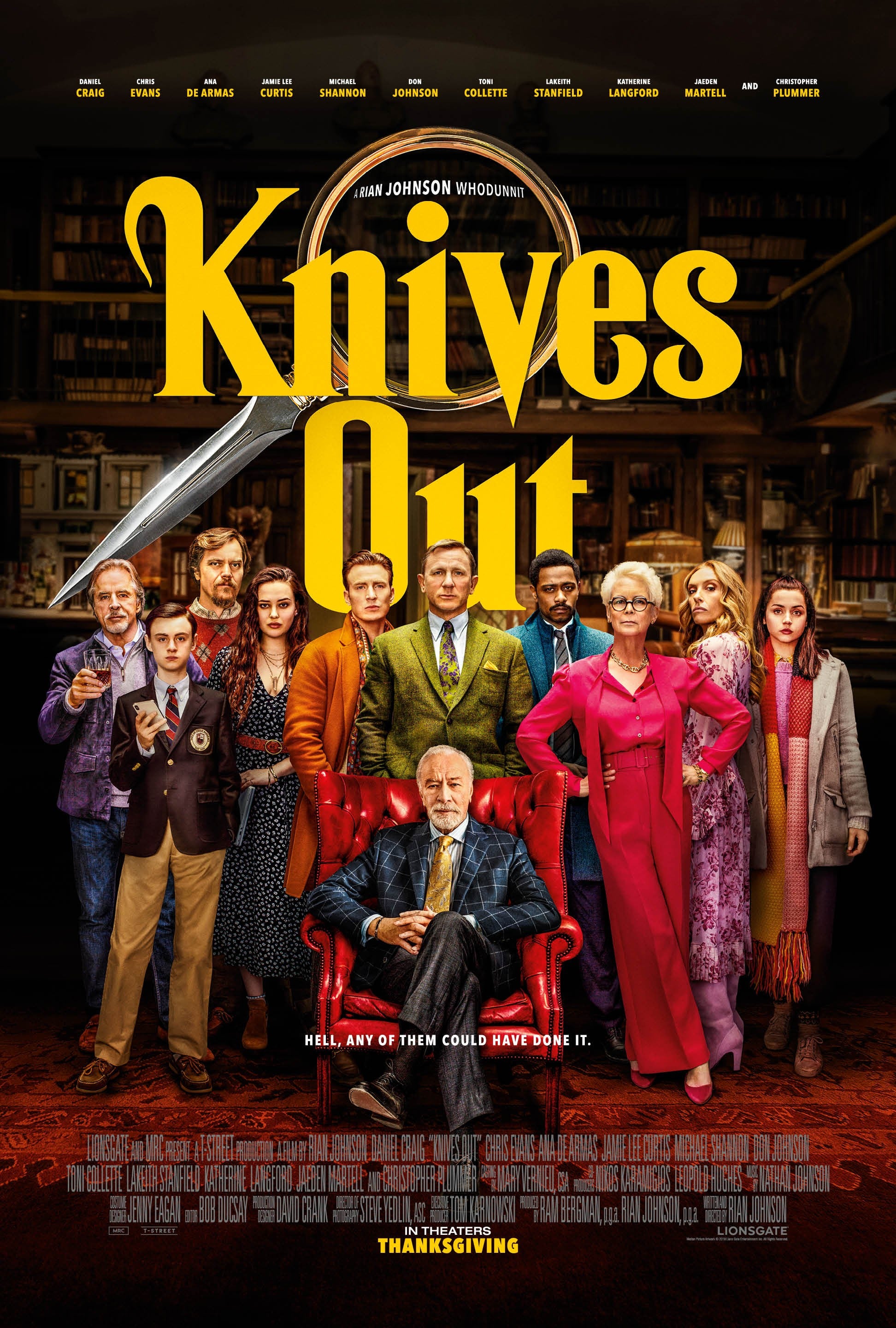
KNIVES OUT – an Alternative Lens review

Starring: Daniel Craig (Casino Royale), Chris Evans (Captain America: The Winter Soldier), Ana de Armas (Blade Runner 2049), Jamie Lee Curtis (Halloween), Toni Collette (Hereditary), Don Johnson (Cold in July), Michael Shannon (Man of Steel), Lakeith Stanfield (Sorry to Bother You), Katherine Langford (13 Reasons Why), Jaeden Martell (It), Christopher Plummer (All the Money in the World)

Writer/Director: Rian Johnson (Star Wars: The Last Jedi)

Runtime: 2 hours 10 minutes

Release Date: 27th November (US, UK)

Much in the same vein as Alfred Hitchcock or Stanley Kubrick, Rian Johnson is not a director who likes being tied down to a genre or aesthetic. He’s a cunning deconstructionist of whatever school he finds himself in, but he doesn’t exactly refashion it in his image like Edgar Wright or Quentin Tarantino tend to. Instead, Johnson slips into a genre like putting on a hand puppet, respects the conventions of the world he’s found himself in, and proceeds to make a spectacular example of that kind of film whilst working in subtle improvements and commentary; the closest comparison I can surmise is that he’s like vintage Shane Black but more quaint and less abrasive.

After delivering his unique takes on film noir, time travel and Star Wars, Johnson now turns his attention to one of the most traditional genres ever conceived: the whodunit. It’s a classic storytelling formula that has been revised and reattempted to the point of parody, and yet somehow Johnson has again struck gold in a well-mined field. Knives Out is not only one of the best films of 2019, but quite possibly Rian Johnson’s greatest cinematic achievement to date.

It’s very hard to discuss the plot of Knives Out without immediately treading on spoilers, but it is undoubtedly one of the most finely crafted and whipsmart screenplays I have ever seen brought to the screen. It’s a story that is very aware that the audience knows the conventions of the murder mystery and seeks to toy with everyone from the totally perplexed to the clue-hunting master sleuths. There is practically a plot swerve every five minutes, constantly keeping you on your toes and questioning again and again every piece of information. The way the film plays with time and perspective to withhold and reveal information is second to none, and no clue ever feels like a concrete certainty.

The pacing and structure is absolutely masterful with never a dull scene or wasted moment, and it’s all held together by corking dialogue at every turn that is sure to be quoted and memed for years to come. Johnson’s knowledge and savviness of not just cinema but of culture and politics is on display on all fronts, coating the film in all kinds of subtext that’ll fuel all manner of think pieces and video essays across the Internet (for example, there is a strong argument to be made that the entire film is simply Johnson’s middle finger to the toxic backlash against The Last Jedi). If there is any way to sum up Knives Out without entirely spoiling it, it is simply this: it is everything you want it to be whilst delivering absolutely nothing you expect.

If you’re going to even attempt a compelling whodunit, you need a varied and fabulous cast of suspects to fill out your cast, and Knives Out has certainly spared no expense in filling out its roster with the perfect actor in every role. As the drawling detective Benoit Blanc, Daniel Craig continues his recent journey into compelling characters with bizarre accents and creates one of the most fascinating and yet down-to-earth cinematic sleuths in recent memory. Blanc is a theatrical and almost ludicrous character, and yet he is far from the master investigator his demeanour would suggest, and Craig balances that weight between fiction and reality to perfect comic effect.

However, Blanc is not the star of the film, with that honour instead unsuspectingly falling to Ana de Armas as the timid nurse Marta. She works as a perfect grounding foil to a cast full of eccentric and larger-than-life characters and, though she plays the role straight as an arrow, Armas still ends up just as charming and hilarious as every other cast member. There is so much more to say about her character arc and her importance to the film’s metatext, but that’s a topic for another spoiler-filled day.

It’s hard to think of it now after nearly a decade of being the all-American golden boy, but Chris Evans used to be the go-to for playing cocky douchebags and it’s fantastic to see him return to that well. As Ransome, Evans is exactly the kind of character you hate to love and he steals every scene he’s in. Toni Collette is a delight as always as a leeching Gwyneth Paltrow wannabe, and the bickering dynamic of Jamie Lee Curtis and Don Johnson could be a movie all on its own.

Michael Shannon is great and responsible for some of the film’s best line deliveries, and though his screen time is brief Christopher Plummer is absolutely perfectly cast as the tired patriarch fed up with his family’s nonsense. The only cast member who feels a little underserved is Jaeden Martell as Shannon’s alt-right preppy son Jacob, especially considering the film’s political subtext, but he does a great subdued job with what he’s given and avoids turning the character into an exaggerated stereotype.

Unlike recent murder mysteries trying to aesthetically distance themselves from the tropes and clichés, Knives Out bathes itself in the iconography of sprawling secret-filled mansions and detectives garbed in tweed in a very tongue-in-cheek manner. Everything feels perfectly crafted to accentuate the grimly playful ambience of the piece, from the extravagance of Plummer’s knife-adorned parlour to the fineness of Evans’ wardrobe of woolly jumpers. Steve Yedlin’s cinematography is lusciously rich in dark wintery colours, Bob Ducsay’s editing accentuates the wit and timing already abundant in the dialogue, and Nathan Johnson’s overly dramatic score keeps you on your toes whilst reminding you not to take any of this particularly seriously.

If the use of a clip from Murder, She Wrote isn’t enough to clue you in that Knives Out is incredibly self-aware, then perhaps this isn’t the movie for you. This is a classic murder mystery caper with a facetious postmodern point of view; it looks and feels timeless and yet its voice is quintessentially 2019. Whilst perhaps not as overt about its themes, it has the same witty and sharp commentary of Jordan Peele’s Get Out as it similarly takes aim at privilege and class. Whilst the idea of further adventures with Benoit Blanc is certainly tempting, Knives Out is absolutely compelling as a standalone story, and overall this could end up being an even greater career-defining piece for Rian Johnson than even The Last Jedi. With that said, I can’t wait to see what he comes up with when he jumps back into that galaxy far, far away…

FINAL VERDICT: 10/10!

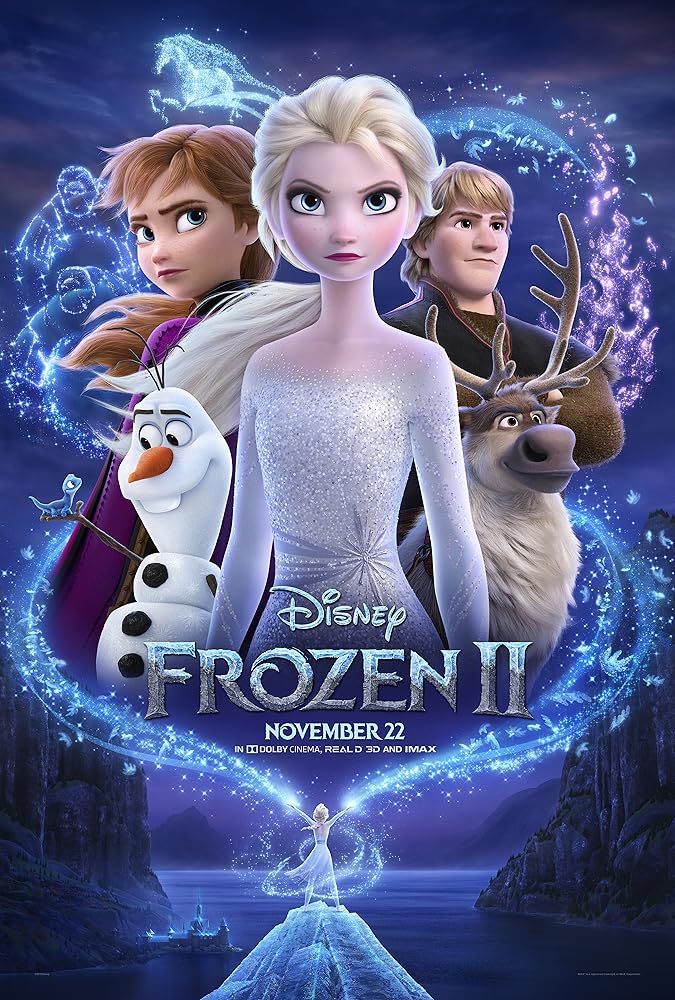
FROZEN II – an Alternative Lens review

Starring: Idina Menzel (Enchanted), Kristen Bell (The Good Place), Jonathan Groff (American Sniper), Josh Gad (Beauty and the Beast), Evan Rachel Wood (Westworld), Sterling K. Brown (Black Panther)

Directors: Chris Buck (Tarzan) & Jennifer Lee (Frozen)

Writer: Jennifer Lee (Wreck-It Ralph)

Runtime: 1 hour 43 minutes

Release Date: 22nd November (US, UK)

So here we are six years later, and the Frozen phenomenon still hasn’t died down. Unlike so many other animated films that fade away until we rediscover them as nostalgic adults, Disney’s loose adaptation of The Snow Queen has taken on a life of its own and essentially became the Beauty and the Beast of the animation studio’s Second Renaissance. However, unlike the films of that last generation, the sequels this time aren’t relegated to direct-to-video. Only the third theatrical follow-up in the company’s history (after The Rescuers Down Under and Ralph Breaks the Internet), Frozen II has an incredibly large pedigree to live up to. It ultimately succeeds by not relying on what made the first film work and strikes out in a bold new direction, even if the transition isn’t as smooth as one would hope.

In much the same way as the Harry Potter series, Frozen II has decided to mature with its audience. It’s still ultimately a family-friendly story, but it steps away from the regular Disney Princess formula and moves the series into something more of an epic fantasy direction. The result is a fascinating and surprisingly seamless blend of tones, as the film drifts back and forth from light-hearted family musical to a surprisingly mature contemplation on colonialism and righting the wrongs of the past. At its core, the film ultimately still focuses on its predecessors themes of sisterhood and arrested development, but the added complexity will certainly give older audience members something to take away too. It beautifully and cleverly expands on the limited mythology set out by the original, crafting a larger story world ripe for expansion, though it disappointingly gets very little time to ruminate on it.

The plot is structurally sound and moves at an effective pace, but the story still often feels rushed from beat to beat. The second act feels especially truncated, introducing a handful of new characters it mostly forgets to develop until the final third, and leaves little room to bask in and enjoy the fantastical new concepts introduced to the world of Arendelle. As films like Warcraft and The Golden Compass have proven before, delivering an epic fantasy adventure in anything less than 135 minutes is a tall order in a genre that demands expansive world building and lore, and though Frozen II excels in many other areas it still can’t help but feel restrained. What’s there is fantastic, and in many facets it exceeds the first film, but it either needed more room to breathe or to drop some ideas and focus in on the key themes. The How to Train Your Dragon films are a top-tier example of how to flesh out and add maturity to a family-friendly fantasy series, and perhaps the creators of Frozen would do well to take some pages out of their book should they decide to return for a third outing.

What made Frozen so endearing to many audiences is the strong bond between Anna and Elsa and the themes of unconditional sisterhood and love that relationship delivered. Frozen II is smart to expand on those ideas and gives the royal sisters more time together to further their tumultuous relationship. The two are given far more equal footing this time around, as Elsa begins to further understand the origins and strength of her powers whilst Anna grapples with maturity and change. Idina Menzel and Kristen Bell are as charming and magnetic as ever, and once again their characters are what make the film so appealing. Jonathan Groff’s Kristoff gets an amusing subplot, though it is unfortunately one of the victims of the film’s truncated second act, whilst Josh Gad manages to stave off the potential for Olaf to become a cloying presence and delivers a surprisingly nuanced performance as the befuddled snowman. Evan Rachel Wood and Sterling K. Brown are great when present, but Wood’s performance is mostly relegated to a prologue flashback and Brown’s character is introduced with a great potential for conflict that never actually pays off.

The songs of the original Frozen quickly became pop culture staples to the point of frustration for many an adult, but it’s hard to deny they aren’t some catchy tunes once you separate them from their overexposure. Whilst there is no song quite as zeitgeist-catching as “Let It Go” to be found in Frozen II, the overall quality and plot-relevance of the music here is far stronger; there are no disposable tunes like “Fixer-Upper” or that one about cutting ice. Obviously positioned as the new flagship song is Menzel’s “Into the Unknown”, which is a fantastic belter ripe with much of the same longing and conflict as her prior hit (and with just as much potential for mining queer subtext). With that said, her second number with Wood “Show Yourself” is arguably even stronger and more heart wrenching. The film’s first big number “Some Things Never Change” is apt and clever way to start off a story all about monumental change, Gad gets another chance to shine with comical “When I Am Older”, and Bell delivers the exact opposite of the blind optimism of “For the First Time in Forever” with “The Next Right Thing”. However, the major surprise there is Groff’s number for Kristoff “Lost in the Woods”, which is a major departure from the film’s otherwise traditional musical aesthetic and is something of a parody of pop movie soundtrack hits in the vein of Peter Cetera or Bryan Adams. It’s a song that is simultaneously sincere and subtly hilarious, but also one likely to split the tastes of the audience.

It’s amazing how quickly the quality of animation evolves over a short period of time, as in only six years Frozen II looks vastly superior to the still technically impressive first. The style has stayed relatively the same but the subtle details are much richer. The fine precision of the texture mapping and physics makes this cartoon world come alive, and if the characters were removed these environments would feel perfectly at home in a live action feature. The production design is as bold and fantastical as ever, and the film’s expanded use of action sequences feel fierce and raw whilst still feeling a part of the same picture as its otherwise Disney-like self. Of course the musical numbers take top billing, but one must not overlook the phenomenal work of Christophe Beck in composing the traditional score, further incorporating Nordic influences into his compositions to create a moody and authentic experience that helps keep the film hopping beyond the usual song-and-dance.

Frozen II is an ambitious and challenging animated film that tries to evolve not only its own story but also the expectations for all of Disney animation. It occasionally feels a little too limited by its tight structure and young audience to go as brazenly out there as it clearly wants to, but what of that intention that is on display is so rich in tonal maturity and subtext that it still delivers a strong emotional impact. It has everything a young audience member wants from a Frozen sequel, but it also has deeper layers for an adult audience to digest and help send a good message about being intersectional and fighting for a better tomorrow. There is clear room left for this world to go on and on and, though the fears of alienating younger viewers and the international market may continue to hinder it, I hope they eventually reach a point where they can drop some of the subtext and embrace the potential this world they’ve created has to offer. For a movie that’s about overcoming fear and prejudice, it’s strange that Disney still has some of that do itself.

FINAL VERDICT: 8/10

LE MANS ’66 (FORD v FERRARI) – an Alternative Lens review

Starring: Matt Damon (The Martian), Christian Bale (The Fighter), Caitriona Balfe (Money Monster), Jon Bernthal (The Punisher), Tracy Letts (Lady Bird), Josh Lucas (Hulk), Noah Jupe (Wonder), Remo Girone (Live by Night), Ray McKinnon (Mud)

Director: James Mangold (Logan)

Writers: Jez Butterworth & John-Henry Butterworth (Edge of Tomorrow) and Jason Keller (Machine Gun Preacher)

Runtime: 2 hours 32 minutes

Release Date: 15th November (US, UK)

It’s a bizarre phenomenon that, as disparate the fandoms of film and sport often are, we all love a good sports film. There are a lot of reasons as to why, but ultimately it comes down to sport inherently having facets that also lend themselves to good storytelling: tension, motivations, conflict, structure, ticking clocks, etc. Out of all sporting fields, motorsport’s speed and dynamism especially lends itself to cinema, and Le Mans ’66 (or Ford v Ferrari as it is titled in the States) itself can easily be seen as a metaphor for the filmmaking process: a team of highly talented but disparate craftsmen, under the watchful eye of money-driven businessmen, all trying to work together to create one perfect product. From whatever lens you view it through, this is a motorsports movie that delivers on everything you could want out of one, providing both the adrenaline and detail car lovers crave and the storytelling and craftsmanship cinephiles need to be absorbed into this world.

lemans66

Set right in the heat of the rivalry between Ford and Ferrari between 1963 and 1966, Le Mans ’66 is a car fanatic’s dream movie whilst also being accessible to the neophytes in the audience, and may well end up creating new fans of car culture in the process. It seeps itself in the lingo and history of its subject matter and makes it all palatable to anyone who doesn’t know their rev counter from their fuel gage, but as passionate as the film is for cars it is ultimately a story about the people who build and drive them. The pressure is palpable from the opening moments with the stakes constantly rising as interpersonal conflict and egos threaten the heart of the sport, yet it also expertly cuts the tension with whipsmart dialogue and a biting sense of humour. The film is long and feels it, but it’s one of those rare epics that is so enveloping and paced so well that it never becomes a problem; one could easily just let the story keep rolling on and on and people would still keep watching. There is not a wasted moment in Le Mans ’66, and so it earns its lengthy runtime and uses it to tell a barrier-crossing story about friendship, loyalty, and putting aside petty disagreements for the love of the game.

While some may argue about who the true main character of Le Mans ’66 is, it’s clearly a two-hander picture with Matt Damon and Christian Bale having equal claim to top billing. As Ken Miles, Bale is easily the far more dynamic and entertaining lead, with the character’s coarse honesty and uniquely British sense of humour making him an unpredictable and relatable rebel hero. Bale commits to the role with a lot of heart, balancing out Miles’ temper and cheek with a genuine love for both the sport and his family, even when those two come into conflict. It’s easily his best work since The Fighter and should be a shoe-in on many a ballot this awards season. Damon’s Carroll Shelby acts as something of a cooling point between Miles and the Ford executives, bringing reason and expertise to a conflict driven by ego, and though he’s the more straight-laced hero he certainly has his moments of mischief and heart. His chemistry with Bale is charming and tactful, and the love-hate relationship that forms between engineer and driver feels as genuine as any athlete-coach relationship in a typical sports drama.

Caitriona Balfe is something of a hidden weapon as Miles’ supportive but feisty wife Mollie, briefly stealing the whole movie in an extended argument scene, and Noah Jupe is the right balance of precocious and sincere as his son Peter even when his British accent starts teetering into parody. Jon Bernthal is great as Ford VP Lee Iacocca but somewhat fades into the background halfway through, whilst Tracy Letts is a tremendous piece of casting as Henry Ford II. Perhaps what may end up being the most contentious character is Josh Lucas as conniving Ford executive Leo Beebe. Putting aside historical accuracy, the character often threatens to lurch over into OTT territory, but Lucas is so adept at playing this type of role and the film frames the feud between him and Miles in a context that ultimately balances that out, though your mileage may vary.

The driving in Le Mans ’66 is far from the usual speed demon car chases of blockbuster cinema, as the titular event and associated races Sebring and Daytona are as much about endurance and efficiency as they are about who can make the wheels go vroom-vroom the fastest. Director James Mangold and cinematographer Phedon Papamichael expertly capture both in the intense and drama-fuelled racing sequences, which focus as much on the drivers’ physical and mental wellbeing as the speed and condition of the vehicles. The period detail is accurate but subtle, allowing the timeless drama to take centre stage, aided by great production and costume design. The editing is sharp and focused, and both the period soundtrack choices and the score by Marco Beltrami perfectly accentuate every moment.

Le Mans ’66 is an absolute gem of a sports film that crosses boundaries to both entertain and enlighten. It’s a captivating and perennial tale of stamina and standing your ground in a fast-paced world, bolstered by yet another career-best performance from Christian Bale. It makes a perfect companion piece to Ron Howard’s Formula 1 drama Rush, contrasting that film’s tale of rivalry-turned-friendship with its own story about two men staying loyal to each other in the face of circumstances that try to make them enemies. All in all, it is destined to not only become the new favourite film of dads the world over, but also remind audiences that there’s far more to sport than just “who can do this thing the best?”

FINAL VERDICT: 9.5/10