
ONCE UPON A TIME IN HOLLYWOOD – an Alternative Lens review

Starring: Leonardo DiCaprio (The Revenant), Brad Pitt (The Big Short), Margot Robbie (The Wolf of Wall Street), Emile Hirsch (Speed Racer), Margaret Qualley (The Nice Guys), Timothy Olyphant (Deadwood), Austin Butler (Yoga Hosers), Dakota Fanning (Man on Fire), Bruce Dern (Nebraska), Al Pacino (Scarface)

Writer/Director: Quentin Tarantino (Pulp Fiction)

Runtime: 2 hours 39 minutes

Release Date: 26th July (US), 14th August (UK)

Quentin Tarantino, love him or hate him, is always going to be a legend of cinema. He’s a man whose zest for and knowledge of the form is all encompassing down to the tiniest detail, and that unbridled passion has made him the messiah figure of many a film fan. Now (supposedly) coming to the end of his cinematic career with his penultimate film Once Upon a Time in Hollywood, an ode to the era and style of filmmaking he loves so much, it feels like a perfect time and subject matter for Tarantino to really lay down his thesis on his career and film itself. In reality however, Once Upon a Time in Hollywood isn’t that movie. It’s trying to be at times, but it’s simultaneously trying to be several other movies too, and in trying to be about everything it ends up being about nothing.

Set in the world of film and television circa 1969, Tarantino’s latest is an unfocused and ambulating affair that never quite sets a tone other than “Tarantino flick”. Clocking in at over two and half hours, the film spends much of that runtime meandering through several storylines connected by mere threads, with their relevance to each other and the ultimate point of the film only becoming clear right as the credits start rolling. The first two acts are quite slow and deliberate, with much time spent on quieter, dialogue-free scenes of characters just driving and listening to tunes woven between the usual Tarantino banter. However, just as the pacing seems to settle into a good grove, the third act suddenly leaps it into high gear as we are rocketed through a massive time jump with excessive narration that feels somewhat unnecessary.

The whole affair feels haphazardly put together, with large swaths of story clearly left on the cutting room floor (with the end credits even noting major actors who’ve been excised), and yet the final product still feels unwieldy. Taking many scenes on their own merits, they are fantastically well put together and deserving of a far better movie than this. There’s a brilliant story in here about a Hollywood has-been trying to come to terms with his status in the industry, with some great introspection into not only the Hollywood machine but Tarantino’s career itself. Unfortunately, it seems like the director couldn’t let go of his own vices, with the film leaping into full-on fantasy in the third act in a way that makes complaints about the finales of Inglourious Basterds and Django Unchained seem pithy. The way it weaves in real world events feels far less justified than Tarantino’s previous historical efforts, and it might have been better if that subject matter had been the focus of its own film or just cut entirely. With it, we have a self-indulgent and esoteric conclusion that will leave viewers unfamiliar with the true events confused, whilst leaving those who do know with a lot of questions about not only how but also why. As the film comes to a close and the film’s message finally dawns, what you’re left with is an egocentric and juvenile piece of revisionist fan fiction that is completely oblivious to its own contemplative possibilities.

When Quentin Tarantino says he’s going to make a new movie, pretty much everyone in the industry wants a role, and with his career coming to an end it seems like he just decided to cast everybody in case he never got to work with them. This is a film jam-packed with stars, with many barely even getting a line before their role is over, but luckily the acting is what ultimately saves Once Upon a Time in Hollywood from being a complete waste of time. Taking centre-stage is Leonardo DiCaprio as washed-up heavy Rick Dalton, and his performance is absolutely fantastic from start to finish. There are so many layers and nuances to his character, making him an endearing yet unpredictable character to follow. It’s just a shame that his arc feels thrown off-course by the film’s end, and ultimately his story would have been better served if you excised it from the rest of the film and cut off before the third act. Brad Pitt is equally brilliant as Dalton’s stunt double and best friend Cliff Booth, bringing a laid-back affableness to a darkly funny character; he’s exactly the kind of guy you love even though he kind of scares you too.

Margot Robbie gives a sweet and understated performance as Sharon Tate, but from a plotting level the film gives her very little to do other than be a symbolic figure. The rest of the cast is so overstuffed it’d take forever to go through everyone, so just be rest assured that no one gives an especially bad performance. However, there are a few names that deserve shout-outs. Firstly, Margaret Qualley is utterly charming and yet unnerving in the role of Pussycat, holding her own against Pitt and once again proving herself a young actor to watch. Then there’s Mike Moh, who gives a spot-on turn as Bruce Lee and has fun with playing an exaggerated version of the legendary martial artist’s persona. However, the star that comes out of nowhere and steals every scene she’s in is Julia Butters as the precocious young method actor Trudi. Her scenes with DiCaprio are among the film’s best, and made me wish the whole movie was just about these two actors at opposite ends of their careers learning from each other.

If you know the aesthetics of a Tarantino movie, you know what to expect here. So many of his film’s have adopted the aesthetics of 1960s B-movies in the past, making one set in the period around the world of B-movies is basically second nature to him. Everything from how the locations have been retrofitted to the fashion of the costume design and even the poster art for Dalton’s fictional films is all beautifully brought to screen with love and attention. There’s some fantastic camera work and editing throughout, with the sequences emulating period films being the main standout in how they emulate the cinematography and artifacting of those old prints and TV broadcasts. Of course, no Tarantino movie would be complete without a fantastic soundtrack, and this film is plenty packed with contemporaneous rock hits both well known and obscure, and I’m sure many a film fan will start associating these songs with the scenes from this movie as a point of reference.

There is so much to like and even love about Once Upon a Time in Hollywood within the details, but when put all together with the film’s narcissistic thesis, the final product is far from the sum of its parts. There’s a much, much better movie hiding in plain sight within this, and it feels like Tarantino either didn’t know what he had or didn’t care. He feels like a slave to his own aesthetics and influences, constantly reaching back to not only his reference films but also his own work instead of forging out something new. It’s easily his weakest film to date, and with only one more supposedly to go, one would better hope he goes out with a bang and not a whimper.

FINAL VERDICT: 5/10
FAST & FURIOUS (PRESENTS): HOBBS & SHAW – an Alternative Lens review

Starring: Dwayne Johnson (Jumanji: Welcome to the Jungle), Jason Statham (Crank), Idris Elba (Thor), Vanessa Kirby (Mission: Impossible – Fallout), Eiza Gonzalez (Baby Driver), Helen Mirren (The Queen)

Director: David Leitch (Deadpool 2)

Writers: Chris Morgan (Wanted) and Drew Pearce (Iron Man 3)

Runtime: 2 hours 15 minutes

Release Date: 1st August (UK), 2nd August (US)

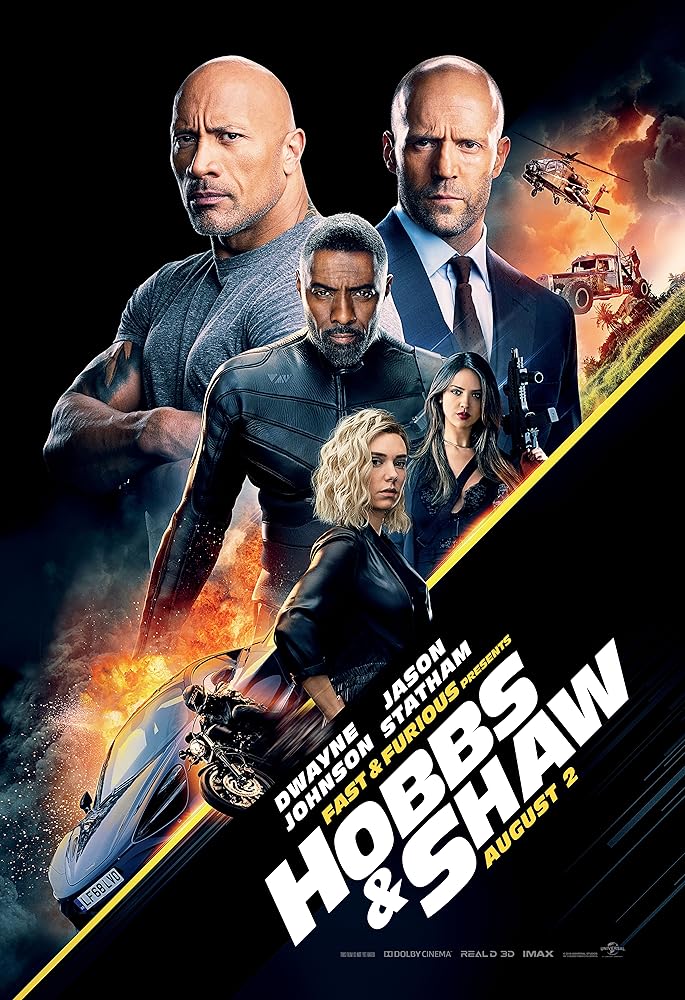
So Fast & Furious 8 (The Fate of the Furious for you Yanks) was a pretty decent movie, eh? I mean, it was hardly the best film in the franchise, but it was a lot of fun and proved the series still has plenty of interesting sharks left to jump. For many audiences, the big surprise was the unexpected chemistry between Dwayne Johnson’s Luke Hobbs and Jason Statham’s Deckard Shaw, so much so that many thought a spin-off just about them would be a neat idea. Well, it seems Universal had the same thought, and so now we have Hobbs & Shaw. Does the focus on these two bickering knuckleheads bring new life to the franchise, or can you really have too much of a good thing?

For the first time since arguably Tokyo Drift, Hobbs & Shaw is thoroughly understandable without prior investment in the franchise (though familiarity with it, especially the eighth instalment, does help). Now less constrained by the car-centric perspective of its mother series, the story now feels more opened up to dabble in all kinds of ridiculous blockbuster spectacle, and with it the series trajectory towards the fantastical has only increased. This film has now leapt into the territory of superhero movies, with biomechanically enhanced soldiers, viral super weapons and Darwinian technology cults now thrown into the mix without an eyelid bat. The film wastes no time throwing these leaps in logic at you either, and if you’re willing to roll with the punches it only makes the experience that much more ridiculously enjoyable. Anybody going into this movie expected anything other than an implausible extravaganza in Hollywood excess is completely missing the point.

With that said, that jump in irreverence does come with a less-welcome leap into self-depreciation. Hobbs & Shaw is easily the most overtly comedic entry in the series thus far, with barely a scene going by without some kind of one-liner or sly wink at the audience. In moderation, this twist in tone helps to differentiate the film from its forbearers, but at many points it oversteps the mark into cloying and unnecessary. The new framing inevitably throws off the film’s balance, which results in not only an oversaturation of comedy but the story’s actually sincere moments coming off far cheaper. The Fast & Furious franchise since the fifth instalment has thrived not just because they’ve grown increasingly ridiculous, but because they’ve retained a po-faced sensibility in spite of it, and that’s ultimately far funnier because it’s not overtly trying to be.

If you liked the way Johnson and Statham played off each other in Fast & Furious 8, you certainly get more of that in Hobbs & Shaw. Their never-ending squabbling and one-upmanship is certainly still entertaining, and the two actors share a much more natural chemistry than Johnson ever has with Vin Diesel, but their rapport also feels stretched to the absolute limit here. Their relationship fails to evolve satisfyingly, with the pair cycling through the same set of jabs over and over again until the third act, when their differences are ultimately resolved because the plot needs them to. Lacking their own tangible evolution or identity, the film simply falls back on the “it’s all about family” themes of the other films, and as is it’s basically just two hours of these two trading yo mamma jokes interrupted by the most ridiculous action scenes this side of Con Air.

As the villainous Brixton, Idris Elba absolutely knows what kind of film he’s in and relishes the opportunity to go full ham. He’s just as naturally charming as ever, but there’s a sadistic joy to his performance that makes him a perfect adversary for Hobbs & Shaw, but I wish there was a little more to his motivations than just “I believe I am a supreme human and the world must be culled because this mysterious cult person says so”. Stealing much of the film away from even our leads is Vanessa Kirby as Shaw’s secret agent sister Hattie. She’s an absolute delight from her first moments on screen, matching (if not besting) the boys not only in the action but in the comedy too. The film occasionally runs the risk of just turning Hattie into a plot token/damsel, but the film does its best to fight against those expectations and so much of that is down to Kirby’s performance. Seriously, she deserves to not only come back in future Fast & Furious instalments, but someone please give Kirby her own blockbuster franchise. As for the rest of the cast, it’s mostly just an avalanche of cameos from a wide spectrum of Hollywood talent, with some of them arguably having more screen time than credited cast members. I won’t spoil them all given the marketing hasn’t, but much like the rest of the film their wink-and-nudge presence constantly threatens to push the entire film into outright farce.

David Leitch has more than proven himself as a talented action director by now through John Wick, Atomic Blonde and Deadpool 2, and with Hobbs & Shaw he finds the perfect balance between his own penchant for grounded, tightly-choreographed brawls with Fast & Furious’ tendency to ignore all the laws of physics. Every set piece here would be the standout in any other summer blockbuster, but that’s just a testament to Leitch’s ability to stage action with an attention to detail most of his contemporaries don’t even aspire to. There’s the occasional moment when the film succumbs to quick cuts and tight cinematography, but for the most part this is a fluidly shot and executed piece of action cinema. Tyler Bates’ score for the film is suitably bassy and rock-influenced, but as usual it’s the film’s soundtrack that takes centre stage, and this film threatens to rival Suicide Squad at points for the number of needle drops throughout its runtime. Heck, Idris Elba even raps on the soundtrack! How much more 90s action blockbuster can you get?

The best Fast & Furious movies know they’re stupid but try not to act like it. Hobbs & Shaw admits its stupidity early on, and your mileage with its tone may vary from there. This is undoubtedly the most brazen and flat-out insane film the franchise has offered thus far, and within it are some of the best moments of the series period. However, the movie is often too high on its own supply, stuffing its overlong running time with self-aware digs at itself and celebrity cameos that somewhat detract from the delusional fun of it all. If you’re a fan of the franchise or either of the film’s stars, you’re probably going to have a blast with this, and it certainly needs to be seen on a big screen for the full effect. However, if they’re going to continue on with Hobbs & Shaw as their own sub-franchise, we need to get past the childish quarrelling and give the characters somewhere else to grow. The next film could involve them fighting space iguanas on a guacamole planet whilst riding unicycles for all I care about story logic, but there needs to be more to them than just The Odd Couple hopped up on Mountain Dew.

FINAL VERDICT: 7/10