

Starring: Eddie Redmayne (The Theory of Everything), Katherine Waterston (Inherent Vice), Dan Fogler (Balls of Fury), Alison Sudol (Transparent), Colin Farrell (The Lobster), Ezra Miller (The Perks of Being a Wallflower), Samantha Morton (Minority Report), Ron Perlman (Hellboy), Jon Voight (Transformers)
Director: David Yates (The Legend of Tarzan)
Writer: J.K. Rowling
Runtime: 2 hours 13 minutes
Release Date: 18 November (US, UK)
After the final Harry Potter film came to a close five years ago, it seemed like J.K. Rowling’s Wizarding World had come to a conclusive end. Little bits and pieces have emerged here and there in the intervening years, but in 2016 that world has exploded back into the pop culture zeitgeist. Harry Potter and the Cursed Child arrived on London’s West End this past summer but, though having only read the script (because getting tickets to that thing right now is probably only possible if you are an actual wizard), I found it relied too much on what had already come and instead felt like well-written fan fiction. Going into Fantastic Beasts and Where to Find Them, I was worried it too would cling onto the events of the original series, but thankfully this is a film that expands Rowling’s universe into mostly new territory.
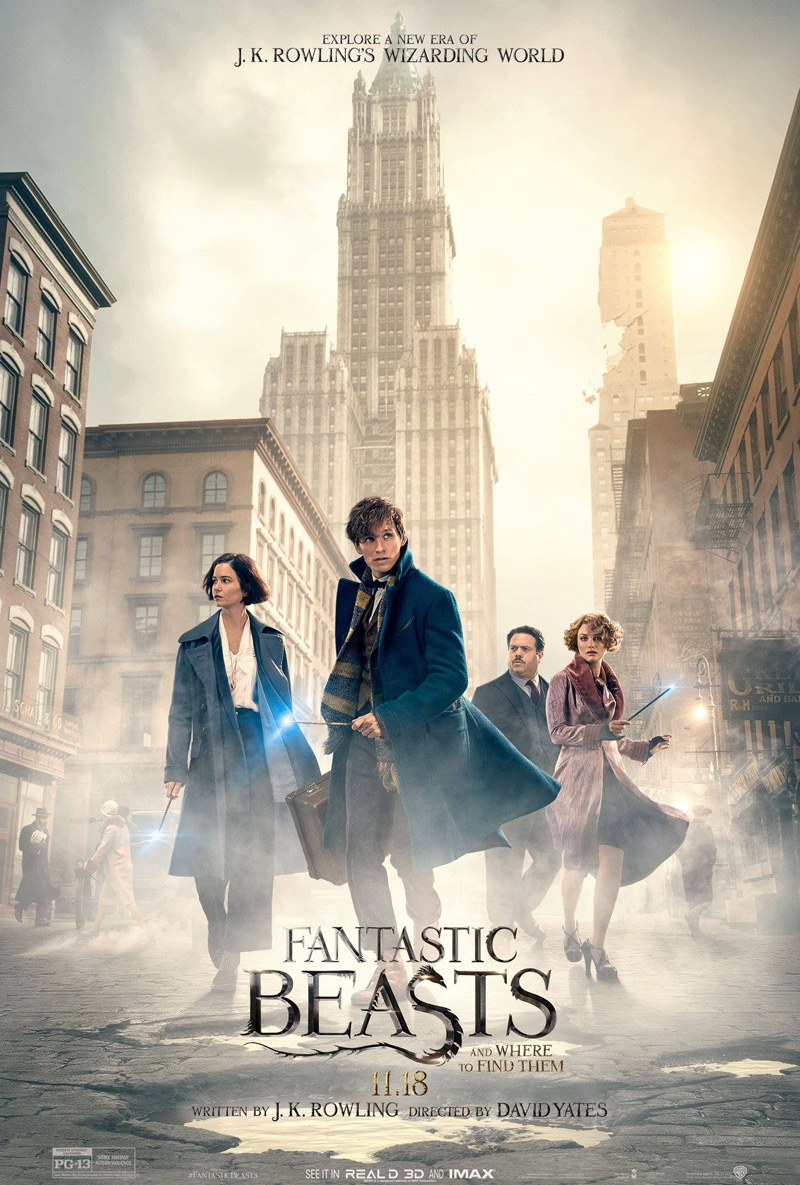
Story-wise, Fantastic Beasts resembles the earlier Potter films more than the later ones, in that it does set the stage for more tales but for the most part is a self-contained story. It’s also tonally closer to the first few, focused more on exploring the fun aspects of the world rather than telling a grand hero’s journey epic. The film is at its liveliest when it’s forging a new path for itself, focusing on the titular beasts and delving into how the wizarding community works in the United States. However, the film’s seemingly main plot constantly gets sidelined by an equally interesting but underdeveloped storyline dealing with a rising anti-magic movement and a mysterious villain hiding in the shadows. For most of the film it’s only tangentially connected to Newt’s (Redmayne) story, but by the third act it completely takes over the movie. It’s almost like Rowling had two separate story ideas and decided to mash them together, and ultimately these two disparate threads compromise each other; one should have been left to the wayside or the two should have more cohesively intertwined. In spite of this, the film surprisingly flows quite smoothly and there’s certainly never a dull moment, making the two-hour-plus running time more than bearable. There is plenty of set-up and potential here for more stories, and thankfully the references to the original films are kept to an acceptable level, but hopefully next time they can decide what kind of movie they actually want to make.
Eddie Redmayne delivers a perfectly fine performance as magizoologist Newt Scamander, managing to breath some life into a character that would feel a little empty on the page. He’s a quirky and likable protagonist mainly thanks to his awkward sense of humour and genuine passion for his work, but beyond that there’s not really much too him. His past is only briefly talked about and not in much detail, and his motivations when entering the story are quickly forgotten about once the plot actually begins. He’s ultimately the least interesting character in his own movie and it’s actually the sidekicks that breathes the most life into Fantastic Beasts, particularly Katherine Waterston and Alison Sudol as sisters Tina and Queenie Goldstein and Dan Fogler as No-Maj Jacob Kowalski. Waterstone brings a grounded but likable performance to the table as Tina, and her character’s goals and ideals feel far more concrete than Newt’s. At points it feels like she should be the real main character considering her heavy involvement in the ballooning subplot, especially in the climax where Newt feels like a third wheel until the last moment. Fogler and Sudol are delightfully entertaining when apart, especially the former’s interactions with this fantastical world, but they are even more special when together and add a lot of much-needed heart to the film.
The rest of the supporting cast is a bit more of a mixed bag. Colin Farrell brings some interesting greyed morality as the elusive Auror Percival Graves, but given the mysterious nature of his character his most interesting traits don’t come to light until the movie is pretty much over. Ezra Miller as the tortured Creedence Barebone is equally kept way too vague a character until the third act, and just as it feels like he’s going to get some resolution he’s taken out of the movie. Samantha Morton as the leader of the anti-magic extremists is very one-note and her story feels like a remnant from an earlier draft where she was more important, as does another subplot involving Jon Voight as a newspaper mogul with a politician son; both serve their purpose in the main plot threads, but they are otherwise pretty superfluous. Ron Perlman has a fun role as goblin gangster Gnarlack but he again feels more like a plot device than an integral character, plus there are a few small roles for some recognisable names that I’ll keep as a surprise but are overall negligible.
Where Rowling has always excelled as a writer is in how she crafts an elaborate and fantastical world, and in Fantastic Beasts she has wonderfully expanded on her already rich universe that keeps the movie feeling fresh. It never feels like everything from the previous films has just been transposed to 1920s New York, instead giving the environment its own unique voice and style. There are a lot of great nuances to the production design that call back to the Potter films whilst still feeling distinctive, and the costumes feel suitably antiquated as well. The cinematography feels vibrant and warm, but the editing during a few moments feels a little clumsy. There are some jarring moments where the cuts feel abrupt, especially a really awkward series of quick cuts when Newt and Tina first meet. Fantastic Beasts relies a lot more on CGI thanks to the plethora of magical creatures crammed into the film, all of which are wonderfully designed and animated; every kid in the audience is going to want at least one of these animals as a soft toy for Christmas. James Newton Howard’s score for the film only gently calls back to the themes established by John Williams and for the most part makes the music his own, including some fun and period-appropriate infusions of jazz into the soundtrack.
Fantastic Beasts and Where to Find Them is a fun return to Rowling’s Wizarding World that sets up a potentially interesting new franchise, but its lack of focus does work against it even during its best moments. Rowling shows a decent grasp of storytelling for the screen but there are noticeable growing pains in her shift from the prose medium, and for future instalments there needs to be a lot more streamlining to remove defects like the underdeveloped subplots and superfluous characters. The main cast all deliver, especially from Waterston and Fogler, and director David Yates’ experience on the latter half of the Potter films helps a great deal, but despite the promising start there is definitely a lot of room for improvement in all areas. But even in spite of all the noticable flaws, it remains an enjoyable ride thanks to the irresistable charm of this bounteous universe and I’m looking forward to see how the story evolves from here. As long as they can deliver that much needed focus, I’m certainly ready for another journey into this magical world.
FINAL VERDICT: 8/10

 Alternative Lens