

Month: January 2016
THE BIG SHORT – a review by JJ Heaton
Starring: Christian Bale (The Dark Knight), Steve Carell (Foxcatcher), Ryan Gosling (Drive), Brad Pitt (Moneyball), Rafe Spall (Hot Fuzz), Hamish Linklater (Fantastic Four), Jeremy Strong (Lincoln), John Magaro (Carol), Finn Wittrock (American Horror Story)
Director: Adam McKay (Anchorman: The Legend of Ron Burgundy)
Writers: Charles Randolph (Love and Other Drugs) and Adam McKay
Runtime: 2 hours 10 minutes
Release Date: 11 December (US), 22 January (UK)
Seeing a director drastically change genre isn’t a new thing. Sam Raimi and Peter Jackson went from gory horror films to iconic blockbusters, George Miller went from Mad Max to Babe: Pig in the City and back again, whilst Steven Spielberg and Danny Boyle flit between styles all the time. Regardless, seeing Adam McKay, director of comedies like Step Brothers and the Anchorman series, swap out goofy laughs for something more dramatic like The Big Short is still a shock. It’s not like McKay’s never shown signs of social commentary, considering how both Anchorman films do satirize the American news network in subtly biting ways, but this is the first time that side of himself has taken focus, and by doing so he’s somehow made one of the best films of 2015.
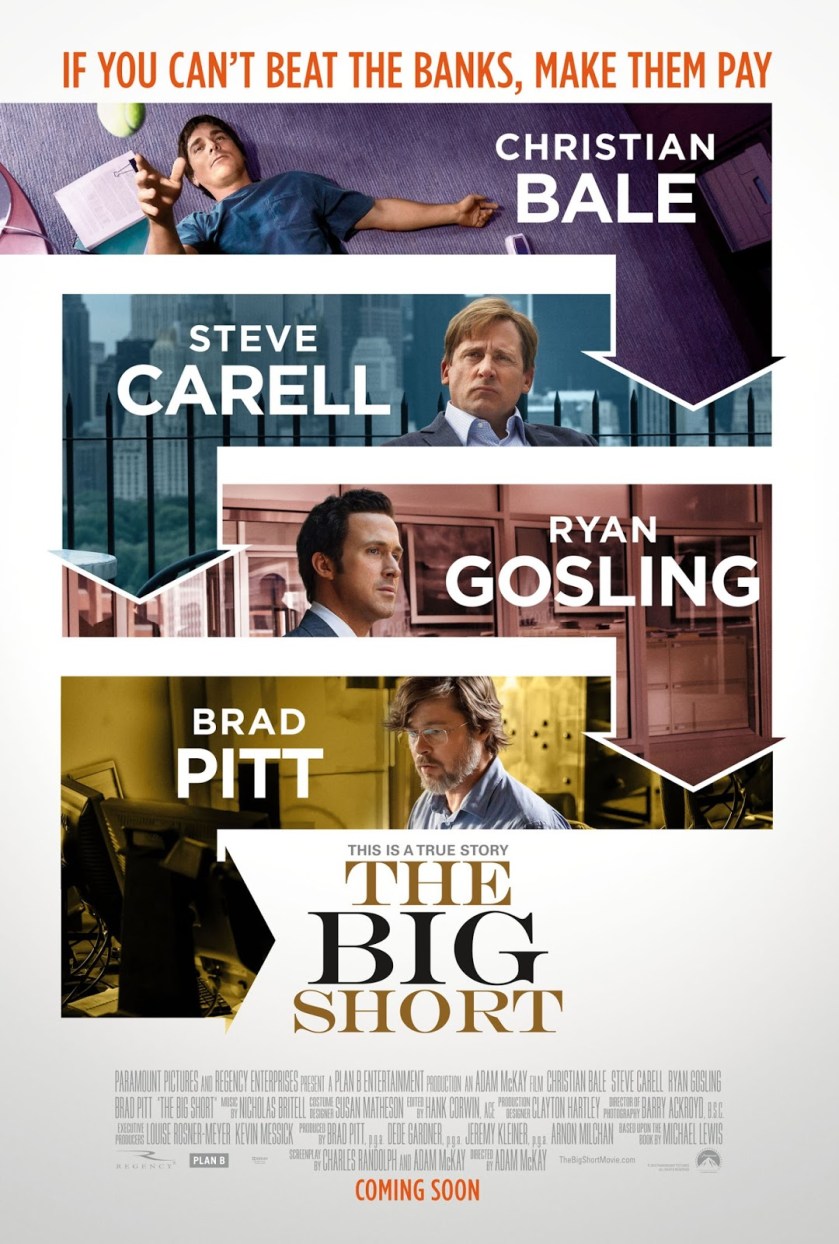
The story charts the lead-up to the 2007-2008 financial crisis through three intertwining stories, and the film does a great job of balancing these threads. Though tied together by a parallel goal, they each have their own unique flavour and show the effects of this impending crisis through different eyes. But just because McKay is focusing on serious subject matter doesn’t mean The Big Short is completely dull or po-faced or snooty. The film wants to be respectable, but it also wants to be accessible to a wide audience, and there’s no better way of being both educational and entertaining than through humour. There is a lot of financial jargon to follow, but everything is clearly explained to the audience in simple and entertaining ways. Whether through clever analogies, humorous asides, or characters directly explaining through the fourth wall, it genuinely educates you on how all these seemingly complicated systems are actually simple and flimsy, and soon the complicated mumbo-jumbo is easy to swallow. By doing this, it then allows you to focus on what’s actually going on and how broken the system was and still is. The film also gains a lot of credibility by never completely siding with our protagonists, nor does it paint them as manipulative hypocrites taking advantage the way The Wolf of Wall Street does. The Big Short’s ultimate goal is to show you that our financial crisis was caused by the ignorance and stupidity of the American banking system, and these people whose eyes we see it through did what they did mainly to prove to those bankers how ignorant and stupid they were for ignoring the signs.
The Big Short is so star-studded that I’m probably not going to even mention half of the famous faces the film has crammed into it, so let’s focus on our main players. Ryan Gosling acts as our main guide through the film as a participant in all three stories, and he excels as scheming market trader seizing the opportunity to make some money out of this falling tree; if the film has a Jordan Belfort equivalent, he’s the closest fit. Steve Carell is fantastic as the angry crusader trying to make a difference in yet another brilliant stretch for the comedy star; it’s hard to believe that he’s working under the same director here as the one who told him to say “I love lamp.” Carell’s underlings are wonderful played by Rafe Spall, Hamish Linklater and Jeremy Strong, each offering their own unique comedic flavour to the proceedings, whilst Brad Pitt’s understated performance as the jaded ex-banker helps ground the film when it gets too exuberant. But ultimately, Christian Bale steals the day as Michael Burry, the socially awkward hedge fund manager who discovers the impending crisis in the first place. Though not quite as transformative as some of his other performances, Bale does manage a convincing introverted weirdo and in turn manages to provide some of the film’s biggest laughs and harshest truths. There are a lot of cameos in the movie, some more important than others, but two in particular may rank among the best and funniest cameos in a movie ever; eat your heart out, Stan Lee.
The Big Short often feels more like a documentary than a fictionalised account, and a lot of that is thanks to the presentation. The cinematography uses a lot of loose handheld camera work, often wobbling around a scene whilst going in and out of focus. In most feature films, this would look amateurish but here it gives the film a stronger sense of verisimilitude; by making the film look more grounded in reality, it removes that aura that reminds you it’s not real. The editing is swift and crisp, keeping even the most jargon-heavy scenes feeling snappy and energetic, and there’s a lot of great use of pop culture imagery to remind ourselves of the world in the mid-2000s. That sense of era also permeates the eclectic soundtrack populated by recognisable songs from pop, rap and even heavy metal, often doing so to comedic effect. I won’t say much more, but the film probably has the best out-of-context use of the theme to Andrew Lloyd Webber’s Phantom of the Opera ever.
The Big Short is not just a great film; it’s an important film. It’s the kind of view into such an important subject I wish we got more often. So many filmmakers would have told this story through some serious filter, believing that would be the only way to for it to be done justice. But Adam McKay understands that often the best way to explain a bad situation is to mock it, and by doing so has created an entertaining satire that doesn’t avoid the hard truths of the matter. Even if you have no understanding of how Wall Street or mortgages work, this film explains it to you in a hilarious way and will have you invested in its issues by the time credits roll. After such a dramatic shift for McKay, it might be hard to seem him return to directing Will Ferrell shouting ludicrous nonsense, but whenever he next puts out something like The Big Short again I’ll be sure to pay attention.
FINAL VERDICT: 10/10!
THE HATEFUL EIGHT – a review by JJ Heaton
Starring: Samuel L. Jackson (Django Unchained), Kurt Russell (Escape from New York), Jennifer Jason Leigh (Road to Perdition), Walton Goggins (Predators), Demian Bichir (Machete Kills), Tim Roth (The Incredible Hulk), Michael Madsen (Reservoir Dogs), Bruce Dern (Nebraska)
Writer/Director: Quentin Tarantino (Pulp Fiction)
Runtime: 2 hours 47 minutes
Release Date: 25 December (US), 8 January (UK)
As Quentin Tarantino is now even closer to his supposed retirement (his plan being to quit directing after ten films), it seems odd for him to return to the western so soon. Django Unchained was an excellent view on the classic genre from the original film geek, but now he brings us an extra helping of blood-soaked bounty hunter justice with The Hateful Eight. Has the director struck gold twice in the same place, or is he scraping for leftovers at his point?
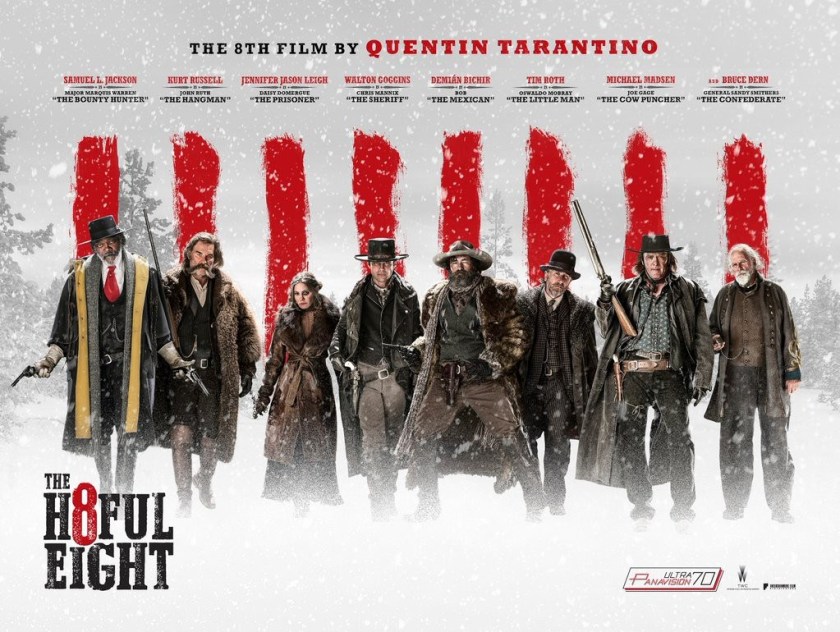
As much as many will compare The Hateful Eight to Django Unchained, they have as many differences as they do similarities. Instead of a sprawling adventure across the open fields of the American South, we have an enclosed suspense film set in the snowy mountains of Wyoming. Instead of focusing on one man’s journey for vengeance against those who wronged him, we have several characters all with hidden motives and backstabbing agendas. Otherwise the film is full of all the classic Tarantino tropes: non-linear storytelling, extensive exchanges of witty dialogue peppered with colourful expletives, anachronistic music choices, and a lot of blood. Story-wise it’s as much a mystery film as it is a western, playing out like a sadistic version of Clue at points, with the uneasy tension of not knowing who did what or what will happen next managing to keep the film riveting through its gargantuan running time. The film’s length is its biggest issue, with certain scenes dragged out far longer than necessary, and it’s a complaint that’s plagued Tarantino films for years but one he’s never heeded. Cutting out about fifteen minutes longer would have made it a little breezier, but then again this isn’t even the longest version of the movie; the 70mm Roadshow version in select theatres is twenty minutes longer including an interval.
The main cast of The Hateful Eight is mostly composed of Tarantino regulars, and all of them give the performances you’d expect from such a production. Samuel L. Jackson has certainly had more interesting characters in his previous collaborations with Tarantino, but in the role of Marquis Warren he gets a lot more screen time and he shines in every moment; a scene between him and Bruce Dern is a major highlight of the film where Jackson joyfully revels in mad perversion. Kurt Russell as the no-nonsense John Ruth is perfect casting, allowing the veteran actor to flex both his dramatic and often-forgotten comedic chops, and of all the characters he’s the one I wish I could have seen more of. Jennifer Jason Leigh steals every scene she’s in as the abrasive Daisy Domergue, her madness levels set at a constant ten as she screeches and grins her way through every scene. Walton Goggins gets a rare chance to act against type by playing the most honourable member of the main cast, but even he has his prejudices that make him an unpredictable character; any time he gets to interact with Jackson, the sparks of tension and chemistry fly. Demian Bichir and Tim Roth take on more comedic roles as the Mexican Bob and British Mobray, affecting ridiculous accents that are amusing on their own but are strengthened by impeccable comedic timing. Bruce Dern’s General Smithers spends all of his screen time sat in one spot, playing a character not dissimilar to his role in Nebraska, but he’s as fantastic an actor as he’s ever been and his aforementioned scene with Jackson is wonderful. The only weak link in the main cast is Michael Madsen’s Joe Gage. Not only is the character bland and forgettable, Madsen’s performance feels disengaged as he spends the whole movie speaking like a hung-over Nick Nolte doing a bad Batman impression. I know Madsen has been in I-don’t-give-a-sh*t mode for the past few years (AKA The Bruce Willis Method), but in reuniting with Tarantino again I’d thought he’d give just a teensy bit more effort.
Tarantino has made a big deal about shooting the film on 70mm film in all of the promotion, and though most viewers will never get the full experience of the format you can still appreciate the gorgeous cinematography in digital projection. The film clearly takes visual influence from the classic Spaghetti Western The Great Silence with its grand shots of bloodstained snow on rural American vistas, and the haberdashery set most of the film takes place in is very well detailed and captured on camera. The special effects are as gory and overdone as any of Tarantino’s previous films, especially when it comes to exploding heads; it wouldn’t be one of his films without it. The music of legendary composer Ennio Morricone has been repurposed in many of Tarantino’s films, but for the first time the director has actually brought in Morricone to compose a brand new original score. Though there is some reuse of music from Morricone’s own scores for The Thing and Exorcist II alongside some other tunes, the new soundtrack blends perfectly with the classic imagery so often associated with the musician’s work.
The Hateful Eight isn’t Quentin Tarantino’s finest work but it’s still a fantastic experience no fan of cinema should go without seeing on the big screen. It doesn’t have as many surprises as you usually find in one of the director’s iconic works, but maybe that’s because we’ve seen him riff on the Western before. For his next project, I hope Tarantino tries a genre we haven’t seen him tackle yet; I know he’s expressed interest in sci-fi before, or perhaps a spy movie or a horror would suit him well.
FINAL VERDICT: 9/10
ROOM – a review by JJ Heaton
Starring: Brie Larson (Trainwreck), Jacob Tremblay (The Smurfs 2), Joan Allen (The Bourne Ultimatum), Sean Bridgers (Trumbo), Tom McCamus (Orphan Black), William H. Macy (Boogie Nights)
Director: Lenny Abrahamson (Frank)
Writer: Emma Donoghue
Runtime: 1 hour 57 minutes
Release Date: October 16 (US), January 15 (UK)
You know how in a lot of thriller mystery movies someone goes missing and at the end the hero finds them living in some hovel in a deranged guy’s basement? What if we saw that story from the captive point of view? Room is that story, but just because it’s about a dire situation that doesn’t mean it’s a depressing experience. It is harrowing and tense in a lot of ways, but ultimately it’s a far more hopeful tale than you’d expect.
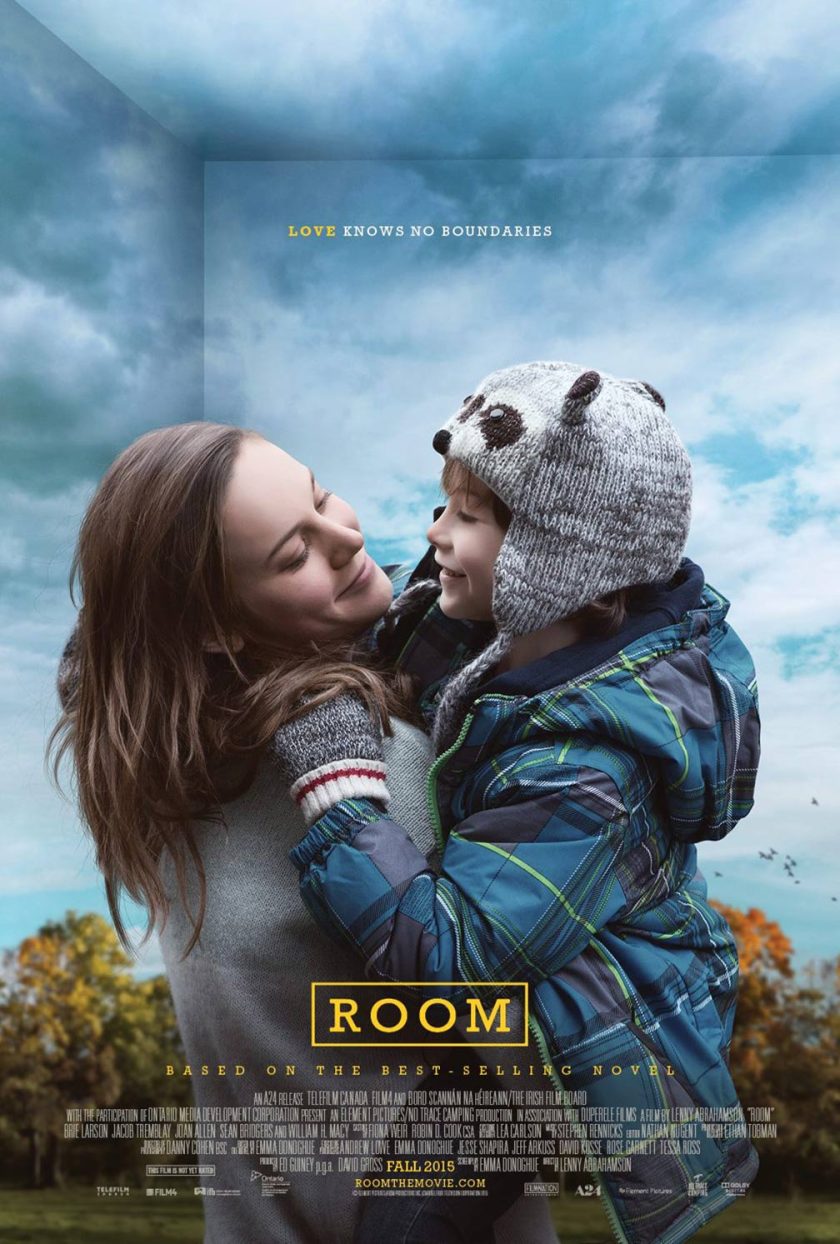
What makes Room so inspired and original an experience is how it’s told from the perspective of 5-year-old Jack (Tremblay). By seeing this story through his eyes, it drastically changes the tone of the movie because he doesn’t see the horror in his situation. In many ways it lightens the mood, but in those moments when you really think about the reality of his and Joy’s (Larson) life it brings you right down to Earth again. When they finally escape their capture, you might expect the film to lighten up, but in certain ways the story takes an even darker turn. It shows how an experience like that would have a massive effect on both characters, and because they perceived their captivity differently they also deal with the aftermath very differently. The film never feels too saccharine or too depressing, blurring the line between the two moods seamlessly, but it’s those moments of high intensity or high emotion where the movie truly sings. The tension in the escape scene is especially frightening to watch as Jack simultaneously deals with trying to flee his captor and comprehend this new world he’s found himself in. It’s a nerve-wracking watch at many points, but ultimately hope wins out and you’ll leave the theatre feeling emotionally drained but fulfilled at the same time. My only major fault with the film is that post-escape the story doesn’t give much closure to the fate of their captor Old Nick (Bridgers). It’s mostly insinuated what happened to him and the story is more about our main characters recovering rather than seeking justice, but I simply felt there was a lack of resolution to that thread.
Brie Larson has been hanging on the fringes of fame for a long time now, popping up in small but memorable roles in films like Scott Pilgrim vs The World and Don Jon, but only recently has she started attracting real attention and I think her performance in Room is going to skyrocket her to even higher stardom. Even during scenes when she’s supposed to be composed and in control, you can sense the fear and frustration underneath every line, and whenever that horror breaks through it’s frightening. A scene where she’s interviewed post-escape and is asked some particularly difficult questions reveals how truly broken she is as a person, making you wonder whether she can or would want to continue living on even though she’s now free. It’s a haunting but beautiful performance that will surely define Larson’s career, and she’s certainly a versatile enough actress as proven by her previous work that she’ll never become typecast. But as much as she impresses, young Jacob Tremblay shines just as brightly. In one of the best performances by a child actor ever put to screen, he is completely convincing as a young boy completely oblivious and even in denial of a world beyond what he knows. The way he locks up when someone unfamiliar enters the room or how he reacts to something unknown or justifies his imagination-fuelled beliefs all feel completely genuine; there’s never a moment where his acting falters. He is the true star of the film, and without such a phenomenal performance I don’t think the movie would have worked even half as well.
Room shows us a horrible situation from the most innocent of perspectives, and in doing so creates a truly unique film experience. Larson and Tremblay elevate the already strong material to awards-worthy calibre, making it certainly one of the best films of 2015. It truly runs the full gamut of emotions during its runtime, but you’ll hopefully find the experience more uplifting than upsetting.
FINAL VERDICT: 9/10
JOY – a review by JJ Heaton
Starring: Jennifer Lawrence (The Hunger Games), Robert De Niro (The Godfather Part II), Edgar Ramirez (Deliver Us From Evil), Virginia Madsen (Sideways), Diane Ladd (Chinatown), Isabella Rossellini (Blue Velvet), Bradley Cooper (American Sniper)
Writer/Director: David O. Russell (Silver Linings Playbook)
Runtime: 2 hours 4 minutes
Release Date: 25 December (US), 1 January (UK)
David O. Russell’s been on a great roll of late, his last three films all being nominated for Best Picture at the Academy Awards. I personally was underwhelmed by his last effort American Hustle, but both The Fighter and Silver Linings Playbook are excellent movies more than worthy of the accolades they received. Joy has been going a little more under the radar however, its presence this awards season overshadowed by bigger pictures and the marketing evasive of what exactly the movie is about. The lack of excitement around it may lead you to believe Joy is one of those movies looking for Oscar attention but failing to get it due to mediocrity, hoping to fly by on name recognition and doomed to join denizens of similarly forgotten “prestige pictures”…but you’d be wrong.
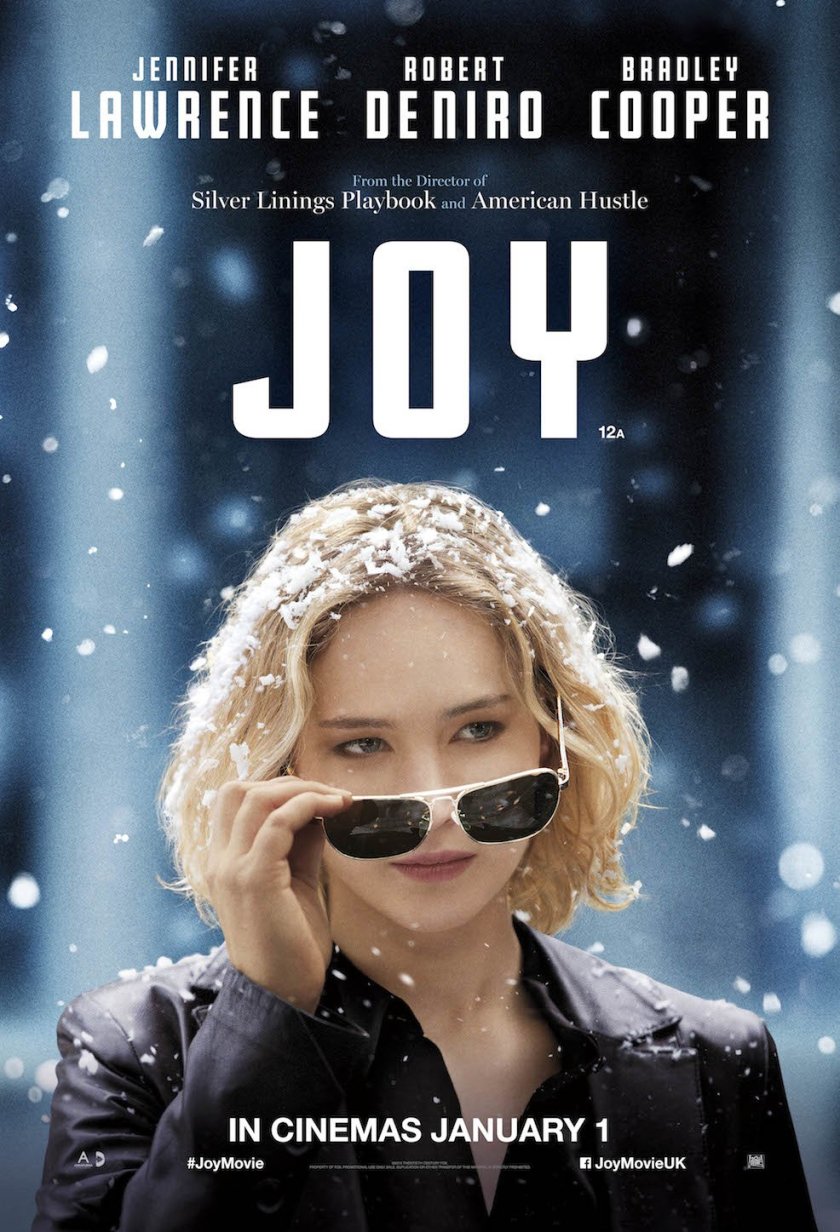
Loosely based on the life of entrepreneur Joy Magano, Joy is above all about the struggle to pursue your passions. Semi-linearly telling her story from childhood to millionaire, the film focuses on Joy’s (Lawrence) constant struggles with her squabbling family and vicious businessmen that send her constantly slamming into failure. It’s a rags-to-riches tale, but one where our heroine is thrown right back to rags several heartbreaking times. But with the struggle being so much harder, it makes the moments of real joy (badum tish!) feel far more satisfying. It sinks you far better into Joy’s mindset and every time she falls you get just as pissed as she does. It’s a tough film to watch at points, but by its conclusion it’s uplifting and inspirational. The film is well paced and consistently engaging, but it does have a tendency to get a bit experimental and surreal. There are several dream sequences in the film, all of which related to the soap opera Joy’s mother (Madsen) obsessively watches, and whilst they are enjoyable in a kitschy way they feel a bit out of place and are overbearing in how they incessantly hammer home Joy’s psychological condition.
Whether you love her to bits or think she’s overexposed, you cannot deny Jennifer Lawrence is a phenomenal actress when given the right material and clearly Russell knows how to get the best out of her. Her performance as Joy is what ultimately makes the film work so well, portraying a very complex character who evolves from put-upon housewife to commanding woman of business whilst remaining relatable and sympathetic even in her darkest moments. It’s a tough balancing act to pull off and Lawrence acquits herself flawlessly, crafting yet another memorable character to add to her quickly growing collection. The supporting cast is negligible when compared to her, but a lot of them are fantastic in their own right. Virginia Madsen is particularly impressive as Joy’s reclusive mother, and Edgar Ramirez delivers a career best performance as the ex-husband with even more unrealistic ambitions. Robert De Niro is there to do what Robert De Niro does best, and Bradley Cooper’s role is small but vital and he does a lot with his small amount of screen time. The only person that lets the side down from a character perspective is Elisabeth Röhm as Joy’s half-sister Peggy. Röhm does her best with the material, but the role of Peggy feels utterly spiteful and shallowly written. The rest of the family all have their annoying foibles but they all genuine moments of humanity too. Peggy never gets a moment to be human and is purely there to aggravate Joy; maybe it went down like that in real life, but it gets to the point where it’s almost like she’s trying to make Joy fail.
One of the positives I can say about Russell’s work on American Hustle is that he really nailed the time period, and he does similarly great work with Joy. He captures that transitional period from the 1980s to the 1990s extremely well in how the fashions and designs don’t quite fit into either decade specifically; it would have been easy to favour one but they found a good balance. The cinematography is strong too, especially how well it emulates the look of soap operas and shopping channels in certain scenes, looking just cheesy enough to capture the feel without seeming forced.
I can understand why Joy has gotten lost in the shuffle this awards season and I doubt it’ll even make my list of favourites, but that’s no reason to not go see it for yourself. It’s quirky and a bit uneven, but overall the film does a fantastic job of taking what might have been a pretty standard story and making it different and impactful by doubling down on those low moments. Too many inspirational stories like this gloss over how frighteningly difficult pursuing your dreams can be, and instead Joy is completely honest and realistic about the entire situation. In other hands this material could have been complete tripe, but Russell and Lawrence elevate it into something more than worth watching.
FINAL VERDICT: 8.5/10
CREED – a review by JJ Heaton
Starring: Michael B. Jordan (Chronicle), Sylvester Stallone (The Expendables), Tessa Thompson (Selma), Phylicia Rashad (The Cosby Show), Tony Bellew, Graham McTavish (The Hobbit)
Director: Ryan Coogler (Fruitvale Station)
Writers: Ryan Coogler & Aaron Covington
Runtime: 2 hours 13 minutes
Release Date: 25 November (US), 15 January (UK)
Like the Italian Stallion himself, the Rocky franchise just won’t stay down. The original 1976 film is a classic not only of sports movies but also of cinema in general; an underdog story that shows it’s not about winning, but about seeing it through to the end. After that, the franchise has had its ups and downs. Rocky II and III were decent sequels, IV is amongst the cheesiest 80s movies ever but enjoyable in its own way, V kind of sucks, and then Rocky Balboa closed out the franchise with true class…until now. However, Creed is less a continuation of the Rocky story and more of a new beginning within the same universe; similar in narrative and theme, but built for a new generation.
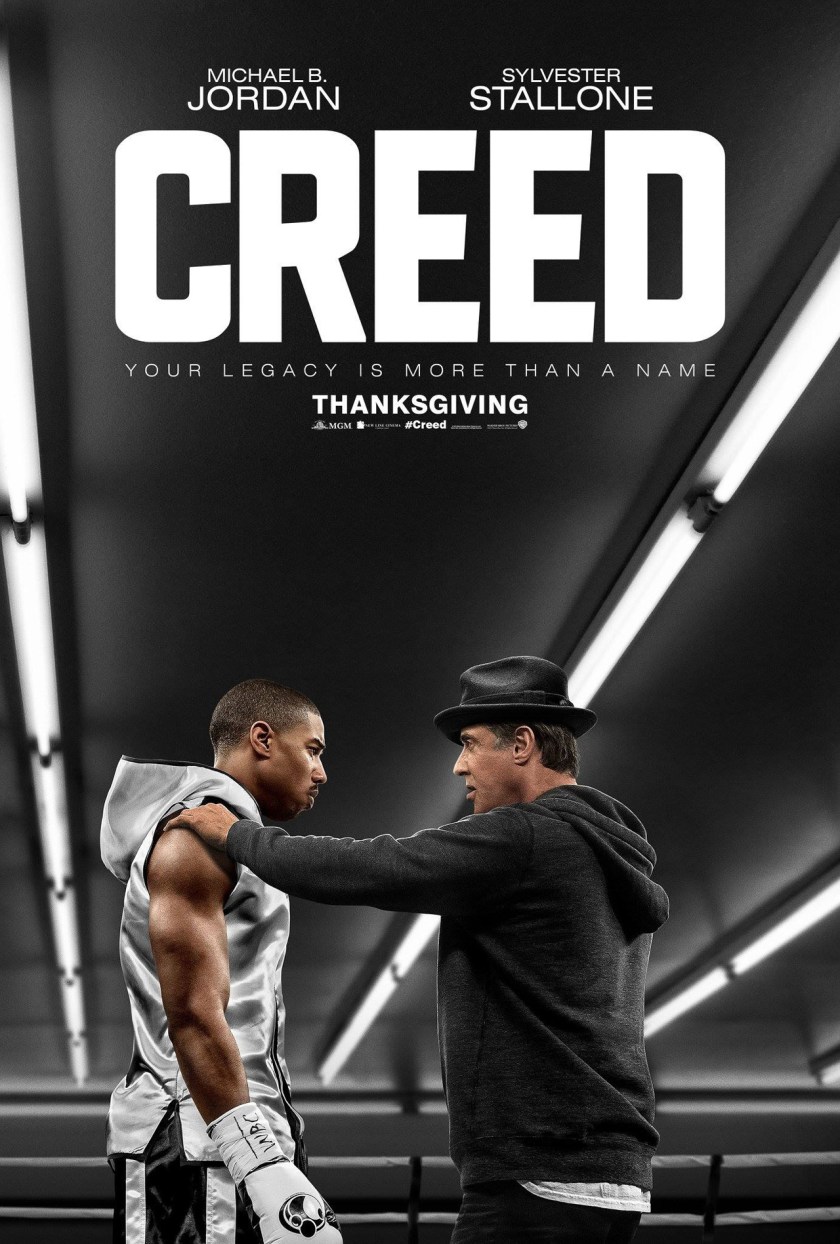
First and foremost, Creed has immense respect for the series legacy. Though not totally fuelled by nostalgia, there are loads of Easter eggs for Rocky fans to find throughout. It’s clear the filmmakers love these movies and want to make sure you know it, but they make sure to add plenty of new flavour too. The film’s story of Balboa training a protégé is actually most similar to the plot of Rocky V, but with the tone of the original and the style of Balboa. The main plot moves along similarly to the other films with similar narrative beats, but much like Star Wars: The Force Awakens it changes up the details just enough to remain fresh. Instead of a nobody given a miraculous shot at stardom, it’s about a man living in the shadow of his father and trying to follow in his path without relying on his name; it’s just as relatable a theme. The film moves along at a solid clip, perhaps a little too lengthy, but it’s paced well and never lets momentum slip for too long, ending on a note that perfectly sums up the film and the entire franchise in a nutshell.
Even though you know how this is probably going to work out, becoming invested in the story of Creed is simple and that’s because the characters are engaging and relatable. Michael B. Jordan is fantastic as Adonis Creed, a man just as determined as his father Apollo but replacing the character’s showmanship and cheer with understandable insecurity. There are small shades of Carl Weathers in Jordan’s performance, but Adonis is far more a character of the actor’s own creation and he does a fantastic job of portraying a stalwart but fearful young man; his reaction right before he’s about to go out for his first big fight perfectly encapsulates what’s going through his mind. Sylvester Stallone rarely flexes his acting muscles these days, but with Rocky being his creation he’s certainly not sleepwalking through this one. He slips back into the hat of Balboa as if the last film took place a week ago, playing the character with a similar mindset to when we last saw him but with an even greater awareness of his mortality. His relationship with Jordan is flawless and sells the film by itself, bantering back and forth and exchanging wisdom in human ways that never feel forced or cheesy. Stallone hasn’t given a performance this good since…well, the last Rocky movie, and it easily ranks up there with his career best. Tessa Thompson is a wonderful find as Jordan’s musician love interest Bianca, keeping the same emotional core as Rocky’s relationship with Adrian but with completely different character dynamics, but she’s also a very fascinating character on her own; you could make a whole movie about her story and it’d be compelling in its own way. The main weak spot of the film, however, is its adversary in Tony Bellew’s Ricky Conlan. He’s a menacing physical presence and the film attempts to give him some back story and motivation, but he doesn’t have that immediate iconic aura the way that adversaries like Clubber Lang, Ivan Drago and, yes, Apollo Creed himself had. Conlan’s hardly an important part of the film beyond being that final hurdle to cross, but he’s just a little too generic of a character.
Ryan Coogler proved his directing chops with the heart-wrenching indie drama Fruitvale Station, and with Creed he proves he can play in the big leagues too. The film has the confidence of a seasoned pro behind the camera, and every technical element delivers on all fronts. The cinematography remains simple and gritty during most scenes, but when it’s time to fight it gloriously shows off the spectacle by taking you into the ring and letting the action play out in long dynamic shots; it adds a visceral sense of realism even most of the good Rocky movies lacked. Backed up by crisp editing and crunching sound design, the boxing scenes are for once just as good if not better than the main drama. Special mention must also go to Ludwig Goransson’s excellent work on the score that only contains hints of Bill Conti’s classic compositions early on and slowly amps them up as the film continues, synchronising brilliantly with Adonis’ own progression as a boxer.
Creed is a more than worthy addition to the Rocky pantheon, paying respect to its forbearers whilst forging its own path to continue the story in new ways. Jordan and Stallone as a team are the true heart and soul of the film, complimenting each other spectacularly in one of the best mentor-student relationships in recent memory. Nobody was particularly asking for another Rocky movie, and though Creed shares its DNA it stands alone as a quality sports movie for this generation, and proves even tired franchises can be reborn with the help of a little youthful spirit.
FINAL VERDICT: 9.5/10
 Alternative Lens